

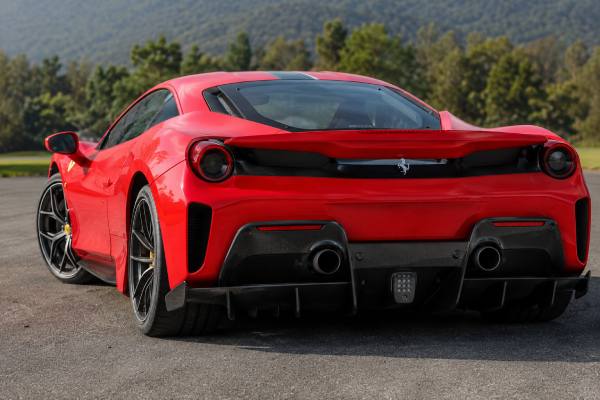

The Ferrari 488 Pista (F142M) is the track-focused version of the 488 GTB, powered by the F154CD 3.9-liter twin-turbocharged V8 and built from 2018 to 2020. It sits in Ferrari’s modern “special series” bloodline, following cars such as the 360 Challenge Stradale, 430 Scuderia, and 458 Speciale, but it brought that formula into the turbocharged era with 710 hp, race-derived aerodynamics, and far more electronic chassis control than its predecessors.
The Pista matters because it is not simply a more powerful 488. It is the road car that translated lessons from the 488 Challenge and 488 GTE into a sharper, lighter, more aggressive mid-engine Ferrari. It also arrived near the end of Ferrari’s non-hybrid mid-engine V8 chapter, before the F8 Tributo and later plug-in hybrid 296 GTB changed the direction of the range. That makes it especially interesting to buyers who want a modern Ferrari with race-car energy, but without hybrid complexity.
Quick Take
The Ferrari 488 Pista is most appealing as a usable modern Ferrari with serious track credibility: a 710 hp twin-turbo V8, a fast dual-clutch gearbox, clever aero, carbon-ceramic brakes, and electronics that make high-speed driving feel unusually controlled. Its main tradeoff is that condition, mileage, tire age, carbon-ceramic brake health, recall completion, and factory-option originality matter far more than they would on an ordinary used car. The best examples are documented, lightly used, correctly serviced, and kept close to original specification.
Table of Contents
- Ferrari 488 Pista History and Significance
- Engine, Chassis and Key Specifications
- Production, Variants and Factory Options
- Design, Engineering and Special Features
- Driving Experience and Performance
- Maintenance, Reliability and Ownership Risks
- Market Value and Buying Guide
Ferrari 488 Pista History and Significance
The 488 Pista is important because it turned the 488 platform from a very fast road car into Ferrari’s most focused V8 special series of the late 2010s. It was unveiled in 2018 as the sharper, lighter, more track-led evolution of the 488 GTB, with development strongly influenced by Ferrari’s GT racing and Challenge programs.
The name “Pista” means “track” in Italian, and Ferrari used it honestly. The car was not built as a stripped-out race car with number plates, but its engineering priorities were clear: more power, less weight, more downforce, faster response, and more stable behavior near the limit. Compared with the standard 488 GTB, the Pista gained a more powerful version of the F154 twin-turbo V8, a revised aerodynamic package, lighter body parts, more focused interior materials, and an advanced version of Ferrari’s Side Slip Control system.
Historically, the Pista sits between two important eras. Before it came the naturally aspirated 458 Speciale, beloved for its throttle response, sound, and rawness. After it came the F8 Tributo, which used a closely related engine but was positioned as a regular production model rather than a hardcore special series. Later, Ferrari’s mid-engine V6 hybrid 296 GTB changed the formula again. Because of that, the 488 Pista has become a key collector reference point: a turbocharged V8 Ferrari that still feels mechanical, compact, and visibly tied to racing.
It also matters because Ferrari’s turbocharged V8 had already proved itself. The standard 488 GTB replaced the 458 Italia’s naturally aspirated V8 with a smaller 3.9-liter twin-turbo unit. That was controversial at first, but the engine quickly earned respect for its power, torque, and response. The Pista pushed the idea further by using lighter internals, improved breathing, and components inspired by Ferrari’s racing cars.
For collectors, the Pista is not rare in the same way as a numbered hypercar. Ferrari did not sell it as a strictly numbered limited edition. However, supply was allocation-driven, production was short, and desirable specifications are far from equal. Cars with strong provenance, low mileage, rare factory options, carbon wheels, special colors, Tailor Made details, or Piloti Ferrari specification can sit in a different market tier from ordinary examples.
Engine, Chassis and Key Specifications
The 488 Pista uses a mid-mounted 3.9-liter F154CD twin-turbo V8 producing 710 hp and 770 Nm of torque. Its specification is central to the car’s identity: compact displacement, huge output, dry-sump lubrication, rear-wheel drive, and a 7-speed F1 dual-clutch transmission.
| Category | Specification |
|---|---|
| Model | Ferrari 488 Pista |
| Internal series | F142M |
| Engine code | F154CD, often written F154 CD |
| Engine layout | Rear-mid-mounted 90-degree V8 |
| Displacement | 3,902 cc, 3.9 liters |
| Induction | Twin turbochargers, charge-air cooling |
| Lubrication | Dry sump |
| Power | 720 cv / 710 hp / 530 kW at 8,000 rpm |
| Torque | 770 Nm / 568 lb-ft at 3,000 rpm in 7th gear |
| Transmission | 7-speed F1 dual-clutch automatic |
| Drivetrain | Rear-wheel drive with electronic differential |
Ferrari did not simply raise boost and call it finished. The Pista engine used features associated with the 488 Challenge, including lightweight rotating parts, titanium connecting rods, Inconel exhaust manifolds, carbon-fiber intake plenums, and a revised intake path. These changes helped reduce weight, improve response, and make the engine feel sharper than the standard 488 GTB unit.
| Item | Ferrari 488 Pista |
|---|---|
| Length | 4,605 mm |
| Width | 1,975 mm |
| Height | 1,206 mm |
| Wheelbase | 2,650 mm |
| Dry weight | 1,280 kg, depending on configuration |
| Kerb weight | About 1,385 kg, depending on market and equipment |
| Weight distribution | 41.5% front / 58.5% rear |
| Front tires | 245/35 ZR20 |
| Rear tires | 305/30 ZR20 |
| Front brakes | 398 mm carbon-ceramic discs |
| Rear brakes | 360 mm carbon-ceramic discs |
| 0–100 km/h | 2.85 seconds |
| 0–200 km/h | 7.6 seconds |
| Top speed | Over 340 km/h / 211 mph |
The chassis is based on Ferrari’s aluminum mid-engine architecture rather than a full carbon monocoque. That matters for ownership because aluminum structure repair after accident damage is specialist work, but it is not the same type of carbon-tub inspection issue seen on some rival supercars. Suspension is by double wishbones at the front and a multi-link rear arrangement, with magnetorheological dampers and electronically managed dynamic systems.
Production, Variants and Factory Options
The 488 Pista was offered as a coupe, with the closely related 488 Pista Spider following for open-top buyers. The coupe is the purer track-focused choice, while the Spider adds the retractable hardtop experience and often carries an additional desirability premium in some markets.
Ferrari did not publish a simple official production total for the Pista coupe in the way it did for some numbered limited cars. That means buyers should be cautious when sellers make strong rarity claims without documentation. “Rare specification” can be true; “rare model” needs context. A Pista in an unusual factory color with carbon wheels, extensive carbon trim, original window sticker, and complete Ferrari service records is meaningfully different from a common-color car with patchy history and aftermarket modifications.
Main versions
The core versions to understand are:
- 488 Pista coupe: the main focus here, with the most direct track-car identity.
- 488 Pista Spider: same basic powertrain and concept, with a retractable hardtop and added open-air drama.
- 488 Pista Piloti Ferrari: a Tailor Made special specification offered to clients involved in Ferrari motorsport programs, inspired by the 488 GTE’s endurance-racing success.
The Piloti Ferrari version is especially important for collectors. It used motorsport-themed graphics, racing-number details, specific interior treatment, and a stronger link to Ferrari’s client-racing world. It is not just a vinyl-stripe package in collector terms; provenance, eligibility, Ferrari Tailor Made documentation, and original build records all matter.
Factory options that affect desirability
Many Pistas were heavily optioned. On a car of this type, options are not just comfort add-ons; they can strongly shape market value.
Common high-value options and features include:
- 20-inch carbon-fiber wheels
- front suspension lift
- carbon-fiber racing seats
- exterior carbon-fiber details
- carbon-fiber engine-bay trim
- carbon-fiber rear diffuser or underbody-related exterior trim
- passenger display
- telemetry or track-focused equipment where fitted
- special paint or historical Ferrari colors
- Tailor Made interior and exterior details
- racing harness preparation or racing-seat specification, depending on market
The carbon-fiber wheels are one of the most discussed options. They reduce unsprung mass and suit the Pista’s purpose, but they also require careful inspection. Buyers should check for impact damage, repair history, curbing, delamination concerns, and correct Ferrari-approved fitment.
Documentation is critical. A proper car should ideally have the original window sticker or build sheet, service book, manuals, battery charger, car cover, tools, tire inflator kit, spare keys, and Ferrari dealer service records. A missing accessory will not ruin a car, but missing provenance can weaken value on an expensive modern collector Ferrari.
Design, Engineering and Special Features
The 488 Pista looks more aggressive than the 488 GTB because its shape is doing more work. The most important design changes serve airflow, cooling, downforce, and weight reduction rather than decoration.
The front end is defined by the S-Duct, an F1-inspired aerodynamic feature that channels air through the nose and out over the hood area. This helps manage front-end downforce and gives the Pista one of its most recognizable visual signatures. The front bumper, underbody treatment, rear diffuser, and rear spoiler treatment all work together to make the car feel more planted at speed.
Ferrari also revised cooling and intake paths. The engine needed consistent performance under hard use, so airflow management was not only about lap time. It was also about thermal stability. A turbocharged engine creates significant heat, especially on track, and the Pista’s design reflects the need to feed, cool, and exhaust air efficiently.
The body uses lightweight carbon-fiber components in key areas such as the front hood, bumpers, and rear spoiler. Inside, the Pista uses Alcantara, carbon fiber, simplified trim, and door pull straps in place of conventional handles on many examples. It is not uncomfortable in the way an old homologation special can be, but it feels clearly more purposeful than a regular 488 GTB.
Electronic systems with a track purpose
One of the Pista’s defining traits is how much it relies on well-calibrated electronics. Ferrari’s Side Slip Control system integrates the electronic differential, traction control, magnetorheological dampers, and Ferrari Dynamic Enhancer. The goal is not to remove driver involvement. It is to make the car more readable and controllable when the driver is using more of its performance.
Ferrari Dynamic Enhancer is especially important. It can use brake-pressure control to help manage yaw behavior near the limit. In plain language, it helps the car rotate and recover more naturally when driven hard, especially in Race mode and beyond. This is one reason the Pista can feel approachable despite its huge power and rear-drive layout.
The sound is different from a naturally aspirated 458 Speciale. The Pista has more turbocharged force than operatic scream. It still has a hard-edged Ferrari character, especially under load, but the appeal is the mixture of intake rush, exhaust aggression, wastegate texture, and violent acceleration rather than the high-pitched purity of the older 4.5-liter V8.
Driving Experience and Performance
The 488 Pista feels explosively fast, but its real achievement is how controlled it feels while delivering that speed. It is a car with supercar numbers and track-car reactions, yet it remains usable enough for road driving when tires, brakes, and fluids are in the right condition.
The engine’s character is built around response and torque. Compared with the 458 Speciale, the Pista does not need to be kept on the boil in the same way. It delivers huge midrange thrust, then keeps pulling hard toward the top of the rev range. There is little sense of waiting for the car to wake up. The throttle mapping, lighter engine components, and quick-shifting dual-clutch gearbox make it feel alert even before the turbos are fully working.
The 7-speed dual-clutch transmission is fast and decisive. In normal use it can be smooth enough for city driving, but in aggressive modes it gives the car the snap expected from a Ferrari special series model. Shift behavior depends heavily on mode, throttle opening, temperature, and driver input, so a brief gentle test drive does not reveal the full personality.
Steering is quick, light, and very direct. Some drivers coming from older Ferraris may want more weight and more texture, but the speed of response suits the car’s layout. The front axle reacts immediately, and the rear follows with confidence as long as tires are warm and in good condition.
Ride quality is firm but not unbearable. The bumpy-road damper setting helps on imperfect pavement, and many owners find the Pista more livable than its appearance suggests. That said, it is still low, wide, loud, and tire-sensitive. The front lift option is valuable for steep driveways and urban use.
On track, the Pista rewards smooth inputs. It has enormous braking ability, strong traction, and clever stability systems, but it is still a 710 hp rear-drive car. Cold tires, old tires, wet roads, or overconfidence can quickly turn its friendly side into a serious challenge. The car is best judged on fresh, correct-spec tires with all systems working properly and alignment set by someone who understands modern Ferraris.
Maintenance, Reliability and Ownership Risks
The 488 Pista can be dependable when maintained correctly, but it is still an exotic Ferrari with expensive consumables and condition-sensitive systems. Reliability should be judged through service history, diagnostic reports, recall completion, tire and brake condition, and evidence of careful use.
The engine itself has a strong reputation when serviced properly, but heat management, fluid quality, battery condition, and correct use matter. Cars that sit for long periods can develop issues unrelated to mileage. Low mileage is attractive, but ultra-low mileage without regular annual servicing is not automatically better than a carefully used car with consistent maintenance.
Important inspection areas include:
- annual service history from Ferrari or a respected Ferrari specialist
- evidence of correct oil, brake fluid, coolant, and gearbox maintenance
- diagnostic scan for fault codes and over-rev or abuse indicators where applicable
- turbocharger, intake, and charge-air system condition
- coolant leaks, oil seepage, and heat-damaged hoses or wiring
- exhaust and catalyst condition
- gearbox behavior at low speed and under hard acceleration
- suspension lift operation, if fitted
- damper function and suspension bushing condition
- carbon-ceramic brake disc wear, cracking, and chip damage
- tire brand, age, tread depth, and matching specification
- battery age and charging history
The braking system deserves special attention. Certain 2019–2020 Ferrari 488 Pista and 488 Pista Spider vehicles were included in a safety recall related to the brake fluid reservoir cap, with the remedy involving cap replacement and, where required, software updates. A buyer should verify recall completion by VIN with an authorized Ferrari dealer, not merely accept a verbal claim.
Carbon-ceramic brakes are another major cost point. They can last a long time in road use, but track use, poor cleaning habits, stone impacts, and heat cycling can change the picture. Replacement is expensive, so a pre-purchase inspection should include actual brake disc condition, not just dashboard readings.
The dual-clutch gearbox is generally robust, but it is not cheap to diagnose or repair. Warning signs include harsh engagement when warm, repeated gearbox warnings, fluid leaks, and inconsistent low-speed behavior. Some low-speed clutch take-up behavior is normal for the type, but obvious shuddering or fault codes should not be ignored.
Cosmetic condition also matters. Low front splitters, carbon trim, underbody panels, and wheel edges are vulnerable. A car that has been tracked carefully may be better than a road car that has been scraped, curbed, jump-started incorrectly, or neglected. Evidence matters more than assumptions.
Market Value and Buying Guide
The 488 Pista occupies a strong modern collector position because it combines Ferrari special-series status, a non-hybrid V8, major performance, and real usability. Values vary widely, with specification, mileage, market, color, options, accident history, and documentation creating large gaps between cars that look similar at first glance.
In the current market, ordinary Pista coupes tend to trade well above standard 488 GTB values. Highly optioned, low-mileage, unusual-color, Tailor Made, carbon-wheel, or Piloti Ferrari cars can command much more. Asking prices are not the same as sale prices, so buyers should compare auction results, dealer listings, and private-sale evidence before treating any single number as the market.
What raises value
The strongest cars usually have:
- low but believable mileage
- complete Ferrari service history
- clean title and no accident history
- original paint or clearly documented paintwork
- desirable factory color
- carbon-fiber wheels in excellent condition
- front suspension lift
- racing seats in the correct size
- original window sticker and build records
- all books, tools, keys, charger, and accessories
- factory-original specification with no questionable modifications
- verified recall completion
Color matters, but not always in a simple way. Rosso Corsa remains popular and liquid, yet rarer colors can bring a premium when paired with the right interior and options. A poor color combination, missing carbon options, or heavily personalized interior can narrow the buyer pool.
What to avoid
Be careful with cars that have:
- incomplete service records
- unclear import history
- heavy paint correction hiding poor storage or track rash
- aftermarket exhaust tunes without documentation
- non-factory carbon parts represented as factory options
- mismatched or old tires
- worn carbon-ceramic brakes
- unresolved warning lights
- front-end scrape damage
- missing books or accessories
- accident damage without specialist repair records
A proper pre-purchase inspection is essential. It should be done by a Ferrari dealer or independent specialist familiar with the 488 platform and Pista-specific parts. The inspection should include paint-depth readings, underbody inspection, diagnostic scan, service-record review, tire and brake evaluation, suspension-lift check, and verification of options against the factory build.
The best buying strategy is to choose the best-documented car you can afford rather than the cheapest available Pista. A lower purchase price can disappear quickly if the car needs tires, brake work, suspension-lift repair, carbon trim replacement, or correction of deferred maintenance. For long-term collectability, originality and documentation will likely matter more than minor mileage differences.
The 488 Pista is likely to remain desirable because it represents a clear moment in Ferrari history: the most extreme road-going expression of the 488’s twin-turbo V8 platform, before Ferrari’s mid-engine performance cars moved deeper into hybrid technology. It is modern enough to use, fast enough to remain serious, and special enough to be treated as more than a normal used exotic.
References
- Ferrari 488 Pista – Ferrari.com 2018 (Manufacturer Specifications)
- Unique Tailor Made specification for the Ferrari 488 Pista 2018 (Manufacturer Publication)
- Part 573 Safety Recall Report 22V-536 2022 (Recall Database)
- 2020 Fuel Economy Guide 2020 (Official Fuel Economy Data)
- Ferrari 488 Pista Market 2026 (Market Data)
Disclaimer
This article is for informational purposes only and is not a substitute for professional diagnosis, repair, appraisal, or inspection. Specifications, torque values, service intervals, recall applicability, and repair procedures can vary by VIN, market, equipment, and software version. Always verify details against official Ferrari service documentation and consult a qualified Ferrari technician before making maintenance, repair, or purchase decisions.
If you found this guide useful, please consider sharing it on Facebook, X/Twitter, or your preferred car community to support our work.