
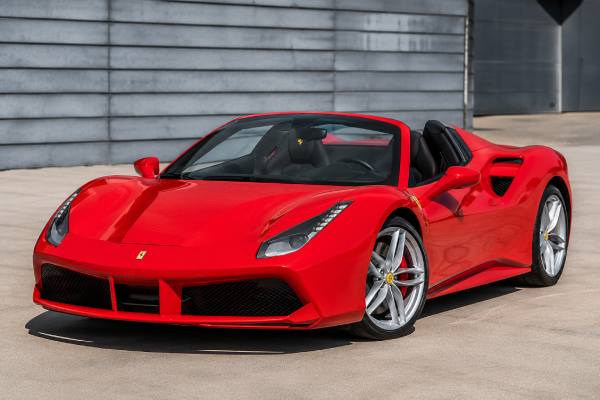

The Ferrari 488 Spider is the open-top version of Ferrari’s mid-engine F142M V8 supercar, built from 2015 to 2019 with the F154CB 3.9-liter twin-turbocharged V8. It replaced the 458 Spider and marked a major shift in Ferrari’s modern road-car history: the naturally aspirated 4.5-liter V8 was gone, and in its place came a smaller, stronger, turbocharged engine with 661 hp and far more torque.
That change is why the 488 Spider still attracts so much attention. It sits at a useful crossroads for buyers: modern enough to offer a fast dual-clutch gearbox, advanced chassis electronics, carbon-ceramic brakes, and a folding hardtop, but old enough to feel more mechanical and less digitally layered than some newer hybrids and heavily software-driven supercars. It is also a genuine open-air Ferrari, not a soft-top compromise, with a retractable hardtop that preserves much of the coupé’s shape and usability.
For collectors and owners, the 488 Spider is now moving from “nearly new exotic” into a more mature used-supercar market. Condition, factory specification, service history, carbon-ceramic brake health, roof operation, recall status, and originality matter more than headline mileage alone.
Quick Take
The Ferrari 488 Spider’s strongest appeal is its mix of huge turbocharged performance, open-top drama, and everyday usability by exotic-car standards. Its identity is tied to the F154CB twin-turbo V8, a 661 hp engine that made the 488 faster and more torque-rich than the 458 Spider while keeping Ferrari’s sharp mid-engine balance. The main caution is that the car is highly condition-sensitive: roof hardware, brakes, tires, battery health, service records, and accident history can change ownership cost dramatically. The best buys are original, well-documented cars with desirable factory options, no open recalls, clean paintwork, healthy carbon-ceramic brakes, and evidence of regular Ferrari-specialist maintenance.
Table of Contents
- Model History and Why It Matters
- Engine, Chassis and Key Specifications
- Production, Variants and Factory Options
- Design, Engineering and Special Features
- Driving Experience and Real Performance
- Reliability, Maintenance and Repair Risks
- Market Value and Buying Guide
Model History and Why It Matters
The 488 Spider matters because it brought Ferrari’s mid-engine V8 Spider line into the turbo era without turning it into a blunt high-power cruiser. It kept the basic 458 Spider formula—two seats, a mid-mounted V8, rear-wheel drive, and a folding hardtop—but added a much stronger engine, revised aerodynamics, and faster control systems.
Ferrari introduced the 488 GTB first, then followed with the 488 Spider as the open-top companion. The Spider used the same broad aluminum chassis concept, seven-speed dual-clutch transmission, and rear-drive layout as the coupé. Its job was not to be the track special of the range. That role later went to the 488 Pista and Pista Spider. The standard 488 Spider was the fast road car: usable, refined enough for long trips, but still serious enough to feel like a mid-engine Ferrari.
The biggest historical change was the engine. The 458 Spider used a high-revving naturally aspirated V8 that built its character around sound and throttle response. The 488 Spider’s F154CB V8 changed the argument. It used twin turbochargers, direct injection, dry-sump lubrication, and careful torque management to deliver far more shove while still trying to preserve a progressive Ferrari feel.
That transition was controversial when the car arrived. Some drivers missed the 458’s sharper induction sound and 9,000 rpm drama. Others quickly accepted that the 488 Spider was simply much faster in normal use. The turbo V8 made the car feel explosive from the middle of the rev range, and the dual-clutch gearbox made the engine’s speed easier to access.
The 488 Spider also belongs to an important phase in Ferrari design. It came before the F8 Spider, before the 296 GTB and 296 GTS hybrid V6 line, and before the broader shift toward electrified performance. That gives it a clear identity: it is a modern turbo V8 Ferrari without hybrid weight, plug-in charging, or electric torque-fill systems.
Today, buyers care about the 488 Spider for three main reasons. First, it is genuinely quick even by current supercar standards. Second, it has a practical folding hardtop that makes it more versatile than many open exotics. Third, it represents a balanced point in Ferrari’s evolution, combining old-school mid-engine proportions with modern forced-induction performance.
Engine, Chassis and Key Specifications
The core specification is simple but serious: a 3,902 cc twin-turbocharged V8, rear-wheel drive, a seven-speed dual-clutch gearbox, and an aluminum chassis tuned for open-top stiffness. The 488 Spider is not just a 458 Spider with more boost; its engine, aero, electronics, and cooling package were reworked around turbocharged performance.
| Item | Specification |
|---|---|
| Model code | F142M |
| Engine code | F154CB |
| Engine layout | 90-degree V8, twin turbo, dry sump |
| Displacement | 3,902 cc |
| Power | 670 cv / 661 hp at 8,000 rpm |
| Torque | 760 Nm / 561 lb-ft |
| Transmission | 7-speed F1 dual-clutch automatic |
| Drive | Rear-wheel drive |
| Body style | 2-seat retractable-hardtop Spider |
The engine is the main event. The F154CB uses two turbochargers rather than one large unit, helping response and packaging. Direct fuel injection, dry-sump oiling, and a flat-plane-crank character help it stay closer to Ferrari’s traditional sports-car feel than a lazy low-rev turbo engine. The dry-sump system also allows the engine to sit lower in the chassis, which helps center of gravity and cornering behavior.
Ferrari used torque management to shape how the power arrives. In the lower gears, the car does not simply dump all available torque at once. The calibration helps the 488 feel more progressive and keeps the rear tires from being overwhelmed too abruptly. In higher gears, the engine can use its full torque more freely, which is why the car feels so strong during rolling acceleration.
| Item | Figure |
|---|---|
| Length | 4,568 mm / 179.8 in |
| Width | 1,952 mm / 76.9 in |
| Height | 1,211 mm / 47.7 in |
| Wheelbase | 2,650 mm / 104.3 in |
| Dry weight | About 1,420 kg / 3,131 lb with lightweight equipment |
| Kerb weight | About 1,525 kg / 3,362 lb |
| 0–100 km/h | 3.0 seconds |
| 0–200 km/h | 8.7 seconds |
| Top speed | Over 325 km/h / about 202 mph |
The suspension uses double wishbones at the front and a multi-link layout at the rear, with magnetorheological dampers that can adjust quickly to road and driving conditions. The brakes are carbon-ceramic as standard, with large discs and powerful calipers. These brakes are a major part of the car’s performance, but they are also one of the most important inspection areas for buyers.
The steering is electrically assisted and quick, as is typical of modern mid-engine Ferraris. The electronic systems include traction control, stability control, an electronic differential, and Ferrari’s Side Slip Control logic. These systems are not there to make the car feel numb. Their purpose is to let a very powerful rear-drive car put power down cleanly while still allowing a skilled driver to work with the chassis.
Production, Variants and Factory Options
The 488 Spider was part of the regular-production 488 family, not a numbered limited edition. Ferrari did not treat the standard Spider like a rare halo car, so value depends more on condition, specification, mileage, color, and documentation than on a published production cap.
The main 488 family included:
- 488 GTB: the fixed-roof berlinetta and the first body style in the range.
- 488 Spider: the retractable-hardtop open version covered here.
- 488 Pista: the lighter, sharper, track-focused coupé with more power.
- 488 Pista Spider: the open-top version of the Pista.
The standard 488 Spider shares its core engine and gearbox with the 488 GTB, but it is not identical in structure or ownership appeal. The Spider’s retractable hardtop adds mechanical complexity and weight, while giving the car a much broader sense of occasion. It is also the more desirable body style for many buyers who want weekend and road-trip usability rather than maximum track focus.
Factory options are especially important on a 488 Spider because Ferrari personalization can make two cars feel very different. Some options are mostly cosmetic, but others affect daily usability, resale desirability, or inspection priorities.
Commonly desirable options include:
- Scuderia Ferrari shields on the front wings
- LED carbon-fiber steering wheel
- front suspension lift system
- forged or special-finish wheels
- carbon-fiber racing seats
- Daytona-style seats or upgraded electric seats
- carbon-fiber driver zone
- carbon-fiber central bridge
- carbon-fiber exterior trim
- parking sensors and rear-view camera
- upgraded audio system
- Apple CarPlay where fitted
- colored brake calipers
- contrast stitching, special leather, Alcantara, or custom interior trim
The front lift system is useful because the 488 Spider has a low nose and expensive underbody panels. It can make a car easier to live with, especially in cities, steep driveways, and parking garages. Buyers should still test it carefully because hydraulic or electronic lift problems can be costly.
The LED steering wheel is popular because it gives the cabin a race-car link and is strongly associated with modern Ferrari driver-focused specifications. Carbon racing seats reduce weight and look purposeful, but they are not always the best choice for every body type. A car with standard or Daytona-style seats may be more comfortable for long drives.
Color also matters. Rosso Corsa remains the classic Ferrari choice and is usually easy to resell. Grigio, Nero, Blu, Bianco, and triple-layer special paints can be very attractive when paired with the right interior. Unusual colors can bring a premium with the right buyer, but very personalized combinations may narrow the market.
Documentation is a key part of authenticity. A strong car should have a clear service history, original books or digital Ferrari service records, option list, VIN-matching paperwork, recall completion records, and evidence that any paint protection film or aftermarket changes were installed without hiding damage.
Design, Engineering and Special Features
The 488 Spider’s design is functional first: almost every opening, crease, and duct exists to feed air, manage heat, reduce drag, or create downforce. It looks smoother than many wing-heavy supercars, but its bodywork is doing serious aerodynamic work.
The 488 was styled by the Ferrari Styling Centre during the Flavio Manzoni era. Compared with the 458 Spider, it has a more technical surface treatment. The large side intakes are the most obvious change, and they are not just visual drama. Turbocharged engines need heavy cooling, and the 488’s side intakes feed the intercoolers and engine bay while becoming part of the car’s signature shape.
At the front, the bumper and splitter manage air for cooling and front-end stability. Along the sides, sculpted channels guide airflow into the engine and cooling systems. Underneath, the flat floor and vortex generators help create downforce without relying on a large fixed rear wing. At the rear, the integrated spoiler and diffuser help the car stay stable at high speed.
The retractable hardtop is one of the Spider’s defining features. Unlike a fabric roof, the folding metal roof gives the car a cleaner coupé-like appearance when closed and better refinement in poor weather. It also makes the 488 Spider feel less like a seasonal toy. The mechanism folds neatly behind the cabin, and the rear buttress design helps preserve the mid-engine silhouette.
The engine packaging is tighter and hotter than in the naturally aspirated 458. Turbochargers, intercoolers, exhaust routing, and additional heat shielding all need space. That is one reason buyers should look closely at heat-related wear, hoses, brackets, and signs of poor repair work around the engine bay.
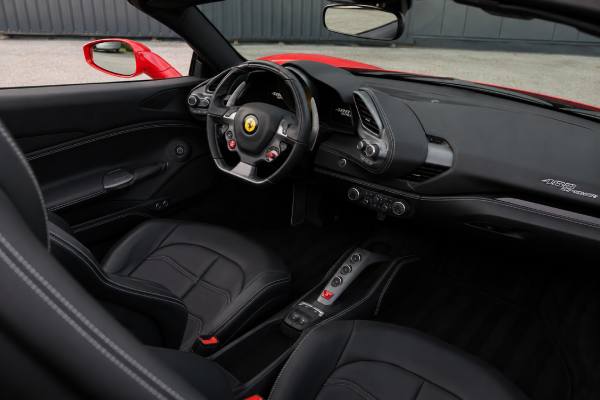
Inside, the cockpit is built around Ferrari’s steering-wheel-centered control layout. The manettino drive-mode switch, turn signals, wiper controls, shift lights when fitted, and many driving controls sit on or near the wheel. This layout takes adjustment for drivers used to conventional stalks, but it keeps the driver’s hands close to the wheel during fast driving.
The cabin is compact but usable. Visibility is better than many mid-engine exotics, although rear three-quarter visibility with the roof up is still limited. The front luggage area is small, but enough for soft bags. The 488 Spider works best when treated as a weekend, touring, and special-occasion car rather than a practical daily driver.
Sound is one area where opinions divide. The 488 Spider is loud and dramatic, especially with the roof down, but it does not have the same naturally aspirated shriek as the 458. The turbos soften some exhaust edge while adding intake rush and a hard-edged boosted surge. A standard exhaust is usually best for long-term value, while aftermarket systems should be inspected carefully for fit, emissions compliance, and warranty or inspection consequences.
Driving Experience and Real Performance
The 488 Spider feels brutally fast because its torque arrives much earlier than in the 458 Spider. It is not only quicker on paper; it feels more forceful in normal road driving, especially when accelerating out of medium-speed corners or overtaking from highway speeds.
The engine has two personalities. Below the top of the rev range, it is muscular and responsive, with the kind of mid-range punch that makes the car feel lighter than it is. Near the redline, it still pulls hard, but the character is different from an older naturally aspirated Ferrari. The 488 rewards smooth throttle use because full boost and rear-wheel drive can cover ground very quickly.
The seven-speed dual-clutch gearbox is one of the car’s strongest daily-use features. In automatic mode, it can be calm enough for traffic. In manual mode, the shifts are quick, clean, and theatrical without the interruption of Ferrari’s older single-clutch F1 gearboxes. There is no manual transmission option, and that is unlikely to change buyer expectations because the 488 was engineered around the dual-clutch setup.
Steering response is very quick. At first, it can feel almost nervous to drivers coming from older sports cars. Once familiar, it makes the car feel alert and eager to change direction. The front end bites strongly, and the rear follows with a mix of mechanical grip and electronic support. The car is not difficult to drive at normal speeds, but it becomes serious very quickly when pushed hard.
Ride quality depends heavily on tires, road surface, wheel choice, and damper mode. On good roads, the 488 Spider can feel surprisingly composed. On broken pavement, the short sidewalls and stiff structure remind you that this is still a supercar. The bumpy-road damper setting is useful and should not be ignored; it lets the chassis breathe without turning the car soft.
With the roof down, the car becomes more memorable. The engine, turbo sounds, exhaust, and open-air noise make normal speeds feel special. With the roof up, it is quieter and more secure, which is part of the Spider’s appeal over a traditional soft-top exotic.
On track, the 488 Spider is capable but not the purest 488. The GTB is lighter and stiffer, while the Pista models are much more focused. The Spider can still handle fast laps, but track use increases wear on tires, pads, discs, fluids, and heat-sensitive components. A car used heavily on track should have more frequent maintenance and a more careful inspection.
The brakes are powerful, but carbon-ceramic systems need to be judged correctly. They can last a long time in road use, but track heat, gravel damage, careless wheel changes, and worn pads can make replacement extremely expensive. Pedal feel should be firm and consistent, with no warning lights, fluid issues, or vibration.
Reliability, Maintenance and Repair Risks
A good 488 Spider can be dependable by modern exotic standards, but it is still a complex Ferrari with expensive parts and specialist labor needs. The difference between a well-kept car and a neglected one can be enormous.
The annual service pattern is important. Ferraris from this era were sold with a seven-year genuine maintenance program in many markets, and that program helped many early cars build a regular service record. By now, most 2015–2019 cars are either out of that initial coverage or close to it, so buyers must look at what happened after the free maintenance period ended.
Key maintenance and inspection areas include:
- annual service records or mileage-based services
- engine oil and filter changes
- brake fluid condition and recall completion
- gearbox service history where applicable
- coolant and hose condition
- battery health and charging-system behavior
- tire age, brand, size, and wear pattern
- carbon-ceramic brake disc and pad condition
- roof operation, alignment, seals, and drains
- suspension lift operation where fitted
- diagnostic scan results from a Ferrari-capable tool
Battery condition deserves special attention. Like many modern Ferraris, the 488 Spider does not like sitting unused without a maintainer. Low battery voltage can create strange warning lights, module faults, and starting problems. A weak battery is not always a disaster, but repeated voltage problems can hide or trigger other issues.
The retractable hardtop should be operated several times during inspection. It should move smoothly, latch correctly, sit evenly, and seal well. Listen for labored motors, clicking, hesitation, or warning messages. Check for water leaks, damp carpets, damaged seals, and misaligned panels.
The brake recall affecting 2016–2019 488 GTB and 488 Spider models is especially important. Buyers should verify the VIN with a Ferrari dealer or official recall database and confirm that any required recall work has been completed. Brake-system warning messages, fluid loss, or a spongy pedal should be treated seriously.
The F154CB engine is generally strong when maintained, but heat management matters. Look for oil leaks, coolant smell, cracked hoses, loose heat shielding, boost faults, or unusual turbo noises. Exhaust modifications can add heat, noise, warning-light risk, and inspection complications. A standard, documented car is usually safer for long-term value.
The gearbox should shift cleanly at low speed, under load, and when hot. Jerky engagement, warning lights, fluid leaks, or delayed gear selection need specialist diagnosis. The dual-clutch unit is far more civilized than older single-clutch Ferrari gearboxes, but it is not cheap to repair.
Paint and structure are another major ownership issue. The 488 Spider uses aluminum construction, and correct accident repair requires proper equipment and knowledge. Uneven panel gaps, overspray, mismatched paint, disturbed fasteners, repaired wheels, damaged undertrays, or poor paint-protection-film installation should prompt deeper investigation.
Interior wear can also affect value. Sticky switches, worn seat bolsters, damaged carbon trim, loose leather, scratched displays, and worn steering-wheel controls are not unusual on used exotic cars. These issues may seem minor, but Ferrari interior parts and trim repair can be expensive.
Market Value and Buying Guide
The 488 Spider now sits in a more selective market than it did when nearly new. Buyers are not just chasing the lowest price; they are separating clean, original, highly optioned cars from tired, modified, poorly documented, or accident-repaired examples.
In the current U.S. market, many usable 488 Spiders trade or are advertised in the high-$200,000 to mid-$300,000 range, with mileage, year, color, options, dealer reputation, and condition creating wide variation. Exceptional low-mileage cars with strong colors and desirable factory options can sit higher. Higher-mileage cars, unusual specifications, weak service records, or stories in the history file trade at a discount.
The main value drivers are:
- clean title and no serious accident history
- complete Ferrari service record
- documented recall completion
- original paint or high-quality disclosed paintwork
- desirable colors and interior combinations
- LED steering wheel, shields, lift, camera, and carbon options
- healthy carbon-ceramic brakes
- low to moderate mileage with regular use
- original exhaust and emissions equipment
- no unresolved warning lights or roof faults
- strong pre-purchase inspection results
Mileage should be viewed intelligently. A very low-mileage car that sat unused for years may need tires, battery, fluids, seals, and sorting. A moderately used car with excellent records can be the better ownership choice. For a 488 Spider, condition and history often matter more than a small mileage difference.
A serious pre-purchase inspection should include:
| Area | What to check |
|---|---|
| Service history | Annual records, dealer or specialist invoices, campaign completion |
| Diagnostics | Stored faults, overheat events, module errors, battery-voltage history |
| Brakes | Disc condition, pad life, chips, cracks, brake-fluid status, recall status |
| Roof | Smooth operation, alignment, latching, seals, water leaks |
| Body | Paint depth, panel gaps, undertray damage, wheel repair, accident signs |
| Powertrain | Cold start, hot idle, leaks, boost behavior, gearbox shift quality |
| Options | Factory option list, carbon trim condition, lift operation, camera and sensors |
The cars to seek are original, well-serviced examples with a specification that makes sense. A Rosso Corsa car with shields, LED wheel, lift, camera, forged wheels, and clean records will be easy to understand and easy to resell. A rare color can be even more desirable if the combination is tasteful and documented.
The cars to avoid are those with incomplete records, unclear accident history, cheap aftermarket exhausts, unresolved warning lights, roof issues, worn brakes, mismatched tires, old tires, or seller claims that cannot be backed up by invoices. Also be cautious with cars that have spent time in harsh climates, cars with heavy track use but no supporting maintenance, and cars where paint protection film may be hiding poor paintwork.
Long-term collectability looks solid, but not because the standard 488 Spider is rare in the way a numbered special edition is rare. Its appeal is broader: it is a final-era non-hybrid mid-engine Ferrari V8 Spider with huge performance, a folding hardtop, and a clean link between the 458 and F8 generations. The Pista Spider will remain the more collectible halo version, but the standard 488 Spider should continue to attract buyers who want the more usable car.
For ownership, budget beyond the purchase price. A proper annual service, tires, battery replacement, brake work, roof adjustment, fluids, alignment, and cosmetic correction can add up quickly. The right car is rewarding and usable. The wrong car can turn a tempting purchase price into a very expensive lesson.
References
- Ferrari 488 Spider – Ferrari.com 2015 (Manufacturer Specifications)
- Part 573 Safety Recall Report 21V-833 2022 (Recall Database)
- Ferrari 488 Spider Market – CLASSIC.COM 2026 (Market Data)
- Ferrari 7-Year Maintenance Program – Continental AutoSports 2026 (Maintenance Program)
Disclaimer
This article is for informational purposes only and is not a substitute for professional diagnosis, inspection, repair, or valuation. Specifications, torque values, service intervals, recall applicability, maintenance procedures, and equipment can vary by VIN, market, model year, and factory option package. Always verify details against official Ferrari service documentation, dealer records, and a qualified Ferrari specialist before buying, servicing, modifying, or repairing a vehicle.
If this guide helped you, please consider sharing it on Facebook, X/Twitter, or your preferred car community to support our work.