
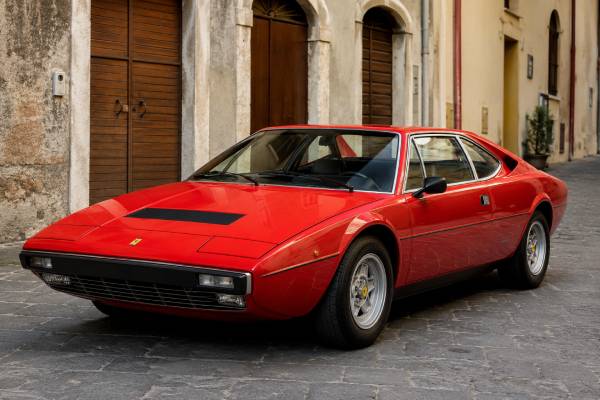
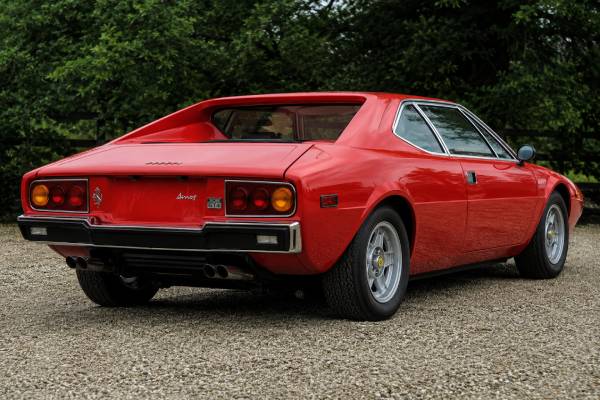

The Ferrari Dino 308 GT4 is one of the most important Ferraris that many people still underestimate. It introduced the mid-mounted production V8 layout that later became central to Ferrari’s road-car identity, yet it arrived with Dino badging, Bertone styling, four seats on paper, and a shape very different from the curvy Dino 246 it followed. For buyers today, that mix is exactly the appeal: genuine Maranello engineering, a compact 2+2 cabin, a carbureted 2.9-liter V8, and a market position that is still more approachable than many classic Ferraris.
Quick Take
The Dino 308 GT4 is best understood as Ferrari’s first practical mid-engine V8 grand tourer rather than a junior exotic trying to copy the Dino 246. The F106 AL 100 chassis and F106 AL 000 V8 give it real Ferrari character, while the Bertone body, longer wheelbase, and 2+2 layout make it more usable than its reputation suggests. The best cars are not the cheapest ones; condition, originality, corrosion history, documentation, carburetor setup, and timing-belt maintenance matter more than mileage alone.
Table of Contents
- Why the Dino 308 GT4 Matters
- F106 V8 Specifications and Chassis Data
- Production Changes, Options, and Authenticity Markers
- Bertone Design and Mid-Engine Packaging
- What the 308 GT4 Feels Like to Drive
- Maintenance, Corrosion, and Restoration Risks
- Values, Inspection Priorities, and Buying Strategy
Why the Dino 308 GT4 Matters
The Dino 308 GT4 matters because it was Ferrari’s first series-production road car with a V8 engine and the first Ferrari road car to combine a mid-engine layout with a 2+2 cabin. It was also the only production Ferrari body styled by Bertone, which gives it a unique place in the company’s design history.
The car was introduced at the 1973 Paris Motor Show and reached customers as a 1974 model. It arrived at an awkward moment. The earlier Dino 206 and 246 had made the Dino name desirable, but those cars were compact, curvy, two-seat sports cars with V6 engines. The 308 GT4 was sharper, wider, more angular, and more practical. It also appeared during the oil crisis, when expensive high-performance cars were harder to sell and buyers were more cautious about fuel consumption, taxes, and running costs.
Ferrari used the Dino badge because the model did not have a V12. That made sense inside Ferrari’s product logic, but it created confusion in showrooms. Some buyers wanted a Ferrari badge, not a Dino badge, even though the car was designed, engineered, and built by Ferrari. In the mid-1970s, the 308 GT4 gradually gained Ferrari identity in many markets, and later cars are commonly known as Ferrari 308 GT4s. Early Dino-badged cars, especially those that retain correct badges and trim, now have extra interest for collectors.
The model’s historical importance is bigger than its old reputation suggests. The transverse mid-mounted V8 layout became a foundation for later Ferraris, including the 308 GTB/GTS, 328, 348, F355, 360, F430, and beyond. The 308 GT4 was not merely a side branch. It was the beginning of Ferrari’s long-running mid-engine V8 road-car line.
It also filled a specific market need. Ferrari had already seen that buyers wanted smaller, more agile cars below the front-engine V12 grand tourers. Rivals such as Lamborghini and Maserati were exploring compact mid-engine 2+2 ideas. The GT4 gave Ferrari a car that could carry two adults and two children, or two adults and luggage, while keeping the engine behind the cabin.
Today, the Dino 308 GT4 appeals to three main groups. Enthusiasts like it for its steering, balance, sound, and mechanical honesty. Collectors like it because it is historically significant, relatively scarce, and visually distinct. Buyers who want a classic Ferrari they can actually drive like it because it is more usable than a two-seat Berlinetta and usually less expensive than a Dino 246 or early 308 GTB.
Its image has changed with time. For years, the 308 GT4 was treated as the odd Ferrari: the angular one, the Bertone one, the not-quite-Ferrari one. That view has softened. The design now looks clean and period-correct, the engineering importance is better understood, and good cars are no longer cheap entry tickets. The market has started to reward originality, correct details, and well-maintained mechanical condition.
F106 V8 Specifications and Chassis Data
The 308 GT4’s core specification is a transverse mid-mounted 2.9-liter V8, a five-speed manual transaxle, rear-wheel drive, and a tubular steel chassis. The F106 AL 100 chassis and F106 AL 000 engine combination gives the car its defining character: compact, mechanical, carbureted, and much more responsive than its 2+2 label suggests.
Power figures vary in period sources because of market specification, emissions equipment, and rating standards. This article follows the stated 240 hp version, while noting that European literature is often quoted with higher DIN or metric horsepower figures.
| Item | Specification |
|---|---|
| Model | Ferrari Dino 308 GT4 |
| Chassis designation | F106 AL 100 |
| Engine designation | F106 AL 000 |
| Engine type | 90-degree V8, rear-mid mounted, transverse |
| Displacement | 2,926.90 cc |
| Induction | Four twin-choke Weber carburetors |
| Valvetrain | Double overhead camshafts per bank, two valves per cylinder |
| Output covered here | 240 hp |
| Transmission | Five-speed manual transaxle |
| Drive | Rear-wheel drive |
The engine is all alloy and uses belt-driven camshafts. That detail matters for ownership because timing-belt condition and service history are central to buying any 308 GT4. A neglected belt service can turn a usable classic into an engine-out rebuild discussion very quickly. Unlike some later Ferraris, the GT4’s engine can be serviced with comparatively good access by Ferrari standards, but it still requires a specialist who understands carbureted V8 Ferraris.
The gearbox is a gated five-speed manual mounted with the engine in a transverse package. The shift pattern, clutch feel, and cold gearbox behavior are part of the car’s personality. A healthy car should feel mechanical but not obstructive once warm. A stiff second gear when cold is not unusual on old Ferraris, but baulking, grinding, or jumping out of gear points to more serious wear or adjustment problems.
| Area | Specification |
|---|---|
| Body style | Two-door 2+2 coupé |
| Structure | Tubular steel chassis with steel body panels |
| Front suspension | Independent wishbones, coil springs, telescopic dampers, anti-roll bar |
| Rear suspension | Independent wishbones, coil springs, telescopic dampers, anti-roll bar |
| Steering | Rack and pinion |
| Brakes | Four-wheel disc brakes |
| Wheelbase | 2,550 mm |
| Length | 4,300 mm |
| Width | 1,800 mm |
| Height | 1,180 mm |
| Fuel capacity | 80 liters |
| Period tire size | 205/70 VR 14 |
| Top speed | About 250 km/h in period factory specification |
The wheelbase is one of the car’s most important figures. At 2,550 mm, it is longer than the two-seat Dino 246 and gives enough cabin length for small rear seats. It also helps ride comfort and straight-line stability. The car is still compact by modern standards, but it does not feel as tiny or delicate as the earlier Dino.
The brakes are conventional steel discs, not exotic modern carbon-ceramics. That is good news for use and restoration, but only if the system has been properly rebuilt. Old rubber hoses, sticky calipers, contaminated fluid, and tired master cylinders can make a GT4 feel much worse than it should.
Production Changes, Options, and Authenticity Markers
The 308 GT4 was built in relatively small numbers, and authenticity depends on more than whether the car wears Dino or Ferrari badges. Buyers should study chassis numbers, engine numbers, market specification, trim details, service records, and any evidence of later cosmetic “updates.”
Total 308 GT4 production was 2,826 cars, with the related 208 GT4 built for the Italian market using a smaller 2.0-liter V8. The 208 looks similar, but it is a different model with different performance, created largely in response to Italian tax rules on engines above 2.0 liters. For the article’s subject, the important car is the 2.9-liter 308 GT4.
The badging story is one of the model’s defining identification issues. Early cars were Dino-branded. Later cars gained Ferrari badging, and some earlier examples were updated by dealers or owners. This means a car’s current badge layout does not automatically prove how it left the factory. A proper inspection should compare the car’s chassis number, production date, market, original records, and physical trim details.
Important authenticity areas include:
- Correct Dino or Ferrari exterior badges for the car’s production point and market
- Steering wheel center badge and wheel-center details
- Rear script and decklid trim
- Front grille and auxiliary lighting arrangement
- Bumper style, especially on U.S.-market cars
- Side marker lights and emissions equipment on federalized examples
- Original engine type and number
- Interior trim pattern, instruments, switches, and seat materials
- Correct 14-inch wheels and period tire specification
- Evidence of factory colors versus later resale-red repaints
The 308 GT4 was produced through a period when regulations were changing quickly. U.S.-market cars can have different bumpers, side markers, emissions equipment, and power output from European cars. Some buyers prefer the cleaner European appearance. Others value a well-documented U.S. car if it has complete federal paperwork and has not been modified carelessly.
Factory options and special-order details are not as wide-ranging as on modern Ferraris, but color and trim still matter. Many GT4s were repainted red because red Ferraris were easier to sell. Today, original or correctly restored period colors can be more interesting. Blues, silvers, yellows, greens, browns, and period metallic shades may stand out in a field of red cars, especially when supported by documentation.
Interior originality is another value driver. The cabin has a very specific 1970s Ferrari atmosphere: slim pillars, large glass area, low seating, simple instruments, and compact rear seats. Re-trimmed interiors can look fresh but still hurt value if the materials, stitching, grain, or pattern are wrong. A worn but original interior may be more attractive to some collectors than a bright restoration using incorrect leather or vinyl.
For serious buyers, documentation should include as much of the following as possible:
- Original books and pouch
- Tool roll and jack, if present
- Warranty card or early service stamps
- Invoices showing timing-belt, cooling-system, brake, and suspension work
- Old registration documents and ownership chain
- Photos from previous restorations or paintwork
- Ferrari specialist inspection reports
- Heritage documentation or Ferrari Classiche paperwork where available
Matching-numbers status is important, but it should be understood properly. The engine number must be checked against credible records, not simply accepted from a seller’s description. A replacement engine does not always make a GT4 undesirable, especially if the car is otherwise excellent and priced honestly, but it changes the collector value. For top-tier cars, originality of engine, gearbox, body, colors, and trim can make a large difference.
Bertone Design and Mid-Engine Packaging
The 308 GT4’s design is special because it is a Bertone-shaped Ferrari with a Marcello Gandini-era wedge profile, not a Pininfarina evolution of the Dino 246. Its proportions were driven by a difficult engineering brief: place a V8 behind the cabin, keep the car compact, and still provide a usable 2+2 layout.
That explains why the car looks the way it does. The nose is low and crisp. The windshield is steeply raked. The side glass is generous. The roofline is longer than a two-seat sports car because the cabin has to make room for rear passengers. The tail is short, squared-off, and functional. It is not conventionally beautiful in the soft Italian sense, but it is well judged as a piece of packaging.
Compared with the Dino 246, the 308 GT4 is less romantic and more architectural. Compared with the later 308 GTB, it is more practical and less obviously exotic. Its shape sits between sports car and compact grand tourer, which is why some people misunderstood it when new. Modern eyes often judge it more kindly because the sharp edges, slim pillars, and clean surfaces now look honest rather than awkward.
The mid-engine packaging has several practical effects. The engine sits transversely behind the rear seats, sharing its space with the transaxle. The fuel tanks are positioned around the rear bulkhead area. Cooling hardware is at the front, which means long coolant pipes and hoses connect the front radiator with the engine bay. This is common in mid-engine cars, but it matters for maintenance because old hoses, poor bleeding, or a marginal radiator can cause overheating.
The cabin is more usable than many expect. The front seats are low and the glass area gives good visibility for a mid-engine classic. The rear seats are small, but they are useful for children, soft bags, jackets, or occasional short trips. The luggage area is also more helpful than the car’s exotic layout suggests. That practicality is a major reason owners often drive GT4s more than more valuable two-seat Ferraris.
The cockpit design is straightforward rather than luxurious. The driver faces clear instruments, a gated shifter, and a compact steering wheel. Switchgear quality is period Italian, which means charming when working and frustrating when neglected. Ventilation and air conditioning need to be judged by 1970s standards. A fully sorted system can make the car usable, but it will not behave like a modern climate-control system.
The sound is central to the car’s identity. Carbureted induction, a short exhaust path, and the flat-plane character associated with Ferrari V8s give the GT4 a crisp, mechanical voice. It is not as hard-edged as later high-revving Ferraris, but it has a layered sound: intake hiss, cam-drive whirr, exhaust rasp, and a busy mechanical texture behind the cabin. Cars with incorrect exhausts can sound louder but not necessarily better.
Several design and engineering details deserve attention during inspection:
- Door fit and window frame alignment, because body repairs can be difficult to correct
- Front lower panels and nose alignment, which can reveal old accident damage
- Engine-lid fit, heat shielding, and latch operation
- Rear buttress and quarter-panel condition
- Originality of lights, lenses, trim, and bumpers
- Condition of the cooling ducting and radiator area
- Interior switchgear, heater controls, and instrument function
The GT4 is not a lightweight minimalist special. It is a compact Ferrari grand tourer with a clever layout. Its engineering is best appreciated when the car is used as intended: fast road driving, long weekend trips, and regular exercise rather than static display.
What the 308 GT4 Feels Like to Drive
A healthy 308 GT4 feels balanced, alert, and mechanical, with more real-world usability than its mid-engine layout suggests. It is not brutally fast by modern standards, but it rewards the driver with steering feel, carburetor response, a satisfying gearbox, and a chassis that comes alive on open roads.
The engine needs to be treated like a classic carbureted Ferrari V8. Cold starts require mechanical sympathy. The car may need a little time before it idles cleanly and pulls smoothly. Once warm and properly tuned, throttle response should be crisp. Hesitation, spitting through the carbs, fuel smell, or uneven idle usually points to tuning, ignition, vacuum, fuel-delivery, or carburetor issues.
The 240 hp output is enough because the car is compact and relatively light. It does not deliver modern turbocharged torque. Instead, it builds power with revs and feels best when the driver keeps the engine in its happy range. The reward is not just speed; it is the way the car responds to small throttle openings and how the engine note hardens as revs rise.
The gearbox is part of the experience. The gated shifter should feel precise when warm, with a deliberate mechanical movement. First-to-second shifts can be stiff when the oil is cold, so experienced owners often shift gently until the drivetrain has temperature. A car that remains obstructive when hot may need linkage adjustment, clutch work, synchro attention, or gearbox repair.
Steering is one of the GT4’s strengths. The rack-and-pinion setup gives clear front-end information, and the relatively modest tire width helps feedback. At parking speeds, effort can be heavy, especially on modern sticky tires. Once moving, the steering should lighten and become accurate. If it feels vague, nervous, or heavy in one direction, check tires, alignment, suspension bushings, steering rack condition, and accident history.
Ride quality is better than many expect. The longer wheelbase helps the car breathe with the road, and the suspension can feel supple when properly rebuilt. Worn dampers, old bushings, incorrect tires, or poor alignment can ruin that quality. A tired GT4 may feel loose and crashy; a sorted one feels planted but not harsh.
Braking performance should be judged honestly. The disc brakes are capable for period road use, but they do not have modern ABS assistance or huge tire contact patches. Pedal feel should be firm and progressive. Pulling, vibration, long pedal travel, or dragging calipers need investigation. For spirited driving, fresh fluid and properly rebuilt calipers are essential.
The handling balance is friendly for a mid-engine car, but it still deserves respect. The GT4 has good stability and progressive responses when set up correctly. Poor tires, old suspension, or aggressive lift-off inputs can make any mid-engine classic less forgiving. Tire choice matters because the original 14-inch sizing limits modern options. Many owners seek period-correct Michelin XWX-style tires or carefully chosen equivalents to preserve steering feel.
Visibility is unusually good for a classic mid-engine Ferrari. The glasshouse is open, the car’s corners are easier to place than in many later supercars, and the driving position is comfortable for many body types. Cabin heat, fuel smell, old seals, and ventilation weakness are common classic-car realities, but they should not be accepted without question. A properly sorted GT4 is far more pleasant than a neglected one.
The best driving use is regular, thoughtful exercise. These cars dislike sitting. Short storage cycles, stale fuel, dry seals, sticky brakes, weak batteries, and old tires create many of the problems blamed on “Italian reliability.” A GT4 that is driven, warmed fully, serviced correctly, and stored well will usually feel more trustworthy than a low-mileage car that has spent years as decoration.
Maintenance, Corrosion, and Restoration Risks
The 308 GT4 is not a simple used car; it is a classic Ferrari whose condition depends heavily on specialist maintenance and past restoration quality. The biggest risks are deferred timing-belt service, corrosion, old fuel and cooling systems, tired suspension, weak electrics, and poorly documented body repairs.
The timing belts are the first maintenance topic most buyers ask about, and rightly so. The F106 V8 uses belt-driven cams, and belt age matters as much as mileage. A seller who says “it has done very few miles” has not answered the question. Buyers need invoice proof showing when the belts, tensioners, accessory belts, and related seals were last handled. Many owners also address water pump, coolant hoses, ignition components, and fuel hoses at the same time because access and labor overlap.
Fuel-system condition is critical. The GT4’s Weber carburetors are a joy when correctly rebuilt and synchronized, but they can mask many problems when neglected. Old fuel lines are a safety risk. Fuel smell should not be dismissed as normal. Check for seepage, cracked hoses, poor clamps, tired pumps, dirty filters, and carburetor leaks. Ethanol-blended fuel can accelerate deterioration in older rubber components if the system has not been updated with suitable materials.
Cooling-system health is another major ownership area. The radiator is at the front while the engine is behind the cabin, so coolant must travel through long pipes. Any weakness in hoses, clamps, radiator condition, thermostat function, fans, or bleeding procedure can cause hot running. A car should hold stable temperature in traffic and on the open road. If it only behaves on cool days, budget for proper diagnosis.
Corrosion can be expensive. The GT4 has steel bodywork and a tubular chassis, so rust inspection must go beyond visible paint. Fresh paint can hide poor repairs. Pay special attention to:
- Lower door skins and door bottoms
- Sills, jacking points, and lower rocker areas
- Wheel arches and lower quarter panels
- Front valance and nose structure
- Floor sections and footwells
- Rear suspension pickup areas
- Battery tray and surrounding metal
- Windscreen and rear-window surrounds
- Areas behind trim, seals, and under old undercoating
Accident repair is another serious concern. Mid-engine Ferraris often suffer from poorly repaired nose damage, parking impacts, or rear-corner repairs. Panel gaps were not modern-perfect when new, but the car should still look coherent. Uneven suspension alignment, mismatched paint, overspray, distorted mounting points, or strange tire wear can reveal a deeper problem.
Electrical issues are common because of age, heat, moisture, and previous owner modifications. Check every switch, light, gauge, fan, window motor, wiper speed, horn, and charging function. Fuse boxes, relays, grounds, alternators, and old connectors can cause intermittent faults. A neat, documented repair is fine; a nest of added wires under the dashboard is a warning sign.
The suspension and brakes need full-system thinking. Replacing one worn part rarely transforms a tired GT4. A proper refresh may include bushings, ball joints, dampers, wheel bearings, brake hoses, caliper rebuilds, master cylinder work, and alignment. The cost can be meaningful, but it is also the difference between a car that feels mediocre and one that reminds you why the GT4 has such a loyal following.
Restoration quality varies widely. Some cars were restored when values were low, so owners had little financial reason to do everything correctly. Others were repainted quickly to look like red Ferraris for resale. A good restoration should have photo documentation, specialist invoices, correct materials, and evidence that mechanical systems were restored along with cosmetics.
Parts availability is reasonable by classic Ferrari standards, but not cheap. Mechanical items are generally more manageable than rare trim, body, and interior pieces. Missing tools, incorrect lights, damaged bumpers, unavailable switches, and poor interior trim can be harder to correct than a routine service item. Before buying a project, confirm parts availability and prices rather than assuming everything can be sourced easily.
Values, Inspection Priorities, and Buying Strategy
The best 308 GT4 to buy is a documented, structurally sound, mechanically sorted car with correct identity and no hidden restoration story. The cheapest car is often the most expensive one after belts, tires, fuel lines, paint correction, rust repair, carburetor work, interior trim, and suspension renewal are added.
Current market position is healthy but still below the most famous classic Ferraris. The GT4 remains more affordable than a Dino 246 and usually less expensive than the most collectible early 308 GTB variants. That makes it attractive, but it also means buyers must avoid thinking of it as a bargain Ferrari that can be repaired cheaply. It is a real Ferrari with Ferrari-level labor, parts, and specialist requirements.
Public sales and market guides show a wide spread. Usable driver-quality cars often trade far below exceptional, low-mileage, rare-color, highly original, or concours-quality examples. Project cars can look tempting but become financially irrational unless the buyer has the skills, parts access, and patience to handle a long restoration. At the other end, the best early Dino-badged cars with excellent provenance can command a serious premium.
Value is driven by:
- Structural condition and absence of serious corrosion
- Correct engine, chassis, and market identity
- Dino versus Ferrari badging correctness for the build period
- Original colors and interior specification
- Quality and age of paintwork
- Complete service history, especially belt and fuel-system records
- Carburetor tuning quality
- Interior originality and trim condition
- Tools, books, jack, and early documents
- Specialist inspection results
- Rare or attractive period color combinations
- Honest mileage supported by records
- Ferrari Classiche or other credible authenticity documentation
A pre-purchase inspection should be done by a Ferrari specialist familiar with carbureted 1970s cars, not a general exotic dealer. The inspection should include a lift check, compression or leak-down testing where appropriate, cooling-system evaluation, brake inspection, suspension assessment, electrical check, paint-depth readings, and a review of documentation.
| Priority | What to Check | Why It Matters |
|---|---|---|
| Identity | Chassis number, engine number, market specification, records | Defines authenticity and long-term value |
| Belts and engine | Timing belts, tensioners, seals, compression, oil leaks | Deferred service can become very expensive |
| Fuel system | Carburetors, hoses, pumps, filters, fuel smell | Impacts safety, drivability, and reliability |
| Cooling system | Radiator, fans, hoses, thermostat, hot-idle behavior | Mid-engine cooling problems can damage the engine |
| Body and chassis | Sills, floors, arches, nose, accident repair, panel gaps | Rust and poor repairs are major cost drivers |
| Suspension and brakes | Bushings, dampers, calipers, hoses, steering rack, alignment | Determines whether the car drives as designed |
| Interior and trim | Seats, dash, switches, badges, lights, tools, wheels | Rare details can be costly or difficult to replace |
The examples to seek are not always the lowest-mileage cars. A well-used car with continuous specialist care can be better than a stored car with old belts, flat-spotted tires, dry seals, stale fuel, and sticky brakes. Look for evidence of regular exercise and recent work by known Ferrari specialists.
Avoid cars with vague stories. Phrases such as “belts done by previous owner,” “minor rust repaired years ago,” “just needs tuning,” or “paint is driver quality” need proof. A GT4 with weak documentation should be priced accordingly. A seller who will not allow an independent inspection is a reason to walk away.
Modifications require judgment. Sensible upgrades such as improved cooling fans, modern fuel hoses, careful ignition updates, or reversible electrical reliability improvements can make ownership easier. Permanent body changes, incorrect modern wheels, non-original interiors, aggressive exhausts, and removed emissions equipment on regulated-market cars can reduce value or create registration problems.
Long-term collectability looks favorable for the right cars. The 308 GT4 has historical importance, limited production, distinctive design, and a growing audience that appreciates 1970s wedge styling. It is also connected directly to Ferrari’s hugely important V8 bloodline. That does not mean every car will rise equally. The market will continue to separate excellent, correct, documented cars from average cars with needs.
For an enthusiast who wants to drive, the best strategy is to buy the soundest car available within budget, even if it costs more upfront. For a collector, prioritize early identity, originality, rare colors, correct badging, complete records, and high-quality preservation or restoration. For an investor, avoid projects unless bought very well; restoration costs can outrun value quickly.
The Dino 308 GT4 rewards the buyer who understands what it is. It is not a discounted Dino 246, not merely a four-seat 308, and not a poor relation to later V8 Ferraris. It is the starting point of a major Ferrari line, wrapped in one of Bertone’s most distinctive 1970s shapes, and powered by a carbureted V8 that still feels special when maintained properly.
References
- Ferrari Dino 308 GT4 (1973) 2026 (Manufacturer Specifications)
- DINO 308 GT4 ARRIVES 2026 (Manufacturer History)
- Ferrari 308 GTB (1975) 2026 (Manufacturer Model Context)
- Ferrari Dino 308 GT4 years | Hagerty Valuation Tools 2026 (Valuation Guide)
- Ferrari Dino 308 GT4 Market – CLASSIC.COM 2026 (Market Data)
Disclaimer
This article is for informational purposes only and is not a substitute for professional diagnosis, repair, valuation, or pre-purchase inspection. Specifications, torque values, service intervals, procedures, and correct parts can vary by VIN, market, production date, and equipment. Always verify details against official Ferrari service documentation and consult a qualified Ferrari specialist before buying, repairing, or restoring a Dino 308 GT4.
If this guide helped you, please share it on Facebook, X/Twitter, or your favorite car community to support our work.