

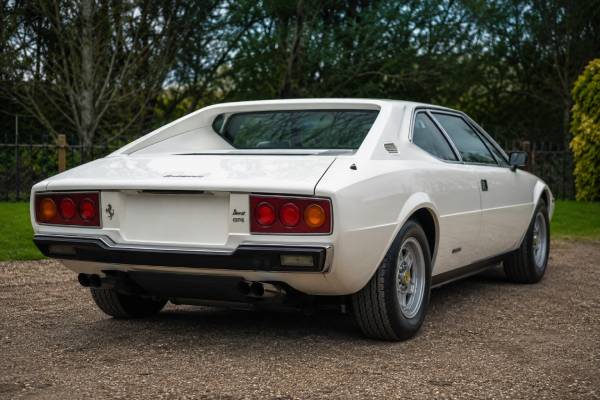

The Ferrari Dino 208 GT4 is one of the most unusual road cars in Ferrari history: a mid-engined, Bertone-designed 2+2 with a 2.0-liter V8 built mainly for Italy’s tax system. It shares the sharp wedge profile and basic architecture of the Dino 308 GT4, but its smaller F106 C 000 engine gives it a different personality. It is not the fastest classic Ferrari. Its appeal is in rarity, packaging, mechanical charm, and the odd fact that Ferrari built a sophisticated V8 around a displacement normally associated with ordinary family cars.
Quick Take
The Dino 208 GT4 is best understood as a rare, high-revving, Italian-market cousin of the 308 GT4 rather than a budget substitute for a full 3.0-liter Ferrari. It rewards buyers who value originality, Bertone design, and unusual Ferrari engineering, but it also demands careful inspection because restoration costs can quickly overtake the car’s market value.
Table of Contents
- Why the 208 GT4 Matters
- Engine, Chassis, and Key Specifications
- Production Details and Authenticity Clues
- Bertone Design and Ferrari Engineering
- Road Feel, Performance, and Usability
- Maintenance, Restoration, and Known Risks
- Values, Buying Checks, and Collectability
Why the 208 GT4 Matters
The Ferrari Dino 208 GT4 matters because it is one of Ferrari’s most distinctive answers to a very specific market problem. It combined a mid-mounted V8, four-seat packaging, and genuine Ferrari construction with a 2.0-liter engine created to sit below Italy’s higher tax threshold.
The 208 GT4 arrived in 1975 as the smaller-displacement version of the Dino 308 GT4. The 308 GT4 had been introduced earlier as a radical break from Ferrari tradition: it was a wedge-shaped 2+2, designed by Bertone rather than Pininfarina, and it used a transverse mid-mounted V8 instead of a front-mounted V12 or V6. The 208 GT4 kept the same basic idea but reduced engine displacement to 1,990.64 cc.
This was not done because Ferrari suddenly wanted to build a small economy engine. In Italy during the period, cars above 2.0 liters faced much heavier taxation. Ferrari’s solution was simple in concept but very unusual in execution: keep the exotic layout, keep the high-revving character, and reduce bore size enough to create a sub-2.0-liter V8.
That decision created one of the smallest production V8 engines ever used in a road car. It also made the 208 GT4 a car with a strange identity. It looks like a 308 GT4, feels like a classic Ferrari in many of its controls, but asks to be driven harder and revved more often because it lacks the torque of its 3.0-liter sibling.
The car also sits in an important place in Ferrari history. The Dino 308 GT4 and 208 GT4 helped establish the mid-engined V8 Ferrari formula that later became central to the brand. Cars such as the 308 GTB/GTS, 328, 348, F355, 360 Modena, F430, 458 Italia, and later V8 models all followed the broad idea of a compact mid-engined Ferrari with a V8 behind the driver. The GT4 was not the prettiest Ferrari in the eyes of traditionalists when new, but its layout pointed toward the future.
The Dino name is also important. Early GT4s were sold under the Dino identity, which Ferrari used for smaller-engined models linked to Alfredo “Dino” Ferrari, Enzo Ferrari’s son. Later cars wore Ferrari badging more directly. This badge transition is one reason buyers should inspect trim, documentation, and restoration history carefully. Incorrect badges are common on older restored cars, and a car’s exact build date and original market specification matter.
Today, the 208 GT4 attracts a narrow but serious audience. Some buyers like it because it is rare, with production generally quoted at about 840 cars. Others like it because it is a more affordable way into classic Ferrari ownership. The best reason to want one, however, is more specific: it is a compact, analog, high-revving, carbureted Ferrari with Bertone styling and an unusual engineering story. Buyers who expect 308 performance may be disappointed. Buyers who enjoy the oddball side of Ferrari history may find it deeply appealing.
Engine, Chassis, and Key Specifications
The core specification of the Dino 208 GT4 is a 1,990.64 cc 90-degree V8 mounted transversely behind the cabin. Its 170 hp output is modest by Ferrari standards, but the engine’s character, layout, and high-revving design make it far more interesting than the number suggests.
| Category | Specification |
|---|---|
| Production years | 1975–1980 |
| Factory type reference | F106 CL 100 |
| Engine code | F106 C 000 |
| Engine layout | Rear mid-mounted, transverse 90-degree V8 |
| Displacement | 1,990.64 cc |
| Bore x stroke | 66.8 mm x 71 mm |
| Valve gear | Double overhead camshafts per bank, two valves per cylinder |
| Fuel system | Four Weber 34 DCNF carburetors |
| Compression ratio | 9.0:1 |
| Power | 170 hp at 7,700 rpm |
| Transmission | 5-speed manual transaxle |
| Drive | Rear-wheel drive |
| Frame | Tubular steel chassis |
| Suspension | Independent front and rear suspension |
| Brakes | Four-wheel disc brakes |
| Steering | Unassisted rack-and-pinion |
| Wheelbase | 2,550 mm |
| Length | 4,300 mm |
| Width | 1,800 mm |
| Height | 1,180 mm |
| Dry weight | About 1,150 kg |
| Claimed top speed | About 220 km/h |
The 208 GT4 engine is closely related in concept to the larger 308 GT4 V8 but uses a much smaller bore. The stroke remains 71 mm, while the bore is reduced to 66.8 mm. This gives the engine a very different feel from the 3.0-liter unit. It wants revs, and it does not deliver the same relaxed mid-range pull as a 308.
The engine uses belt-driven camshafts, which is a major ownership point. Timing belt age matters as much as mileage because many 208 GT4s cover very few kilometers each year. A car that has been displayed more than driven may still need a full belt service, carburetor work, coolant hoses, fuel hoses, ignition parts, and brake-system renewal.
The transmission is a 5-speed manual transaxle mounted with the engine assembly. Like many period Ferraris, it can feel reluctant when cold, especially when selecting second gear. This is not automatically a fault, but heavy baulking, grinding, or jumping out of gear is a warning sign. Correct oil, proper linkage adjustment, and good internal condition all matter.
The chassis is a tubular steel structure with independent suspension. The body is steel, and the car’s low nose, wedge profile, and mid-engine layout give it the visual language of the 1970s. It is not a lightweight track special, but it is compact by modern standards and has the kind of narrow-body feel that many newer performance cars have lost.
Period performance figures vary by source, and buyers should be cautious when comparing old road tests. The requested 170 hp figure is the safest reference for this F106 C 000 version. Some auction descriptions and older literature quote 180 bhp, often because of different measurement standards, market wording, or simple repetition. In real driving, condition and tuning matter more than the paper difference. A properly tuned 170 hp 208 GT4 will feel sharper than a neglected example claimed to have more power.
Production Details and Authenticity Clues
The 208 GT4 was built in small numbers, and authenticity depends on more than paint color or badges. Buyers should confirm the chassis identity, engine type, original market details, trim, and documentation before paying a premium.
Most references place total Dino/Ferrari 208 GT4 production at about 840 cars. The model was mainly intended for the Italian market and was produced only in left-hand drive. This makes it far rarer than the 308 GT4, but rarity alone does not guarantee high value. The car’s smaller engine limits demand among buyers who prioritize performance, while its rarity increases the importance of correct parts and documentation.
The most important identity points are:
- Correct F106 C 000 engine type for the 2.0-liter V8.
- Correct chassis records and factory identity.
- Left-hand-drive layout.
- Italian-market history where applicable.
- Period-correct badging for the car’s build period.
- Factory-style trim, instruments, wheels, exhaust, and carburetion.
- Documentation connecting chassis, engine, ownership, and restoration work.
The 208 GT4 is closely related to the 308 GT4, so visual confusion is common. A casual observer may not notice the difference. The 208 typically has narrower tires, smaller carburetors, and detail differences that separate it from the 308. Some descriptions note bright or plain metal finish on certain louver details and a single exhaust outlet as useful clues, but individual cars may have been altered over decades. Always treat visual details as starting points, not proof.
Badging and model identity
The Dino-to-Ferrari badging period makes GT4 authenticity more complicated than it first appears. Some owners added Ferrari shields or changed nose and rear badges to make the car look more like later Ferrari-branded models. Others restored cars according to personal taste rather than factory build.
For a collector, this matters. A car with incorrect badges is not necessarily a bad driver, but it should not be valued the same as a well-documented, factory-correct example. The safest approach is to compare the car with period photos, factory literature, parts catalogs, and specialist knowledge for the exact chassis range.
Colors, interiors, and documentation
Many 208 GT4s were finished in traditional Ferrari colors, but unusual period shades and correct interiors can add interest. Interior condition is important because GT4 cabins use many model-specific parts that are not as easy to source as mechanical service items. Seats, switchgear, dashboard materials, console trim, gauges, and original steering wheels should all be checked.
Good documentation can include:
- Original Italian libretto or registration papers.
- Owner’s manual and pouch.
- Service invoices from recognized Ferrari specialists.
- Engine rebuild records, if applicable.
- Carburetor, timing belt, cooling-system, and brake-service receipts.
- Photos from restoration work.
- Heritage or marque-expert reports.
- Records showing long-term ownership and mileage continuity.
A thin file does not automatically mean the car is poor, but it increases inspection risk. With a car this specialized, missing history can become expensive very quickly.
Bertone Design and Ferrari Engineering
The 208 GT4 is visually important because it is a Bertone Ferrari with a sharp, angular shape that rejected the softer curves of earlier Dino models. Its design is not universally loved, but it is purposeful, compact, and very representative of 1970s Italian sports-car thinking.
The GT4 shape is usually associated with Marcello Gandini at Bertone, the same design world that produced some of the era’s most dramatic wedge cars. Compared with the Dino 246 GT, the 208 GT4 looks almost severe. The nose is low, the windscreen is steeply raked, the sides are clean, and the rear quarters are defined by strong geometric lines.
The design was not just about style. The GT4 had to package four seats, a transverse mid-mounted V8, luggage space, cooling airflow, and acceptable visibility into a short, low body. That is difficult even now. In the 1970s, it required careful use of every available space.
The 2+2 layout is a key part of the car’s character. The rear seats are small, but they make the GT4 more versatile than a two-seat 308 GTB or GTS. They can carry children, soft luggage, tools, jackets, or weekend bags. That practicality helped define the GT4’s role in the Ferrari range: it was a more usable mid-engined Ferrari, not a pure two-seat exotic.
Cooling and intake management are important visual and mechanical features. The rear-quarter intake treatment is one of the car’s signature details. On these cars, airflow is not decoration. It feeds the mechanical systems that allow a compact mid-engined car to work in real traffic and warm weather.
The engine bay is dense. The V8 sits transversely, and access is tighter than on many front-engined classics. This packaging gives the car much of its exotic appeal, but it also explains why specialist labor is not optional. Routine work often takes more time than a new owner expects.
Inside, the GT4 has a practical but very period cabin. The driving position is low, the dashboard is simple, and the glass area is better than many later supercars. Controls feel mechanical. The cabin is not luxurious in a modern sense, but a correct, well-preserved interior has strong period charm.
The 208 GT4’s sound is also part of the engineering story. A 2.0-liter V8 does not deliver the heavy bass of a larger Ferrari engine. Instead, it has a lighter, sharper, more mechanical voice. Carburetor induction, cam drive, exhaust note, and the need to rev the engine all contribute to the experience. The result is a Ferrari that feels delicate and busy rather than muscular.
Road Feel, Performance, and Usability
The 208 GT4 is enjoyable when driven as a momentum car, not as a torque-rich supercar. It rewards clean inputs, high revs, and mechanical sympathy, while punishing lazy driving with modest acceleration.
In simple terms, the 208 GT4 is not fast by modern standards. A good modern hot hatch will outrun it easily. Even in period, the 308 GT4 had a clear performance advantage. But that does not make the 208 dull. The appeal is in the way it asks the driver to work with the machine.
The engine needs revs. Below the stronger part of the rev range, it can feel mild. Keep it spinning, and it becomes more alert and more Ferrari-like. Carburetor setup makes a major difference. A well-synchronized set of Weber 34 DCNF carburetors gives crisp response and clean progression. Poorly tuned carburetors can make the car stumble, smell rich, foul plugs, or feel far weaker than it should.
The gearbox is part of the ritual. When cold, the shift can be stiff and slow. Many experienced owners avoid rushing second gear until the oil has warmed. Once warm and properly adjusted, the 5-speed manual should feel deliberate and satisfying. A vague or obstructive shift may point to linkage issues, worn bushings, incorrect oil, clutch drag, or internal gearbox wear.
The steering is unassisted, which means effort is noticeable at parking speeds. On the move, it becomes one of the car’s strengths. The front end feels light by modern standards, and the narrow tires help communication. There is less ultimate grip than in a modern performance car, but more feedback at sane speeds.
Braking expectations should also be period-correct. The 208 GT4 has four-wheel discs, but it does not have modern ABS, huge tires, or contemporary brake cooling. A healthy system should feel stable and progressive. Pulling, pulsing, long pedal travel, or weak braking usually means the system needs attention. Old hoses, tired calipers, contaminated fluid, and uneven pad material are common issues on lightly used classics.
Ride quality is better than the wedge shape may suggest. The car is compact, relatively light, and not over-tired. On suitable rubber and healthy suspension bushings, it can flow well on back roads. Worn dampers, old tires, incorrect alignment, or tired suspension joints can make it feel nervous or imprecise.
In traffic, the experience is more demanding. Cabin heat, heavy low-speed steering, carburetor behavior, cooling-system condition, and clutch feel all matter. A properly sorted car can be used for relaxed weekend drives, but it is not a modern commuter. Warm-up matters, and so does mechanical sympathy after hard driving.
The best roads for a 208 GT4 are flowing secondary roads where the driver can maintain momentum, use the upper half of the rev range, and enjoy the steering. It is less convincing as a drag-race car or motorway-status object. That distinction is important. The 208 GT4 is at its best when treated as a rare analog sports car, not as an underpowered modern Ferrari.
Maintenance, Restoration, and Known Risks
The 208 GT4 can be reliable when maintained properly, but neglect is expensive because it is still a mid-engined Ferrari with rare trim and model-specific parts. The purchase price may be approachable by Ferrari standards, but service and restoration costs are not economy-car costs.
The most important ownership rule is simple: buy condition and history, not just rarity. A cheap 208 GT4 with corrosion, missing trim, poor carburetion, and no recent belt service can become more expensive than a better car within months.
Engine and fuel-system priorities
The F106 C 000 V8 needs regular belt and tensioner attention. A seller who says the car has covered very few miles since the last belt service may still be describing an overdue engine. Time matters. Rubber ages, seals harden, fuel evaporates, and carburetors gum up.
Important engine checks include:
- Timing belts and tensioners by date and mileage.
- Cam-cover, crank, and distributor-area oil leaks.
- Cooling-system health, including radiator, thermostat, hoses, and fans.
- Correct carburetor type and synchronization.
- Fuel hoses, fuel pump, filters, and tank condition.
- Ignition components, coils, leads, plugs, and distributors.
- Exhaust condition, leaks, and originality.
- Compression and leak-down test results.
A smooth idle is nice, but it is not enough. The engine should pull cleanly, rev willingly, maintain stable temperature, and restart properly when hot. Blue smoke, heavy crankcase fumes, coolant loss, or persistent misfire all need specialist diagnosis before purchase.
Gearbox, clutch, suspension, and brakes
The transaxle should be checked when cold and warm. Some cold stiffness is normal, but grinding or severe resistance is not something to dismiss. Clutch take-up should be clean. A dragging clutch can make gearbox symptoms worse.
Suspension and brake renewal can be costly because old cars often need complete system work rather than one small repair. Bushings, dampers, ball joints, wheel bearings, brake hoses, calipers, discs, pads, and master cylinders all age. If one part of the system is tired, the rest may not be far behind.
Corrosion and body repair
Rust is one of the biggest risks on any steel-bodied classic Ferrari of this era. Even cars that look good from a few meters away can hide poor repairs. The GT4’s value does not always justify an open-ended restoration, so corrosion inspection is critical.
Inspect carefully around:
- Sills and lower body seams.
- Wheel arches and lower front wings.
- Door bottoms and drain areas.
- Front trunk and spare-wheel area.
- Floor sections.
- Suspension mounting points.
- Engine-bay structure.
- Window surrounds.
- Areas behind trim and under carpets.
Accident damage is another major concern. A mid-engined Ferrari with poor chassis repairs can be difficult to align and unpleasant to drive. Panel gaps, uneven stance, cracked paint near stress points, and mismatched underbody finishes should be investigated.
Interior, trim, and originality
Mechanical parts are often easier to solve than missing trim. Interior pieces, correct instruments, switchgear, vents, badges, wheels, and small exterior details can be difficult or expensive to source. A car with a tired but complete original interior may be a better restoration candidate than one with missing or incorrect parts.
Originality also affects value. Sensible upgrades for safety and drivability can be acceptable on a driver-quality car, such as improved cooling fans, modern fuel hoses, or discreet ignition improvements. But heavy modification, incorrect engine swaps, non-original interiors, or badly chosen modern wheels narrow the buyer pool.
Values, Buying Checks, and Collectability
The 208 GT4 remains one of the more accessible classic Ferrari models, but the best cars are no longer simply “cheap Ferraris.” Value depends heavily on originality, condition, documentation, and whether the buyer understands the cost of correcting a poor example.
Market data for the 208 GT4 is thinner than for the 308 GTB/GTS because far fewer cars trade publicly. Recent public listings and auction records commonly place usable cars in the broad £30,000–£60,000 range, with exceptional, highly original, freshly restored, or unusually documented examples asking or achieving more. Poor cars can look tempting below that range, but they are rarely cheap after restoration math is included.
| Value factor | Why it matters |
|---|---|
| Original engine and identity | The correct F106 C 000 engine and clean chassis history support collector confidence. |
| Rust-free structure | Body and chassis repairs can exceed the value gap between average and excellent cars. |
| Service documentation | Recent belt, fuel, cooling, brake, and suspension work reduces immediate ownership risk. |
| Correct trim and badges | Small missing parts can be hard to source and expensive to correct. |
| Original color and interior | Factory-correct combinations are more attractive to collectors. |
| Specialist inspection | A knowledgeable Ferrari inspection can reveal hidden corrosion, accident repair, and mechanical neglect. |
| Driving quality | A properly tuned 208 GT4 feels far better than a car that merely looks presentable. |
A serious pre-purchase inspection should be done by someone who knows 1970s carbureted Ferraris, not just general classics. The inspection should include a lift check, paint-depth readings where useful, compression or leak-down testing, cooling-system evaluation, carburetor and ignition assessment, brake inspection, gearbox behavior, and a review of all paperwork.
The most desirable examples are not necessarily the lowest-mileage cars. A long-stored car with old belts, stale fuel, seized brake components, cracked tires, and dry seals may need extensive recommissioning. A regularly maintained car with honest mileage can be a better choice.
Good cars to seek include:
- Complete, documented, rust-free examples.
- Cars with long-term ownership history.
- Examples retaining correct 208 GT4 mechanical specification.
- Cars with recent specialist service and sorted carburetion.
- Interiors with original materials and correct trim.
- Cars that drive cleanly from cold and maintain temperature in traffic.
Cars to avoid include:
- Fresh paint over unknown metalwork.
- Missing or inconsistent chassis and engine information.
- Incorrect engine swaps presented as upgrades without clear pricing adjustment.
- Cars with no belt-service history.
- Poor hot-starting, overheating, or carburetor problems.
- Heavily modified interiors or missing model-specific trim.
- Bargain cars needing “only minor finishing.”
Long-term collectability is likely to remain specialist rather than mainstream. The 208 GT4 has rarity, Ferrari heritage, Bertone design, and unusual engineering on its side. Against it are modest performance, a shape that still divides opinion, and the higher desirability of some other classic V8 Ferraris. That means it is unlikely to become universally chased in the way a Dino 246 GT is, but excellent examples should remain interesting to collectors who value unusual Ferrari history.
For the right owner, the 208 GT4 is a rewarding car. It is rare without being obvious, exotic without being unusable, and historically important without being fully appreciated by the wider market. The safest purchase is the best documented, best preserved, best driving example you can afford. The most dangerous purchase is the one that seems cheap because it needs everything.
References
- Ferrari Dino 208 GT4 (1975) 1975 (Manufacturer Specifications)
- 1975 Ferrari Dino 208 GT4 | London 2016 | RM Sotheby’s 2016 (Auction Record)
- Price Guide: Ferrari Dino 208 GT4 [UPDATED 2026] 2026 (Market Data)
- Ferrari Dino 208 gt4 Instruction Book 1975 (Owner’s Manual)
- Resources – Dino 308 GT4 2024 (Manual and Technical Literature Index)
Disclaimer
This article is for informational purposes only and is not a substitute for professional diagnosis, repair, appraisal, or pre-purchase inspection. Specifications, torque values, service intervals, repair procedures, and correct parts can vary by VIN, market, production date, and equipment. Always verify details against official Ferrari service documentation and consult a qualified Ferrari specialist before buying, repairing, or restoring a Dino 208 GT4.
If this guide was useful, please consider sharing it on Facebook, X/Twitter, or your favorite car community to support our work.