
The Ferrari F60 America is one of the rarest modern front-engined Ferraris: a 10-car, open-top V12 special built to celebrate 60 years of Ferrari in North America. It is based on the F12berlinetta’s F152 architecture, but it is not simply an F12 with the roof removed. The F60 America has its own bodywork, NART-inspired detailing, asymmetric cabin trim, and a lightweight roof concept aimed more at occasion than daily usability. Its 6.3-liter naturally aspirated F140 FC V12, rear-wheel drive layout, and dual-clutch gearbox place it in the last great era of non-hybrid Ferrari V12 grand tourers. For collectors, the appeal is straightforward: extreme rarity, American-market symbolism, special-order craftsmanship, and a direct link to Ferrari’s history of limited open V12 cars such as the 275 GTB/4 NART Spider.
Table of Contents
- Why the F60 America Matters
- F140 FC V12 Specs and Chassis Details
- Build Numbers, Options, and Authenticity
- NART-Inspired Design and Bespoke Engineering
- Road Feel, Performance, and V12 Character
- Ownership, Maintenance, and Known Risks
- Market Values and Buying Checklist
Why the F60 America Matters
The F60 America matters because it combines three things Ferrari collectors value heavily: a naturally aspirated front V12, an open body, and a production run of only 10 cars. It was created as a North American anniversary model, but its real significance is that it revived Ferrari’s old habit of building a tiny number of special cars for its most important clients.
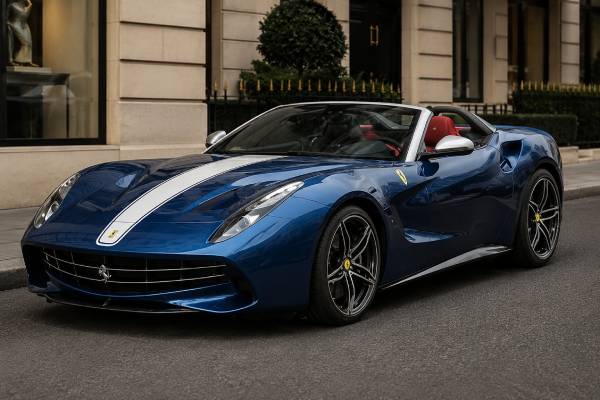
Ferrari presented the F60 America in 2014 to mark 60 years of Ferrari sales in North America. The choice of theme was not random. The American market helped fund Ferrari’s racing ambitions in the early postwar decades, and Luigi Chinetti’s North American Racing Team gave the marque a strong U.S. competition identity. The F60 America reflects that story through its blue-and-white NART-style presentation, open cockpit, and 1960s racing cues.
The car also sits at an important point in Ferrari’s model history. The F12berlinetta had already moved Ferrari’s front-engined V12 line into a sharper, more technical era after the 599 GTB Fiorano. The F60 America used the F12’s mechanical foundation but shifted the message from lap-time performance to exclusivity, coachbuilt flavor, and collector drama.
It is tempting to describe the F60 America as an F12 roadster, but that undersells it. Ferrari did not offer a normal series-production F12 Spider. Instead, it reserved open F12-based V12 motoring for special projects and ultra-limited cars. That makes the F60 America very different from later production models such as the 812 GTS, which gave buyers a more regular catalog open-top V12.
The F60 America’s closest spiritual comparison is the 275 GTB/4 NART Spider. That earlier Ferrari was also linked to the U.S. market, also built in tiny numbers, and also transformed a front-engined V12 berlinetta formula into a much rarer open car. The F60 America does not try to copy the NART Spider directly, but it clearly borrows the idea: take a serious Ferrari V12 coupe platform, remove the normal roof, add special bodywork, and build only enough examples for a very small group of favored clients.
Today, the F60 America is collectible for reasons beyond low production. It represents one of the last naturally aspirated Ferrari V12 special editions before Ferrari’s broader shift toward hybrid technology, turbocharged V8 models, and more complex active systems. It also belongs to the era when Ferrari’s Tailor Made and special-project culture became central to high-end collector demand.
For enthusiasts, the F60 America is fascinating because it is both modern and old-fashioned. The gearbox, chassis controls, carbon-ceramic brakes, and magnetorheological dampers are modern Ferrari technology. The experience, however, is rooted in a classic recipe: long hood, rear-drive balance, open cockpit, and a large-displacement V12 that makes its power through revs rather than boost.
F140 FC V12 Specs and Chassis Details
The core of the F60 America is the F140 FC 65-degree V12, a 6,262 cc naturally aspirated engine related to the F12berlinetta unit. Its key numbers are 730 hp when rounded in common imperial use, 690 Nm of torque, rear-wheel drive, and a 7-speed F1 dual-clutch transmission.
| Item | Specification |
|---|---|
| Model | Ferrari F60 America |
| Platform reference | F152 / F12berlinetta-based architecture |
| Production theme | 60 years of Ferrari in North America |
| Production total | 10 examples |
| Engine code | F140 FC |
| Engine layout | Front-mid-mounted 65-degree V12 |
| Displacement | 6,262 cc / 6.3 liters |
| Induction | Naturally aspirated |
| Power | 541 kW / about 730 hp, often quoted as 740 CV |
| Torque | 690 Nm / 509 lb-ft |
| Redline | 8,700 rpm |
| Transmission | 7-speed F1 dual-clutch automatic |
| Drivetrain | Rear-wheel drive |
| Body and frame | Aluminum body over aluminum alloy spaceframe chassis |
The displacement is worth noting because it marks a peak period for Ferrari’s naturally aspirated road-car V12s. The F140 family appeared in several important Ferrari models, but the F140 FC tune is closely associated with the F12berlinetta generation. It is a high-compression, high-revving engine with direct response and a hard top-end charge. Unlike a turbocharged engine, it does not rely on boost pressure to create its character. The drama comes from throttle opening, intake sound, exhaust pitch, and rising revs.
The front-mid-engine layout places the V12 behind the front axle line as far as packaging allows. This helps reduce the heavy-nose feel that older front-engined GT cars could suffer from. The result is still a large, powerful V12 car, but the balance is much more athletic than the phrase “front-engined grand tourer” might suggest.
The gearbox is a 7-speed dual-clutch unit with Ferrari’s F1-style shift logic. In normal use, it can behave like a smooth automatic. In manual mode, it gives the driver fast paddle shifts and keeps the V12 in its strongest rev range. The close ratios suit the engine’s character because the V12 rewards revs and quick transitions rather than lazy low-speed torque.
| Area | Specification |
|---|---|
| Front suspension | SCM-E magnetorheological damping |
| Rear suspension | SCM-E magnetorheological damping |
| Front brakes | CCM3 carbon-ceramic discs, 398 mm |
| Rear brakes | CCM3 carbon-ceramic discs, 360 mm |
| Front tires | 255/35 ZR20 |
| Rear tires | 315/35 ZR20 |
| Front wheels | 20 x 9.5 in |
| Rear wheels | 20 x 11.5 in |
| Wheelbase | Approximately 2,718 mm / 107.0 in |
The brakes are a major part of the car’s performance envelope. Carbon-ceramic systems save weight, resist fade, and suit high-speed use, but they require careful inspection on a collector car. Disc wear, impact damage, and pad condition matter because replacement costs are substantial.
The tire sizes also reveal the F60 America’s character. A 315-section rear tire gives the car the footprint needed to manage 690 Nm through the rear axle. Tire age is as important as tread depth on a low-mileage example. A car that has covered only a few thousand miles can still be on old rubber, and old high-performance tires can transform a fast Ferrari from sharp to nervous.
Build Numbers, Options, and Authenticity
The most important production fact is simple: Ferrari built only 10 F60 Americas. For buyers, that makes documentation, original specification, factory details, and provenance more important than normal mileage-based used-car thinking.
All 10 cars were spoken for when the model was introduced. That means the F60 America was not a regular showroom model. It was a client-allocated special, aimed at collectors with a strong relationship to the brand and to the North American Ferrari story.
The F60 America’s identity is built around several core features:
- F12berlinetta-based F152 mechanical architecture
- open two-seat body with bespoke exterior panels
- NART-inspired blue-and-white presentation
- Ferrari 60th anniversary badging
- asymmetric interior theme
- American flag motifs in the seats
- lightweight roof concept rather than a normal folding convertible system
- extremely small production run
The roof arrangement is part of the car’s special identity. Rather than using a complex retractable hardtop, the F60 America was conceived as an open celebration car with limited weather protection. Some auction descriptions also refer to a fabric roof and a separate carbon-fiber hardtop arrangement, depending on the specific car and supplied accessories. For a buyer, the key point is not just whether the roof is present, but whether all original roof parts, storage pieces, bags, tools, books, and delivery accessories remain with the car.
What matters for authentication
A normal F12berlinetta can be inspected by production options, paint, service history, and condition. An F60 America needs a more careful authenticity review because tiny details can affect both value and historical integrity.
Important checks include:
- chassis number and factory records
- original build specification
- Ferrari Classiche documentation, where available
- original paint color and livery details
- interior leather colors and stitching layout
- seat inserts and American flag motifs
- 60th anniversary badges
- roof equipment and storage accessories
- original books, tools, battery charger, covers, and keys
- service invoices from authorized Ferrari dealers or respected specialists
- auction catalog history and ownership timeline
The F60 America is not a car where a missing accessory is a small inconvenience. Because production was so limited, replacing special parts can be slow, expensive, or impossible without factory support. Trim pieces, badges, roof components, and unique body parts carry far more importance than they would on a standard model.
Colors and collector appeal
Blu Nart is strongly associated with the F60 America’s public image, partly because the car’s NART-style theme suits blue paint and white detailing so naturally. That does not mean every buyer should ignore all other details and chase only color, but color and originality are central to value.
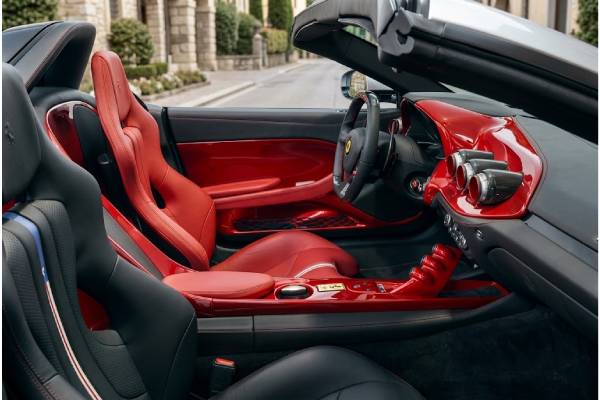
The interior is equally important. The driver-focused red trim and darker passenger side are part of the car’s personality. A car that has been retrimmed, altered, or repaired after damage needs very careful review. Even high-quality work can reduce collector confidence if it changes the original factory presentation.
Because there are only 10 cars, each example has its own story. Mileage, condition, ownership history, public auction exposure, and completeness can create meaningful value differences. A very low-mileage car is attractive, but a car with stronger documentation and all correct accessories may be more desirable than a lower-mileage car with gaps in its history.
NART-Inspired Design and Bespoke Engineering
The F60 America’s design is not just decoration; it uses visual references to connect a modern F12-based V12 to Ferrari’s American racing and road-car history. The car looks familiar enough to be read as a modern Ferrari, but the open cockpit, roll hoops, grille treatment, and cabin split make it immediately different from a standard F12.
The front end uses a more classical Ferrari grille idea, with a single grille opening and integrated brake cooling. This gives the car a softer historical reference than the sharper, more technical face of the F12berlinetta. The side profile is defined by a long hood, a compact cabin, and a dramatic open upper section. With the roof removed, the proportions emphasize the V12 layout: engine ahead of the driver, cabin pushed rearward, power going to the rear wheels.
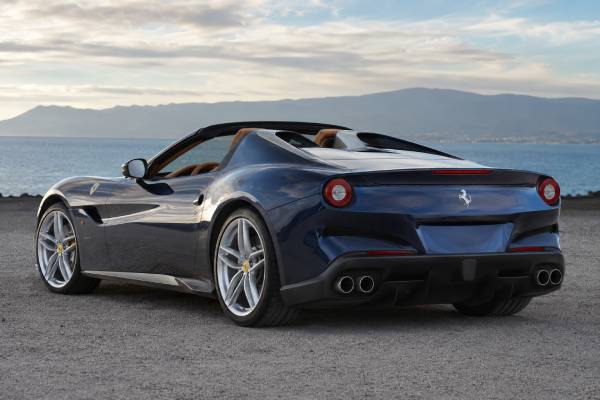
Behind the seats, the F60 America uses roll hoops and rear bodywork that recall older open racing cars without looking like a replica. The rear deck and tail treatment are more sculptural than the standard F12’s fastback roofline, because the car has to solve a different design problem. It needs to look complete as an open car, not like a coupe with the roof cut away.
The chrome fuel filler detail is one of the clearest retro touches. It evokes older competition Ferraris and gives the car a physical, mechanical detail in an era when many supercar surfaces were becoming smoother and more digitally shaped.
Inside, the asymmetric cabin is the signature feature. The driver’s side uses a stronger red treatment, while the passenger side is darker and more restrained. This layout is unusual because most high-end cars aim for symmetry and uniform luxury. Ferrari used imbalance as a deliberate design tool: the driver’s zone feels like the active side of the machine, and the passenger side feels like the observer’s side.
The seats carry American flag motifs, which could have felt heavy-handed on a larger-production car. On the F60 America, the detail works because the entire model exists to celebrate Ferrari’s North American connection. The same is true of the 60th anniversary badging. These pieces are not random special-edition stickers; they define the reason the model exists.
Engineering choices shaped by rarity
Because the F60 America is based on the F12, Ferrari did not have to reinvent the drivetrain. That allowed the special work to focus on body, cockpit, roof concept, and presentation. This is typical of many modern Ferrari specials: proven mechanical hardware gives the car performance credibility, while bespoke body and trim work create collectability.
The use of an aluminum chassis also matters. The F12 platform was not a carbon-tub hypercar platform like the LaFerrari. It was a high-performance front-engined GT structure, designed to combine stiffness, long-distance usability, and serious road speed. For the F60 America, the open configuration required careful structural and body engineering to preserve feel and integrity.
Aerodynamically, the F60 America is less about chasing a public lap-time claim and more about stability, cooling, and visual drama. The large V12 needs airflow, the brakes need cooling, and the open cockpit changes how air moves around the cabin. A car like this must feel stable at high speed, but the emotional effect of open V12 driving is just as important as the numbers.
The sound is central to the design. A naturally aspirated Ferrari V12 in an open car produces a very different experience from the same engine under a fixed roof. Intake noise, exhaust harmonics, and mechanical vibration reach the occupants more directly. That is one reason the F60 America remains so compelling even though newer Ferraris are faster.
Road Feel, Performance, and V12 Character
The F60 America should feel like a dramatic, open-air version of Ferrari’s F12-era front V12 formula: fast, sharp, vocal, and more special-occasion than everyday practical. Its performance is supercar-level, but its true character comes from the combination of rear-drive balance and open V12 sound.
The engine is the main event. It does not deliver power in a quiet, effortless luxury-car way. It builds intensity as revs rise, with a sharper upper range and the kind of response that turbo engines struggle to match. At low and medium speeds, the driver can use the torque and dual-clutch gearbox to make quick progress without chasing the redline. But the car’s personality only fully appears when the V12 is allowed to rev.
Acceleration is in the same broad performance class as the F12berlinetta, with 0–100 km/h commonly quoted around the low-three-second range for the underlying platform. More important than the launch number is how the car covers ground once moving. The V12 pulls hard beyond normal road speeds, and the transmission keeps the engine in the right part of its range with very little interruption.
The steering should feel quick and alert, as modern Ferraris of this period are known for fast front-end response. That can be thrilling on a smooth road and demanding on a poor one. With so much power going to the rear wheels, the car rewards clean inputs. It is not an old-school soft GT that simply wafts along behind a large engine.
The magnetorheological dampers help broaden the car’s ability. In a softer setting, they make the chassis more usable over real roads. In a firmer setting, they support faster direction changes and better body control. Tire temperature and tire age make a major difference. A cold, old, or incorrect tire can make the car feel edgy; a fresh correct tire makes the chassis far more trustworthy.
The carbon-ceramic brakes are powerful, but they need temperature, condition, and proper pad material to feel their best. On road use, some carbon-ceramic systems can feel less progressive when cold than traditional steel brakes. That is not necessarily a fault, but buyers unfamiliar with modern Ferrari brakes should drive a known-good car before judging pedal feel.
Open-top usability
The F60 America is not a conventional all-weather convertible. That is a key part of understanding the driving experience. It is a car for clear mornings, events, coastal roads, collector gatherings, and memorable drives, not a car designed to replace a California or Portofino as an easy daily-use spider.
Visibility should be good forward, helped by the long hood and low seating position, but the car is wide and valuable enough that urban use requires patience. Parking, steep driveways, low curbs, and tight underground garages need care. As with most modern low Ferraris, front-end clearance is a practical ownership issue even when the car is mechanically healthy.
Cabin noise, wind movement, heat, and attention from bystanders are all part of the package. On a long highway run, the car will likely feel more exposed than a fixed-roof F12. On a mountain road or at a Ferrari event, that exposure is exactly the point.
The F60 America is therefore best judged as a collector’s open V12 experience, not as the most rational way to drive quickly. A standard F12berlinetta may be more usable. An 812 GTS may be more modern and easier to live with. The F60 America is rarer, more theatrical, and far more tied to a specific moment in Ferrari history.
Ownership, Maintenance, and Known Risks
The F60 America’s main ownership risk is not that the basic F12-derived drivetrain is fragile; it is that the car is rare, valuable, and full of special parts. Maintenance must be handled like exotic-car preservation, where originality, documentation, and correct procedures matter as much as mechanical repair.
The F140 FC V12 is a serious performance engine. It needs correct oil, correct service procedures, proper warm-up, and regular use. Cars that sit for long periods can develop issues that do not show up in mileage alone. Low mileage is attractive for collectors, but very low use can still mean aged fluids, old tires, weak batteries, sticky seals, and electronic faults caused by voltage problems.
The dual-clutch gearbox is generally more user-friendly than older single-clutch automated Ferrari gearboxes, but it is still an expensive component. Any hesitation, warning light, harsh engagement, fluid leak, or shift fault needs specialist diagnosis. A buyer should not assume that a rare Ferrari with low miles is automatically trouble-free.
Carbon-ceramic brakes require close inspection. The discs should be checked for wear, chips, cracks, heat damage, and previous track abuse. Pads, calipers, brake lines, and fluid condition should all be reviewed. Brake repairs on a car like this are not normal used-car expenses.
A 2022 U.S. safety recall affecting certain Ferraris, including the 2016 F60 America, involved the brake fluid reservoir cap and the risk of improper venting, which could contribute to brake fluid loss. Any F60 America buyer should verify recall completion by VIN and confirm that dealer documentation matches the car.
| Area | What to check | Why it matters |
|---|---|---|
| Engine | Leaks, service history, fluid age, warm-start behavior, warning lights | V12 repairs require specialist labor and correct parts |
| Gearbox | Shift quality, fault codes, leaks, clutch behavior | Dual-clutch problems can be costly and diagnosis must be precise |
| Brakes | Carbon-ceramic disc condition, pad life, recall completion | Replacement parts are expensive and safety-critical |
| Suspension | Damper function, lift system if fitted, bushings, tire wear | Ride and handling depend on healthy electronic damping |
| Body | Paint depth, panel alignment, underside damage, special trim | Bespoke body parts are difficult to source |
| Interior | Original leather, stitching, seat motifs, carbon trim, plaque | Special cabin details are central to authenticity |
| Accessories | Roof parts, tools, books, covers, charger, keys, storage pieces | Missing rare accessories can reduce value sharply |
Age-related concerns
Even carefully stored Ferraris age. Rubber parts harden, fluids absorb moisture, batteries lose strength, and tires age out. A car kept in a climate-controlled collection may look perfect but still need recommissioning before serious driving.
Common age-related checks include:
- tire date codes and correct tire specification
- brake fluid age and recall-related brake work
- coolant condition and hose inspection
- battery health and tender use
- electronic module scan
- air-conditioning function
- sticky interior switches or trim degradation
- suspension bushings and damper operation
- paint protection film condition, if fitted
Because the F60 America is so rare, many owners will avoid adding mileage. That is understandable, but a car still needs mechanical exercise. Sitting unused can be harder on certain systems than careful, regular driving. The best collector examples often show a pattern of low but consistent use, with annual service records and no long unexplained gaps.
Originality versus upgrades
Modifications are risky on an F60 America. Exhaust changes, aftermarket wheels, altered suspension settings, non-original paint protection work, or interior retrimming may be reversible, but they still raise questions. A standard F12 owner may upgrade for personal taste; an F60 America owner is usually preserving a historical object.
That does not mean every protective measure is bad. High-quality paint protection film, correct battery maintenance, and careful storage are sensible. The line is crossed when changes alter the car’s factory identity or make future buyers wonder what happened to the original parts.
A pre-purchase inspection should be done by a Ferrari dealer or an independent specialist with experience in F12-era V12 cars and limited-production Ferraris. A general exotic-car inspection is not enough. The inspector should understand how to evaluate carbon-ceramic brakes, Ferrari diagnostic data, special trim, body repairs, recall records, and documentation quality.
Market Values and Buying Checklist
The F60 America sits in a thin, collector-driven market where public sales are rare and each car’s history matters. A recorded public sale at Monterey in 2021 reached $3.635 million, and market trackers have treated that result as a key benchmark, but a 10-car Ferrari cannot be valued like a normal production model.
The original reported price when new was already far above a standard F12berlinetta. Since then, the F60 America has become a modern collector Ferrari rather than a depreciating used exotic. Its value is driven less by age and more by rarity, provenance, completeness, condition, and whether the right buyers are active when a car comes to market.
The market is not highly liquid. With only 10 cars built, there may be years with no public sale. Private transactions can happen quietly, and public auction results may reflect the specific car, venue, timing, and buyer competition more than a stable “book value.” A single sale can influence perception, but it does not create a broad market by itself.
What drives value
The strongest F60 America examples usually combine:
- factory-original specification
- low but credible mileage
- complete service history
- full accessory set
- correct roof equipment
- strong Ferrari dealer or specialist records
- clean paint and body inspection
- no accident history
- no non-factory modifications
- clear title and ownership history
- Ferrari Classiche or factory documentation, where applicable
- desirable color and interior presentation
- public provenance from a respected auction or known collection
Mileage matters, but it should not be viewed alone. A 500-mile car with missing parts, old tires, stale fluids, and unclear service records may be less attractive than a 2,500-mile car with complete documentation and excellent care.
Examples to seek
The ideal car is original, complete, and easy to document. It should have its original books, tools, keys, charger, covers, roof equipment, delivery accessories, and service invoices. The paint should show no unexplained repair patterns. The interior should retain its correct asymmetric trim, seat details, and badging. The VIN, build data, and documentation should all tell the same story.
A strong buyer should also seek a car that has been maintained by the calendar, not just by mileage. Annual or regular service matters because fluids and seals age. The brake recall should be clearly completed where applicable. Tires should be correct and recent enough for safe use, even if the original tires are preserved separately for historical completeness.
Examples to avoid
Be cautious with any F60 America that has:
- missing roof pieces or storage equipment
- unclear title history
- incomplete service records
- paintwork with no explanation
- modified exhaust, wheels, or trim without original parts
- accident repair evidence
- electronic warning lights
- old tires presented as “like new”
- carbon-ceramic brake wear that has not been priced correctly
- gaps between auction descriptions and current condition
- seller reluctance to allow specialist inspection
The biggest buying mistake is treating the F60 America as a normal F12 variant with a rarity premium. It is better viewed as a coachbuilt-style limited Ferrari with F12 mechanical roots. That means the buyer must inspect both layers: the proven F12-based hardware and the irreplaceable F60-specific details.
For long-term collectability, the F60 America has several advantages. It is naturally aspirated, V12-powered, rear-wheel drive, open-top, North America-themed, and limited to only 10 examples. It also links modern Ferrari personalization culture to the brand’s older tradition of special cars for special clients. Those traits are likely to remain meaningful.
The risks are equally clear. The buyer pool is small, maintenance is expensive, and unique parts can be difficult to replace. Values can move unevenly because there are so few public data points. A buyer should purchase because the car’s story, configuration, and ownership experience matter, not because short-term resale is guaranteed.
A disciplined purchase process should look like this:
- Confirm the VIN, build identity, and factory specification.
- Review ownership history, service invoices, recall records, and accessory inventory.
- Commission a Ferrari specialist inspection before negotiating final terms.
- Inspect body, paint, roof parts, interior trim, brakes, tires, and diagnostic data.
- Price the car according to condition and completeness, not mileage alone.
For the right collector, the F60 America is not just a rare Ferrari; it is a very specific kind of Ferrari. It celebrates the American market, recalls the romance of the NART Spider, and preserves the naturally aspirated front V12 in a form that feels more ceremonial than practical. That is exactly why it remains important.
References
- 2014 Ferrari F60 America 2014 (Specifications)
- 2016 Ferrari F60 America | Monterey 2021 | RM Sotheby’s 2021 (Auction Catalogue)
- Ferrari F60 America Market – CLASSIC.COM 2026 (Market Database)
- Part 573 Safety Recall Report 22V-536 2022 (Recall Report)
- Check for Recalls: Vehicle, Car Seat, Tire, Equipment | NHTSA 2026 (Recall Database)
Disclaimer
This article is for informational purposes only and is not a substitute for professional diagnosis, repair, appraisal, or inspection. Specifications, torque values, service intervals, recall status, equipment, and procedures can vary by VIN, market, software level, and individual vehicle history. Always verify details against official Ferrari service documentation and have any Ferrari F60 America inspected by a qualified Ferrari dealer or specialist before purchase or repair.
If you found this guide useful, please share it on Facebook, X/Twitter, or your favorite automotive community to support our work.