
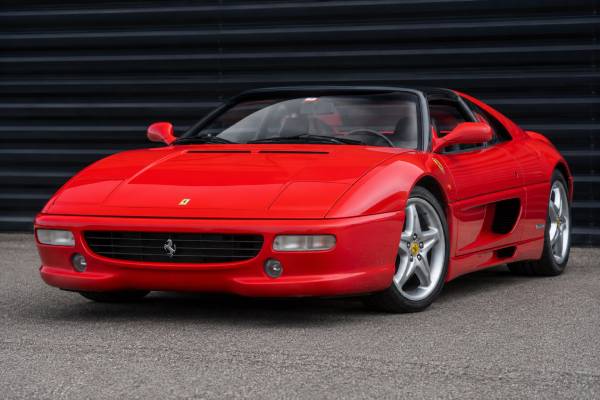

The Ferrari F355 GTS is the removable-roof version of Ferrari’s mid-engined F355, built for the 1995–1999 era and powered by the 3.5-liter F129 five-valve V8. It sits between the closed Berlinetta and the open Spider, giving buyers the core F355 driving experience with a stowable targa-style roof panel. In Ferrari history, the F355 mattered because it repaired much of the 348’s reputation: it was faster, easier to drive, more refined, and far more polished without losing the raw, high-revving character expected from a 1990s Ferrari. For collectors, the GTS is especially interesting because it was produced in smaller numbers than the Berlinetta and Spider, and gated manual cars have become highly sought after. For owners, it remains one of the most rewarding modern-classic Ferraris, but only when maintenance, documentation, originality, and inspection standards are taken seriously.
Table of Contents
- Why the F355 GTS Still Matters
- F129 V8 Specs and Chassis Data
- Production, Variants, and Factory Identifiers
- Pininfarina Shape and Engineering Details
- Road Feel, Performance, and Character
- Maintenance Risks and Restoration Realities
- Values, Inspection, and Buying Advice
Why the F355 GTS Still Matters
The F355 GTS matters because it combines one of Ferrari’s best-sounding naturally aspirated V8s with a rarer open-air body style and the final feel of the old-school mid-engine Ferrari era. It is modern enough to use regularly with care, yet mechanical enough to feel very different from later automated, larger, and more insulated supercars.
Ferrari launched the F355 family in 1994 as the successor to the 348. The GTS version followed for the 1995 model year, using the Berlinetta’s structure and drivetrain with a removable roof panel that stores behind the seats. That made it the spiritual successor to earlier targa-style mid-engined Ferraris such as the 308 GTS, 328 GTS, and 348 TS.
The F355 was not a clean-sheet car in the way the later 360 Modena would be, but that is part of its appeal. Ferrari heavily reworked the 348 platform, changed the suspension behavior, improved the gearbox linkage, added power steering, revised the aerodynamics, and transformed the engine. The result felt like a major leap rather than a mild update.
The most important change was the engine. The F355’s 3.5-liter F129 V8 used five valves per cylinder, with three intake valves and two exhaust valves. For the mid-1990s, this was serious exotic-car engineering. It helped the engine breathe at high rpm and gave the car its signature character: sharp, metallic, urgent, and happiest when worked hard.
The GTS also arrived at an important moment for Ferrari. Under Luca di Montezemolo’s leadership, Ferrari road cars were becoming more usable without becoming ordinary. The F355 showed that a Ferrari could be dramatic and precise, but also easier to drive in traffic, more comfortable on long journeys, and less intimidating than the car it replaced.
Today, the GTS is desirable for four main reasons:
- It is rarer than the Berlinetta and Spider.
- It offers open-air sound without the full complexity of the Spider roof.
- It keeps the elegant flying-buttress profile that many enthusiasts associate with classic mid-engine Ferraris.
- Manual examples deliver the gated-shifter experience that has become central to 1990s Ferrari collectability.
The F355 GTS is not a limited-edition homologation special, and it was not built primarily for motorsport. Its significance comes from balance. It was one of the cars that helped move Ferrari from temperamental old-world exotic toward usable modern supercar, while still preserving the sound, smell, compact size, and driver involvement collectors now want.
F129 V8 Specs and Chassis Data
The F355 GTS uses a longitudinal mid-mounted 3.5-liter V8, rear-wheel drive, and either a six-speed gated manual or the later F1 electrohydraulic paddle-shift transmission. The headline figures are 380 PS, 279 kW, 363 Nm, a claimed 295 km/h top speed, and 0–100 km/h in about 4.7 seconds.
| Item | Specification |
|---|---|
| Production years covered | 1995–1999 |
| Body style | Two-seat targa-style GTS with removable roof panel |
| Layout | Longitudinal rear mid-engine, rear-wheel drive |
| Engine | F129 90-degree naturally aspirated V8 |
| Displacement | 3,495.5 cc |
| Valve gear | DOHC, five valves per cylinder, 40 valves total |
| Induction | Naturally aspirated, electronic fuel injection |
| Power | 380 PS / 279 kW at 8,250 rpm |
| Torque | 363 Nm / 268 lb-ft at 6,000 rpm |
| Bore x stroke | 85 mm x 77 mm |
| Compression ratio | 11.0:1 |
| Lubrication | Dry sump |
| Transmission | Six-speed manual; six-speed F1 automated manual from 1997 |
| Top speed | 295 km/h / 183 mph |
| 0–100 km/h | About 4.7 seconds |
The F129 B/C description refers to the F129 engine family across early and later F355 versions. Early cars are commonly associated with Bosch Motronic 2.7 engine management, while later cars moved to Motronic 5.2. Buyers often discuss this difference because it affects diagnostics, emissions equipment, intake layout, parts, and owner preference.
| Area | F355 GTS detail |
|---|---|
| Chassis structure | Steel monocoque with tubular rear subframe |
| Suspension | Independent double wishbones front and rear |
| Dampers | Gas-filled electronically controlled dampers with selectable settings |
| Steering | Power-assisted rack-and-pinion |
| Brakes | Ventilated discs with ABS |
| Wheels | 18-inch magnesium alloy wheels |
| Tires | 225/40 ZR18 front, 265/40 ZR18 rear |
| Length | 4,250 mm |
| Width | 1,900 mm |
| Height | 1,170 mm |
| Wheelbase | 2,450 mm |
| Dry weight | About 1,350 kg, depending on market and specification |
The numbers only tell part of the story. The F355 GTS is compact by modern standards, with a low cowl, short cabin, slim pillars, and a narrow-feeling body from behind the wheel. Its performance is still quick today, but its real advantage is response. The engine needs rpm, the steering talks clearly, and the chassis gives the driver more information than many newer supercars.
Production, Variants, and Factory Identifiers
The GTS is the lowest-volume regular F355 road body style, with commonly cited production of 2,577 cars. Of those, 2,048 were built with the six-speed manual and 529 with the F1 transmission, making factory manual GTS cars especially important to collectors.
The F355 range consisted of three main road bodies: Berlinetta, GTS, and Spider. The Berlinetta was the fixed-roof coupe. The Spider used a fully convertible soft top. The GTS used the Berlinetta’s basic look but added a removable roof panel. That roof panel is central to the car’s identity, and its condition, seals, fit, storage bag, and matching finish all matter during inspection.
Manual and F1 gearbox cars
Early GTS cars were manual only. From 1997, Ferrari offered the F1 gearbox, an electrohydraulic automated version of the six-speed manual transaxle. It was significant because Ferrari brought road-car paddle shifting closer to its Formula 1 image, and the F355 was the first Ferrari road car offered with this kind of system.
For collectors today, the gated manual usually commands the strongest interest. It is simpler, more tactile, and more closely tied to the car’s analog reputation. The F1 version is historically interesting and can be enjoyable when properly set up, but it has more hydraulic and electronic inspection points. A poorly adjusted F1 car can feel clumsy; a healthy one feels period-correct and dramatic, even if it is not as smooth as later dual-clutch systems.
Early and later engine-management differences
F355 buyers often separate cars into early 2.7 Motronic and later 5.2 Motronic examples. The difference is not just internet trivia. It affects intake layout, diagnostics, emissions behavior, and sometimes sound preference.
A quick visual guide:
- Early 2.7 cars have separate airflow paths for each bank.
- Later 5.2 cars use a more consolidated intake arrangement.
- U.S.-market cars may differ in emissions equipment and quoted output.
- Later cars can be easier to scan with more familiar OBD-era tools.
- Some enthusiasts prefer early cars for sound and response, while others prefer later cars for parts commonality and emissions compliance.
Neither type is automatically better. Condition, maintenance quality, and correct repair history matter more than the management version.
Documents that matter
For a serious GTS purchase, documentation is not a bonus. It is part of the car’s value. A strong file should include service invoices, timing-belt history, recall confirmation where applicable, ownership records, import documents if relevant, tool kit, books, leather pouch, radio code material if supplied, roof panel storage equipment, and evidence of correct parts.
Ferrari Classiche certification can help with originality, but it does not replace a mechanical inspection. A Classiche-certified F355 can still need belts, manifolds, sticky interior refinishing, suspension work, or valve-guide diagnosis. Treat certification as one useful part of the provenance picture, not as a complete health report.
Pininfarina Shape and Engineering Details
The F355 GTS works visually because Pininfarina kept the 1990s wedge clean, low, and elegant while correcting the harder edges of the 348. The GTS roof opening adds drama without destroying the side profile, which is why many buyers see it as the sweet spot of the range.
The design is full of Ferrari cues, but it is not retro in a lazy way. The flying buttresses behind the cabin connect it to earlier mid-engine Ferraris, while the covered underbody work, side intakes, and integrated tail treatment make it look more mature than the 348. Pop-up headlights, a low nose, and a simple rear grille give it a very specific 1990s identity.
The GTS roof is a major part of the engineering package. It gives open-air intake and exhaust sound without the weight and mechanical complexity of the Spider’s power soft top. The tradeoff is that roof seals, latches, alignment, and storage wear become important. A roof that fits poorly can create wind noise, water leaks, squeaks, and paint damage around the contact points.
Aerodynamics were a serious part of the F355 program. Ferrari used underbody shaping and rear detailing to improve stability at speed. The car does not rely on a large fixed rear wing. Instead, it uses cleaner airflow management, a low frontal area, and subtle body shaping. That suits the GTS perfectly: the car looks graceful rather than track-aggressive, but it still feels settled when driven fast.
Cooling also defines the design. The side intakes feed the mid-mounted V8 and cooling system, while the rear deck allows heat to escape from a tightly packaged engine bay. Heat management is part of F355 ownership. Exhaust components, catalytic converters, engine-bay insulation, wiring, and rubber parts all live in a harsh environment, so a beautiful engine bay is not just cosmetic. It can signal careful use and proper maintenance.
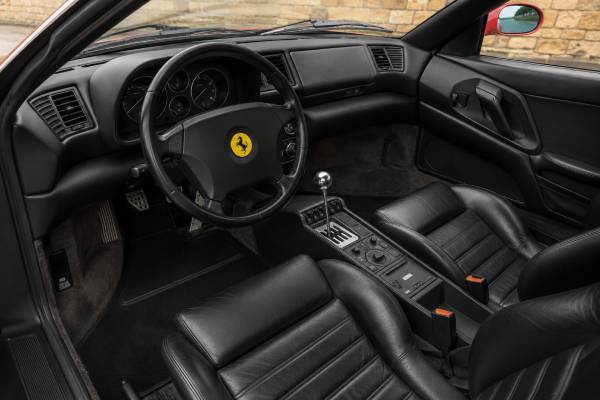
Inside, the F355 is simple compared with modern Ferraris. The low dashboard, analog instruments, metal gate on manual cars, leather-trimmed cabin, and compact seating position create a focused cockpit. The driving position is not perfect for every body type, and the offset pedals remind you this is still an Italian exotic from the 1990s, but the layout feels more usable than earlier cars.
The sound is the special feature most owners remember. The five-valve V8 does not make its best impression at idle. Its character builds with rpm, moving from mechanical chatter to a sharp, hard-edged wail. Roof off, the GTS lets more of that intake and exhaust note into the cabin without turning the car into a full convertible. That is a large part of its appeal.
Road Feel, Performance, and Character
The F355 GTS feels fast because it is responsive, not because it overwhelms the driver with modern torque. It rewards revs, precision, and rhythm, which makes it more involving on real roads than many cars with far larger power numbers.
The engine is the center of the experience. Below about 3,500 rpm it is flexible enough for town use, but it does not feel muscular in a modern turbocharged way. The car comes alive as the revs climb. Past the midrange, the response sharpens, the sound hardens, and the final stretch toward 8,000 rpm gives the F355 its reputation.
A good manual GTS has one of the most satisfying shift experiences of any 1990s exotic. The shift can be stiff when cold, especially into second gear, but it should improve as the gearbox oil warms. The metal gate makes every shift feel deliberate. A worn linkage, tired engine mounts, or incorrect adjustment can make the car feel much older than it is, so shift quality is a useful inspection clue.
The F1 gearbox changes the personality. It is not a modern dual-clutch transmission, and it should not be judged like one. It gives the car a period motorsport feel, with dramatic upshifts and a more technical interaction. It also needs careful setup. Clutch wear, actuator condition, pump performance, hydraulic leaks, and calibration history should all be checked before purchase.
Steering is another strength. Compared with the 348, the F355 feels more cooperative and less nervous. Compared with modern Ferraris, it feels lighter, smaller, and more transparent. The power steering helps at low speeds but still gives useful road texture when the tires and suspension are healthy.
The chassis balance is approachable. The car has mid-engine rotation, but it is not a widow-maker when aligned correctly and driven on proper tires. Old tires, incorrect ride height, worn suspension bushings, or tired dampers can transform the car for the worse. Many complaints about vague or nervous F355s come from neglected suspension rather than flawed design.
Braking performance is strong for road use, with good pedal feel when the system is fresh. On track, heat and age matter. Brake hoses, fluid age, caliper condition, pads, discs, and cooling should be checked carefully. The F355 is capable of track work, but using one hard on circuit exposes expensive maintenance needs quickly.
In normal driving, the GTS is more usable than its exotic image suggests. Visibility is good for a mid-engine car, the footprint is compact, and the engine is not impossible in traffic. The downsides are low ground clearance, cabin heat, road noise with the roof off, expensive tires, and the constant need to treat temperatures and fluids with respect.
A healthy F355 GTS should feel tight, eager, and mechanical. A tired one feels hot, smoky, loose, rattly, and expensive. That gap is large, and it is why inspection quality matters so much.
Maintenance Risks and Restoration Realities
The F355 GTS can be reliable when maintained properly, but it is not a low-effort collector car. The biggest ownership risks are deferred engine-out belt service, valve-guide wear, cracked exhaust manifolds, catalytic-converter damage, fuel-system recall history, sticky interior parts, aging suspension, and poor previous repairs.
Timing belts and engine-out service
The F355 is famous for engine-out major service. Timing belts sit at the front of the transverse-accessory side of the engine package in a way that makes proper service labor-intensive. A “major” normally includes belts, tensioner bearings, accessory belts, cam seals where needed, valve-cover gaskets, fluids, filters, inspection of hoses, and related work while access is available.
Intervals vary by market documentation and specialist practice, so buyers should not rely on casual claims. The safest approach is to verify the specific car’s official service schedule, then compare it with current Ferrari-specialist advice. If a seller says the belts were “done recently,” ask for invoices showing date, mileage, parts, labor scope, and who performed the work.
Valve guides, manifolds, and catalytic converters
Early F355s are widely known for valve-guide concerns, especially cars with bronze guides. Symptoms can include oil consumption, smoke, weak compression, leak-down problems, fouled plugs, and poor running. Repair is expensive because proper correction involves significant engine work.
Exhaust manifolds are another major issue. Factory headers can crack, often producing ticking noises on cold start. A crack can allow air into the exhaust stream, disrupt readings, raise temperatures, and contribute to catalytic-converter damage. Catalytic converters are expensive, and overheated cats can create further engine-bay risk.
A proper pre-purchase inspection should include:
- Cold start observation.
- Compression and leak-down testing.
- Exhaust manifold inspection.
- Catalytic-converter temperature and condition checks.
- ECU fault review where possible.
- Oil-consumption history.
- Inspection for smoke under overrun and acceleration.
Fuel-system recalls and safety checks
U.S.-market F355 and 355 F1 cars were subject to fuel-system recall activity involving fuel supply pipes and later fuel divider block work. For any car, especially one imported across markets, verify recall completion by VIN with an authorized Ferrari dealer or official recall source. Do not accept “probably done” as proof.
Fuel smell is never normal. Look for aged hoses, incorrect clamps, rubbing lines, old repairs, damp fittings, and evidence of fuel staining. The engine bay is hot and tightly packaged, so fuel-system condition is a safety issue, not just a maintenance detail.
Suspension, brakes, wheels, and tires
The F355’s suspension is now old enough that age matters as much as mileage. Low-mile cars can still need bushings, ball joints, shock service, steering components, engine mounts, and alignment work. Electronically controlled dampers should be checked for warning lights and actual function.
Original magnesium wheels are part of the car’s appeal, but they need close inspection. Check for cracks, corrosion, poor refinishing, incorrect hardware, and damage from careless tire mounting. Tire age is also critical. A 10-year-old tire with full tread is still unsuitable for a high-performance Ferrari.
Brake inspection should cover discs, pads, calipers, hoses, ABS function, fluid age, and handbrake operation. Track-driven cars may need more than a normal road inspection because heat cycles can accelerate wear.
Interior aging and roof-related issues
The F355 interior has several age-related concerns. Leather can shrink, harden, pull around edges, or distort around the dashboard and airbag areas. Sticky switchgear is common on 1990s and 2000s Ferraris, caused by soft-touch coatings breaking down. Correct refinishing is possible, but poor cosmetic repair can reduce the cabin’s originality and value.
For the GTS specifically, inspect the roof panel carefully. Look for paint mismatch, damaged seals, loose trim, latch wear, water marks, wind noise, and storage damage behind the seats. A missing roof bag or damaged roof hardware is not a small detail on a collector-grade GTS.
Restoration is possible, but it is rarely cheap. The best F355 to buy is usually not the cheapest car that can be improved later. It is the car that already has strong mechanical history, correct parts, good cosmetics, and no hidden structural or engine issues.
Values, Inspection, and Buying Advice
The F355 GTS sits in a strong collector position because it is rarer than the Berlinetta and Spider, and manual cars have become especially desirable. As of early 2026, public market trackers generally show manual GTS examples trading well above F1 GTS cars, with condition, mileage, color, documentation, and recent major service creating large price gaps.
A useful way to think about value is not “cheap versus expensive.” It is “sorted versus risky.” A higher-priced GTS with a recent engine-out service, clean compression and leak-down results, documented manifold work, good tires, healthy suspension, complete books and tools, and strong paint history may be cheaper to own than a discounted car with mystery records.
| Value factor | Why it matters |
|---|---|
| Transmission | Factory gated manuals usually bring the strongest collector interest |
| Service history | Recent documented major service reduces immediate ownership risk |
| Engine health | Compression, leak-down, valve-guide condition, and manifold health drive cost |
| Originality | Factory colors, interior, wheels, books, tools, and roof equipment support value |
| Mileage | Low mileage helps, but ultra-low-mile cars can still need age-related work |
| Color combination | Rosso Corsa/tan is liquid, while rare colors can bring premiums with the right buyer |
| Accident history | Panel fit, paint depth, chassis condition, and repair quality are crucial |
| Market region | U.S., U.K., European, and Japanese-market cars can differ in equipment and history |
Pre-purchase inspection priorities
A proper F355 GTS inspection should be done by a Ferrari specialist who knows the model, not just a general exotic-car shop. The inspection should be written, photographed, and detailed enough to support negotiation.
Key checks include:
- VIN, assembly number, engine number, and gearbox number where available.
- Service invoices, not just stamped books.
- Timing-belt age, mileage, and full major-service scope.
- Compression and leak-down numbers.
- Exhaust manifold and catalytic-converter condition.
- Valve-guide symptoms and oil-consumption evidence.
- Fuel-system recall completion and fuel-line condition.
- Clutch life and gearbox behavior.
- F1 hydraulic system condition if applicable.
- Suspension bushings, dampers, ball joints, and alignment.
- Brake discs, pads, hoses, ABS function, and fluid history.
- Roof panel fit, seals, latches, bag, and storage condition.
- Paint depth, panel gaps, underbody damage, and corrosion signs.
- Interior leather shrinkage, sticky controls, HVAC function, and electrical faults.
Cars to seek
The best buys are honest, well-used-but-cared-for examples with strong records. A car with moderate mileage, regular specialist maintenance, a recent major service, sorted manifolds, healthy compression, clean paintwork, and complete accessories can be ideal. Collector-grade low-mile manual cars are wonderful, but they can be too valuable for relaxed use and may still need recommissioning.
For many enthusiasts, a factory manual GTS in a desirable color with complete books, tools, roof equipment, and no stories is the target. For buyers focused on driving value rather than maximum collectability, a well-maintained F1 GTS can make sense if the price reflects the transmission preference gap and the F1 system is healthy.
Cars to avoid
Avoid cars with vague service claims, missing invoices, smoky exhaust, ticking manifolds, hot catalytic converters, unresolved warning lights, fuel smell, poor roof fit, sticky interiors presented as “easy fixes,” or a seller unwilling to allow specialist inspection. Also be cautious with manual-converted cars. Some conversions are excellent, but they are not the same as factory manual cars for provenance and valuation.
Accident repair is another major risk. The F355 sits low, and front underside damage is common. Poor paintwork around the nose, sills, buttresses, roof opening, and rear quarters can be costly to correct. A shiny respray without documentation should trigger more questions, not fewer.
Long-term, the F355 GTS has strong collectability because it represents a rare mix: compact size, naturally aspirated V8, five-valve engineering, Pininfarina styling, removable roof, and available gated manual transmission. It is not cheap to keep right, but a properly bought and maintained example is one of the most satisfying Ferraris of its generation.
References
- Ferrari F355 GTS (1994) – Ferrari.com 1994 (Manufacturer Specifications)
- Ferrari 355 F1 GTS (1997) 1997 (Manufacturer Specifications)
- Vehicle Detail Search – 1999 FERRARI F355 | NHTSA 2026 (Recall Database)
- RC48 cover USA.pmd 2009 (Recall Campaign)
- Ferrari F355 Market 2026 (Market Data)
Disclaimer
This article is for informational purposes only and is not a substitute for professional diagnosis, repair, inspection, valuation, or restoration advice. Specifications, torque values, service intervals, recall applicability, repair procedures, and equipment can vary by VIN, market, model year, transmission, and individual vehicle history. Always verify details against official Ferrari service documentation and consult a qualified Ferrari specialist before buying, repairing, or modifying an F355 GTS.
If you found this guide useful, please consider sharing it on Facebook, X/Twitter, or your favorite enthusiast community to support our work.