
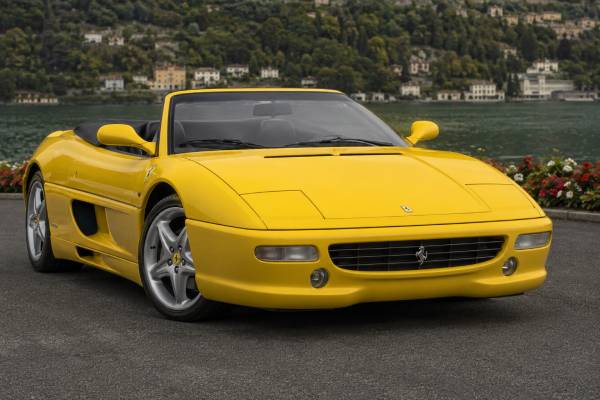
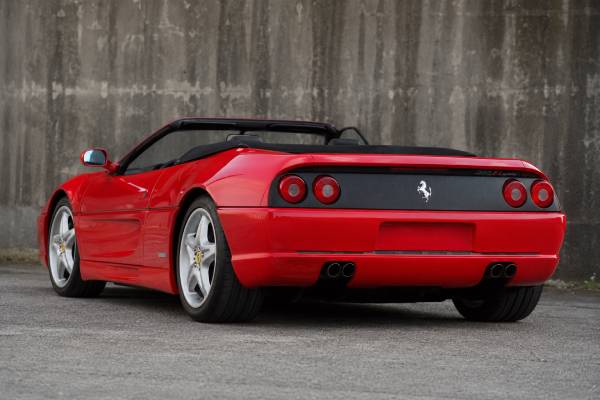
The Ferrari 355 F1 Spider Serie Fiorano is the final, collector-focused version of the F355 Spider, built for the 1999 model year as the model line was giving way to the Ferrari 360. It combines the open body, the electrohydraulic F1 paddle-shift gearbox, and a sharper Fiorano specification inspired by Ferrari’s track hardware. Under the rear deck sits the F129-series 3.5-liter, five-valve-per-cylinder V8, a high-revving naturally aspirated engine rated at 380 hp.
What makes the Serie Fiorano more than a normal F355 Spider is its narrow production run, special suspension and braking equipment, quick steering, Challenge-style details, carbon-fiber cabin trim, and numbered identity on U.S.-market cars. Buyers still care because it sits at a sweet spot: analog Ferrari sound and size, early paddle-shift history, late-production refinement, and genuine scarcity.
Table of Contents
- Why the Serie Fiorano Matters
- F129 V8, Chassis, and Key Specs
- Production Breakdown and Originality Clues
- Pininfarina Design and Fiorano Hardware
- Road Feel, Performance, and F1 Shifts
- Maintenance Risks and Restoration Costs
- Market Values and Buyer Inspection
Why the Serie Fiorano Matters
The Serie Fiorano matters because it was the send-off version of one of Ferrari’s most loved modern V8 cars. It took the already charismatic F355 Spider and added a more focused specification at the end of production, when Ferrari had refined the platform and was preparing to move into the aluminum-bodied 360 era.
The F355 itself was a major reset after the 348. The 348 had the right mid-engine layout and Ferrari badge, but it was often criticized for nervous handling and less forgiving road manners. The F355 answered with more power, better aerodynamics, power steering, electronic dampers, a cleaner Pininfarina shape, and a far more flexible personality. It could still feel raw and exotic, but it was easier to drive slowly, easier to place on the road, and more polished than its predecessor.
The Spider version added another layer of appeal. Introduced after the Berlinetta and GTS, it brought the F355’s sound and shape into an open car without turning it into a soft grand tourer. The electronically operated soft top was a notable feature for the period, and the car kept the compact, mid-engine proportions that make the F355 feel small by modern supercar standards.
The 355 F1 models added another important historical point. Ferrari’s F1-style electrohydraulic gearbox made the F355 the first Ferrari road car family to bring paddle shifting into production. By today’s dual-clutch standards it is slow, mechanical, and sometimes awkward. In period, it was a direct link to Ferrari’s Formula 1 image and a major change in how high-performance road cars were controlled.
The Serie Fiorano sits at the intersection of these ideas:
- final-year F355 Spider production
- rare limited-edition identity
- F1 paddle-shift significance
- more aggressive chassis tuning
- Challenge-inspired visual and hardware details
- collector appeal from low numbers and factory documentation
It is not the fastest F355 in every situation, and it is not always the most valuable version. A gated manual Serie Fiorano often attracts stronger collector interest because of its rarity and the market’s affection for manual Ferraris. Still, the F1 Spider Serie Fiorano has its own importance. It is a rare, factory-built link between classic analog Ferraris and the paddle-shift era that soon became normal across the brand.
For enthusiasts, its appeal is simple: high-revving V8, open-air sound, compact size, sharp steering, and special-series rarity. For collectors, the appeal is more specific: confirmable production identity, late F355 build, factory Fiorano equipment, service history, and originality.
F129 V8, Chassis, and Key Specs
The key mechanical story is the F129 3.5-liter V8: a naturally aspirated, dry-sump, five-valve-per-cylinder engine that makes its power high in the rev range. The Serie Fiorano did not need more horsepower to feel special; its sharper value came from chassis, steering, braking, and trim changes.
| Category | Specification |
|---|---|
| Model year | 1999 |
| Platform/type | Ferrari F129 / F355 Spider |
| Body style | Two-seat spider with powered soft top |
| Engine | Rear-mid-mounted, longitudinal 90-degree V8 |
| Displacement | 3,495.50 cc |
| Bore x stroke | 85 mm x 77 mm |
| Valvetrain | DOHC, five valves per cylinder, 40 valves total |
| Compression ratio | 11.0:1 |
| Maximum power | 279 kW / 380 hp at 8,250 rpm |
| Maximum torque | 363 Nm / 268 lb-ft at 6,000 rpm |
| Lubrication | Dry sump |
| Transmission | Six-speed F1 electrohydraulic automated manual |
| Drivetrain | Rear-wheel drive with rear transaxle layout |
The engine is the centerpiece. The “355” name refers to 3.5 liters and five valves per cylinder, a useful reminder of how advanced this V8 looked in the 1990s. The layout gives the car a high specific output for a naturally aspirated road engine of the era. It also gives the F355 its famous sound: metallic, urgent, and increasingly sharp as it climbs toward the top of the tachometer.
| Item | Figure |
|---|---|
| Length | 4,250 mm |
| Width | 1,900 mm |
| Height | 1,170 mm |
| Wheelbase | 2,450 mm |
| Front track | 1,514 mm |
| Rear track | 1,615 mm |
| Dry weight | 1,350 kg |
| Top speed | 295 km/h / 183 mph |
| 0–100 km/h | 4.7 seconds |
| 0–400 m | 12.9 seconds |
| 0–1,000 m | 23.7 seconds |
Under the body, the F355 uses independent suspension with unequal-length wishbones, coil springs, anti-roll bars, and electronically controlled dampers. Standard F355 road cars already had a balance between ride comfort and sport response. The Serie Fiorano sharpened that balance with a more focused suspension package and a quicker steering rack.
The brakes are steel discs, not carbon-ceramics. For collectors this is not a drawback; it keeps the car period-correct and makes inspection more about disc wear, caliper condition, flexible lines, fluid history, and whether the Fiorano-specific drilled-disc and pad setup is still represented correctly.
The F1 gearbox is a conventional manual transaxle operated by hydraulics and electronics. That detail matters. It is not a torque-converter automatic and not a modern dual-clutch unit. It has a clutch, clutch wear, hydraulic actuation, and setup sensitivity. A well-adjusted example feels crisp for its age. A tired or poorly calibrated one can feel jerky, slow, or expensive.
Production Breakdown and Originality Clues
The Serie Fiorano is valuable because it is identifiable, limited, and mechanically distinct from a normal F355 Spider. Buyers should treat its build identity as seriously as its mechanical condition, because missing documentation or incorrect trim can quickly reduce confidence.
Most accepted production accounts state that Ferrari planned 100 Serie Fiorano Spiders for the U.S. market and built 104 total examples, with 100 U.S.-market cars, three European-market cars, and one South African-market car. Within the U.S. group, the common breakdown is 74 cars with the F1 transmission and 26 with the six-speed manual gearbox.
| Market or transmission | Commonly cited count | Buyer relevance |
|---|---|---|
| U.S.-market Serie Fiorano | 100 | Usually numbered with a dashboard plaque |
| U.S. cars with F1 gearbox | 74 | Most common Serie Fiorano configuration |
| U.S. cars with manual gearbox | 26 | Generally strongest collector demand |
| European-market cars | 3 | Very rare; plaque details may differ |
| South African-market car | 1 | Exceptionally rare market allocation |
| Total production | 104 | The figure most often used by registries and market trackers |
A real Serie Fiorano should not be judged only by badges. Several F355s have been modified with Challenge grilles, shields, carbon trim, upgraded suspension parts, or aftermarket exhausts. Those changes may be attractive, but they do not make a car a Serie Fiorano.
Important authenticity clues include:
- numbered dashboard plaque on U.S.-market cars
- original build records or Ferrari documentation
- matching VIN, assembly number, service book, and market history
- Fiorano suspension equipment rather than later imitation parts
- drilled brake discs and upgraded pads consistent with the package
- quicker steering rack
- Challenge-style rear grille
- enameled Scuderia Ferrari shields
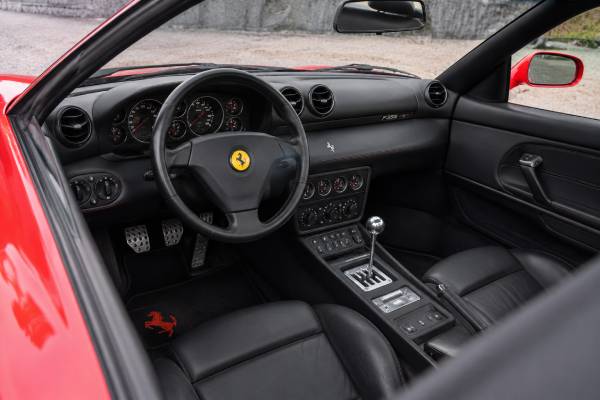
- carbon-fiber center console, door sill trim, and F1 paddle details
- suede or Alcantara-style steering wheel covering
- correct books, tool kit, tire inflator, keys, remotes, and alarm fobs where available
Factory color and interior combinations also affect desirability. Rosso Corsa over tan remains the familiar Ferrari image, but less common colors can be highly desirable when original and documented. Argento Nürburgring, black, yellow, blue, or unusual interior pairings may attract serious collectors if the car has the right paper trail.
The best cars have a clean chain of ownership, original paint or high-quality documented paintwork, factory-correct trim, recent major service, and no mystery gaps. A car with perfect paint but missing documents is not automatically better than a slightly used car with complete records. On a rare Ferrari, trust is part of the asset.
Pininfarina Design and Fiorano Hardware
The F355 Spider works visually because it is compact, low, and restrained by modern supercar standards. The Serie Fiorano adds just enough hardware and trim to signal special status without turning the car into a race-car replica.
Pininfarina’s F355 shape softened the harder edges of the 348 while keeping a clear mid-engine Ferrari profile. The side intakes are cleaner, the rear deck is lower and more elegant, and the body has a tautness that still reads as modern-classic rather than old. The pop-up headlights also place it in a specific era. Later Ferraris moved away from them, which makes the F355 one of the last Ferraris with that 1990s supercar signature.
The Spider roof changes the design more than it first appears. With the top down, the car’s rear buttresses and deck treatment become central to its character. The cabin is open, the engine note is more present, and the car feels more emotional at road speeds than a closed Berlinetta. The tradeoff is structural complexity. A Spider needs careful inspection around the roof system, seals, frame alignment, and evidence of past accident repair.
The Fiorano hardware gives the car its sharper edge. Compared with a standard F355 Spider, the package is valued for:
- lower, firmer suspension tuning
- wider, more planted stance
- thicker anti-roll bar specification
- quicker steering response
- drilled and ventilated brake discs with more aggressive pad material
- Challenge-style rear grille
- Ferrari shield treatment on the front fenders
- carbon-fiber interior trim pieces
- suede-covered steering wheel
- F1 paddle trim on equipped cars
These parts matter because they change the way the car feels, not just the way it looks. The quicker steering rack makes the front end feel more alert. The suspension gives the Spider a tighter attitude. The Challenge grille improves the visual link to Ferrari’s one-make racing cars and helps define the rear view.
Inside, the F355 cabin is narrow and simple by modern standards. The driving position is low, the dashboard is not overloaded with screens, and the central gauges and switchgear feel mechanical. The F1 version adds paddle shifters behind the steering wheel and a gear-position display, which gives the cockpit a different personality from the gated manual car.
The sensory character is a major reason people still chase the F355. The intake note rises behind the cabin, the exhaust hardens with revs, and the engine has a lighter, more urgent feel than many later, heavier supercars. The Serie Fiorano does not need wild aero or giant vents to feel special. Its appeal comes from the way a compact body, high-revving V8, open roof, and focused chassis equipment work together.
Road Feel, Performance, and F1 Shifts
The Serie Fiorano is quick, but its lasting appeal is how it feels while going quickly. It delivers sound, steering, size, and engine response in a way that many newer cars, even faster ones, can struggle to match.
The F129 V8 is not a low-rpm torque engine. It will pull from moderate speeds, but it comes alive when the revs rise. Below the middle of the tachometer it feels clean and precise. Above that, it becomes sharper, louder, and more urgent. The final part of the rev range is where the F355 earns its reputation. It sounds expensive, mechanical, and slightly raw.
The F1 gearbox defines the driving rhythm. A driver coming from a modern dual-clutch Ferrari may need to reset expectations. The early F1 system likes deliberate inputs and mechanical sympathy. Lift slightly during shifts in normal driving and it can feel smoother. Keep the throttle committed in hard driving and it gives a more dramatic, period-correct shift event. It is part of the car’s history, but it is also a system that must be healthy and properly adjusted.
Steering is one of the car’s strengths. The F355 has power assistance, but it still feels communicative compared with many newer cars. The Serie Fiorano’s quicker rack makes the car feel more immediate. On a good road, the front end responds eagerly, and the car feels small enough to place with confidence.
Ride quality depends heavily on condition. A correct, fresh Serie Fiorano should feel firm but controlled. A tired car can feel crashy, loose, or nervous because of worn bushings, aging dampers, old tires, incorrect ride height, or neglected alignment. Tires are especially important. Fresh, high-quality tires in the correct sizes can transform the car, while old tires can make even a great example feel dull or unpredictable.
The brakes are strong for road use when maintained properly. They do not have the endless repeated-stop ability of a modern carbon-ceramic track setup, but they suit the car’s weight and era. Brake feel should be confident and progressive. Pulsation, pulling, vibration, soft pedal feel, or visible cracks around drilled holes deserve attention.
In city driving, the F355 F1 can feel fussy. Clutch take-up, heat, traffic, and slow-speed maneuvering expose the limits of the early system. On open roads, the car makes much more sense. The engine has room to breathe, the chassis settles, and the gearbox becomes part of the theater.
On track, the Serie Fiorano is more capable than a standard Spider, but it is still a valuable open collector Ferrari, not a disposable track tool. Heat management, brake condition, tire age, and service history matter. Serious track use should be documented and inspected carefully, especially if the car has aftermarket exhaust, altered suspension, or repeated clutch replacements.
Maintenance Risks and Restoration Costs
A Serie Fiorano can be reliable when maintained correctly, but it is never a casual used car. The ownership risk is concentrated in engine-out service, F1 gearbox condition, exhaust and catalyst health, sticky interior plastics, roof operation, fuel-system recall history, and the cost of rare original parts.
The F355’s major-service reputation is well deserved. Timing-belt service is a major event, and many specialists remove the engine assembly to do the work properly. Buyers should not focus only on mileage. Age, storage, heat cycles, and the quality of the last service are just as important. A low-mileage car with old belts, aging seals, and limited recent use can be riskier than a higher-mileage car serviced by a respected specialist.
Key mechanical risks include:
- timing belts, tensioners, cam seals, and accessory belts
- exhaust manifold cracks or previous manifold repairs
- catalytic converter deterioration and heat-related warning issues
- valve-guide wear, especially where compression or leakdown results are poor
- cooling-system leaks, old hoses, and radiator condition
- engine mounts and gearbox mounts
- oil leaks from cam covers, seals, and dry-sump plumbing
- alternator, starter, and charging-system age
- F1 pump, actuator, accumulator, clutch position setup, and relay condition
The F1 gearbox needs specialist diagnosis. A short test drive is not enough. Buyers should ask for clutch-wear data, recent calibration records, hydraulic-system health, and evidence that the car shifts cleanly when hot and cold. Jerky takeoff, failure to select gears, warning lights, pump over-cycling, or unexplained clutch replacement can point to expensive work.
The Spider roof system deserves a full function test. It should open and close smoothly, latch correctly, and seal properly. Slow movement, hydraulic fluid leaks, torn fabric, weak elastics, frame misalignment, or evidence of water entry can be costly. A roof that “just needs adjustment” should be treated as a real repair until proven otherwise.
Interior restoration is another F355-specific issue. Sticky switches and soft-touch trim are common. Many cars have already had refinishing work. Quality varies, so inspect symbols, texture, fit, and whether the repair looks factory-like. Carbon trim on a Serie Fiorano should be checked for cracks, lifting, clouding, and authenticity.
Ferrari issued fuel-system recall work for certain 1995–1999 355 and 355 F1 vehicles, involving the fuel divider block and possible interference that could damage fuel supply pipes. A buyer should verify recall and campaign completion through Ferrari service records, dealer history, or official recall checks. Do not rely on a seller’s verbal assurance.
| Area | What to check | Why it matters |
|---|---|---|
| Engine service | Belts, tensioners, seals, fluids, compression, leakdown | Major cost driver and core mechanical risk |
| F1 system | Clutch wear, pump cycling, actuator function, calibration | Bad setup can make the car unpleasant and expensive |
| Exhaust | Manifolds, cats, bypass valve, heat shields | Cracks and heat damage are common concerns |
| Roof | Hydraulics, frame, fabric, seals, latches | Spider-specific repairs can be time-consuming |
| Chassis | Accident repairs, alignment, suspension pickup points | Collector value depends heavily on structural integrity |
| Fiorano identity | Plaque, trim, suspension, brake and steering equipment | Authenticity affects value more than cosmetic shine |
Restoration is possible, but originality is usually better than over-restoration. A rare Ferrari with original finishes, correct special parts, and honest wear can be more attractive than a car with modernized trim, aftermarket suspension, non-original wheels, or missing Fiorano equipment.
Market Values and Buyer Inspection
The Serie Fiorano occupies the upper end of F355 Spider values, with the strongest money going to documented, low-mileage, original cars and especially manual-gearbox examples. F1 cars can still be very desirable, but condition, service quality, and authenticity decide whether they trade like rare Ferraris or like expensive projects.
Market data moves quickly, and individual sale prices vary widely. Recent public listings and auction records show a broad spread from driver-quality F1 cars under the top tier to exceptional, very low-mileage or unusually specified cars at much higher numbers. As a practical guide, serious buyers should think in bands rather than one fixed value:
| Factor | Value impact |
|---|---|
| Factory manual gearbox | Usually a major premium because of very low production |
| F1 gearbox | Historically important and rarer than normal F355 Spiders, but usually below manual examples |
| Low mileage | Strong premium if maintenance is current and storage was proper |
| Service history | Critical; recent major service supports value |
| Original Fiorano equipment | Essential for collector confidence |
| Color combination | Can help or hurt depending on rarity, taste, and originality |
| Accident history | Large negative unless minor, documented, and repaired correctly |
| Books, tools, records, Classiche | Important support for provenance and resale |
A good buying process should be methodical. Start with identity, then condition, then price. Many buyers do the reverse and become emotionally attached before the inspection. That is risky with any F355 and especially risky with a rare limited edition.
A serious pre-purchase inspection should include:
- VIN, assembly number, and Serie Fiorano documentation review
- confirmation of plaque and factory-correct special equipment
- paint-meter readings and accident-repair inspection
- engine compression and leakdown testing
- inspection for exhaust manifold cracks and catalyst condition
- full F1 system diagnostic scan and clutch-wear assessment
- roof operation test through complete cycles
- suspension, damper, bushing, steering-rack, and alignment review
- brake disc, pad, caliper, hose, and fluid inspection
- verification of recall and campaign completion
- check for sticky interior repairs and quality of refinished parts
- review of tires by date code, not just tread depth
The best examples to seek are original, documented, recently serviced cars with no major stories. A car with sensible use can be excellent if the service history is deep and specialist-backed. Be careful with cars that have been stored for years, cars with fresh cosmetic work but old mechanical records, and cars advertised as “Fiorano-style” rather than documented Serie Fiorano.
Modifications require judgment. A high-quality aftermarket exhaust may be acceptable to some buyers if the original parts are included. Non-original wheels, altered suspension, missing carbon trim, converted gearboxes, or poorly documented repaint work are more serious. For a limited-edition Ferrari, reversibility matters.
Long-term collectability looks strong because the car has several durable strengths: limited production, late F355 status, open body, high-revving naturally aspirated V8, early F1 transmission history, and a clear special-series identity. The risk is not demand; the risk is buying the wrong car. A neglected Serie Fiorano can consume the price difference between a bargain and a good one very quickly.
References
- Ferrari 355 F1 Spider (1997) 1997 (Manufacturer Specifications)
- Ferrari F355 Spider (1995) – Ferrari.com 1995 (Manufacturer Specifications)
- Vehicle Detail Search – 1999 FERRARI F355 | NHTSA 2026 (Recall Database)
- RC48 cover USA.pmd 2009 (Recall Campaign)
- Ferrari F355 Spider Serie Fiorano Market – CLASSIC.COM 2026 (Market Data)
Disclaimer
This article is for informational purposes only and is not a substitute for professional diagnosis, repair, appraisal, or pre-purchase inspection. Specifications, torque values, service intervals, procedures, equipment, and recall applicability can vary by VIN, market, build date, and factory configuration. Always verify details against official Ferrari service documentation and consult a qualified Ferrari specialist before buying, servicing, or restoring a Ferrari 355 F1 Spider Serie Fiorano.
If you found this guide useful, please consider sharing it on Facebook, X/Twitter, or your favorite enthusiast community to support our work.