
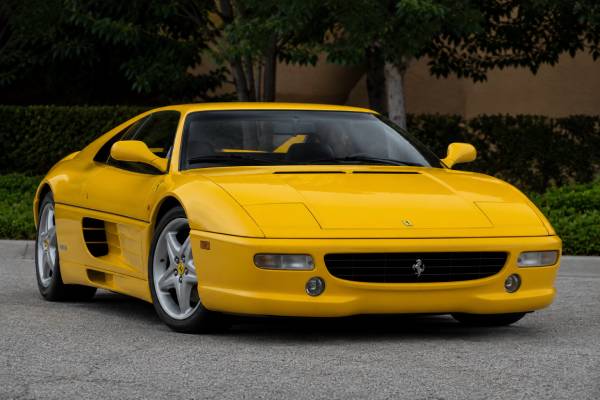
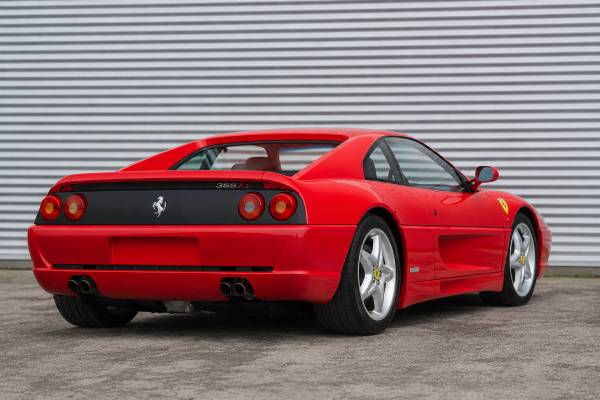
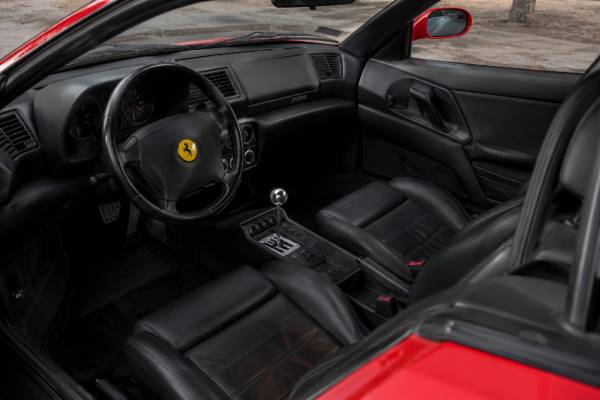
The Ferrari 355 F1 Berlinetta is the closed-roof, mid-engine V8 Ferrari that introduced paddle-shift Formula 1-style gearbox control to road-car buyers. Built from 1997 to 1999 as part of the F129 F355 family, it paired the Pininfarina-designed Berlinetta body with Ferrari’s 3.5-liter five-valve-per-cylinder V8 and an electro-hydraulic version of the six-speed manual gearbox. It was not a conventional automatic. It was a clutch-and-gearbox system operated by paddles, hydraulic actuators, and electronic control.
That makes the 355 F1 Berlinetta important for two different reasons. Enthusiasts value it for the high-revving 380 hp V8, compact size, sound, and classic Ferrari proportions. Collectors study it because it sits at a turning point: old enough to feel analog, but modern enough to preview the paddle-shift era that shaped Ferrari road cars for the next two decades.
Table of Contents
- Why the 355 F1 Berlinetta Matters
- F129 V8, Chassis, and Core Specifications
- Production, Variants, and Factory Identification
- Pininfarina Design and F1 Gearbox Engineering
- Road Feel, Sound, and Period Performance
- Maintenance Risks and Restoration Realities
- Market Values and Buying Checklist
Why the 355 F1 Berlinetta Matters
The 355 F1 Berlinetta matters because it brought Ferrari’s electro-hydraulic paddle-shift idea from racing culture into a production road car. It also preserved the compact, naturally aspirated, mid-engine V8 character that many buyers now see as a peak point between older analog Ferraris and later electronic supercars.
The F355 family replaced the Ferrari 348, a car that had strong visual drama but a mixed reputation for road manners. Ferrari’s answer was not a light facelift. The F355 was a deep rework with a new five-valve V8, revised suspension, cleaner aerodynamics, a more usable cockpit, and a more forgiving chassis. In Berlinetta form, it offered the purest shape: fixed roof, two seats, rear-mid engine layout, and no targa or convertible compromises.
The “355” name is also unusually meaningful. It points to the 3.5-liter displacement and the five valves per cylinder. Earlier Ferrari V8 names often combined displacement and cylinder count, but the F355 highlighted valve technology because that was one of the car’s defining engineering advances.
When the F1 gearbox arrived, Ferrari also adjusted the naming. Manual-shift cars were usually referred to as F355, while paddle-shift examples became 355 F1. The Berlinetta was the first body style associated with that new system before it appeared across the wider F355 range.
For collectors, the 355 F1 Berlinetta is interesting because it is both historically important and slightly misunderstood. Manual F355 Berlinettas usually command stronger money because buyers love the open-gate shifter. Yet the 355 F1 has a stronger claim to being the landmark version. It was the beginning of Ferrari’s road-car paddle-shift lineage, long before dual-clutch gearboxes made fast automated shifting feel normal.
For drivers, the appeal is simpler. It is small by modern Ferrari standards, narrow enough for older roads, low enough to feel special, and powered by one of Ferrari’s most musical V8s. It is not the fastest classic-adjacent Ferrari anymore, but the combination of size, sound, steering, throttle response, and mechanical drama still gives it a strong identity.
The 355 F1 Berlinetta also sits in an attractive historical gap. It followed the sharper-edged 348 and preceded the aluminum-bodied 360 Modena. The 360 was more spacious and modern, but the F355 kept more of the old-world Ferrari feeling: low scuttle, flying-buttress rear pillars, compact cabin, and a tightly packaged powertrain visible through the rear deck.
Its reputation today is built on three truths:
- It is one of the most beautiful modern-era V8 Ferraris.
- It introduced a major transmission idea that changed Ferrari road cars.
- It requires serious specialist maintenance, especially around belts, valve guides, headers, and F1 gearbox hardware.
That last point is important. A good 355 F1 Berlinetta can be deeply rewarding. A neglected one can turn into a very expensive education.
F129 V8, Chassis, and Core Specifications
The heart of the 355 F1 Berlinetta is its naturally aspirated 3,495.50 cc F129-series V8, rated at 279 kW, or 380 metric horsepower, at 8,250 rpm. Its character comes from revs, five-valve cylinder heads, dry-sump lubrication, and a short-stroke layout that rewards using the upper half of the tachometer.
Engine and drivetrain
| Item | Specification |
|---|---|
| Engine type | Rear-mid, longitudinal 90-degree V8 |
| Engine family | F129 B/C series |
| Displacement | 3,495.50 cc |
| Bore x stroke | 85 mm x 77 mm |
| Valvetrain | Twin overhead camshafts per bank, five valves per cylinder |
| Fuel and ignition management | Bosch Motronic M5.2 electronic control |
| Lubrication | Dry sump |
| Maximum power | 279 kW / 380 hp at 8,250 rpm |
| Maximum torque | 363 Nm / 268 lb-ft at 6,000 rpm |
| Transmission | Six-speed F1 electro-hydraulic automated manual |
| Drivetrain | Rear-wheel drive |
The engine is not a lazy torque motor. It makes useful mid-range pull, but its personality is high-revving and urgent. The five-valve cylinder heads use three intake valves and two exhaust valves per cylinder, helping breathing at high rpm. The dry-sump system helps oil control under cornering and allows a lower engine installation than a conventional wet-sump design.
The F1 transmission uses the same basic gearbox idea as the manual car but replaces the clutch pedal and shift lever with hydraulic actuation. The driver selects gears with paddles behind the steering wheel. The system opens and closes the clutch, moves the selector mechanism, and manages shift timing through electronic and hydraulic control.
This matters when buying one. A 355 F1 is not best judged like a torque-converter automatic. It should be evaluated as a manual gearbox with an automated clutch system. Clutch wear, hydraulic pressure, actuator adjustment, and correct calibration are central to how well the car drives.
Chassis, suspension, brakes, and dimensions
| Item | Specification |
|---|---|
| Body style | Two-seat fixed-roof Berlinetta coupe |
| Chassis structure | Steel monocoque with tubular steel rear sub-frame |
| Front suspension | Independent double wishbones, coil springs, dampers, anti-roll bar |
| Rear suspension | Independent double wishbones, coil springs, dampers, anti-roll bar |
| Steering | Rack and pinion with power assistance |
| Front brakes | Ventilated discs with ABS |
| Rear brakes | Ventilated discs with ABS |
| Wheels | 18 x 7.5 in front, 18 x 10 in rear |
| Tires | 225/40 ZR18 front, 265/40 ZR18 rear |
| Wheelbase | 2,451 mm |
| Length | 4,249 mm |
| Width | 1,900 mm |
| Height | 1,171 mm |
| Dry weight | About 1,350 kg |
| Fuel capacity | About 88 liters |
The F355 used electronically adjustable dampers, selected through cabin controls, to broaden the car’s road manners. This was part of Ferrari’s effort to make the car easier to use at low speed and less nervous than the 348, without removing the sharpness buyers expected from a mid-engine Ferrari.
Performance figures
| Measure | Figure |
|---|---|
| Top speed | 295 km/h / 183 mph |
| 0–100 km/h | About 4.7 seconds, depending on test conditions |
| Specific output | About 109 hp per liter |
| Redline character | High-revving, with peak power near 8,250 rpm |
The numbers were serious in the late 1990s, but the F355’s lasting appeal is not just the stopwatch. It is the way the car builds speed: intake noise rising behind the cabin, exhaust pitch hardening, and the V8 becoming more vivid as it approaches the top of the rev range.
Production, Variants, and Factory Identification
The 355 F1 Berlinetta belongs to the wider F355 family, but it is not the same buying proposition as a manual Berlinetta, GTS, Spider, or Challenge car. Its value and authenticity depend heavily on body style, gearbox originality, documentation, market specification, and whether the car still presents as a correct factory F1 example.
The main F355 road body styles were:
- Berlinetta: fixed-roof coupe, the cleanest and stiffest road body style.
- GTS: targa-style removable roof panel.
- Spider: convertible with a powered soft-top mechanism.
- Challenge: competition version used for the Ferrari Challenge series.
The F1 gearbox became available from 1997 and was offered across Berlinetta, GTS, and Spider versions. For the Berlinetta, this created a historically important sub-variant: a fixed-roof F355 with the first-generation Ferrari road-car paddle-shift system.
Production figures for F355 models are often quoted with small differences depending on whether sources separate road cars, Challenge cars, markets, and transmission types. The useful collector takeaway is simple: manual Berlinettas are more numerous than 355 F1 Berlinettas, but manuals are currently more sought after by many buyers. The 355 F1 Berlinetta is therefore rarer in transmission configuration, while the manual car is usually more valuable in today’s collector market.
Factory identification points
A correct 355 F1 Berlinetta should have details that match the F1 specification rather than a later conversion or incomplete repair history. During inspection, check:
- VIN, assembly number, and market documentation.
- Factory build record, service book, invoices, and ownership history.
- F1 transmission controls and correct interior layout.
- Gearbox, actuator, hydraulic pump, and clutch service documentation.
- Emissions equipment appropriate to the delivery market.
- Matching body panels, glass markings, and trim details where possible.
- Correct wheel size, brake specification, and suspension components.
- Evidence of accident repair around the rear sub-frame, suspension pick-up points, front structure, and door apertures.
The F1 system also affects how the car is described. Some sellers loosely call it an automatic. That is misleading. It is an automated manual. A knowledgeable seller should be able to explain clutch wear readings, pump behavior, shift quality, and recent calibration work.
Colors, trim, and options
Rosso Corsa over tan leather is the most familiar F355 combination, but it is not the only desirable one. Giallo Modena, Argento Nürburgring, Nero, Blu Tour de France, and other period colors can be very attractive when paired with the right interior and documentation.
Interior originality matters. The F355’s cabin is known for leather shrinkage, sticky switchgear, worn bolsters, and trim refinishing. A restored cabin can be acceptable, but buyers should look for careful work using correct materials and textures rather than glossy over-restoration.
Commonly discussed factory and period features include:
- Connolly leather upholstery.
- Electrically adjustable seats on some cars.
- Air conditioning.
- Factory audio equipment.
- Scuderia Ferrari shields, depending on market and configuration.
- Luggage, books, tools, tire inflator, and original accessories.
Complete accessories do not transform a poor car into a good one, but on a collector-grade 355 F1 Berlinetta, missing books, missing tool kit, incomplete service records, or unexplained mileage gaps can affect confidence and value.
Pininfarina Design and F1 Gearbox Engineering
The 355 F1 Berlinetta looks delicate compared with many modern supercars, but its shape is functional as well as beautiful. Pininfarina gave it smoother surfaces than the 348, while Ferrari used underbody airflow, cooling paths, and rear-end detailing to improve stability and engine-bay management.
The front end is low and clean, with pop-up headlights that now date the car in the best way. The side profile is defined by the air intake scallops and the flying-buttress rear pillars. At the rear, the round taillights and wide stance bring it back into classic Ferrari language after the horizontal strakes and sharper visual themes of the 348.
The Berlinetta body is the most resolved version visually. Without the Spider roof mechanism or GTS removable panel, the coupe keeps a tight roofline and strong rear-quarter shape. It also avoids some of the body-flex concerns that can come with open versions as cars age.
Aerodynamics and cooling
The F355’s body is not covered in large wings. Its aerodynamic work is more subtle. The flat underbody treatment, rear nolder lip, ducting, and side intakes all contribute to high-speed behavior and cooling. The car needs that cooling discipline because the engine, gearbox, exhaust, catalytic converters, and rear sub-frame are packed tightly into a compact rear structure.
This tight packaging has ownership consequences. Heat affects hoses, wiring, exhaust components, engine mounts, and nearby trim. A healthy F355 should have its cooling system, fans, radiators, expansion tank, and temperature behavior checked carefully. Overheating or repeated high-heat operation can turn small problems into expensive ones.
The five-valve V8 character
The F129 V8 is one of the defining features of the car. It is oversquare, meaning the bore is larger than the stroke, which helps it rev freely. The five-valve heads were advanced for the era and helped Ferrari achieve a very high specific output for a naturally aspirated road engine.
The engine also has a layered sound. At low rpm it can feel mechanical and busy. Through the middle of the rev range it becomes sharper. Near the top, it delivers the bright, metallic wail that made the F355 famous. Exhaust condition matters here. Cracked manifolds, failing bypass valves, tired catalytic converters, or poorly chosen aftermarket systems can change the sound and create reliability concerns.
How the F1 gearbox works
The F1 gearbox is the feature that separates this car from a standard F355 Berlinetta. The hardware starts with a six-speed manual gearbox and clutch. The difference is the operation. Instead of the driver moving a gated lever and pressing a clutch pedal, the car uses paddles, electronics, hydraulic pressure, and actuators.
In period, this felt dramatic and futuristic. Today, it feels slower and more mechanical than a modern dual-clutch gearbox, but that is part of its character. It shifts best when treated with mechanical sympathy. Lifting slightly during upshifts, avoiding repeated low-speed creeping, and keeping the system properly calibrated can make a major difference.
For collectors, the early F1 system is significant because it shows the first stage of a technology path that later led to faster F1 transmissions in the 360, F430, 575M, 599, and eventually to Ferrari’s dual-clutch era. The 355 F1 is the origin point, not the polished final form.
Road Feel, Sound, and Period Performance
A well-sorted 355 F1 Berlinetta feels compact, alert, and alive, with a stronger sense of mechanical involvement than most modern supercars. Its performance is still quick, but the real reward is the way the engine, steering, chassis, brakes, and gearbox ask the driver to participate.
At low speeds, the car is usable but not effortless. Visibility is better than many modern mid-engine cars because the front is low and the cabin is relatively simple. The steering has assistance, but it is not numb. The ride can be firm, especially on old tires or tired suspension, yet a properly maintained car should not crash harshly over every bump.
The engine needs revs. Below the mid-range, it is tractable enough for town use, but it does not feel like a large-displacement modern turbocharged engine. The magic happens as the tachometer climbs. The throttle response sharpens, the intake and exhaust harden, and the car begins to feel more serious.
The F1 gearbox defines the driving rhythm. In automatic-style use, it can feel clumsy by modern standards. In manual paddle mode, driven with timing and sympathy, it becomes more convincing. The driver learns to anticipate the shift, ease the throttle slightly, and let the mechanism do its work. It is involving, but in a different way from a gated manual.
Steering and cornering balance
The chassis is one of the reasons the F355 repaired Ferrari’s mid-engine V8 reputation after the 348. It is more settled, more communicative, and more confidence-inspiring. The rear-mid engine layout still demands respect, especially on old tires or damp roads, but the car is not famous for being vicious when properly aligned and maintained.
Tires make a huge difference. A 355 F1 Berlinetta on old, hardened rubber may feel nervous, noisy, and short of grip. On correct modern performance tires with a proper alignment, it feels more fluid and more precise. Suspension bushings, ball joints, dampers, and engine mounts also affect the driving experience more than many buyers expect.
Braking and road use
The brakes are conventional steel discs with ABS, not carbon-ceramics. That is good news for usability and cost, but condition matters. The pedal should feel firm and progressive. Vibration, pulling, weak bite, or long pedal travel can point to warped discs, old fluid, sticking calipers, worn pads, or aged flexible hoses.
On a mountain road, the car is at its best when it is warmed through and driven smoothly. The engine likes clean inputs. The gearbox likes deliberate timing. The chassis likes a driver who does not abruptly lift mid-corner. It rewards rhythm rather than brute force.
On highways, the F355 is more refined than its reputation may suggest, but it remains a 1990s Ferrari. There is road noise, mechanical noise, cabin heat on some examples, and limited storage. It can tour, but it is not a modern grand tourer.
Maintenance Risks and Restoration Realities
The 355 F1 Berlinetta is a specialist-maintenance Ferrari, not a normal used sports car. The difference between a cherished example and a deferred-maintenance example can be tens of thousands in engine, gearbox, exhaust, suspension, and cosmetic work.
The most famous maintenance item is the timing-belt service. F355 belt work is commonly associated with engine-out major service. Service schedules and specialist practice vary by market and documentation, but buyers should treat belt age, not just mileage, as critical. A low-mileage car with old belts is not “safe” because it has not been driven much.
A proper major service is not just belts. It may include tensioners, accessory belts, cam seals, fluids, water pump inspection, hoses, engine mounts, fuel lines, valve-cover gaskets, spark plugs, filters, and “while you are in there” work. Cheap major-service invoices are worth reading carefully, because they may not include the items a buyer assumes were done.
Common F355 issues to inspect
| Area | Why it matters |
|---|---|
| Timing belts and tensioners | Age-sensitive service item; neglected belts can cause catastrophic engine damage. |
| Valve guides | Wear can cause oil consumption, smoking, poor compression, and expensive cylinder-head work. |
| Exhaust manifolds | Cracks are common and can damage nearby components if ignored. |
| F1 clutch system | Clutch wear, actuator setup, pump health, and calibration affect drivability and cost. |
| Hydraulic F1 hardware | Pump, accumulator, actuator, relay, and sensors can cause poor shifting or failure to select gears. |
| Cooling system | Radiators, fans, hoses, expansion tanks, and thermostats must control heat in a tight engine bay. |
| Suspension dampers | Electronically controlled dampers and actuators can be costly if leaking or inoperative. |
| Interior trim | Sticky plastics, shrinking leather, worn bolsters, and cracked switch panels affect value. |
| Fuel-system recalls | Recall completion and fuel-line condition should be verified, especially on U.S.-market cars. |
Valve guides deserve special attention. Some F355 engines developed guide wear, and the only reliable way to assess engine health is through records, leak-down and compression testing, oil-consumption history, borescope inspection where appropriate, and cold-start observation. A shiny engine bay is not enough.
Exhaust manifolds are another major concern. Factory manifolds can crack, creating ticking noises, heat issues, and possible damage to catalytic converters or valves if ignored. Many cars have replacement or upgraded manifolds. That is not automatically bad, but the work should be documented and emissions legality should match the buyer’s location.
The F1 system is often unfairly blamed for every drivability issue. In reality, a well-set-up system can work well, but it needs correct maintenance. Buyers should ask for:
- Recent clutch wear reading.
- Records for clutch replacement or setup.
- Evidence of F1 pump, relay, accumulator, or actuator work if performed.
- Smooth gear engagement from cold and hot.
- No warning lights or selection faults.
- Correct reverse engagement.
- Clean shifts during light, medium, and hard throttle.
Avoid cars that cannot be test-driven properly or whose sellers dismiss warning lights as “normal Ferrari stuff.” Some quirks are normal. Faults are not.
Restoration and originality
The F355 is new enough that many cars are still used, but old enough that restoration issues are real. Paintwork, leather, dashboard shrinkage, sticky plastics, wheel refurbishment, suspension rebuilds, and engine-bay detailing can all affect value.
Originality is not always simple. Some upgrades improve usability and reliability, such as better exhaust manifolds, improved fuel hoses, updated sticky interior refinishing, or modern tires. But modifications should be reversible, documented, and tasteful. A buyer looking for a collector-grade 355 F1 Berlinetta should be cautious with loud exhausts, non-factory wheels, missing emissions equipment, poorly retrimmed cabins, and manual-converted F1 cars.
Manual conversions are a special case. Because manual F355s are worth more, some F1 cars have been converted. A well-executed conversion may be enjoyable, but it is no longer a correct 355 F1 Berlinetta. For a collector who wants the first-generation paddle-shift milestone, originality matters.
Market Values and Buying Checklist
The 355 F1 Berlinetta currently sits below manual Berlinettas in most collector pricing, but above neglected or poorly documented cars from less desirable body and condition categories. It is a historically important Ferrari that can still be bought for less than many manual F355 coupes, which makes condition and documentation especially important.
Market data in 2026 shows a clear pattern: manual F355 Berlinettas tend to command a premium, while F1 Berlinettas are valued more cautiously. That does not mean the F1 car is undesirable. It means today’s market rewards the traditional gated-shifter experience, even though the 355 F1 is the more important gearbox milestone.
For buyers, this creates an opportunity and a trap. A good 355 F1 Berlinetta can offer a serious Ferrari experience and real historical significance at a lower entry point than a comparable manual. A cheap one, however, may only be cheap until the first major service, clutch job, manifold repair, valve-guide diagnosis, or interior restoration.
What drives value
The strongest cars usually have:
- Low to moderate verified mileage.
- Complete service records with no long gaps.
- Recent major service from a known Ferrari specialist.
- Documented clutch health and F1 system work.
- Original colors and factory-correct trim.
- Clean accident history.
- Complete books, tools, accessories, and ownership file.
- Correct wheels, exhaust layout, emissions equipment, and interior details.
- No unresolved warning lights.
- Strong compression and leak-down results.
- Evidence that recalls and safety campaigns were completed where applicable.
Mileage matters, but it is not everything. A 10,000-mile car with old belts, sticky interior, failing manifolds, and unclear clutch data can be worse to buy than a 30,000-mile car with excellent maintenance and transparent records.
Buyer inspection checklist
Before purchase, arrange a pre-purchase inspection with a Ferrari specialist familiar with F355 and 355 F1 systems. The inspection should include:
- Confirm VIN, market specification, build data, and title history.
- Review service records for belt age, major-service scope, clutch work, and recall completion.
- Perform compression and leak-down testing.
- Inspect exhaust manifolds, catalytic converters, bypass valve, and exhaust ECUs.
- Check F1 clutch wear, actuator operation, pump cycling, warning lights, and calibration.
- Inspect cooling system, radiator condition, hoses, fans, and temperature behavior.
- Check suspension dampers, actuators, bushings, ball joints, steering, and alignment evidence.
- Inspect brakes, tires, wheel condition, and tire age.
- Look for accident repair, panel mismatch, paintwork, corrosion, and underbody damage.
- Test all electrical systems, HVAC, windows, lights, instruments, and interior switches.
The test drive should include cold start, warm idle, low-speed maneuvering, normal shifts, harder acceleration, braking, and hot restart. A car that only behaves when cold, only shifts well under light throttle, or shows temperature problems in traffic needs further diagnosis.
Examples to seek and avoid
Seek a car that has been used enough to stay healthy but maintained like a collector vehicle. The ideal 355 F1 Berlinetta is original, documented, recently serviced, mechanically sharp, and cosmetically honest. It should not need excuses.
Be careful with cars that have:
- Missing service books or unexplained record gaps.
- Old belt service despite low mileage.
- No clutch wear data.
- Sticky or delayed F1 shifts.
- Smoke on start-up or overrun.
- Ticking exhaust manifolds.
- Overheating in traffic.
- Non-original wiring, alarm, or audio work.
- Poorly refinished interior trim.
- Accident repair around structural areas.
- Seller resistance to specialist inspection.
The long-term collectability of the 355 F1 Berlinetta should be good, but selective. It has the right ingredients: Pininfarina design, naturally aspirated V8, limited late-1990s production window, and first-road-car F1 gearbox significance. The market may continue to prize manuals more highly, but the best original F1 Berlinettas have a story that manual cars do not.
For the right buyer, that is the appeal. The 355 F1 Berlinetta is not merely a less-expensive alternative to a gated F355. It is a landmark Ferrari in its own right, with a sound, shape, and technology story that still feel special nearly three decades later.
References
- Ferrari 355 F1 Berlinetta (1997) 1997 (Manufacturer Specifications)
- Ferrari F355 Berlinetta (1994) – Ferrari.com 1994 (Manufacturer Specifications)
- Ferrari F355 Challenge (1995) – Ferrari.com 1995 (Manufacturer Specifications)
- Vehicle Detail Search – 1998 FERRARI 355 F1 | NHTSA 2026 (Recall Database)
- Ferrari F355 Market – CLASSIC.COM 2026 (Market Data)
Disclaimer
This article is for informational purposes only and is not a substitute for professional diagnosis, repair, valuation, or inspection. Specifications, torque values, service intervals, recall applicability, and procedures can vary by VIN, market, model year, equipment, and prior repair history. Always verify details against official Ferrari service documentation and have any car inspected by a qualified Ferrari specialist before purchase or major work.
If you found this guide useful, please consider sharing it on Facebook, X/Twitter, or your favorite car community to support our work.