


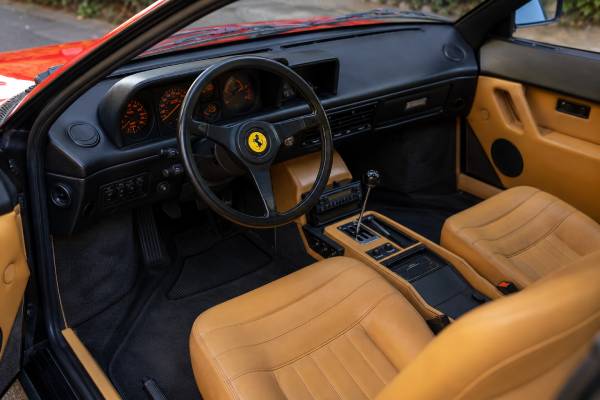
The Ferrari Mondial 8 is the first version of Ferrari’s long-running Mondial line and one of the most unusual V8 Ferraris of the early 1980s. Built from 1980 to 1982, it used the F106B 2.9-liter transverse mid-mounted V8 with Bosch K-Jetronic fuel injection, a five-speed gated manual gearbox, and a longer 2+2 body designed by Pininfarina. It replaced the wedge-shaped Dino/Ferrari 308 GT4 as Ferrari’s practical mid-engine family grand tourer, while keeping a strong link to the 308 GTBi and GTSi through its powertrain and chassis ideas. The Mondial 8 has often been judged harshly for its modest acceleration, but that reputation is only part of the story. Today it matters because it remains a rare, usable, mechanically interesting Ferrari with real collector appeal when bought carefully.
Table of Contents
- Why the Mondial 8 Matters
- F106B V8 Specs and Chassis Data
- Production Numbers, Variants, and Authenticity
- Pininfarina 2+2 Design and Engineering
- Road Character, Speed, and Usability
- Maintenance Risks and Restoration Costs
- Market Values and Buying Checks
Why the Mondial 8 Matters
The Mondial 8 matters because it was Ferrari’s attempt to make a mid-engine V8 car more usable without turning it into a conventional front-engine grand tourer. It kept the drama of a transverse V8 behind the cabin, but added a longer wheelbase, four-seat packaging, better everyday access, and a more mature touring character.
Ferrari introduced the Mondial 8 at the start of a difficult era for performance cars. Emissions rules, fuel injection, safety requirements, and changing buyer expectations were reshaping the market. The hard-edged carbureted Ferrari 308s of the 1970s were giving way to cleaner, more regulated cars. The Mondial 8 sat right in that transition.
It replaced the 308 GT4, a Bertone-designed 2+2 that had originally carried Dino branding before becoming a Ferrari. The Mondial moved the idea forward with Pininfarina styling, a more spacious cabin, improved entry and exit, and a chassis designed around a longer 2,650 mm wheelbase. It was not meant to be a stripped sports car. It was meant to be the Ferrari a buyer could use for weekends, trips, city driving, and occasional rear-seat passengers.
The name also carried history. Ferrari had used “Mondial” in the 1950s on racing cars, and the word means “world” or “global.” For the 1980 road car, the name suited Ferrari’s goal: a model designed for wider international markets, including regions with strict safety and emissions rules.
The first Mondial has a mixed reputation today. Critics often focus on the 214 hp output and the relatively heavy body. Those points are fair. The Mondial 8 is not quick by modern standards, and even in period it was softer than many expected from Ferrari. But collectors now look at it with more nuance. It is rare, mechanically related to the 308 family, visually distinct, and usually less expensive than Ferrari’s two-seat V8 cars.
The important ownership question is not whether the Mondial 8 is the fastest Ferrari of its period. It is not. The better question is whether a specific car is original, well documented, properly serviced, corrosion-free, and enjoyable at real-road speeds. A good Mondial 8 can be a charming classic Ferrari. A neglected one can quickly become an expensive restoration project.
For enthusiasts, the car is also historically important because it began Ferrari’s last line of mid-engine V8 2+2 cars. Later Mondials became more powerful, especially the Quattrovalvole, 3.2, and Mondial t. But the Mondial 8 is the first chapter: the cleanest early shape, the two-valve injected V8, and the purest expression of Ferrari’s early-1980s practical mid-engine idea.
F106B V8 Specs and Chassis Data
The Mondial 8 uses the F106B 2,926.90 cc V8, a naturally aspirated, 90-degree, two-valve-per-cylinder engine related to the unit in the 308 GTBi and GTSi. Its key numbers are 157 kW, commonly quoted as 214 metric horsepower, at 6,600 rpm and 243 Nm of torque at 4,600 rpm.
| Item | Specification |
|---|---|
| Model | Ferrari Mondial 8 |
| Chassis type | F 108 AL 100 tubular steel chassis |
| Production years | 1980–1982 |
| Body style | 2+2 coupé |
| Engine code | F106B |
| Engine layout | Rear-mid transverse 90-degree V8 |
| Displacement | 2,926.90 cc |
| Bore x stroke | 81 mm x 71 mm |
| Valve gear | Double overhead camshafts per bank, two valves per cylinder |
| Fuel system | Bosch K-Jetronic mechanical fuel injection |
| Compression ratio | 8.8:1 |
| Maximum power | 157 kW / 214 hp at 6,600 rpm |
| Maximum torque | 243 Nm at 4,600 rpm |
| Transmission | Five-speed manual with gated shift |
| Drive | Rear-wheel drive |
The engine is mounted transversely behind the cabin with the gearbox below and alongside it in the familiar Ferrari V8 layout of the period. This packaging helped keep the car compact enough to feel like a sports car, while the extended wheelbase made space for small rear seats.
The Bosch K-Jetronic system is central to the Mondial 8’s character. It improved emissions control and drivability compared with earlier carbureted engines, but it also softened the top-end feel. The two-valve cylinder heads and emissions-era tuning mean the engine does not have the urgency of the later four-valve Mondial Quattrovalvole.
| Area | Ferrari Mondial 8 data |
|---|---|
| Length | 4,580 mm |
| Width | 1,790 mm |
| Height | 1,250 mm |
| Wheelbase | 2,650 mm |
| Front track | 1,495 mm |
| Rear track | 1,517 mm |
| Weight | About 1,445 kg, depending on specification and source basis |
| Fuel capacity | 84 liters |
| Tyres | 240/55 VR 390 front and rear |
| Suspension | Independent front and rear with unequal-length wishbones, coil springs, telescopic dampers, and anti-roll bars |
| Brakes | Ventilated discs front and rear |
| Steering | Rack and pinion |
| Top speed | 230 km/h |
| Standing 400 m | About 15 seconds |
| Standing 1,000 m | About 28 seconds |
The chassis specification is more serious than the car’s reputation suggests. The tubular steel frame, independent suspension, ventilated discs, mid-engine layout, and five-speed manual gearbox are all proper Ferrari hardware. What holds the Mondial 8 back is not basic engineering quality. It is the combination of added weight, emissions-era tuning, long gearing, and the broader brief of a comfortable 2+2.
Production Numbers, Variants, and Authenticity
The Mondial 8 was a short-lived early variant, with roughly 703 coupés built before Ferrari replaced it with the more powerful Mondial Quattrovalvole. That low production number is one reason collectors are now paying closer attention to correct, well-preserved cars.
Unlike later Mondials, the Mondial 8 was only offered as a coupé. The cabriolet body style arrived with the Quattrovalvole generation. This makes identification fairly straightforward at first glance: an early Pininfarina 2+2 coupé, two-valve injected V8, metric wheels, and period interior details.
How the Mondial 8 fits into the model line
The Mondial family can be understood in four main phases:
| Version | Years | Main change |
|---|---|---|
| Mondial 8 | 1980–1982 | Original two-valve injected 2.9-liter V8 coupé |
| Mondial Quattrovalvole | 1982–1985 | Four-valve heads and stronger performance |
| Mondial 3.2 | 1985–1988 | Larger 3.2-liter V8 and updated details |
| Mondial t | 1988–1993 | Longitudinal engine, transverse gearbox, 3.4-liter V8, major chassis revisions |
The Mondial 8 is therefore the least powerful but also the earliest and rarest closed chapter of the line. Some buyers prefer later cars because they are faster and more developed. Others prefer the Mondial 8 because it has the clean early shape and direct link to the 308 GTBi-era drivetrain.
Identification and documentation
For a collector-grade Mondial 8, the paperwork matters almost as much as the paint and leather. A serious buyer should look for:
- A clear chassis number and engine number recorded in invoices or inspection notes.
- Evidence that the car is a genuine Mondial 8 rather than a later model described loosely.
- Original books, tools, jack kit, pouch, and service records where available.
- Long-term ownership history with dated maintenance invoices.
- Market-specific paperwork, especially for U.S., European, and right-hand-drive cars.
- Ferrari specialist inspection notes showing compression, leak-down, corrosion condition, and fuel-injection setup.
Matching-numbers status can influence desirability, but condition still comes first. A highly original car with its correct engine, gearbox, colors, interior, and documentation will usually be more attractive than a modified car with missing history. However, a mechanically excellent car with honest cosmetic wear may be a better driver than a shiny car with no records.
Options, colors, and originality
The Mondial 8 was not a modern options-heavy Ferrari in the way later supercars became. Buyers mainly considered exterior color, interior trim, market equipment, wheels, air conditioning, audio equipment, and small trim details. Rosso Corsa over tan is the familiar classic Ferrari combination, but subtler period colors can be very appealing on the Mondial shape.
Originality questions should focus on:
- Correct metric wheels and tyre type or documented changes to modern wheel packages.
- Correct seats, dashboard, steering wheel, switchgear, and instruments.
- Factory-style exhaust routing rather than crude aftermarket systems.
- Paint thickness and evidence of accident repairs.
- Correct exterior badging and lighting for the market.
- Whether any upgrades are reversible.
Many Mondials were once inexpensive by Ferrari standards, so some received low-budget repairs. That history is the main reason authenticity checks are important. The cheapest car to buy is rarely the cheapest car to own.
Pininfarina 2+2 Design and Engineering
The Mondial 8’s design is best understood as packaging-led Pininfarina work: it had to look like a Ferrari, hold four people in a mid-engine layout, meet global rules, and remain usable. The result is longer, taller, and more restrained than a 308 GTB, but it is also more practical and more distinctive.
The body was built around a simple visual idea. The nose is low, the cabin is moved forward, the side intake treatment feeds the rear-mounted V8, and the roofline stretches rearward to create space for the back seats. It is not as instantly dramatic as a Berlinetta Boxer or 308 GTB, but the proportions make sense once the 2+2 purpose is understood.
Packaging and cabin layout
The longer wheelbase is the key engineering choice. At 2,650 mm, it gave Ferrari enough room to place small rear seats ahead of the engine bay. These seats are not spacious by normal car standards, but they make the Mondial more flexible than a two-seat Ferrari. They can carry children, small adults for short trips, luggage, jackets, or travel bags.
The cabin is upright enough to feel more relaxed than a low two-seat sports car. Visibility is good for a mid-engine exotic of the period, and the doors are large enough to make entry easier. The driving position still feels classic Ferrari: low scuttle, gated shifter, clear instruments, and a sense that the engine is part of the cabin experience.
Cooling, access, and service thinking
A practical benefit of the Mondial layout is service access. The rear deck and engine bay packaging are friendlier than many mid-engine exotics. Access is still tight by normal standards, but the Mondial was designed with maintenance in mind. That does not make it cheap to maintain, but it does make routine work less punishing than on some more exotic layouts.
Cooling is a major part of the design. The side intakes, rear bay ventilation, front radiator layout, coolant pipes, and electric fans all need to work correctly. A Mondial 8 with a neglected cooling system can overheat or run poorly in traffic, especially in warm climates. A sorted car should be stable, but only if the radiator, thermostat, hoses, expansion tank, fans, and wiring are in good order.
Sound and sensory character
The Mondial 8 does not have the sharpest Ferrari V8 soundtrack, but it still has real character. The flat-plane-crank-style Ferrari V8 note, intake texture, mechanical valvetrain sound, and gated manual all help create a classic feel. The sound is smoother and more muted than many carbureted 1970s Ferraris, partly because of fuel injection and emissions equipment.
This is why exhaust modifications are common. A good stainless system can make the car more engaging, but buyers should be careful. Loud does not always mean better. Poorly designed exhausts can drone, upset originality, or hide mixture and running problems. For collector value, a reversible system and retained original parts are preferable.
Road Character, Speed, and Usability
The Mondial 8 drives like a classic Ferrari grand tourer rather than a razor-edged supercar. Its steering, balance, seating position, and manual gearbox are the main pleasures; outright acceleration is the weak point.
The engine likes revs, but it does not deliver big torque low down. Around town, the car can feel heavier and softer than its mid-engine layout suggests. Once warm and moving, it becomes more satisfying. The chassis has good balance, the steering has natural feedback, and the ride is more forgiving than many people expect.
Acceleration and power delivery
Period performance varies by test method, market specification, and condition, but the Mondial 8 is generally an eight-second-range 0–60 mph car rather than a six-second sports car. It can reach a claimed 230 km/h, yet it is not the kind of Ferrari that feels explosively fast from low rpm.
The power delivery is progressive. Below the midrange, it is smooth but not urgent. Above that, the engine feels more alive, especially when the fuel injection, ignition, valve clearances, and exhaust are correctly set up. A tired Mondial 8 can feel flat and disappointing. A properly tuned one feels much more alert, even if the stopwatch still shows modest numbers.
Gearbox and controls
The five-speed gated manual is central to the experience. Like many Ferraris of the period, second gear can feel stiff when cold. Rushing the shift before the oil warms up is a bad habit. A patient driver who lets the gearbox come up to temperature will usually enjoy a precise, mechanical shift.
The clutch should be firm but not unpleasant. A very heavy pedal, dragging engagement, gear crunching, or baulking when warm can indicate clutch, linkage, synchro, or adjustment issues. These are not small concerns on a classic Ferrari, so any test drive should include cold behavior and fully warm operation.
Steering, brakes, and ride
The steering is one of the Mondial 8’s best features. It has proper road feel and a natural build-up of effort. At parking speeds it requires some muscle, but on the move it becomes fluid and accurate. The longer wheelbase also gives the car a calm high-speed personality.
The ventilated disc brakes are adequate when the system is fresh. They do not feel like modern carbon-ceramic brakes, and they should not be judged that way. A good car should stop straight, with a firm pedal and no pulling, vibration, or sinking pedal. Old hoses, tired calipers, contaminated fluid, and worn suspension bushings can make the brakes feel much worse than they should.
The ride is relatively compliant for a Ferrari. That is part of the Mondial’s appeal. It can handle rougher roads and longer trips better than many low, stiff sports cars. Tyres matter greatly, especially because the original metric tyre size limits choices. Some owners move to alternative wheel packages for better modern tyre availability, but originality-minded buyers often prefer the factory setup.
Everyday use
The Mondial 8 is more usable than its reputation suggests. It has reasonable visibility, cabin space for two adults and luggage, occasional rear seats, and a less intimidating driving character than many classic exotics. The drawbacks are also real: cabin heat, old air-conditioning performance, heavy low-speed steering, expensive parts, and the need for warm-up sympathy.
A buyer who expects modern speed and convenience may be disappointed. A buyer who wants a classic Ferrari with real mechanical feel and some touring practicality may find the Mondial 8 surprisingly rewarding.
Maintenance Risks and Restoration Costs
The Mondial 8 is not difficult because it is badly engineered; it is difficult because it is an aging mid-engine Ferrari with complex period systems, expensive parts, and many examples that were once maintained on tight budgets. A pre-purchase inspection by a Ferrari specialist is not optional.
The engine itself can be durable when serviced properly. The risks come from deferred belt service, neglected cooling systems, fuel-injection faults, weak ignition components, oil leaks, old rubber, corroded wiring connections, and poor previous repairs.
Engine and belt service
The timing belts are one of the first ownership checks. A car with unknown belt age should be treated as due immediately, regardless of mileage. Belt service should also include tensioners, related seals, inspection of cam timing, and a general look at hoses, coolant pipes, accessory belts, and oil leaks.
Important engine checks include:
- Compression and leak-down test results.
- Evidence of regular timing belt service.
- Valve-clearance history where available.
- Oil leaks from cam seals, distributors, sump, and gearbox areas.
- Correct cold start, warm idle, and hot restart behavior.
- No fuel smell from old hoses or injection components.
- No overheating in traffic or after a spirited drive.
The Bosch K-Jetronic system rewards correct diagnosis. Random parts replacement can become expensive. A specialist should check fuel pressures, warm-up behavior, injector spray, vacuum leaks, air-metering plate movement, and mixture setup.
Cooling, electrical, and fuel systems
Cooling-system condition is a major buying factor. Old hoses, weak fans, clogged radiators, faulty thermostats, tired expansion tanks, and poor grounds can create problems. The car should hold temperature at idle, in traffic, and after a hot shutdown.
The electrical system is another age-related concern. Fuse boxes, relays, connectors, window motors, slow fans, lighting faults, and poor earths are common on old Italian exotics. Electrical issues are not always catastrophic, but tracing them can consume many labor hours.
Fuel-system safety deserves special attention. Rubber fuel hoses age, and the engine is behind the cabin. Any smell of fuel, damp hose, cracked line, or poor clamp should be treated seriously. A careful owner replaces old fuel hoses proactively.
Chassis, corrosion, and body
The Mondial 8 has a steel body and tubular steel structure, so corrosion inspection is essential. Buyers should look beyond shiny paint. Rust can hide in lower body sections, wheel arches, sills, door bottoms, suspension pickup areas, underbody seams, front compartments, and around repaired accident damage.
Accident repair is another major concern. A poorly repaired tubular chassis can ruin the way the car drives and reduce collector value. Check panel gaps, headlamp alignment, door fit, suspension geometry, welding quality, and paint thickness. A Ferrari body repair done properly is expensive; a cheap repair can be worse than visible cosmetic wear.
Interior and trim
The cabin can be costly to restore correctly. Leather shrinkage, cracked dashboards, sticky or faded switchgear, damaged seat bolsters, sagging headliners, weak air conditioning, and non-original stereos are common. Some wear is acceptable on a driver-quality car. Missing or incorrect trim is more troubling because parts can be hard to source.
A high-quality interior restoration can improve enjoyment and value, but over-restoration can erase originality. Collectors usually prefer a preserved original cabin with honest patina over a poorly retrimmed one in incorrect materials.
Known recall-related checks
U.S. recall records list front wheel bearing and steering-related campaigns affecting some early Mondial 8 cars. Because many examples have crossed borders or changed hands several times, buyers should verify campaign completion through paperwork, dealer records, or inspection of the relevant parts. Even when a recall is decades old, the underlying areas still matter: front hub condition, wheel-bearing noise, steering play, corrosion, and correct hardware.
Market Values and Buying Checks
The Mondial 8 remains one of the more affordable classic Ferraris, but that does not make it a cheap car. Current market data places many usable examples in the lower-to-mid classic Ferrari range, while exceptional cars with strong originality, records, and condition can sit higher.
Recent market guides and auction trackers show the Mondial 8 generally below later Mondial t cars and below many two-seat 308 models. That makes sense. Later Mondials are faster, and the 308 GTB/GTS shape has broader collector demand. But the early Mondial’s low production, Pininfarina design, and Ferrari V8 hardware give it a firmer collector base than it had when these cars were simply inexpensive used exotics.
The best buying strategy is to pay more for the right car. A cheap Mondial 8 with missing records, old belts, weak paint, tired suspension, poor interior, electrical issues, and unknown fuel hoses can easily cost more than a sorted car after only one year of ownership.
| Value factor | Why it matters |
|---|---|
| Service history | Shows whether expensive belt, cooling, fuel, brake, and suspension work has been done |
| Originality | Correct wheels, trim, colors, engine, gearbox, and documents support collector appeal |
| Body condition | Rust and accident damage are costly and can reduce long-term value |
| Mechanical tune | A properly set-up F106B feels much better than a neglected one |
| Interior condition | Correct leather, dashboard, switches, and instruments are expensive to restore |
| Color and market specification | Desirable colors and clear market history can improve buyer confidence |
| Tools, books, and records | Small items can be costly to replace and help prove careful ownership |
Pre-purchase inspection checklist
A serious inspection should include:
- Chassis number, engine number, gearbox number, and paperwork consistency.
- Timing belt age, tensioner history, and related service invoices.
- Compression and leak-down testing.
- Fuel-injection pressure and mixture checks.
- Cooling-system pressure test and fan operation.
- Oil leaks from engine, gearbox, cam seals, and driveshaft areas.
- Gearbox behavior cold and warm, especially second gear.
- Clutch bite point, pedal effort, and slip under load.
- Brake pedal feel, caliper condition, hoses, discs, and fluid age.
- Suspension bushings, ball joints, dampers, wheel bearings, and alignment.
- Steering play, rack condition, column joints, and recall-related hardware.
- Corrosion inspection on sills, arches, floors, suspension points, and repaired areas.
- Paint-depth readings and accident repair signs.
- Interior trim, instruments, windows, fans, air conditioning, and lights.
- Tyre age, wheel condition, and whether metric tyre replacements are available.
Cars to seek
The best Mondial 8 is not necessarily the lowest-mileage car. It is the car that has been used enough to stay healthy, serviced enough to be trustworthy, and preserved enough to remain authentic. A strong example will start cleanly, idle properly, hold temperature, shift well when warm, brake straight, track correctly, and come with a thick folder of records.
Look for cars with:
- Specialist maintenance within recent years.
- Recent belt service with supporting invoice.
- Fresh fuel hoses and cooling-system attention.
- Original books, tools, and documented ownership.
- Good panel fit and no hidden corrosion.
- A clean, usable interior rather than a neglected or over-restored one.
Cars to avoid
Avoid any Mondial 8 sold as a bargain without proof of maintenance. Also be careful with cars that have been standing for years. Low mileage can sound attractive, but long storage often means stale fuel, seized brakes, leaking seals, dead electrics, old tyres, weak cooling, and dried rubber.
Warning signs include:
- No record of timing belt service.
- Fuel smell in or around the engine bay.
- Overheating during inspection.
- Heavy smoke, misfire, or uneven idle.
- Crunching gearbox when warm.
- Severe interior shrinkage and missing trim.
- Fresh paint with poor documentation.
- Rust near structural areas.
- Cheap aftermarket modifications with no original parts retained.
- Seller unwillingness to allow a specialist inspection.
The Mondial 8 is still undervalued compared with many classic Ferraris, but the gap has narrowed for good cars. Long-term collectability should be strongest for original, documented, mechanically sorted examples in attractive colors. Driver-quality cars will remain appealing if they are honest and safe. Project cars should only be bought by people who understand Ferrari restoration costs.
References
- Ferrari Mondial 8 (1980) – Ferrari.com 1980 (Manufacturer Model Archive) ([Ferrari][1])
- Ferrari Mondial – 8 Market 2026 (Market Data) ([Classic.com][2])
- Price Guide: Ferrari Mondial 8 [UPDATED 2026] 2026 (Market Data) ([The Classic Valuer][3])
- FERRARI MONDIAL 8 1982 SUSPENSION:FRONT:WHEEL BEARING Recall NHTSA Campaign ID Number: 85V004000 | Justia 1985 (Recall Database) ([auto-recalls.justia.com][4])
- FERRARI MONDIAL 8 1982 STEERING: STEERING WHEEL/HANDLE BAR Recall NHTSA Campaign ID Number: 85V005000 | Justia 1985 (Recall Database) ([auto-recalls.justia.com][5])
Disclaimer
This article is for informational purposes only and is not a substitute for professional diagnosis, inspection, repair, or restoration advice. Specifications, torque values, service intervals, recall status, and procedures can vary by VIN, market, equipment, prior repairs, and factory updates. Always verify details against the official service documentation for the specific vehicle and consult a qualified Ferrari specialist before buying or repairing a Mondial 8.
If you found this guide useful, please share it on Facebook, X/Twitter, or your favorite car community to support our work.