

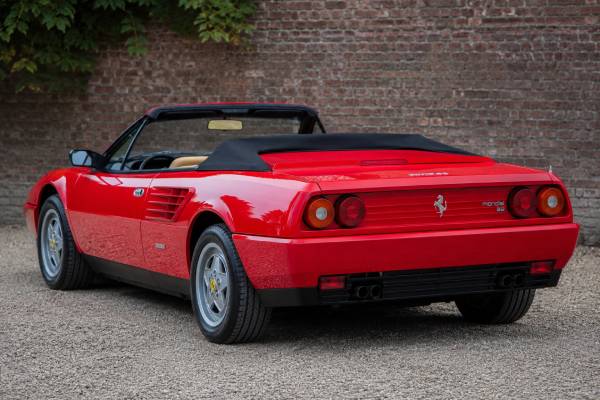
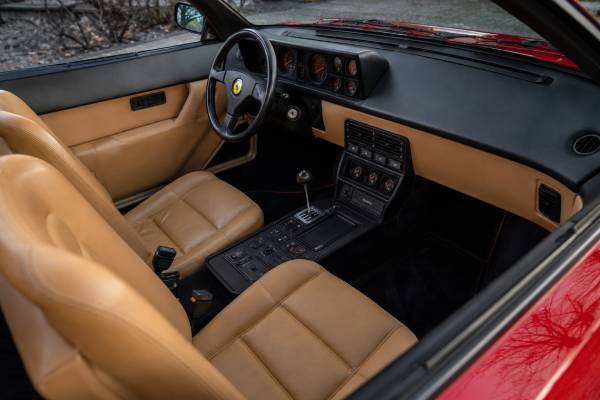
The Ferrari 3.2 Mondial Cabriolet is the open four-seat version of Ferrari’s mid-engined V8 grand tourer, powered by the F105C 3.2-liter quattrovalvole engine. Introduced for 1985 and built in limited numbers, it sits between the earlier Mondial QV Cabriolet and the later Mondial t Cabriolet. For many buyers, it is one of the most usable classic Ferraris: a manual-gated, transverse V8 Ferrari with a proper folding roof, small rear seats, a usable luggage compartment, and service access that is friendlier than the later Mondial t. It is not as sharp or as valuable as a 328 GTS, but that is part of its appeal. The 3.2 Cabriolet offers much of the same engine character in a rarer, more practical, more relaxed package. Today it matters because condition, documentation, originality, and specialist maintenance can separate a rewarding collector car from a costly restoration project.
Table of Contents
- Why the 3.2 Mondial Cabriolet Matters
- F105C Engine, Chassis, and Key Specs
- Production, Identity, and Factory Configuration
- Pininfarina Design and Mid-Engine Packaging
- Road Feel, Performance, and Cabriolet Character
- Maintenance Risks and Restoration Reality
- Market Values and Buying Checklist
Why the 3.2 Mondial Cabriolet Matters
The Ferrari 3.2 Mondial Cabriolet matters because it combines several things Ferrari rarely put together: a mid-mounted V8, a manual gearbox, four-seat packaging, and a full convertible roof. It is a more mature and more usable Ferrari than its old reputation suggests, especially in 3.2-liter form.
The Mondial line replaced the Bertone-styled 308 GT4 and carried Ferrari’s idea of a practical V8 grand tourer into the 1980s. The original Mondial 8 was not loved for its performance, but Ferrari improved the model steadily. The Quattrovalvole engine made it livelier, and the 3.2 version brought the biggest step before the completely reworked Mondial t.
The 3.2 Cabriolet arrived during an important period for Ferrari’s road cars. The company was refining its V8 formula, and the closely related 328 GTB and GTS became some of the most respected entry points into classic Ferrari ownership. The Mondial 3.2 shared much of that mechanical character, but it was aimed at a different buyer. It was for someone who wanted a Ferrari that could take a passenger, a weekend bag, and perhaps two children, while still delivering the sound and feel of a mid-engined Maranello V8.
The Cabriolet body style is central to its appeal. A mid-engined four-seat convertible is an unusual layout, and in regular-production Ferrari history the Mondial Cabriolet remains one of the most distinctive examples. It is not a stretched luxury convertible in the usual sense. The engine sits behind the cabin, the steering is unassisted, the gearbox is a gated five-speed, and the driving position still feels very much like a 1980s Italian sports car.
The 3.2 version is often considered the sweet spot of the Mondial family. Compared with the earlier Mondial 8 and QV, it has more power, better bumpers, a cleaner interior, and stronger overall performance. Compared with the later Mondial t, it is mechanically simpler in one important way: the engine and gearbox arrangement is closer to the 308/328 family, and major belt service does not require the same level of engine-out complexity associated with the t.
Collectability is also shaped by numbers. Ferrari built only 810 examples of the 3.2 Mondial Cabriolet. That is not ultra-rare by hand-built Ferrari standards, but it is scarce enough that excellent, original cars are not easy to replace. Many examples have been used, neglected, modified, or maintained on tight budgets because the model spent years as one of the more affordable classic Ferraris. That history now makes the best cars more desirable.
The car’s reputation has changed. For years, the Mondial was criticized for its proportions, weight, and softer mission. Enthusiasts often compared it unfairly with the 308, 328, or later two-seat Ferraris. Buyers now tend to judge it more accurately: as a charismatic, open, manual Ferrari with real-world usability and a strong parts and specialist ecosystem. The 3.2 Cabriolet is not the Ferrari to buy if you want the sharpest lap time. It is the Ferrari to buy if you want sound, mechanical involvement, open-air touring, and a sense of occasion without giving up all practicality.
F105C Engine, Chassis, and Key Specs
The 3.2 Mondial Cabriolet uses the F105C 3.2-liter V8, a naturally aspirated four-valve-per-cylinder engine closely related to the Ferrari 328 unit. Its technical layout is traditional for Ferrari’s mid-1980s V8 cars: transverse mid-engine placement, rear-wheel drive, a gated five-speed manual, and a tubular steel chassis.
| Item | Specification |
|---|---|
| Model | Ferrari 3.2 Mondial Cabriolet |
| Chassis type | F 108 CS 100 tubular steel chassis |
| Engine code | F105C |
| Engine layout | Rear mid-mounted transverse 90-degree V8 |
| Displacement | 3,185.76 cc |
| Bore x stroke | 83.0 mm x 73.6 mm |
| Compression ratio | 9.8:1 |
| Valvetrain | Twin overhead camshafts per bank, four valves per cylinder |
| Fuel system | Bosch K-Jetronic mechanical injection |
| Maximum power | 270 hp at 7,000 rpm |
| Maximum torque | 304 Nm at 5,500 rpm |
| Transmission | Five-speed gated manual |
| Drive | Rear-wheel drive with limited-slip differential |
| Lubrication | Wet sump |
The engine is the most important upgrade over earlier Mondials. The extra displacement came from a larger bore and stroke compared with the 3.0-liter cars. It gives the 3.2 Cabriolet a broader torque spread and a stronger top end. It still needs revs to feel properly alive, but it is less strained than the earlier versions.
The gearbox is a defining part of the experience. It uses Ferrari’s open metal gate, with a deliberate shift action that rewards patience when cold and precision when warm. First gear is not something to rush on a cold morning. Once the oil is up to temperature, the gearbox becomes part of the car’s charm rather than an obstacle.
| Area | Specification |
|---|---|
| Wheelbase | 2,650 mm |
| Length | 4,535 mm |
| Width | 1,795 mm |
| Height | 1,265 mm |
| Dry weight | About 1,400 kg |
| Fuel capacity | 80 liters |
| Front suspension | Independent unequal-length wishbones, coil springs, telescopic dampers, anti-roll bar |
| Rear suspension | Independent unequal-length wishbones, coil springs, telescopic dampers, anti-roll bar |
| Steering | Unassisted rack and pinion |
| Brakes | Ventilated discs front and rear |
| Front tires | 205/55 VR16 |
| Rear tires | 225/55 VR16 |
| Top speed | About 250 km/h |
| 0–100 km/h | About 7.4 seconds |
The chassis is steel tube construction rather than a modern aluminum or carbon structure. The rear subframe arrangement is significant because the engine, gearbox, and rear suspension can be handled as an assembly. That does not make the car cheap to maintain, but it does make the 3.2 more approachable than some later exotic layouts.
The braking system uses ventilated discs all around. Anti-lock braking appeared on later cars, commonly discussed as optional around 1987 and standard by the final 3.2 period depending on market and specification. Buyers should check the exact car rather than assuming every late example has the same system.
Production, Identity, and Factory Configuration
The 3.2 Mondial Cabriolet was a low-volume Ferrari, with 810 units produced before the Mondial t Cabriolet replaced it. The most important identification points are the F 108 CS 100 chassis type, F105C engine, correct Cabriolet body details, factory documentation, and consistency between the car, its records, and its market specification.
The Mondial 3.2 was available as a coupé and Cabriolet. The Cabriolet is the more open and lifestyle-focused version, but it is not simply a roofless coupé. Ferrari had to package the folding roof, side glass, rear seating, body reinforcement, and rear engine bay into one compact layout. That makes trim condition, roof function, sealing, and body alignment especially important on surviving cars.
The model sits in a clear sequence:
| Version | General period | Main character |
|---|---|---|
| Mondial 8 | Early 1980s | Original 2-valve injected V8 version |
| Mondial QV | 1980s | Four-valve 3.0-liter improvement |
| Mondial 3.2 | 1985–1989 period | 3.2-liter V8, updated trim, stronger performance |
| Mondial t | Late 1980s–early 1990s | Longitudinal 3.4-liter engine, major mechanical redesign |
Factory identity matters because many Mondials have lived complex lives. Some cars were imported between markets, repainted, converted cosmetically, fitted with non-original wheels, or updated with later components. A thoughtful buyer should confirm:
- VIN and chassis stamping consistency
- Engine type and visible engine-number records where available
- Correct Cabriolet body configuration
- Original color and trim combination
- Market equipment, including lighting, emissions, instruments, and bumpers
- Presence of books, pouch, tools, jack, spare, and service records
- Evidence of timing belt, fuel system, brake, suspension, and roof maintenance
Documentation can add real value. A complete history file is often more important than low mileage on its own. These cars are old enough that mileage claims need context. A 20,000-mile Mondial with long storage, old belts, dry seals, tired tires, and stale fuel-system parts may be more risky than a 55,000-mile car that has been used and serviced correctly.
Factory colors also influence desirability. Rosso Corsa remains the easiest Ferrari color to sell, especially with tan or black leather. Dark blue, black, silver, white, and metallic shades can be attractive when original and well preserved, but the market tends to reward condition and documentation more than unusual color alone. Repaint quality matters greatly because correcting poor paint on a Ferrari can be expensive.
Interior originality is a major inspection area. Leather shrinkage, sticky or broken switches, worn bolsters, faded carpets, cracked trim, and damaged roof seals can add up quickly. A Cabriolet interior also faces more sun exposure than a coupé interior. Original leather with honest patina is often preferable to a cheap retrim that uses the wrong grain, stitching, or fit.
Matching-numbers status should be verified through specialist inspection and documentation rather than assumed from an advertisement. For collector-grade examples, Ferrari Classiche certification or strong marque-specialist records can support provenance. Not every good driver needs certification, but every serious buyer should want clear evidence that the car is what it claims to be.
Pininfarina Design and Mid-Engine Packaging
The 3.2 Mondial Cabriolet is distinctive because it stretches Ferrari’s mid-engined V8 design language into a usable 2+2 convertible. Its proportions are unusual, but the shape makes sense once you understand the packaging problem Ferrari and Pininfarina had to solve.
The Mondial had to carry passengers ahead of a transverse V8 while still leaving room for cooling, luggage, a folding roof, and crash structure. That explains the long wheelbase, higher roofline, and more upright cabin compared with the two-seat 308 and 328. In Cabriolet form, the car also had to preserve enough body strength without a fixed roof.
The 3.2 update improved the design compared with the earlier Mondial 8 and QV. The most obvious change is the cleaner bumper treatment. Earlier black bumpers made the car look heavier and more separate from the body. The 3.2’s body-color bumpers, revised lower treatment, and more modern wheel design give it a smoother 1980s Ferrari appearance.
Exterior details that define the 3.2
Key visual identifiers include:
- Body-color bumpers rather than the heavier black bumper look of earlier cars
- Pop-up headlights with the classic 1980s Ferrari front profile
- Five-spoke alloy wheels
- Side intakes feeding the mid-mounted V8
- Long cabin and rear deck proportions
- Full folding soft top with rear buttress-like body structure
- Four-seat Cabriolet layout with a compact rear seating area
The side view is where the Mondial is most debated. It does not have the tight, low, wedge-like stance of a 328. The cabin is longer, the roof structure is more complex, and the rear deck has to work around the engine and folded top. Some buyers see awkwardness. Others see an honest design shaped by real usability.
The cockpit also changed meaningfully in the 3.2 generation. The dashboard and instrument layout became more rounded and ergonomic than earlier versions. It still feels old-world and hand-built, but it is less kit-like than the first Mondial interiors. The driving position is low enough to feel sporty, but the windshield, side glass, and seating arrangement make the car more approachable than many exotic mid-engined cars.
Engineering choices behind the character
The transverse V8 layout keeps the car connected to the 308 and 328 family. The gearbox sits with the engine package, and the driveline layout gives the Mondial a compact rear mechanical mass. It is not as pure as a two-seat Ferrari in weight distribution or response, but it remains a genuine mid-engined Ferrari rather than a front-engined grand tourer.
The unassisted steering is part of the charm. At parking speeds it can feel heavy, especially with modern tires. On the move, it gives honest feedback through the wheel. Later power-assisted Ferraris are easier in town, but the 3.2 Mondial has a more mechanical feel.
The roof is a major ownership item. A good soft top should fold correctly, seal properly, and sit neatly. A tired top can create wind noise, water leaks, poor appearance, and expensive trim work. Because the roof is central to the Cabriolet’s identity, a buyer should treat its condition as seriously as paint or mechanical service.
Sound is another reason people still care about this car. The flat-plane V8 does not have the deep rumble of an American V8. It has a sharper, more metallic note that builds with rpm. Intake sound, exhaust condition, and engine tune all affect the experience. A well-sorted car feels crisp and alive; a tired one can feel flat, hesitant, and less special than the badge promises.
Road Feel, Performance, and Cabriolet Character
The 3.2 Mondial Cabriolet is quick enough to feel special on the road, but its real appeal is interaction rather than outright speed. It rewards smooth inputs, warm fluids, clean revs, and roads where steering feel and engine sound matter more than modern acceleration figures.
With 270 hp and a top speed of about 250 km/h, the car was genuinely fast in its period. Today, many modern hot hatchbacks can match or beat its straight-line numbers. That does not make the Mondial dull. The Ferrari experience comes from the way the engine revs, the way the gated shift feels, and the way the chassis communicates.
The F105C engine likes rpm. Below the middle of the rev range it is flexible enough for touring, but it does not deliver modern turbocharged punch. The car feels best when the driver lets the engine climb, uses the gearbox deliberately, and keeps momentum. The sound hardens as the revs rise, and the last third of the tachometer is where the car feels most like a Ferrari.
The gearbox needs respect. Cold second gear can be reluctant, which is common in classic Ferraris of this era. Owners often avoid forcing the shift until the gearbox oil warms. Once warm, the shift is satisfying, with a defined mechanical path through the gate. A sloppy, obstructive, or grinding shift is not “just character.” It can point to adjustment issues, worn synchros, clutch drag, or tired linkage components.
The steering is heavy at low speed but clear on the road. There is no modern filter between the front tires and the driver’s hands. On a good alignment with fresh suspension bushings and correct tires, the Mondial feels more agile than its reputation suggests. On old tires, worn dampers, tired bushings, or incorrect ride height, it can feel vague and heavy.
Ride quality is more forgiving than in a two-seat sports Ferrari. The longer wheelbase gives the car a calmer touring character. That suits the Cabriolet mission. It can cover distance comfortably, especially with the roof down and the engine settled into a steady cruise. Cabin heat, wind noise, and air-conditioning performance depend heavily on condition. A perfectly sorted car is pleasant; a neglected one can feel hot, drafty, and tiring.
The brakes are period Ferrari brakes. They should feel firm and progressive, not wooden or spongy. They do not have the bite of modern carbon-ceramic systems, but they are adequate for spirited road use when fresh. Old hoses, tired fluid, seized calipers, uneven pads, or neglected ABS components on later cars can transform the braking feel from confidence-inspiring to worrying.
As a Cabriolet, the car trades some rigidity for open-air character. Buyers should not expect the same structural tightness as a fixed-roof modern sports car. Some shake over broken surfaces is normal, but excessive scuttle shake, rattles, poor panel alignment, or strange roof movement can suggest tired structure, past accident damage, or poor restoration work.
The rear seats are best viewed as occasional seats. They are useful for children, small passengers over short distances, or soft luggage. That practicality is still a major reason to buy the car. A 328 GTS may be sharper, but it cannot offer the same family-weekend fantasy.
Maintenance Risks and Restoration Reality
A 3.2 Mondial Cabriolet can be a rewarding Ferrari to own, but only if it has been maintained like a Ferrari, not like an inexpensive used convertible. Deferred maintenance is the biggest danger, and a cheap purchase price can disappear quickly once belts, fuel systems, brakes, suspension, electrics, and trim all need attention at the same time.
The engine itself has a strong reputation when serviced correctly. The timing belts are the headline item. Belt age matters as much as mileage, and buyers should look for documented belt service by a competent Ferrari specialist. A verbal claim is not enough. The invoice should show what was replaced, not just that a “major service” was done.
Important engine and driveline areas include:
- Timing belts, tensioners, cam seals, and accessory belts
- Water pump condition and cooling-system health
- Fuel hoses, injector lines, accumulators, warm-up regulator, and K-Jetronic tune
- Ignition modules, coils, distributors, plug extenders, and leads
- Oil leaks from cam covers, seals, sump joints, and gearbox areas
- Clutch wear, clutch hydraulics, and shift adjustment
- Exhaust condition, catalysts on market-specific cars, and heat shielding
Cooling-system condition is especially important. A mid-engined Ferrari with old hoses, a weak radiator, tired fans, or trapped air can run hot. The Mondial has long coolant runs and several age-sensitive parts. A car that behaves well only on a cool day may become troublesome in traffic or hot weather.
Fuel-system aging is another serious issue. Old rubber fuel lines in a mid-engined car are not a minor detail. They are a safety concern. Cars that have sat for years can suffer from stale fuel, clogged injectors, poor fuel pressure, and rough running. Bosch K-Jetronic can be reliable, but it does not tolerate neglect forever.
The electrical system deserves careful checking. Window motors, lighting, cooling fans, relays, fuse panels, switches, gauges, and air-conditioning controls should all be tested. Many faults come from age, heat, poor grounds, and previous amateur repairs. Intermittent electrical problems can consume specialist hours quickly.
The suspension is conventional in layout but expensive to refresh properly. Bushings, ball joints, dampers, wheel bearings, tie rods, and alignment settings all affect the way the car drives. A Mondial that feels heavy or imprecise may simply need a full chassis refresh. That work is not glamorous, but it can transform the car.
Rust and body condition must not be ignored. These cars use steel structure and body panels, and many have seen moisture, coastal climates, or poor repairs. Inspect the lower body, wheel arches, door bottoms, sills, floor areas, windshield surround, roof storage area, front compartment, and rear structure. Accident damage is also a major concern because chassis alignment and panel fit are expensive to correct.
Cabriolet-specific concerns
The soft top is one of the most expensive non-engine areas to put right. Check:
- Fabric condition, shrinkage, tears, and fading
- Rear window clarity and stitching
- Latches, frame operation, pivots, and cables
- Side-window alignment with the roof seals
- Water leaks into carpets or rear trim
- Condition of roof storage covers and fasteners
A poor roof can make an otherwise good car unpleasant. Water intrusion can also damage carpets, leather, wiring, and hidden metalwork.
Originality versus sensible upgrades
Some upgrades are acceptable on driver-quality cars. Modern tires in the correct size and speed rating, improved fuse protection, upgraded cooling fans, better hoses, and careful air-conditioning improvements can make the car easier to use. The best upgrades are reversible and documented.
Collectors should be more cautious. Non-original wheels, aftermarket exhausts, incorrect interiors, color changes, and heavy stereo modifications can reduce appeal. A tasteful sports exhaust may please an owner, but the original system should ideally be retained if the car is otherwise highly original.
Restoration is rarely economical on a poor Mondial unless the purchase price is very low or the car has special provenance. Paint, leather, roof, engine, gearbox, suspension, and electrical restoration can easily exceed the value gap between a tired car and a good one. For most buyers, the best advice is simple: buy the best maintained, most complete example you can afford.
Market Values and Buying Checklist
The 3.2 Mondial Cabriolet remains one of the more attainable classic open Ferraris, but the best cars are no longer simply cheap entry-level Ferraris. Market value is driven by condition, originality, service history, mileage credibility, color, market specification, and whether the car feels sorted rather than merely polished.
In the current market, usable driver-quality cars often sit below the headline prices achieved by exceptional low-mile examples. Well-presented cars with strong service files commonly occupy the middle of the market, while unusually original, low-mileage, freshly serviced, desirable-color examples can bring much stronger money. A recent high auction result above $100,000 shows what a special example can do, but that should not be treated as the price of every Mondial 3.2 Cabriolet.
Value factors are different from ordinary used-car shopping. A cheap Mondial with no records can be a trap. A more expensive car with documented belts, fresh tires, rebuilt suspension, working air conditioning, a good roof, correct tools, and strong specialist history may be the better buy.
| Value factor | Why it matters |
|---|---|
| Service history | Shows whether expensive maintenance was done on time |
| Timing belt records | Essential for risk control and buyer confidence |
| Original color and trim | Supports collectability and easier resale |
| Roof condition | Cabriolet-specific repairs can be costly |
| Interior originality | Correct leather, trim, and switches are expensive to restore |
| Mechanical sorting | A well-sorted car drives dramatically better |
| Tools, books, and records | Important for collector appeal and provenance |
| Rust or accident history | Can turn a fair car into a major restoration |
Pre-purchase inspection priorities
A proper pre-purchase inspection should be done by a Ferrari specialist familiar with 308, 328, and Mondial-era cars. The inspection should include a road test, lift inspection, compression or leak-down testing when appropriate, records review, and verification of major systems.
Focus on these areas:
- Confirm chassis, VIN, engine identity, and market specification.
- Review invoices for belt service, not just stamped books.
- Inspect for fuel leaks, coolant leaks, oil leaks, and exhaust leaks.
- Check cold start, hot restart, idle quality, and warm running.
- Test every electrical function, including windows, lights, fans, gauges, and air conditioning.
- Inspect roof frame, fabric, seals, latches, and water-tightness.
- Check tires by age as well as tread depth.
- Look for uneven panel gaps, overspray, corrosion, and repaired accident damage.
- Inspect suspension bushings, dampers, steering components, brakes, and wheel bearings.
- Drive long enough to test gearbox behavior cold and warm.
Avoid cars with vague ownership history, missing records, poor repaint quality, water-damaged interiors, non-working cooling fans, fuel smell, overheating, or sellers who discourage a specialist inspection. Also be cautious with cars advertised as “just needing recommissioning.” On a Ferrari, recommissioning can mean anything from fluids and belts to a full mechanical revival.
The ideal car is not necessarily the lowest-mileage car. It is the car that starts cleanly, runs cool, shifts well when warm, tracks straight, brakes confidently, has a dry and functional roof, carries a strong file of specialist invoices, and feels like it has been loved rather than merely stored.
Long-term collectability looks positive but measured. The Mondial 3.2 Cabriolet has rarity, Ferrari heritage, manual transmission, open-air driving, and a charismatic V8. It also has a reputation that still keeps it more affordable than many other classic Ferraris. That gap may narrow for the best cars, especially as buyers continue to value analog driving and usable classics. Still, this is not a car to buy only as a financial bet. The best reason to own one is that it offers a unique kind of Ferrari pleasure: open, mechanical, practical enough for real use, and special every time the V8 comes alive behind the seats.
References
- Ferrari 3.2 Mondial Cabriolet (1985) 2026 (Manufacturer Specifications)
- Ferrari 3.2 Mondial (1985) – Ferrari.com 2026 (Manufacturer Specifications)
- Vehicle Detail Search – 1986 FERRARI MONDIAL 2026 (Recall Database)
- Ferrari Mondial Market 2026 (Market Data)
- 1986 Ferrari 3.2 Mondial Cabriolet | The Amelia Auction 2025 2025 (Auction Result)
Disclaimer
This article is for informational purposes only and is not a substitute for professional diagnosis, repair, appraisal, or inspection. Specifications, torque values, service intervals, procedures, and equipment can vary by VIN, market, production date, and individual vehicle history. Always verify technical details against the official Ferrari service documentation for the exact car and consult a qualified Ferrari specialist before purchase or repair.
If you found this guide useful, please consider sharing it on Facebook, X/Twitter, or your favorite enthusiast community to support our work.