
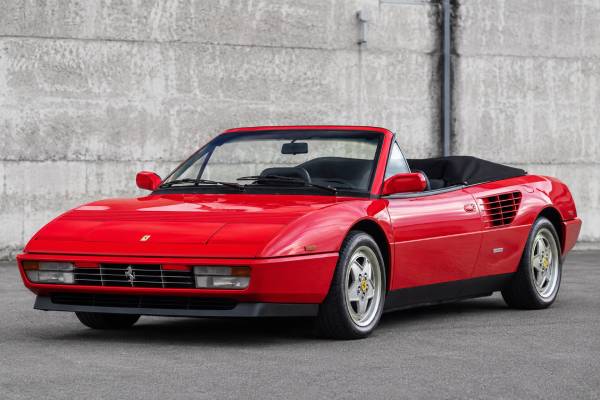
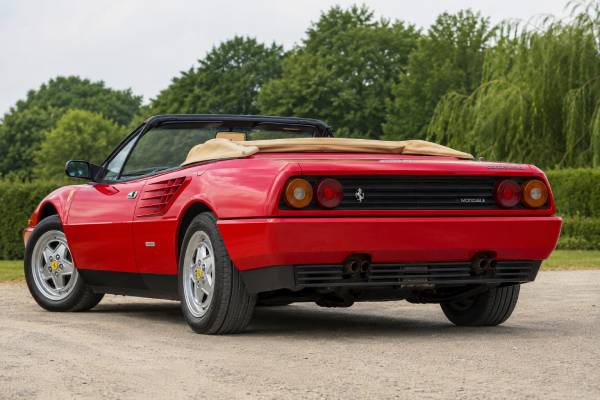
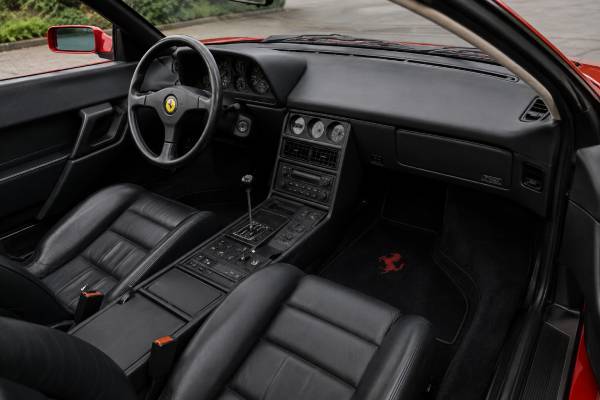
The Ferrari Mondial t Cabriolet is the final and most developed open-top Mondial, built from 1989 to 1993 with Ferrari’s 3.4-liter F119 V8 and a distinctive “t” drivetrain layout. It kept the Mondial’s unusual mid-engined 2+2 formula, but added much of the engineering character associated with the early Ferrari 348: a longitudinal engine, transverse gearbox, Bosch Motronic engine management, power steering, ABS, and electronically adjustable dampers. For buyers and collectors, it sits in an interesting place. It is more usable than many two-seat Ferraris of the same era, rarer than its long production run might suggest, and more expensive to maintain than earlier Mondials. A good Mondial t Cabriolet offers open-air Ferrari sound, gated-shifter drama, and genuine touring usability. A neglected one can quickly become a major restoration project.
Table of Contents
- Why the Mondial t Cabriolet Matters
- F119 V8, Chassis, and Core Specifications
- Production, Variants, and Factory Identification
- Pininfarina Design and T-Layout Engineering
- Real-World Driving Character and Performance
- Maintenance Risks and Restoration Realities
- Market Values and Buyer Checklist
Why the Mondial t Cabriolet Matters
The Mondial t Cabriolet matters because it was Ferrari’s last mid-engined, four-seat convertible and the most advanced version of the Mondial line. It combined the practical idea of a 2+2 Ferrari with the drivetrain direction Ferrari would use in the 348 and later V8 models.
The original Mondial arrived in 1980 as Ferrari’s successor to the 308 GT4. It was not designed as a pure two-seat sports car. Instead, Ferrari tried to create a more usable mid-engined grand tourer with occasional rear seats, a more spacious cabin, better luggage practicality, and a less demanding personality. The concept was unusual then, and it remains unusual now. Most mid-engined sports cars are two-seaters; most four-seat grand tourers place the engine in front.
The Cabriolet version gave the Mondial its most distinctive identity. Introduced earlier in the Mondial family, the open body made sense for buyers who wanted Ferrari style and sound without giving up the small rear seats. By the time the Mondial t Cabriolet appeared, Ferrari had refined the formula through the Mondial 8, Quattrovalvole, and 3.2 versions.
The “t” was not just a facelift. It represented a major mechanical rethink. Earlier Mondials used a transverse V8 and transaxle arrangement related to the 308 and 328. The Mondial t rotated the engine into a longitudinal position and kept the gearbox transverse, creating the “t” layout that gave the car its name. This lowered the engine placement, improved packaging, and brought the Mondial closer to Ferrari’s next-generation V8 platform.
The car also arrived during a transition period for Ferrari. The brand was moving away from carburetors, purely mechanical controls, and earlier 308-era architecture toward electronically managed engines, assisted steering, anti-lock brakes, and more complex chassis systems. The Mondial t Cabriolet sits right in that overlap. It still has a gated manual gearbox, a naturally aspirated V8, pop-up headlights, and an analog cockpit, but it also has systems that require modern specialist knowledge.
Its reputation has changed over time. For years, Mondials were treated as entry-level Ferraris and sometimes unfairly dismissed because of their 2+2 layout and less aggressive styling. Today, the best Mondial t Cabriolets are viewed more seriously. They are rare, usable, mechanically important, and still relatively approachable compared with many classic Ferraris. That does not make them cheap to own, but it does make them interesting.
For collectors, the appeal is clear:
- It is the last and strongest evolution of the Mondial Cabriolet.
- It uses the 3.4-liter F119-family V8 shared in concept with the 348 era.
- It offers open-top driving with a gated manual gearbox.
- It has genuine Ferrari usability, including rear seats and better cabin space than most mid-engined exotics.
- It remains less common than many casual observers assume.
The Mondial t Cabriolet is not a concours icon in the same way as a 275, Daytona, or F40. Its importance is different. It is a bridge between old Ferrari and modern Ferrari, and its ownership experience rewards buyers who understand both sides of that divide.
F119 V8, Chassis, and Core Specifications
The Mondial t Cabriolet’s key specification is its 3.4-liter, 32-valve, naturally aspirated V8 mounted longitudinally behind the cabin. In 300 hp form, it gave the Cabriolet much stronger performance than earlier Mondials while keeping the open-top 2+2 layout.
The engine is part of Ferrari’s F119 family. In this application, engine-code references such as F119DL and F119G are commonly associated with market and emissions differences. The broad layout is consistent: a 90-degree V8, four valves per cylinder, dual overhead camshafts per bank, dry-sump lubrication, and electronic fuel injection. The Bosch Motronic system replaced the older fuel and ignition arrangements used on previous Mondials.
The drivetrain is the defining feature. The V8 sits longitudinally, while the gearbox is mounted transversely behind it. That creates the “t” shape. It was a more sophisticated arrangement than earlier Mondials and helped link the car to Ferrari’s 348 architecture.
| Category | Specification |
|---|---|
| Production years | 1989–1993 |
| Body style | Two-door 2+2 cabriolet |
| Chassis designation | F 108 AL/DN for Cabriolet |
| Engine | 3.4-liter naturally aspirated 90-degree V8 |
| Displacement | 3,404.7 cc |
| Bore x stroke | 85 mm x 75 mm |
| Valvetrain | Dual overhead camshafts per bank, four valves per cylinder |
| Fuel and ignition | Bosch Motronic electronic engine management |
| Lubrication | Dry sump |
| Output | 300 hp / 221 kW at 7,200 rpm |
| Torque | About 324 Nm at 4,200 rpm |
| Transmission | Five-speed gated manual, transverse gearbox |
| Drivetrain | Rear-wheel drive |
| Suspension | Independent suspension with electronically adjustable dampers |
| Brakes | Ventilated discs with ABS |
| Steering | Power-assisted rack and pinion |
| Wheelbase | 2,650 mm |
| Length | About 4,535 mm |
| Width | About 1,810 mm |
| Top speed | About 255 km/h |
The 300 hp rating is the headline figure most associated with the Mondial t Cabriolet, although some market-specific catalytic versions are sometimes listed with lower output figures. That is why buyers should compare the car’s VIN, market, engine-code details, emissions equipment, and original documentation rather than relying only on a sales listing.
Performance was strong for an open 2+2 of its period. Period testing and factory data generally place the car around the low-six-second range for 0–60 mph or 0–100 km/h, with top speed around 255 km/h. Exact figures vary depending on market version, test method, weather, tire condition, and whether the car is fully healthy.
The chassis is a tubular steel structure with a rear subframe designed to carry the engine, gearbox, suspension, and related components. This layout helps with major service access because the drivetrain can be removed as an assembly, but it also means that some engine-out work is expensive and labor-intensive.
The Mondial t Cabriolet’s specification is important because it explains both its appeal and its ownership cost. It is not simply a 3.2 Mondial with more power. It has a different drivetrain layout, more advanced controls, and more complex service needs.
Production, Variants, and Factory Identification
The Mondial t Cabriolet was built in low numbers, and published production totals vary slightly depending on counting method. Most serious references place global production at roughly just over one thousand cars, making it far less common than its long-running nameplate suggests.
The Mondial t was offered as both a coupe and a cabriolet. The coupe arrived first, with the Cabriolet following for the 1989 model year. The Cabriolet is generally the more recognizable and more sought-after version because it combines the Mondial’s 2+2 practicality with open-top Ferrari theater.
Chassis and identity details
The Cabriolet chassis designation is commonly given as F 108 AL/DN. This matters because sellers sometimes describe all Mondial t models loosely, and some advertisements blur the differences between coupe, cabriolet, earlier 3.2 cars, and the later t. A proper inspection should confirm the body style, VIN, engine type, emissions specification, gearbox, and original market.
Key identification points include:
- “t” badging and later Mondial body updates.
- 3.4-liter F119-family V8 rather than the earlier 3.0 or 3.2 engines.
- Longitudinal engine layout with transverse gearbox.
- Power steering, ABS, and adjustable damping.
- Later interior layout compared with earlier Mondials.
- Market-specific lighting, bumper, emissions, and instrumentation details.
For collectors, matching identity is important. The Mondial t Cabriolet is not so valuable that every car has been preserved perfectly, and some have passed through years of budget ownership. That makes documentation especially important. A car with books, tools, service invoices, original panels, matching drivetrain components, and a clear ownership chain is worth more than one with vague history.
Manual and Valeo versions
Most Mondial t Cabriolets use the conventional five-speed gated manual with a clutch pedal. A small number were built or equipped with the Valeo clutch system. Valeo cars retained a manual gear lever but used an electronically controlled clutch, removing the clutch pedal. The system is historically interesting and rare, but it adds a layer of diagnostic and parts complexity.
A buyer should not treat a Valeo car as simply an automatic Mondial. It is a different driving and maintenance proposition. Some collectors value the rarity; others prefer the simplicity and feel of the standard manual.
| Area | Why It Matters |
|---|---|
| European vs U.S. market cars | Emissions equipment, lighting, instruments, and power references may differ. |
| Manual vs Valeo clutch | Valeo cars are rarer but require specialist knowledge and parts planning. |
| Early vs later engine management details | Motronic and emissions components should match the car’s market and build period. |
| Original colors and trim | Classic Ferrari colors usually help liquidity, but unusual factory colors can interest collectors. |
| Documentation quality | Books, tools, invoices, and provenance strongly affect buyer confidence. |
Factory color and trim combinations follow the wider Ferrari palette of the period. Rosso Corsa over tan remains the most recognizable combination, but black, silver, blue, and darker metallic colors can suit the Mondial’s shape well. Interior condition matters because correct leather work, switchgear, carpets, roof trim, and small fittings can be expensive to restore properly.
The best cars are not always the lowest-mileage cars. A very low-mileage Mondial t that has sat unused can need fuel-system work, seals, belts, hoses, tires, brakes, and electrical sorting. A regularly exercised car with careful specialist maintenance may be a safer purchase.
Pininfarina Design and T-Layout Engineering
The Mondial t Cabriolet is distinctive because its design had to solve a problem few Ferraris attempted: placing four seats, a folding roof, and a mid-mounted V8 in one car. Its shape is more restrained than a 348 or Testarossa, but the engineering beneath it is more interesting than the exterior first suggests.
The Mondial line was styled by Pininfarina, with body construction associated with Scaglietti. Compared with Ferrari’s two-seat V8 cars, the Mondial has a longer wheelbase, a taller roofline in coupe form, and more cabin volume. The Cabriolet loses the fixed roof but keeps the essential 2+2 idea.
Design opinion has always been divided. Some enthusiasts admire the clean wedge profile, side intakes, pop-up headlights, and practical proportions. Others find it less dramatic than Ferrari’s two-seat sports cars. The t version improved the look with updated bumpers, revised detailing, and a more mature stance. The Cabriolet also benefits visually from the roof-down profile, which gives the car a lower and more relaxed character.
The “t” drivetrain layout
The drivetrain layout is the most important engineering feature. In earlier Mondials, the V8 sat transversely. In the Mondial t, Ferrari placed the engine longitudinally and mounted the gearbox transversely. This arrangement helped lower the powertrain and improve weight placement while keeping the transaxle compact.
For drivers, the benefit is a more serious mechanical feel and stronger performance. For owners, the cost is more involved service access. The Mondial t’s rear subframe and drivetrain arrangement mean major belt work is not as simple as on some earlier Ferrari V8s. This is one of the biggest reasons the t can cost more to maintain than a Mondial 3.2.
Body, cabin, and roof
The Cabriolet roof is central to the car’s appeal and its inspection risk. A healthy top should operate cleanly, seal properly, and sit correctly when raised. Age, poor adjustment, damaged seals, tired latches, and old fabric can create leaks and wind noise. Water intrusion can then damage carpets, leather, wiring, and hidden body areas.
Inside, the Mondial t offers a more usable cabin than most mid-engined Ferraris. The rear seats are best for children, smaller adults over short distances, or luggage, but they are real seats rather than decorative shelves. The driving position is more relaxed than in many exotics, visibility is useful, and the cabin feels more like a touring Ferrari than a stripped sports car.
The sound is a major part of the experience. The 3.4-liter V8 has a sharper, more modern character than earlier two-valve Mondials, with a metallic Ferrari tone that builds as revs rise. Exhaust condition and originality matter. Many cars have aftermarket exhausts, and while these can improve drama, buyers should check quality, legality, heat shielding, and whether original parts come with the car.
The specialness of the Mondial t Cabriolet is not found in one dramatic feature. It comes from the combination: Pininfarina open body, four-seat packaging, gated manual control, Ferrari V8 sound, and a transitional drivetrain layout that connects the 1980s V8 Ferraris to the 1990s generation.
Real-World Driving Character and Performance
A good Mondial t Cabriolet feels quicker, smoother, and more modern than earlier Mondials, but it still drives like a classic Ferrari rather than a modern sports car. Its best qualities are sound, steering feel, open-air drama, and the satisfaction of using the gated manual gearbox well.
The engine likes revs. Below the midrange it is tractable enough for town use, but the car feels properly alive as the tachometer climbs. The 3.4-liter V8 does not deliver modern turbocharged torque. It rewards deliberate throttle use and clean gear selection. When properly tuned, it pulls strongly and has the crisp response expected from a naturally aspirated Ferrari V8.
The gearbox is a central part of the experience. The gated five-speed shift is mechanical, precise, and satisfying when warm. When cold, it can feel stiff, especially into second gear. This is normal to a point, but excessive crunching, baulking, or unwillingness to select gears can indicate clutch adjustment issues, worn synchros, linkage problems, or incorrect lubricant.
Power steering makes the Mondial t easier to use than earlier Mondials at low speeds. Some purists prefer the heavier unassisted feel of older cars, but the assisted rack suits the Cabriolet’s touring brief. It makes parking, city driving, and relaxed use less tiring.
The electronically adjustable dampers also add usability. They were advanced for the period and help the car balance comfort and control. However, they must work properly. Failed actuators, tired dampers, damaged wiring, or warning lights should be treated as inspection items, not minor quirks.
On the road, the Mondial t Cabriolet is best enjoyed as a fast grand-touring Ferrari rather than a track weapon. It has good balance, but it is heavier and less rigid than a fixed-roof two-seat Ferrari. The open body can show some flex over rough roads, and old tires or tired suspension bushings can make the car feel vague.
Strong examples feel composed, communicative, and stable. Poor examples feel loose, noisy, and nervous. That difference often comes down to maintenance rather than basic design.
Braking performance is period-appropriate, helped by ventilated discs and ABS. Pedal feel should be firm and confidence-inspiring. A long pedal, vibration, pulling, or aged brake hoses suggest deferred work. Tires also transform the car. A Mondial t on old, hard rubber will not steer, brake, or ride as intended, even if the tread looks acceptable.
Usability is one of the car’s strengths. Compared with many classic Ferraris, the Mondial t Cabriolet is easier to enter, easier to see out of, and more practical for weekend travel. It has space for luggage, small rear passengers, and open-air touring. Heat, noise, and roof sealing are still classic-car realities, but a sorted car can be genuinely pleasant on long drives.
The driving experience is most rewarding when the car is fully warmed, the gearbox is cooperating, the suspension is fresh, and the roof is down. It is not about chasing modern performance numbers. It is about the combination of V8 response, manual control, Ferrari noise, and a level of practicality that few mid-engined classics can match.
Maintenance Risks and Restoration Realities
The Mondial t Cabriolet can be reliable when maintained properly, but it is not a low-cost classic. Its biggest ownership risks are belt-service access, aging electronics, roof and seal issues, deferred suspension work, cooling-system deterioration, and cars that were maintained cheaply because they were once undervalued.
The timing-belt service is the headline maintenance concern. Because of the t drivetrain layout, major belt work is more involved than on earlier 308/328-derived cars. Many owners and specialists perform engine-out or major-access services, and buyers should budget accordingly. A seller saying “belts were done” is not enough. You want invoices showing who did the work, when, what parts were replaced, and whether related items were addressed.
Important maintenance areas include:
- Timing belts, tensioners, cam seals, and accessory belts.
- Water pump, coolant hoses, radiator condition, and thermostat function.
- Fuel hoses, injectors, fuel pumps, and old rubber lines.
- Clutch wear, hydraulic system condition, and gearbox behavior.
- Suspension bushings, ball joints, dampers, and electronic damper controls.
- Brake calipers, hoses, discs, pads, ABS sensors, and fluid age.
- Alternator, starter, fuse boards, relays, grounds, and wiring connectors.
- Convertible top fabric, frame alignment, seals, latches, and drains.
- Air conditioning, heater controls, window motors, and interior switches.
Electrical issues are common on older exotic cars, and the Mondial t has enough electronic systems to make diagnosis more involved than on earlier Ferraris. Poor grounds, aged connectors, fuse-board heat damage, weak relays, and old alarm or stereo installations can create frustrating intermittent faults.
Cooling-system health is critical. The mid-engine layout, long coolant runs, and age of components mean overheating should never be dismissed. A proper inspection should check operating temperature, fan function, radiator condition, coolant leaks, hose age, expansion tank condition, and signs of previous overheating.
The Cabriolet body adds its own concerns. Water leaks can create hidden damage. Inspect the floor areas, carpets, seat mounts, lower door sections, rear trim, roof storage area, and any wiring that may have been exposed to moisture. Roof parts and seals can be expensive or difficult to source, and poor adjustment can make even new seals ineffective.
Restoration cost traps
A cheap Mondial t Cabriolet is rarely cheap after sorting. The car’s market value does not always justify a full restoration, so buyers should be careful with projects. Paintwork, leather, roof work, engine-out servicing, suspension renewal, and electrical repair can quickly exceed the price difference between a poor car and a good one.
Common restoration traps include:
- Old repaint work hiding accident damage or corrosion.
- Missing tools, books, jack kit, manuals, or original parts.
- Non-original wheels, exhaust, stereo, or interior trim with no factory parts included.
- Long storage followed by minimal recommissioning.
- Incomplete belt service where tensioners, seals, hoses, or water pump were ignored.
- Valeo clutch faults on rare cars without specialist support.
- Worn leather and sticky or broken interior controls.
Corrosion is less obvious than on many older classics but still important. Check lower body areas, seams, wheel arches, door bottoms, windshield surround, roof-related water paths, suspension pickup areas, and previous repair zones. Accident damage is a serious concern because correct body alignment, panel gaps, and chassis geometry are essential to value and safety.
The safest approach is to buy the best-documented, best-maintained car you can afford. A pre-purchase inspection by a Ferrari specialist familiar with Mondial t and 348-era systems is not optional. It is part of the purchase cost.
Market Values and Buyer Checklist
The Mondial t Cabriolet remains one of the more accessible classic open Ferraris, but the best cars are no longer bargain-basement choices. Current market behavior generally rewards originality, service history, manual gearbox condition, roof quality, color combination, mileage credibility, and specialist documentation.
As of the current market, many driver-quality Mondial t Cabriolets trade or list in a broad range from the mid-five figures to stronger six-figure asking prices for exceptional examples, rare specifications, or very low-mileage cars. Auction results often show a wide spread because condition varies sharply. A car needing major belt service, roof work, tires, suspension, and electrical sorting should be valued very differently from a freshly serviced, documented, original example.
The Mondial t Cabriolet is usually worth more than earlier Mondial 8 and Quattrovalvole examples, and often competes with good Mondial 3.2 Cabriolets. The 3.2 can be attractive for buyers who want simpler maintenance, while the t appeals to those who want the final evolution, the stronger engine, and the more advanced chassis.
Value drivers include:
- Complete service history from recognized Ferrari specialists.
- Recent major service with supporting invoices.
- Original books, tools, pouch, jack, and factory documentation.
- Matching drivetrain and correct market specification.
- Clean title, clear import history, and documented mileage.
- Original paint or high-quality paintwork with no hidden damage.
- Strong roof condition with good seals and correct operation.
- Healthy gearbox, clutch, brakes, and suspension.
- Desirable color combination.
- Unmodified or easily reversible specification.
Pre-purchase inspection checklist
| Inspection Area | What to Check | Why It Matters |
|---|---|---|
| Documentation | Books, tools, invoices, ownership history, mileage records | Proves care and supports resale value |
| Engine service | Timing belts, tensioners, seals, water pump, hoses | Major cost area and key reliability item |
| Gearbox and clutch | Cold shift quality, synchros, clutch bite, hydraulic leaks | Repairs are expensive and affect enjoyment |
| Cooling system | Fans, radiator, hoses, leaks, overheating signs | Heat damage can become serious quickly |
| Suspension | Dampers, bushings, warning lights, ride quality | Transforms the way the car drives |
| Convertible top | Fabric, frame, seals, latches, water leaks | Cabriolet-specific parts and repairs can be costly |
| Body and chassis | Panel gaps, corrosion, accident repair, underbody condition | Structural and originality issues affect value |
| Electrical systems | Windows, lights, HVAC, warning lights, fuse board, grounds | Intermittent faults can be time-consuming to solve |
Cars to seek
The strongest buys are cars that have been used regularly, stored correctly, and maintained by specialists. Look for a Mondial t Cabriolet with recent belt service, fresh tires, clean fluids, working air conditioning, functioning roof, strong brakes, and no dashboard warning lights. A car with moderate mileage and excellent records is often more appealing than a low-mileage car with long periods of inactivity.
Cars to avoid
Be cautious with cars sold on vague claims, incomplete records, old tires, non-working electronics, oil leaks, coolant smells, stiff gearbox behavior, poor roof fit, or “minor” needs. On a Ferrari of this era, minor needs can become expensive. Also avoid cars with unclear import paperwork, inconsistent VIN details, questionable mileage, or accident repairs that were not documented and measured.
Long-term collectability looks positive but measured. The Mondial t Cabriolet has rarity, final-series status, a proper Ferrari V8, open bodywork, and analog controls. It also has a complicated ownership profile that will always separate good cars from neglected ones. It is unlikely to become cheap to restore, so preservation will matter more over time.
For the right buyer, the Mondial t Cabriolet is a highly satisfying classic Ferrari: usable, sonorous, rare, and mechanically significant. The key is to buy with discipline. Choose condition over bargain price, documentation over promises, and specialist inspection over optimism.
References
- Ferrari Mondial T Cabriolet (1989) 1989 (Manufacturer Specifications)
- Check for Recalls: Vehicle, Car Seat, Tire, Equipment 2026 (Recall Database)
- Ferrari Mondial t Cabriolet (1989 to 1993) 2026 (Market Data)
- 1989 Ferrari Mondial t Cabriolet Archive Road Test 2025 (Road Test Archive)
- Ferrari / Mondial t Coupe & Cabriolet / 152 – Top -Cabriolet- 2026 (Parts Catalog)
Disclaimer
This article is for informational purposes only and is not a substitute for professional diagnosis, repair, inspection, or valuation. Specifications, torque values, service intervals, procedures, parts, and market-specific equipment can vary by VIN, market, production date, and optional equipment. Owners and buyers should verify all details against official Ferrari service documentation and consult a qualified Ferrari specialist before purchase or repair.
If you found this guide useful, please consider sharing it on Facebook, X/Twitter, or with other Ferrari enthusiasts to support our work.