
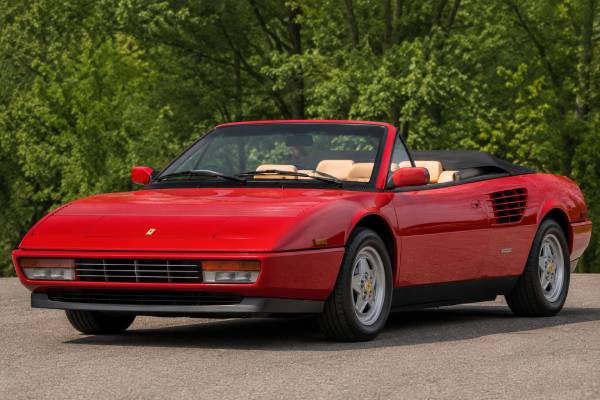
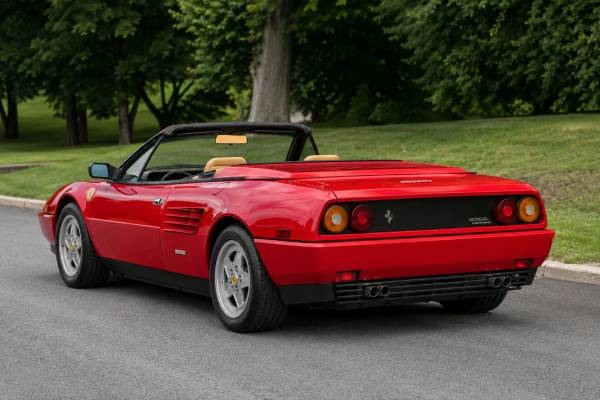
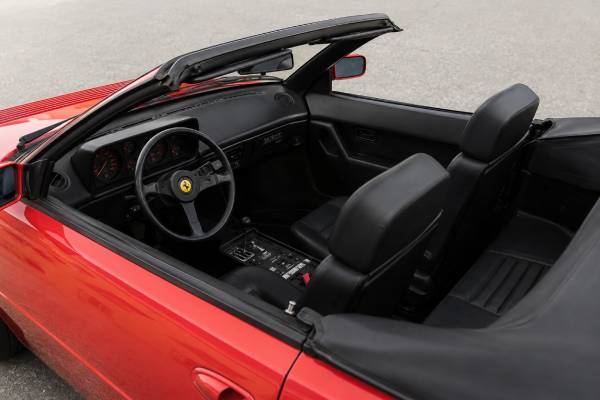
The Ferrari Mondial Quattrovalvole Cabriolet is the open version of Ferrari’s early-1980s mid-engine 2+2 grand tourer, powered by the F105A 2.9-liter V8 with four valves per cylinder. Built from 1983 to 1985, it sits between the slower Mondial 8 and the later 3.2 Mondial, making it an important turning point in the model’s development. It kept the practical long-wheelbase Mondial layout, added open-air driving, and restored much of the performance Ferrari buyers expected from a V8 car of the period. For collectors and owners, its appeal is not just speed. The QV Cabriolet is rare, unusual, usable, and mechanically related to the 308 Quattrovalvole, yet it remains one of the more approachable classic Ferraris to buy. The challenge is finding one with solid documentation, correct mechanical care, and no hidden restoration debt.
Table of Contents
- Mondial QV Cabriolet in Ferrari History
- F105A V8, Chassis, and Key Specifications
- Production Numbers, Variants, and Authenticity
- Pininfarina Design and Open-Top Engineering
- Road Feel, Performance, and Everyday Usability
- Maintenance Risks, Restoration, and Known Issues
- Market Values and Buyer Inspection Guide
Mondial QV Cabriolet in Ferrari History
The Mondial Quattrovalvole Cabriolet matters because it combined three things Ferrari rarely put together: a mid-mounted V8, four usable seats in a 2+2 layout, and a folding roof. It was not a pure sports car like the 308 GTS, but it gave Ferrari buyers a more social and practical way to enjoy the same basic V8 character.
The Mondial line began in 1980 as the Mondial 8, replacing the Bertone-styled 308 GT4. Ferrari wanted a more modern, internationally usable 2+2, with better cabin space, improved safety compliance, and styling by Pininfarina. The result was larger, more comfortable, and more refined than the 308 GT4, but early Mondial 8 performance was criticized. Its two-valve injected V8 did not feel especially urgent for a Ferrari, especially in emissions-controlled markets.
The Quattrovalvole update changed the car’s reputation. “Quattrovalvole” means four valves, and in Ferrari terms it marked the move from two valves per cylinder to four. The new cylinder heads improved breathing at higher rpm and gave the 2.9-liter V8 a stronger top end. In European specification, output rose to about 240 hp, which made the Mondial feel much closer to the 308 QV family.
The Cabriolet arrived for 1983 and added a new identity to the car. At the time, a mid-engine four-seat convertible was highly unusual. The layout created compromises, especially in rear-seat space and structural stiffness, but it also gave the Mondial a personality no two-seat Ferrari could match. It could take two adults up front, children or small passengers in the rear, and luggage in the front compartment, while still offering the sound and drama of a Ferrari V8 behind the cabin.
Its historical importance comes from that mix. The Mondial QV Cabriolet is not the fastest classic Ferrari, not the most beautiful to every eye, and not the most celebrated in period road tests. Yet it occupies a very specific place in Ferrari history:
- It helped rescue the Mondial from the weaker image of the Mondial 8.
- It brought open-top driving to Ferrari’s mid-engine 2+2 line.
- It shared core engine architecture with the 308 Quattrovalvole.
- It remained more serviceable than the later Mondial t, which used a different powertrain layout.
- It was produced in relatively small numbers, especially compared with later cabriolet versions.
Today, collectors tend to view the Mondial QV Cabriolet more kindly than past critics did. Its long wheelbase, upright cabin, and 1980s bumpers are now part of its character. It is a Ferrari for people who want to drive, maintain, and understand a car rather than simply display one. Good examples reward regular use, but neglected cars can be expensive enough to erase any purchase-price advantage.
F105A V8, Chassis, and Key Specifications
The key specification is the F105A 2.9-liter V8, a transverse mid-mounted engine with four valves per cylinder, Bosch K-Jetronic fuel injection, and a five-speed manual transaxle. In period European form, it delivered 240 hp and gave the Mondial QV Cabriolet a factory top speed of about 240 km/h.
| Item | Specification |
|---|---|
| Model | Ferrari Mondial Quattrovalvole Cabriolet |
| Chassis type | F 108 BS 100 |
| Production years | 1983–1985 |
| Body style | 2+2 cabriolet |
| Engine code | F105A |
| Engine layout | Rear mid-mounted, transverse 90-degree V8 |
| Displacement | 2,926.90 cc |
| Valvetrain | DOHC, four valves per cylinder |
| Fuel system | Bosch K-Jetronic mechanical fuel injection |
| Maximum power | 240 hp, market specification dependent |
| Transmission | 5-speed manual transaxle |
| Driven wheels | Rear-wheel drive |
The F105A V8 is closely related to the engine used in the 308 Quattrovalvole. It uses aluminum construction, dry-sump lubrication on many European 308 applications, and in Mondial form a packaging arrangement suited to the longer 2+2 chassis. The engine sits behind the passenger compartment and ahead of the rear axle line, which gives the car a genuine mid-engine balance. Unlike the later Mondial t, the QV keeps the engine transverse, with the gearbox underneath and across the rear of the car.
The chassis is a tubular steel structure, with steel and aluminum body panels depending on section and construction. Suspension is independent at all four corners, using unequal-length wishbones, coil springs, telescopic dampers, and anti-roll bars. Steering is rack and pinion, without power assistance. Braking is by ventilated discs at the front and rear.
| Item | Specification |
|---|---|
| Length | 4,580 mm |
| Width | 1,790 mm |
| Height | 1,260 mm |
| Wheelbase | 2,650 mm |
| Front track | 1,495 mm |
| Rear track | 1,517 mm |
| Dry weight | About 1,430 kg |
| Suspension | Independent wishbones, coil springs, dampers, anti-roll bars |
| Brakes | Ventilated discs front and rear |
| Steering | Manual rack and pinion |
| Tyres | 240/55 VR 390 metric tyres on period metric wheels |
| Fuel capacity | About 87 liters |
Performance figures vary by market, test method, gearing, emissions equipment, and condition. A healthy European-specification car is generally treated as a 240 km/h Ferrari with 0–100 km/h performance in the low-to-mid seven-second range. U.S.-market examples can feel softer because of emissions calibration and added equipment, although condition usually matters more than brochure output on a 40-year-old car.
Production Numbers, Variants, and Authenticity
The Mondial QV Cabriolet is the rarest major Mondial body-and-engine combination, with 629 examples produced from 1983 to 1985. That number makes documentation, chassis identity, and correct specification more important than they might seem from the car’s still-accessible market position.
The Mondial family can be divided into four main generations: Mondial 8, Mondial Quattrovalvole, Mondial 3.2, and Mondial t. The QV Cabriolet sits in the second generation. It keeps the early black-bumper body style but gains the four-valve V8. Later 3.2 cars received a larger 3.2-liter engine and styling updates, while the Mondial t brought a longitudinal engine layout, different gearbox arrangement, more complexity, and a stronger performance image.
| Version | Years | Main character |
|---|---|---|
| Mondial 8 | 1980–1982 | Original two-valve injected V8, slower but historically important |
| Mondial Quattrovalvole | 1982–1985 coupe, 1983–1985 cabriolet | Four-valve 2.9-liter V8, stronger performance, early body style |
| Mondial 3.2 | 1985–1988 | Larger 3.2-liter V8, updated bumpers and wheels, improved drivability |
| Mondial t | 1989–1993 | Longitudinal 3.4-liter V8, higher performance, more complex servicing |
For the exact car covered here, the important identifier is the cabriolet chassis type, F 108 BS 100. Buyers should confirm the VIN, chassis stamping, engine number, gearbox number where available, market specification, and title history. The Ferrari Classiche program can help verify originality for owners who want formal certification, but a specialist inspection is still essential because certification does not automatically mean the car is mechanically fresh.
The QV Cabriolet’s quick visual identifiers include the folding soft top, rear buttress-style roof line when raised, “Quattrovalvole” badging, early Mondial black bumpers, and the 390 mm metric wheel package. Interior details vary by market and year, but most cars use leather upholstery, power windows, air conditioning, and a relatively upright dashboard compared with Ferrari’s two-seat models.
Original colors and interiors matter, but condition and documentation matter more. A rare color can help a car stand out, yet poor paintwork, missing service history, or a tired interior will quickly reduce desirability. Rosso Corsa over tan remains the familiar Ferrari combination, while darker exterior colors can flatter the Mondial’s length and black trim. Buyers should be cautious of color changes unless the work is documented and the original color is disclosed.
Factory documentation is especially valuable on a Mondial QV Cabriolet because many cars have lived as affordable used Ferraris. That means deferred maintenance, incomplete records, non-original wheels, aftermarket audio, alarm systems, retrimmed interiors, and improvised electrical repairs are common. A strong file should include:
- stamped service book or early dealer records;
- timing-belt and tensioner-bearing invoices;
- valve-clearance and cam-cover service records;
- cooling-system and fuel-system work;
- clutch, brake, and suspension invoices;
- old registrations, import documents, and emissions paperwork;
- tool kit, jack kit, manuals, pouch, and spare keys where possible.
Matching numbers are meaningful, but buyers should also care about whether the car is complete, correctly assembled, and maintained by people who understand 1980s Ferraris. A fully original but neglected car can be a worse purchase than a sympathetically restored example with proper invoices.
Pininfarina Design and Open-Top Engineering
The Mondial QV Cabriolet’s design is best understood as a practical mid-engine Ferrari shaped around packaging, safety rules, and open-air usability. It is not as low or dramatic as a 308 GTS, but its proportions make sense once you understand the 2+2 cabin and roof mechanism.
Pininfarina had to package a mid-mounted V8, a front luggage compartment, two real front seats, small rear seats, and a folding roof into one car. The Mondial’s long wheelbase is central to that mission. Compared with a two-seat Ferrari, the cabin is pushed into a more upright and spacious form. The roofline is higher, the glass area is larger, and the rear quarters are longer. On the cabriolet, the roof structure and rear seating area required more compromises than the coupe.
With the roof raised, the Cabriolet keeps a buttress-like rear profile that echoes the coupe. With the roof lowered, the car looks more relaxed and visually shorter. This is why many enthusiasts prefer the Mondial Cabriolet to the coupe in real-world use. It turns the car’s size into part of its charm rather than something to apologize for.
The open-top conversion required extra structural attention. Removing a fixed roof from any car reduces torsional stiffness, and a mid-engine 2+2 adds packaging challenges. Ferrari strengthened key areas around the sills and body structure to reduce flex. Even so, buyers should expect more body movement than in a fixed-roof 308 or Mondial coupe. This is normal to a point, but rattles, door misalignment, cracked paint around stress areas, or uneven panel gaps can point to accident damage or poor repairs.
The cockpit is pure early-1980s Ferrari. The driving position is slightly offset, the steering wheel is close, the shifter sits in Ferrari’s open metal gate, and the main controls require familiarity rather than casual operation. Visibility is good for a mid-engine car, helped by the taller glasshouse. The cabin feels more like a compact grand tourer than a stripped sports car.
Several details define the car’s emotional character:
- The gated shifter gives every shift a mechanical sense of occasion.
- The V8 sits close enough to dominate the sound without overwhelming the cabin at all speeds.
- The manual steering adds weight at parking speeds but real texture once moving.
- The folding roof makes the engine and exhaust note more present.
- The rear seats turn the car into a shared experience, even if they are best for children or short trips.
The Mondial QV Cabriolet is not a design built for shock value. It is a design built around a rare problem: how to make a mid-engine Ferrari usable by more than two people while still feeling special.
Road Feel, Performance, and Everyday Usability
A good Mondial QV Cabriolet feels lighter and more alive than its reputation suggests, but it is a classic GT rather than a modern high-grip sports car. Its best qualities are steering feel, engine sound, open-gate shifting, and the way the V8 wakes up as revs rise.
The F105A engine is not especially muscular at low rpm. It prefers to be warmed properly and used with intent. Below the midrange it is smooth and tractable, but the reason for the Quattrovalvole name becomes clearer higher up the tachometer. The engine breathes better than the two-valve Mondial 8 unit, and the car feels more willing when driven in the upper half of the rev range.
The gearbox is part of the experience. When cold, second gear can be stiff, and many owners avoid rushing the shift until the oil is warm. This is common in Ferraris of the period. A good gearbox should feel mechanical, not obstructive. Crunching, jumping out of gear, or heavy baulking when warm suggests wear or adjustment issues.
The manual steering is heavy at parking speeds because there is no power assistance. Once the car is rolling, it becomes one of the Mondial’s best features. The front end gives useful feedback, and the longer wheelbase makes the car stable on faster roads. The Cabriolet is not as sharp as a 308 GTS, but it is more comfortable and less nervous over uneven surfaces.
Ride quality is better than many expect. The Mondial was designed as a grand tourer, and the suspension has enough compliance for longer drives. Old dampers, tired bushings, mismatched tires, or incorrect ride height can ruin that balance. A properly set-up car should feel supple but controlled, not loose or floaty.
Braking performance is period-correct. The ventilated discs are adequate for road use when the system is fresh, but the pedal feel, stopping distances, and fade resistance are not comparable to a modern performance car. Old brake hoses, sticky calipers, aged fluid, and worn pads are common on cars that sit.
The Cabriolet is also more usable than many classic Ferraris:
- The cabin is easier to enter than a low two-seat berlinetta.
- The front luggage compartment is useful for weekend bags.
- The rear seats can carry children, soft bags, or occasional passengers.
- The car can cruise comfortably when properly maintained.
- The open roof makes moderate-speed driving feel special without needing high speed.
The weak points in daily usability are heat, age, and traffic. Cooling systems must be healthy, fans must work, and the electrical system must be in good order. Air conditioning can be weak by modern standards, especially in hot climates. Cabin heat soak is part of the mid-engine experience.
A tired Mondial feels disappointing. A sorted one feels honest, charismatic, and more capable than old jokes suggest. The difference between those two cars is usually maintenance, not the basic design.
Maintenance Risks, Restoration, and Known Issues
The Mondial QV Cabriolet is not a cheap car to own just because it is one of the more affordable classic Ferraris to buy. Its major risks are deferred belt service, aging fuel and cooling systems, electrical faults, corrosion, trim deterioration, and poor previous repairs.
The timing belts are the first maintenance topic. The F105A V8 uses belt-driven camshafts, and belt age matters as much as mileage. A buyer should not accept “low mileage” as a substitute for current belt records. A proper major service usually includes belts, tensioner bearings, cam seals where needed, accessory belts, valve-cover gaskets, fluids, and inspection of related components. Many owners also address the water pump, thermostat, hoses, and ignition items while access is available.
The good news is that QV Mondials are generally less daunting than later Mondial t models for major service because the transverse engine layout does not require the same full engine-out approach associated with the t. That does not make the work inexpensive. It still requires Ferrari knowledge, correct parts, careful setup, and patience.
Common mechanical and ownership issues include:
- Fuel hoses, tanks, pumps, accumulators, and injectors suffering from age or old fuel.
- Cooling-system weakness from clogged radiators, tired fans, failing thermostats, and old hoses.
- Oil leaks from cam covers, seals, and aged gaskets.
- Ignition faults from old coils, distributors, leads, and connectors.
- Clutch wear, especially on cars driven in traffic or with poor adjustment.
- Worn suspension bushings, ball joints, dampers, and wheel bearings.
- Brake calipers sticking after storage.
- Metric tire availability and cost, leading some owners to convert to later-style wheel sizes.
- Slow windows, weak switches, fuse-panel heat damage, and alarm-related wiring problems.
Electrical issues deserve special attention. The Mondial has more comfort equipment than a simple two-seat sports car, and age makes connections brittle. Power windows, fans, lighting, gauges, air conditioning, and aftermarket stereos should all be tested. A neat, original wiring harness is a major plus. Random splices and hidden immobilizers are red flags.
Corrosion is another serious inspection area. The car uses a tubular structure and bodywork that can hide problems. Check the lower sills, door bottoms, wheel arches, lower front valance, floor areas, suspension pick-up points, battery area, and around the windshield and soft-top sealing points. Water leaks from an old roof can damage carpets, leather, floor sections, electrical connectors, and interior trim.
The soft top is specific and expensive to put right. Inspect the frame, latches, seals, rear window, fabric condition, stitching, and how the roof sits against the side glass. A poorly adjusted top can create wind noise, leaks, and stress on the frame. Replacement trim pieces can be hard to source, and high-quality upholstery work is costly.
Restoration economics are important. The Mondial QV Cabriolet’s market value has risen, but it still does not support careless blank-check restoration unless the car has special provenance or emotional value. Paintwork, leather, top restoration, engine service, suspension rebuild, and electrical sorting can quickly exceed the gap between a cheap car and a good car.
For most buyers, the safest approach is to buy the best documented, most complete, most regularly used car they can afford. A car that has been driven, serviced, and improved over time is often a better bet than a long-stored low-mileage example needing recommissioning.
Market Values and Buyer Inspection Guide
The Mondial QV Cabriolet remains one of the more attainable classic open Ferraris, but the best cars are no longer bargain-bin exotics. Recent market data places many usable examples in the broad $35,000–$60,000 range, with projects below that and exceptional, low-mileage, highly documented cars capable of reaching higher.
The market is condition-sensitive. A car that looks cheap can become expensive after one major service, one soft-top replacement, and a round of electrical and suspension work. Because the model is less valuable than a 308 GTS, restoration costs must be judged carefully before purchase.
Value is driven by several factors:
- Original colors, original interior, and correct trim.
- Full service history with recent belt service.
- Strong compression and leak-down results.
- Clean chassis with no corrosion or accident damage.
- Correct wheels, books, tools, jack, records, and keys.
- Working air conditioning, windows, lights, and instruments.
- A clean soft top with good seals and frame operation.
- Proven ownership history and market-specific documentation.
- Specialist inspection results, not just seller claims.
| Area | What to check | Why it matters |
|---|---|---|
| Engine | Belt history, leaks, warm idle, smoke, compression, cooling fans | Deferred engine work can exceed the savings on a cheaper car |
| Gearbox and clutch | Cold and warm shifts, second gear, clutch bite, noise | Repairs are specialist and labor-intensive |
| Structure | Sills, floors, suspension mounts, accident repairs, panel gaps | Hidden corrosion or poor crash repair damages value and safety |
| Soft top | Fabric, frame, latches, seals, rear window, water leaks | Cabriolet parts and skilled trimming work are expensive |
| Electrical system | Fuse panel, windows, fans, lights, gauges, aftermarket wiring | Old wiring faults can be time-consuming to trace |
| Interior | Leather shrinkage, dash condition, carpets, switches, originality | Correct interior restoration can be costly |
| Documentation | VIN, engine number, invoices, import papers, manuals, tools | Records support authenticity and future resale |
Avoid cars with fresh paint but no bodywork records, missing emissions equipment in strict markets, vague belt history, overheating, heavy oil smoke, patched wiring, or a seller who discourages a specialist inspection. Also be cautious with cars that have been stored for many years. Storage can preserve mileage but damage fuel systems, brakes, seals, tires, and electrical contacts.
A strong example should start cleanly, warm without overheating, idle evenly, shift cleanly once warm, track straight, brake without pulling, and show no major warning signs from the cooling or charging systems. The engine should feel eager above the midrange and should not stumble badly under load. Some old-Ferrari noises and smells are normal; overheating, fuel smell, smoke, and electrical flicker are not things to dismiss.
Long-term collectability is likely to remain steady to positive because the QV Cabriolet has a rare combination of Ferrari badges: gated manual, mid-engine V8, Pininfarina design, open roof, and limited production. It is also more usable than many classic Ferraris. Still, it is unlikely to behave like a top-tier investment Ferrari unless the example is exceptional. The best reason to buy one is that you want the experience.
For the right owner, the Mondial Quattrovalvole Cabriolet is a rewarding classic Ferrari with a distinct identity. Buy carefully, maintain it preventively, and use it often. That is when the car makes the most sense.
References
- Ferrari Mondial Cabriolet (1983) – Ferrari.com 1983 (Manufacturer Specifications)
- Ferrari Mondial Quattrovalvole (1982) – Ferrari.com 1982 (Manufacturer Specifications)
- Vehicle Detail Search – 1985 FERRARI MONDIAL | NHTSA 2026 (Recall Database)
- Check for Recalls: Vehicle, Car Seat, Tire, Equipment | NHTSA 2026 (Recall Database)
- Ferrari Mondial QV Cabriolet Market – CLASSIC.COM 2026 (Market Data)
Disclaimer
This article is for informational purposes only and is not a substitute for professional diagnosis, repair, appraisal, or pre-purchase inspection. Specifications, torque values, service intervals, procedures, equipment, and compliance details can vary by VIN, market, production date, and later modifications. Always verify details against official Ferrari service documentation and consult a qualified Ferrari specialist before buying, repairing, or restoring a Mondial Quattrovalvole Cabriolet.
If you found this guide useful, please consider sharing it on Facebook, X/Twitter, or your favorite enthusiast community to support our work.