

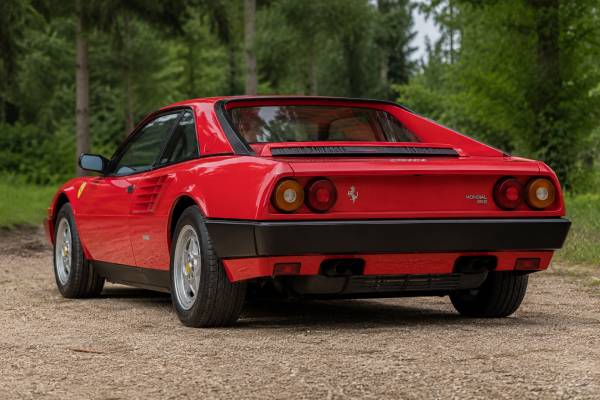

The Ferrari 3.2 Mondial is the most balanced version of Ferrari’s transverse-engine Mondial line before the later Mondial t changed the powertrain layout completely. Built from late 1985 through the end of the 1980s, it paired Pininfarina’s practical mid-engine 2+2 body with the F105C 3.2-litre quad-cam V8, closely related to the engine used in the Ferrari 328. In European specification, output was 270 hp, enough to give the Mondial sharper performance than the earlier Mondial 8 and Quattrovalvole while keeping the older, simpler service layout. Today, the 3.2 Mondial matters because it offers classic Ferrari sound, gated-shifter involvement, usable seating, and a relatively approachable entry point into 1980s Maranello ownership. It is still an exotic, though, and condition, documentation, originality, and specialist maintenance matter far more than headline price.
Table of Contents
- Why the 3.2 Mondial Still Matters
- F105C Engine, Chassis, and Key Specs
- Production, Variants, and Authenticity Clues
- Pininfarina Design and Mid-Engine Packaging
- Road Feel, Performance, and Usable GT Character
- Maintenance, Weak Points, and Restoration Risk
- Market Values and Smart Buying Checks
Why the 3.2 Mondial Still Matters
The 3.2 Mondial is important because it fixed much of the early Mondial’s performance problem without losing the model’s unusual practicality. It sits between the earlier Mondial QV and the later Mondial t, making it the final Mondial generation with the transverse V8 and comparatively accessible major-service layout.
Ferrari launched the original Mondial 8 in 1980 as a mid-engine 2+2 grand tourer. That idea was unusual then and remains unusual now. Most mid-engine Ferraris were strict two-seaters; the Mondial tried to give owners rear seats, better visibility, more luggage flexibility, and open-air motoring in Cabriolet form. It was not intended to be a lightweight berlinetta. It was a Ferrari that could be used more often, by more people, and on longer trips.
The problem was that the first Mondial arrived during a difficult emissions era. Its two-valve V8 did not have enough power to overcome the car’s size and weight, especially in U.S. form. The later Quattrovalvole helped by adding four-valve cylinder heads, but the 3.2 was the version that gave the car a fuller identity. The enlarged 3,185 cc V8 brought more torque and stronger high-rpm power, while the body received smoother, body-coloured bumpers and a cleaner family resemblance to the Ferrari 328.
The Mondial’s reputation has changed over time. For years it was treated as the awkward, affordable Ferrari: bigger than a 308, less dramatic than a Testarossa, and more complicated than a normal used sports car. That reputation kept prices low, but it also made many cars suffer from deferred maintenance. Today, the better 3.2 cars are seen more fairly. They are not cut-price 328s, but they share enough engine character to be exciting while adding real usability.
For collectors, the 3.2 Mondial’s appeal is not just speed. It is the combination of a naturally aspirated flat-plane-crank V8, a five-speed gated manual, Pininfarina styling, limited production, and a body style Ferrari never really repeated in the same way. The Cabriolet is especially unusual because it gives open-air driving with a mid-rear engine and small rear seats. The coupe, meanwhile, has cleaner lines and tends to appeal to buyers who want a more traditional, enclosed 1980s Ferrari GT.
Its place in Ferrari history is also helped by what came after. The Mondial t moved to a longitudinal engine with a transverse gearbox, previewing the layout used in the 348. It was faster and more modern, but more complex to service. The 3.2 therefore occupies a sweet spot: newer and better resolved than the early Mondial, but mechanically less intimidating than the t.
F105C Engine, Chassis, and Key Specs
The heart of the 3.2 Mondial is the F105C 3.2-litre V8, a naturally aspirated, four-valve-per-cylinder engine with the rev-happy personality expected from a 1980s Ferrari. The chassis is a tubular steel structure with a detachable rear subframe, giving the car a practical service advantage over later engine-out layouts.
The engine is mounted transversely behind the cabin and drives the rear wheels through a five-speed manual gearbox. Fuel delivery is by Bosch K-Jetronic mechanical injection, and ignition is electronic. It is not a modern computer-controlled engine, but it is not primitive either. When set up correctly, it starts cleanly, pulls better than the earlier cars, and builds power with a crisp, metallic V8 sound.
| Item | Specification |
|---|---|
| Model | Ferrari 3.2 Mondial |
| Factory type reference | F 108 CL 100 for main coupe reference; related Cabriolet variants use their own body references |
| Engine code | F105C |
| Engine layout | Rear-mid-mounted transverse 90-degree V8 |
| Displacement | 3,185.76 cc |
| Valvetrain | Double overhead camshafts per bank, four valves per cylinder |
| Fuel system | Bosch K-Jetronic mechanical fuel injection |
| Maximum power | 270 hp / 199 kW at 7,000 rpm in European specification |
| Maximum torque | About 304 Nm / 224 lb-ft |
| Transmission | Five-speed manual with gated selector |
| Drivetrain | Rear-wheel drive |
| Top speed | About 250 km/h / 155 mph |
| 0–100 km/h | Period figures vary, commonly around 6.5–7.4 seconds depending on market, test method, and condition |
The Mondial’s chassis uses independent suspension front and rear, with unequal-length wishbones, coil springs, telescopic dampers, and anti-roll bars. Steering is rack and pinion, without the filtered feel of later assisted systems. Brakes are discs all round. Later 3.2 cars could have ABS, so buyers should verify specification by build date, market, and equipment rather than assuming all cars are the same.
| Area | Detail |
|---|---|
| Body style | 2+2 coupe; closely related 2+2 Cabriolet also produced |
| Construction | Tubular steel chassis with removable rear subframe section |
| Suspension | Independent wishbones, coil springs, dampers, anti-roll bars |
| Steering | Rack and pinion |
| Brakes | Four-wheel disc brakes |
| Wheelbase | 2,650 mm |
| Length | 4,535 mm |
| Width | 1,795 mm |
| Height | About 1,235 mm for the coupe; Cabriolet is taller |
| Dry weight | About 1,400–1,410 kg depending on body style and source |
| Fuel capacity | About 80 litres |
| Common 16-inch tyre sizes | 205/55 VR16 front, 225/55 VR16 rear |
The numbers tell only part of the story. The 3.2 Mondial is not as light or sharp as a two-seat 328, but it is not slow when healthy. The engine likes revs, the gearing rewards involvement, and the longer wheelbase gives the car a calmer GT feel at speed.
Production, Variants, and Authenticity Clues
The 3.2 Mondial was built in coupe and Cabriolet form, with total production commonly listed at 987 coupes and 810 Cabriolets. Because values depend heavily on originality and records, identification details matter as much as the badge on the rear panel.
The 3.2 arrived after the Mondial QV and before the Mondial t. It is easy to identify compared with earlier cars because of its smoother body-coloured bumpers, revised light treatment, new wheel design, and updated interior. Earlier Mondial 8 and QV models have more prominent black bumper forms, while the Mondial t has later styling details and a different engine layout.
| Variant | Typical production period | Approximate production | Buyer relevance |
|---|---|---|---|
| 3.2 Mondial Coupe | 1985–1988, with registrations into 1989 | 987 examples | Cleaner roofline, stiffer body feel, usually preferred by buyers who want the most traditional driving structure |
| 3.2 Mondial Cabriolet | 1985–1988, with registrations into 1989 | 810 examples | Open-air appeal, greater U.S. market interest, more checks needed around roof condition and body integrity |
Year-by-year details can be tricky because production year, model year, registration year, and market paperwork do not always align neatly. A car advertised as a 1989 3.2 may be a late-built or late-registered example rather than a Mondial t. Buyers should verify the VIN, engine number, gearbox number, body style, original market, and factory documentation before treating any claim as fact.
Originality is especially important on a Ferrari from this era. The strongest cars usually have:
- Clear ownership history with service invoices, not just stamped booklets.
- Correct F105C engine identity and supporting records.
- Original colours or a well-documented, high-quality repaint in the original shade.
- Correct wheels, trim, lights, instruments, and interior materials for the year and market.
- No unexplained VIN, engine, gearbox, or body-number inconsistencies.
- Evidence of timing-belt service, cooling-system care, fuel-system work, brake maintenance, and suspension renewal.
Factory options were not as complex as on modern Ferraris, but specification still affects desirability. Metallic paint, leather colour, air conditioning, roof condition on Cabriolets, and wheel type all matter. Some coupe buyers value the electric sunroof when fitted, while others prefer simpler cars with fewer potential repair points. Cabriolet buyers should pay close attention to the hood frame, tonneau, seals, latches, and evidence of water entry.
For authenticity, Ferrari Classiche certification can be valuable, but it should not replace a mechanical inspection. A certification file may support originality and provenance, while a pre-purchase inspection tells you how the car actually behaves now. The best buying position is to have both: strong identity paperwork and a current specialist report.
Pininfarina Design and Mid-Engine Packaging
The 3.2 Mondial’s design is best understood as a practical Pininfarina Ferrari, not as a stretched 308. Its shape was created around a difficult brief: place a V8 behind the cabin, keep a usable passenger compartment, allow small rear seats, and still make the car look like a Ferrari.
The Mondial is taller and longer in the wheelbase than the two-seat V8 cars of the period. That extra volume gives the car its character. The driver sits in a more open cabin, visibility is better than expected for a mid-engine exotic, and the car feels less claustrophobic than many 1980s supercars. It is not a small car by classic Ferrari standards, but the shape has aged better as the market has become more appreciative of honest grand touring design.
The 3.2 update helped the styling considerably. Body-coloured bumpers replaced the more awkward earlier treatment, and the front and rear details became smoother and more integrated. The lights, grille area, and wheel design made the car look more closely related to the 328. These changes did not turn the Mondial into a low, dramatic poster car, but they made the design more cohesive.
Engineering packaging is one of the car’s most interesting features. The engine and gearbox sit transversely, with the gearbox beneath and beside the engine assembly. This arrangement is compact, but it also creates specific service needs. Access is tighter than on a front-engine GT, but major belt work can be done without removing the complete engine and transmission assembly from the car, unlike the later Mondial t’s more complex layout.
The removable rear subframe is another important ownership detail. It was designed to let the engine, transmission, and rear suspension assembly be removed as a unit when deeper work is required. That is not something a casual owner will do at home, but it shows that Ferrari thought about service access in a practical way.
Inside, the 3.2 received a more modern dashboard and better ergonomics than earlier Mondials. The driving position is still very 1980s Italian, meaning some drivers will find the wheel angle, pedal offset, and seat position unusual at first. Once familiar, the cabin becomes part of the appeal. The gated shifter, analogue gauges, leather trim, slim pillars, and mid-engine sound all give the car a sense of occasion.
The Cabriolet adds another layer. With the roof down, the Mondial becomes more about sound, visibility, and relaxed speed than ultimate body control. It is one of the few Ferraris that combines open-air driving, a mid-rear V8, and rear seating. That unusual layout is a major reason Cabriolets remain popular, especially in markets where open Ferraris traditionally command stronger attention.
Road Feel, Performance, and Usable GT Character
A healthy 3.2 Mondial feels quick, mechanical, and involving rather than brutally fast. Its real charm is the way the V8, gated gearbox, steering, and visibility work together on real roads.
The engine is flexible enough to drive gently, but it is happiest when warmed properly and allowed to rev. Below the midrange it feels civilised, with better torque than the early cars. Higher up, it takes on the hard-edged sound and urgency that buyers expect from a classic Ferrari V8. The final part of the rev range is where the car feels most alive, but the driver needs to respect oil temperature, belt condition, ignition health, and fuel-system tune. A tired car will not deliver the same crisp response.
The gearbox is a major part of the experience. The open metal gate rewards deliberate shifts. When cold, second gear can be reluctant, as with many Ferraris of the era. Forcing it is the wrong approach. Good drivers let the oil warm, shift with patience, and use the car’s rhythm. Once warm, a well-adjusted linkage should feel precise rather than obstructive.
Steering is one of the car’s strengths. It has weight, texture, and a clear sense of what the front tyres are doing. The longer wheelbase makes the car stable at speed and more relaxed than a two-seat 308 or 328. On mountain roads, it is not as razor-edged as a smaller two-seat Ferrari, but it flows well when driven smoothly. The Mondial rewards clean inputs more than aggressive ones.
Ride quality is better than many people expect. The car was designed as a GT, so it has enough compliance for poor roads and longer journeys. That does not mean every example rides well. Old dampers, worn suspension bushings, aged tyres, incorrect alignment, and tired wheel bearings can make the car feel loose or nervous. A properly maintained Mondial is far more composed than its reputation suggests.
Braking performance is period-correct. The discs are adequate for spirited road use when the system is fresh, but the pedal feel and stopping distances should not be judged by modern performance-car standards. Old hoses, aged fluid, sticking calipers, and poor pad choice can all damage confidence. Any car that pulls under braking or has a long, soft pedal needs immediate inspection.
As a city car, the 3.2 Mondial is manageable but not effortless. Heat, clutch weight, low-speed steering effort, and traffic can make it feel like a true classic. On the highway, it comes into its own. The seating position, visibility, luggage flexibility, and engine note make it a more usable Ferrari than many two-seat alternatives. That is the point of the car: it is a Ferrari you can enjoy on a long weekend, not just on a short blast.
Maintenance, Weak Points, and Restoration Risk
The 3.2 Mondial is one of the more approachable classic Ferraris to service, but it is still an exotic car with exotic repair costs. The biggest ownership risk is not one famous defect; it is the combined cost of deferred maintenance across the engine, fuel system, cooling system, suspension, brakes, electrics, and interior.
The F105C V8 is durable when maintained correctly. Timing belts are the headline item, but a proper service is more than belts alone. Tensioners, cam seals, valve clearances, ignition components, fuel lines, coolant hoses, accessory belts, and engine mounts should all be considered. A cheap belt-only invoice may not mean the car is fully sorted.
Fuel-system condition is critical. Bosch K-Jetronic can work very well, but it dislikes stale fuel, vacuum leaks, poor warm-up control, contaminated injectors, and incorrect adjustment. A car that hunts at idle, starts poorly hot, smells strongly of fuel, or hesitates under load needs diagnosis, not random tuning. Replacing parts without understanding the system can become expensive quickly.
Cooling-system health matters because mid-engine Ferraris have long coolant runs, multiple hoses, radiators, fans, sensors, and bleed points. Overheating can come from simple causes, but repeated overheating can lead to serious engine damage. Check that fans cut in correctly, the radiator is clean, hoses are fresh, the expansion tank is sound, and the car holds temperature in traffic.
Electrical faults are common on older Mondials, partly because of age and partly because these cars often sat unused. Window motors, fuse boxes, relays, connectors, switches, lighting, fans, and instruments all need checking. Slow windows may be normal in reputation, but they still point to old motors, dirty tracks, weak wiring, or poor grounds.
The chassis and body require careful inspection. The Mondial uses a tubular structure with bolt-on panels and a rear subframe area that must be checked for corrosion, accident repair, and poor restoration work. Look closely around jacking points, suspension mounts, lower body areas, door bottoms, wheel arches, front compartment edges, and any seam where moisture can sit. Cabriolets deserve extra attention around sills, floor areas, roof seals, and water drainage.
| Area | What to check | Why it matters |
|---|---|---|
| Timing belts and major service | Date, mileage, tensioners, seals, valve clearances, supporting work | Incomplete service history can turn a cheap car into an expensive one |
| Fuel injection | Cold start, hot start, idle quality, fuel smell, injector condition | K-Jetronic needs proper diagnosis and clean components |
| Cooling system | Temperature stability, fans, hoses, radiator, expansion tank | Overheating risk is costly on any mid-engine Ferrari |
| Gearbox and clutch | Cold second gear, warm shift quality, clutch take-up, linkage feel | Adjustment and wear can change the whole driving experience |
| Suspension and steering | Bushings, dampers, ball joints, wheel bearings, alignment | Worn suspension makes the car feel worse than it should |
| Body and chassis | Corrosion, accident repairs, panel fit, paint thickness, subframe condition | Structural and cosmetic repairs can exceed the value gap between cars |
| Cabriolet roof | Fabric, frame, seals, latches, water entry, tonneau condition | Roof repairs and trim work are specialised and costly |
Restoration choices need discipline. Upgrades such as modern tyres, improved cooling fans, better fuse-box solutions, or stainless exhaust parts may improve usability. But irreversible modifications, incorrect interiors, non-original colours without documentation, cheap repainting, and missing factory parts can hurt long-term value. For a collector-grade car, originality and quality matter more than fashionable changes.
Market Values and Smart Buying Checks
The 3.2 Mondial remains one of the more accessible classic Ferraris, but the cheapest example is rarely the best buy. Current market data tends to place average 3.2 coupes around the high-$30,000s to low-$40,000s, while Cabriolets often sit higher, with exceptional low-mileage or highly documented cars priced well above ordinary driver examples.
The market separates cars sharply by condition. A neglected Mondial may appear tempting because the purchase price is low, but a major catch-up service, tyres, suspension work, fuel-system sorting, brake overhaul, roof repair, paint correction, and interior work can exceed the amount saved. A properly maintained car with higher mileage is often a safer buy than a low-mileage car that has been stored badly.
Value is driven by several factors:
- Condition: Mechanical health is the first priority. Cosmetic freshness without service depth is not enough.
- Documentation: Invoices from recognised Ferrari specialists carry real weight.
- Originality: Correct colours, trim, wheels, books, tools, and factory details improve desirability.
- Body style: Cabriolets often attract open-car buyers, while coupes appeal to purists who prefer cleaner structure and lines.
- Market specification: European and U.S. cars can differ in power rating, emissions equipment, lighting, and paperwork.
- Mileage: Very low mileage helps only when storage, recommissioning, and service history are excellent.
- Provenance: Long-term ownership, known specialists, and Ferrari Classiche documentation can support confidence.
A smart buying process should be methodical.
- Confirm the exact model, VIN, engine identity, market specification, and body style.
- Review service records before viewing the car, looking for depth rather than vague claims.
- Inspect cold start, hot restart, idle, oil pressure, coolant temperature, smoke, fuel smell, and charging behaviour.
- Drive the car long enough to warm the gearbox, brakes, tyres, and cooling system.
- Put the car on a lift and inspect the chassis, subframes, suspension, leaks, brake lines, fuel lines, and corrosion areas.
- Check all electrical equipment, including windows, fans, lights, gauges, HVAC, and warning lamps.
- Price the car after the inspection, not before it.
Cars to seek are usually honest, complete, well-maintained examples in good colours with consistent records. A few stone chips and signs of regular use are not a problem if the mechanical condition is strong. Cars to avoid include those with missing records, overheating history, poor accident repair, unresolved fuel smells, incorrect parts, cheap paintwork, neglected interiors, and sellers who discourage specialist inspection.
Long-term collectability looks steady rather than explosive. The Mondial 3.2 has rarity, a manual gearbox, analogue controls, a naturally aspirated V8, and Ferrari heritage. Against that, it still carries the Mondial name, and some collectors will always prefer a 308, 328, or 348. Its best future is likely as a respected usable classic: less speculative than top-tier Ferraris, but increasingly appreciated when preserved properly.
For an enthusiast who wants a classic Ferrari to drive, the 3.2 Mondial can be a rewarding choice. For an investor who wants effortless appreciation, it requires more caution. Buy the best car you can justify, keep it serviced by people who know the model, preserve its originality, and use it regularly enough to keep the systems healthy.
References
- Ferrari 3.2 Mondial (1985) – Ferrari.com 1985 (Manufacturer Specifications)
- Ferrari 3.2 Mondial Cabriolet (1985) 1985 (Manufacturer Specifications)
- Vehicle Detail Search – 1986 FERRARI MONDIAL | NHTSA 2026 (Recall Database)
- FERRARI MONDIAL 3.2 OWNER’S MANUAL Pdf Download | ManualsLib 2013 (Owner’s Manual)
- Ferrari Mondial 3.2 Coupe Market – CLASSIC.COM 2026 (Market Data)
Disclaimer
This article is for informational purposes only and is not a substitute for professional diagnosis, repair advice, appraisal, or pre-purchase inspection. Ferrari specifications, torque values, service intervals, parts, procedures, emissions equipment, and market-specific details can vary by VIN, country, build date, and equipment. Always verify technical information against the official Ferrari service documentation for the exact car and consult a qualified Ferrari specialist before maintenance, repair, restoration, or purchase decisions.
If you found this guide useful, please consider sharing it on Facebook, X/Twitter, or other social platforms to support our work.