
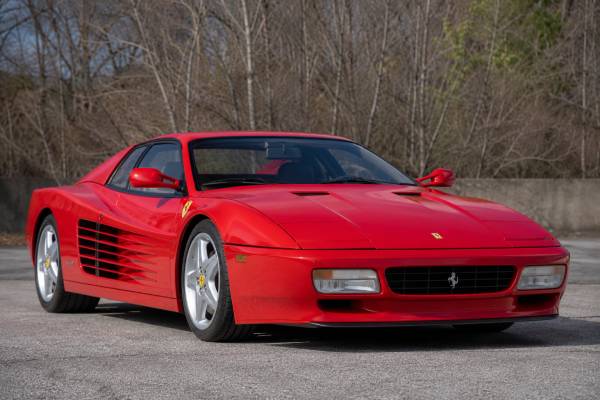
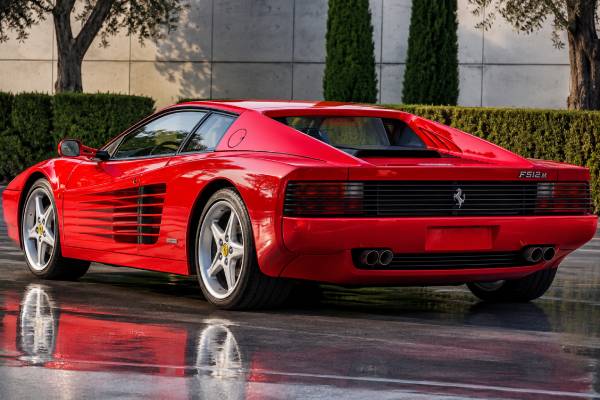
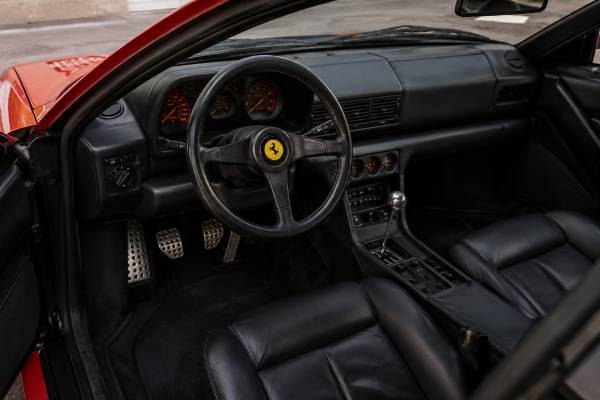
The Ferrari F512 M is the final road-going evolution of the Testarossa family and the last mid-engine Ferrari production car powered by the company’s famous flat-12 engine layout. Introduced in 1994, the F512 M replaced the 512 TR with sharper styling, fixed headlights, revised aerodynamics, lighter engine internals, and the F113 G 4.9-liter 12-cylinder producing 440 hp. It was not a clean-sheet supercar, but that is part of its appeal: it represents the most developed version of the wide, dramatic, side-straked Testarossa concept. With only about 501 examples built, it sits in a rare space between analog 1990s Ferrari performance and modern collector-grade scarcity. Buyers care about originality, service history, factory documentation, and specification, while enthusiasts value its gated manual gearbox, broad rear track, unmistakable sound, and end-of-era significance.
Table of Contents
- Why the F512 M Matters
- F113 G Flat-12 Specifications
- Production Numbers, Variants, and Options
- Pininfarina Design and Final Testarossa Engineering
- Road Feel, Speed, and Everyday Usability
- Maintenance Risks and Restoration Realities
- Market Values and Buyer Checklist
Why the F512 M Matters
The F512 M matters because it closed Ferrari’s mid-engine flat-12 road-car chapter. It was the final form of the Testarossa idea before Ferrari moved its front-line 12-cylinder grand tourer back to a front-engine layout with the 550 Maranello.
The original Testarossa arrived in 1984 as one of the defining supercars of its decade. It was wide, theatrical, and unmistakably Pininfarina, with dramatic side strakes that fed the radiators and gave the car its signature shape. In 1991, Ferrari developed the concept into the 512 TR, improving chassis stiffness, engine output, weight distribution, gearbox behavior, and cockpit ergonomics. The F512 M, shown in 1994, was the last and rarest step.
“M” stands for “Modificata,” meaning modified. That name is accurate. The F512 M was not a totally new car, but it received enough mechanical, visual, and detail changes to stand apart from the 512 TR. The engine was reworked with lighter internal components, the body gained fixed exposed headlights, the rear received round lamps, the wheels became model-specific 18-inch split rims, and the cabin gained small but useful updates.
Its importance is also tied to timing. By the mid-1990s, the supercar world was changing quickly. The McLaren F1 had moved the benchmark for speed and engineering. The Lamborghini Diablo was louder, wilder, and more powerful on paper. Ferrari itself was modernizing under Luca di Montezemolo, with cars such as the F355 showing a more polished and usable direction. The F512 M stood at the crossroads: old-school Ferrari layout, analog controls, gated manual gearbox, and big naturally aspirated 12-cylinder character, but with enough refinement to feel less raw than the earliest Testarossa.
Collectors now treat it as the most collectible production Testarossa derivative. The reasons are clear:
- It is the rarest standard-production Testarossa-family road car.
- It is the last Ferrari road car with the mid-mounted flat-12 layout.
- It has a manual gearbox and no modern driver-mode complexity.
- It carries recognizable 1990s Ferrari design with unique final-version details.
- It sits between usable modern-classic Ferrari ownership and blue-chip rarity.
It is not universally loved for its styling changes. Some enthusiasts prefer the original Testarossa’s pop-up headlights and full-width rear grille. Others prefer the F512 M because it looks more aggressive, more modern, and more clearly limited. That split opinion has become part of the car’s identity. For buying and collecting, however, rarity, final-series status, and mechanical development make the F512 M a serious car rather than simply a late facelift.
F113 G Flat-12 Specifications
The F512 M’s core specification is a naturally aspirated 4.9-liter flat-12, a five-speed gated manual transaxle, rear-wheel drive, and a tubular steel chassis with independent suspension. Its official performance placed it among the fastest road Ferraris of the mid-1990s.
Strictly speaking, the engine is often described as a flat-12, though Ferrari also described these engines as 180-degree V12 units. In practical terms, the cylinders lie horizontally opposed in two banks, creating a low engine mass and a distinctive sound. The F113 G engine used four valves per cylinder, dry-sump lubrication, electronic fuel injection, and revised internals compared with the 512 TR.
| Item | Specification |
|---|---|
| Model code | F110 HB |
| Engine code | F113 G |
| Engine layout | Mid-mounted 180-degree 12-cylinder / flat-12 |
| Displacement | 4,943 cc |
| Bore x stroke | 82.0 mm x 78.0 mm |
| Valvetrain | 48 valves, double overhead camshafts per bank |
| Induction | Naturally aspirated |
| Maximum power | 324 kW / 440 PS at 6,750 rpm |
| Maximum torque | 500 Nm at 5,500 rpm |
| Transmission | 5-speed gated manual transaxle |
| Drivetrain | Rear-wheel drive |
The F512 M was not about a huge horsepower jump. The 512 TR was already powerful, so Ferrari focused on sharper response, lighter rotating parts, and better breathing. Titanium connecting rods and a revised crankshaft helped reduce internal mass. The result was a more eager version of the same basic engine character: strong low-end torque for a high-end exotic, a hard pull through the middle of the tachometer, and a cleaner rush toward the top end.
| Item | Specification |
|---|---|
| Length | 4,480 mm |
| Width | 1,976 mm |
| Height | 1,135 mm |
| Wheelbase | 2,550 mm |
| Front track | 1,532 mm |
| Rear track | 1,644 mm |
| Dry weight | 1,455 kg |
| Fuel capacity | 100 liters |
| Front tires | 235/40 ZR18 |
| Rear tires | 295/35 ZR18 |
| Top speed | 315 km/h |
| 0–100 km/h | 4.7 seconds |
The chassis followed the Testarossa-family formula: a tubular steel structure, aluminum body panels in key areas, independent suspension, ventilated disc brakes, ABS, and a very wide rear stance. The rear track is notably wider than the front, which gives the car its planted look and contributes to its high-speed stability.
The five-speed gearbox may seem old beside later six-speed Ferraris, but it suits the engine. Ratios are long, and the shift quality depends heavily on condition, temperature, and correct adjustment. A healthy car has a deliberate, mechanical shift through the metal gate. A tired one can feel obstructive, especially when cold.
Production Numbers, Variants, and Options
The F512 M was built in very small numbers, with about 501 cars produced globally. That low production total is the main reason it now trades differently from the more numerous Testarossa and 512 TR.
Unlike some later Ferrari models, the F512 M range was simple. There was one body style: a two-seat Berlinetta coupe. There was one basic powertrain: the F113 G flat-12 with a five-speed manual gearbox. There was no factory Spider, no automatic, no Challenge version, and no lightweight homologation special.
The meaningful differences are found in market specification, steering position, color, interior trim, options, documentation, and condition. For collectors, these differences matter more than they might on an ordinary used car.
Market specification and identification
U.S.-market cars are especially significant because very few were imported. Public auction descriptions commonly cite 75 examples for the United States market, making U.S.-spec cars a small subset of an already rare model. These cars can have market-specific equipment, emissions details, lighting, labeling, and passive restraint requirements.
European and other-market cars can be equally desirable, especially when finished in rare colors or preserved in exceptional condition, but import history and compliance documentation must be checked carefully. A car that moved between markets should have a clear paper trail.
Key identification points include:
- VIN and chassis number matching the correct model and market.
- Engine number and gearbox number recorded in documentation where available.
- Correct F512 M fixed-headlight front bodywork.
- Round rear lamps rather than the earlier Testarossa-style rear treatment.
- Correct model-specific wheels.
- Proper F512 M interior details, instruments, and trim.
- Factory books, tools, service book, manuals, and pouch.
Factory equipment and desirable options
The most visible factory option is the carbon-fiber sport seat, often described in sale listings as a major desirability factor. These seats give the cabin a more focused feel and are especially prized when original to the car. They are also harder to source correctly later.
Other value-sensitive items include:
- Original paint color and interior color combination.
- Factory luggage, when supplied or documented.
- Complete tool kit and jack.
- Owner’s manuals and service book.
- Original window sticker or delivery paperwork.
- Ferrari Classiche certification where applicable.
- Major service invoices from recognized Ferrari specialists.
- Original wheels, exhaust components, and interior trim.
The highest-value examples tend to combine low mileage, rare color, original trim, full documentation, and a recent major service. A common red-over-tan or red-over-black car can still be very desirable, but unusual factory colors can bring strong premiums when the condition and paperwork support the story.
Originality and matching numbers
Matching numbers are important because the F512 M is now a serious collector Ferrari. A replaced engine, undocumented gearbox replacement, non-original color change, or missing documentation can materially affect value.
That does not mean every restored or repaired car should be rejected. A properly repaired car with expert documentation can still be a good car to own and drive. The issue is price. A car with repaint history, accident repair, or incomplete records should not be valued like a low-mile, original, fully documented example.
For this model, authenticity is more than a talking point. It directly affects liquidity. When it is time to sell, buyers will ask the same questions about books, tools, Classiche file, service invoices, paint readings, production records, and component numbers.
Pininfarina Design and Final Testarossa Engineering
The F512 M looks different because Ferrari tried to modernize the Testarossa shape without erasing its core identity. The result is sharper, rarer, and more controversial than the earlier cars.
Pininfarina’s original Testarossa design was built around cooling needs. The radiators sat at the sides, not the nose, which allowed a low front profile and required large side intakes. The famous strakes were not merely decoration; they managed airflow into those side openings while becoming one of the most recognizable design signatures of the 1980s.
The F512 M kept that wide-side architecture but changed the front and rear dramatically. The pop-up headlights disappeared, replaced by exposed fixed lamps under clear covers. The front lid gained twin NACA-style ducts. At the rear, the earlier horizontal grille treatment gave way to four round tail lamps, visually connecting the F512 M to other Ferraris of the period and previewing the styling language that would become familiar on later models.
Not everyone loves the change. Some see the fixed headlights as less pure than the original Testarossa’s dramatic pop-up arrangement. Others see them as the key detail that makes the F512 M feel like a final, more focused evolution rather than a simple continuation.
Aerodynamics and cooling
The F512 M’s shape was still governed by cooling and stability. The wide rear bodywork fed air to the side-mounted radiators and helped manage the heat produced by the large 12-cylinder engine. The rear deck, side intakes, underbody airflow, and broad stance all contributed to high-speed confidence.
Unlike modern supercars, the F512 M does not rely on active aero, movable flaps, or software-controlled stability systems. Its aerodynamic character is mechanical and physical. The car feels planted because of its dimensions, tires, suspension geometry, weight distribution, and the way air is managed through the body.
Cockpit and sensory character
The cockpit is pure 1990s Ferrari: low seating, long dashboard, gated shifter, simple controls, and a view framed by broad front wings and large mirrors. It is more usable than the earliest Testarossa cabin, but it is still a wide, low exotic with compromises.
The most important special feature is the way the engine dominates the experience. The flat-12 sits behind the occupants and changes personality with revs. At lower speeds it has a deep mechanical hum. Under load it becomes smoother, harder, and more urgent. The intake, exhaust, gear whine, and mechanical noise all blend into something very different from a modern turbocharged supercar.
This is why the F512 M remains emotionally important. It is not simply fast. It feels mechanical in a way that modern performance cars often filter out.
Road Feel, Speed, and Everyday Usability
A good F512 M feels fast, wide, stable, and deeply mechanical rather than light or playful. It is a high-speed analog Ferrari with real effort in the controls and a strong sense of occasion.
The engine is the main event. The 4.9-liter flat-12 pulls cleanly once warm, with enough torque that the car does not need constant downshifts in normal driving. It is not peaky in the fragile sense. Instead, it builds speed with a long, muscular surge, then rewards the driver with a harder, brighter sound as the revs rise.
The five-speed gated manual adds to the occasion. Shift action should feel precise but deliberate. When cold, second gear may need patience, as with many older Ferraris. Once warm, the gearbox should become more cooperative. A car that remains difficult to select, jumps out of gear, grinds, or feels vague needs specialist inspection.
Steering is heavy at low speeds and more satisfying once the car is moving. The F512 M is not small, and it never lets the driver forget its width. On narrow roads, that width is part of the challenge. On faster roads, it becomes part of the appeal. The car settles into long bends with a planted rear end and a stable, confident feel.
The ride is firm but not brutally harsh when the suspension is healthy. Old dampers, tired bushings, incorrect tires, or poor alignment can make the car feel nervous or crashy. A properly set-up F512 M should feel controlled, not loose.
Braking performance was strong for the period, with ventilated discs and ABS, but expectations need to be realistic. The system does not feel like a modern carbon-ceramic setup. Pedal feel, disc condition, fluid age, caliper health, and tire condition all matter. A car used gently for years may need brake refurbishment before it feels right.
Where the F512 M works best
The F512 M is happiest on open roads where its engine, gearing, and stability can breathe. It can be driven in town, but that is not its natural setting. The clutch, heat, width, low nose, and limited rear visibility all demand attention.
It is best understood as:
- A fast grand-touring supercar, not a small sports car.
- A mechanical experience, not a digital performance tool.
- A car that rewards smooth inputs more than aggression.
- A car that improves dramatically when maintained and set up correctly.
- A collector Ferrari that still needs regular exercise.
Track use is possible, but it is not the smartest way to enjoy most collector-grade examples today. The car’s value, parts cost, cooling load, tire wear, and age make road use more sensible unless the owner is prepared for serious maintenance expense.
Maintenance Risks and Restoration Realities
The F512 M is not a casual-maintenance exotic. It needs specialist care, engine-out belt service, careful inspection of age-related systems, and a buyer who understands that low mileage does not automatically mean low cost.
The major service is the central ownership topic. Timing belt work on the flat-12 typically requires removing the engine assembly, which means labor costs are substantial. Many owners plan belt service by time rather than mileage because age hardens belts, seals, hoses, and rubber parts even when the car is rarely driven. Exact intervals should be verified against the official service documentation for the VIN and market.
A recent major service is valuable only if it is properly documented. A vague statement such as “belts done” is not enough. A strong invoice should show who performed the work, when it was done, what parts were replaced, and whether related items were addressed while the engine was out.
Common areas to inspect
The best inspection is done by a Ferrari specialist who knows Testarossa-family cars. General exotic-car knowledge is helpful, but this model has specific packaging, service, and parts issues.
Important checks include:
- Timing belts, tensioners, seals, and service date.
- Valve-cover leaks and oil seepage around the flat-12.
- Cooling hoses, radiators, fans, and thermostat operation.
- Fuel hoses, injectors, pumps, pressure regulation, and tank condition.
- Clutch wear, release bearing noise, and hydraulic operation.
- Gearbox synchros, shift linkage adjustment, and transaxle noises.
- Suspension bushings, dampers, ball joints, and alignment.
- Brake calipers, discs, hoses, ABS operation, and fluid condition.
- Air-conditioning function, cabin controls, and electrical accessories.
- Fuse panel condition, connectors, grounds, and evidence of heat damage.
- Original wheel condition, especially on multi-piece wheels.
- Tire age, not just tread depth.
- Underbody damage from lifts, curbs, or poor transport.
- Accident repair, paintwork, panel alignment, and frame measurements.
The F512 M’s low nose and wide body make transport and storage damage common inspection points. Scraped undertrays, cracked front lower panels, bent jacking points, or poor paint repairs can reveal how carefully the car has been handled.
Age matters more than mileage
Many F512 Ms have low mileage, but long storage creates its own problems. Fuel can degrade. Seals can dry. Clutch hydraulics can leak. Brake calipers can stick. Tires can age out long before the tread wears down. Electrical contacts can corrode. Cooling systems can develop leaks after heat cycles return.
A higher-mile car with steady expert maintenance may drive better than a very low-mile car that sat for years. For collectors, mileage still affects value, but for owners, condition and maintenance quality matter more.
Restoration and parts concerns
Restoring an F512 M is expensive because production was low and many trim, body, wheel, and interior parts are model-specific. Mechanical parts shared with the broader Testarossa family may be more available, but final-version components can be difficult or costly.
Originality creates a tradeoff. Sensible reversible upgrades, such as improved cooling fans, modern tire choices in correct sizes, or discreet electrical improvements, may make ownership easier. But visible modifications, aftermarket wheels, non-original seats, non-standard paint, or altered exhaust systems can reduce collector appeal unless the original parts come with the car.
U.S.-market cars should also be checked by VIN for recall and campaign history. Some 1995 Ferrari 512M vehicles were associated with a multi-piece wheel campaign involving loosening wheel fasteners. A buyer should verify whether the specific car was affected and whether the remedy was completed.
Market Values and Buyer Checklist
The F512 M now occupies the top tier of Testarossa-family values. As of 2026, ordinary driver-quality examples can sit in the mid-six-figure range, while exceptional low-mile, rare-color, highly documented cars can reach far higher.
Recent public sales show how wide the range can be. Strong examples have sold from the $400,000s into the $900,000s, with exceptional results above $1 million when mileage, rarity, color, documentation, and buyer demand align. That does not mean every F512 M is a million-dollar car. It means the best cars have separated sharply from average or compromised examples.
Value is driven by a small set of factors:
| Value factor | Why it matters |
|---|---|
| Original specification | Factory-correct color, trim, wheels, seats, and equipment support collector value. |
| Documentation | Books, tools, service records, ownership history, and build data reduce uncertainty. |
| Recent major service | A properly documented engine-out service can prevent immediate major expense. |
| Mileage | Low mileage helps value, but only when condition and maintenance are also strong. |
| Color combination | Rare and attractive factory colors can bring a premium. |
| Market specification | U.S.-spec, European-spec, and other-market cars have different buyer pools. |
| Certification | Ferrari Classiche certification can improve confidence for top-tier buyers. |
| Accident history | Structural repair, poor paintwork, or missing history can reduce value sharply. |
Cars to seek
The best F512 M to buy is the car with the clearest story. It should have strong service history, correct parts, known ownership, good paint readings, a clean inspection, and no mystery around its market history.
Seek examples with:
- Documented recent major service by a respected Ferrari specialist.
- Original books, tools, pouch, jack, and service records.
- Correct wheels and trim.
- Matching or well-documented engine and gearbox details.
- Clean underbody and no signs of poor lifting.
- Healthy gearbox operation when warm.
- Cooling system that holds temperature in traffic.
- Interior materials that match the mileage claim.
- Clear import and emissions documentation if moved between markets.
- Classiche certification or enough records to support originality.
Cars to avoid or discount heavily
Avoid cars where the story depends on excuses. A rare Ferrari can still be a bad buy if the paperwork is weak or the car needs expensive catch-up work.
Be cautious with:
- Missing service history.
- Long-term storage without recent recommissioning.
- Cheap repaint work or visible overspray.
- Non-original wheels, seats, exhaust, or body pieces without original parts included.
- Unexplained engine or gearbox replacement.
- Weak second-gear synchro, clutch issues, or transaxle noise.
- Overheating in traffic.
- Electrical problems across multiple systems.
- Old tires on a car presented as “ready to drive.”
- Accident history without proper repair documentation.
- Seller reluctance to allow a specialist inspection.
A pre-purchase inspection is not optional on this car. The inspection should include paint readings, lift inspection, road test from cold, compression or leak-down testing when justified, review of service invoices, and verification of recall or campaign completion for the specific VIN.
For long-term collectability, the F512 M has strong fundamentals: low production, final-series status, manual gearbox, naturally aspirated 12-cylinder engine, and a direct connection to one of Ferrari’s most recognizable model lines. Its main risk is not desirability. The risk is buying the wrong example at the right-car price.
References
- Ferrari F512 M (1994) – Ferrari.com 1994 (Manufacturer Specifications)
- FERRARI F512M OWNER’S MANUAL Pdf Download | ManualsLib 1995 (Owner’s Manual)
- Check for Recalls: Vehicle, Car Seat, Tire, Equipment | NHTSA 2026 (Recall Database)
- FERRARI 512M 1995 WHEELS:MULTI PIECE Recall NHTSA Campaign ID Number: 95V217000 | Justia 1995 (Recall Database)
- 1995 Ferrari F512 M | Monterey 2025 | RM Sotheby’s 2025 (Auction Result)
Disclaimer
This article is for informational purposes only and is not a substitute for professional diagnosis, repair, valuation, or inspection. Specifications, torque values, service intervals, procedures, equipment, and compliance details can vary by VIN, market, production date, and installed components. Always verify details against the official Ferrari service documentation for the specific car and consult a qualified Ferrari specialist before purchase or repair.
If you found this guide useful, please consider sharing it on Facebook, X/Twitter, or your favorite car community to support our work.