
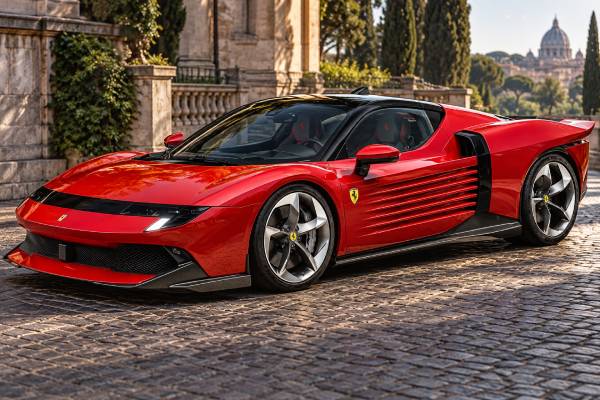
The Ferrari 849 Testarossa is the plug-in hybrid successor to the SF90 Stradale and the modern return of one of Ferrari’s most famous names. It is not a retro remake of the 1980s Testarossa. It is a mid-rear-engine, all-wheel-drive hybrid flagship built around a heavily revised 4.0-liter twin-turbo V8, three electric motors, and a total output of 1,050 cv, or about 1,036 hp. The internal-combustion engine carries the F154FC project code, while the car is often associated with the F173M development lineage because it evolves the SF90’s basic concept.
For buyers, collectors, and enthusiasts, the 849 Testarossa matters because it sits at an important turning point: Ferrari is combining combustion drama, electric response, active aerodynamics, and software-driven vehicle control in a regular-production flagship. It is fast enough to challenge limited-run hypercars, yet it remains a road car with a usable cabin, factory warranty support, and real ownership considerations.
Table of Contents
- Where the 849 Testarossa Fits in Ferrari History
- F154FC V8 Hybrid System and Key Specs
- Coupe, Spider, Assetto Fiorano, and Options
- Aero Design, Cooling, and Cockpit Engineering
- Road, Track Performance, and Driving Character
- Hybrid Maintenance, Reliability, and Service Risks
- Market Values, Buying Checks, and Collectability
Where the 849 Testarossa Fits in Ferrari History
The 849 Testarossa is important because it replaces the SF90 Stradale as Ferrari’s most advanced series-production hybrid supercar. It keeps the basic idea of a mid-mounted twin-turbo V8 supported by three electric motors, but Ferrari revised the engine, aerodynamics, electronics, cockpit, and styling to make it sharper and more emotionally distinct.
The name is the most obvious talking point. “Testarossa” means “red head” in Italian, a reference to red-painted cam covers on Ferrari competition engines. The name first became famous through Ferrari’s 1950s and 1960s racing cars, including the 250 Testa Rossa, and later through the dramatic 1984 Testarossa road car. That 1980s model became a cultural object as much as a supercar, known for its flat-12 engine, wide body, side strakes, and poster-car presence.
The 849 Testarossa uses the name differently. It does not copy the old flat-12 formula. Instead, it revives the badge for a new hybrid era. The “849” part points to the combustion engine: eight cylinders and roughly 499 cc per cylinder from the 3,990 cc V8. That makes the name both historical and technical.
In Ferrari’s modern range, the 849 Testarossa sits above the V6 hybrid 296 family and far above the front-engine grand tourers in performance focus. It is also different from limited hypercars such as the LaFerrari or F80. The 849 is a high-end series-production model, not a numbered halo car, but its price, allocation process, and complexity still make it an exotic purchase rather than a normal showroom car.
Its launch also shows how Ferrari is managing the transition toward electrification. The car can run for short distances in electric-only mode, but its identity remains built around a high-output V8. The hybrid system is used for traction, torque fill, response, braking control, and lap-time performance, not just fuel economy.
Historically, that makes the 849 Testarossa a bridge car. It carries an iconic name from the brand’s analog past while relying on electric motors, digital control systems, active aerodynamics, and hybrid energy management. Collectors will watch it because it may become one of the defining Ferrari V8 hybrids of the 2020s. Enthusiasts care because it shows that Ferrari still sees the combustion engine as a core emotional feature, even in a 1,000-plus-horsepower plug-in hybrid.
F154FC V8 Hybrid System and Key Specs
The 849 Testarossa’s headline specification is its 1,050 cv total system output, equal to roughly 1,036 hp. The combustion engine alone produces 830 cv from a 3,990 cc twin-turbo V8, while the three electric motors add response, traction, and torque-vectoring ability.
The engine is the F154FC, a development of Ferrari’s long-running twin-turbo V8 family. Compared with the SF90’s V8, the 849’s unit receives major revisions, including larger turbochargers, revised cylinder heads, updated intake and exhaust hardware, and changes aimed at both power and sound quality. Peak engine torque is 842 Nm, or about 621 lb-ft, delivered at high engine speed.
The hybrid layout uses two electric motors on the front axle and one electric motor at the rear. The front motors make the car all-wheel drive when the system is active and allow precise torque vectoring across the front axle. The rear electric unit helps blend electric torque with the V8 and the 8-speed dual-clutch transmission.
| Item | Specification |
|---|---|
| Vehicle type | Mid-rear-engine plug-in hybrid supercar |
| Combustion engine | F154FC 90-degree twin-turbo V8 |
| Displacement | 3,990 cc / 4.0 liters |
| Engine output | 830 cv at 7,500 rpm |
| Engine torque | 842 Nm at 6,500 rpm |
| Electric motors | Three: two front, one rear |
| Hybrid battery | 7.45 kWh lithium-ion battery |
| Total output | 1,050 cv / about 1,036 hp |
| Transmission | 8-speed dual-clutch automatic |
| Drivetrain | Hybrid all-wheel drive |
The battery capacity is modest compared with a mainstream plug-in hybrid, but that is intentional. The 849 Testarossa uses its battery as a performance tool. The car can travel up to about 25 km in electric-only eDrive mode, useful for low-speed urban use, early departures, or restricted areas, but the main purpose is to provide repeatable performance support.
The transmission is an 8-speed dual-clutch gearbox, a type of automated manual transmission with two clutches. One clutch handles odd-numbered gears and the other handles even-numbered gears, allowing very quick shifts without the feel of a conventional torque-converter automatic.
| Category | Ferrari 849 Testarossa |
|---|---|
| 0–100 km/h | Under 2.3 seconds |
| 0–200 km/h | About 6.35 seconds for the coupe |
| Top speed | Over 330 km/h / over 205 mph |
| Fiorano lap time | 1:17.500 |
| Dry weight | About 1,570 kg with lightweight options |
| Weight distribution | About 45 percent front / 55 percent rear |
| Maximum downforce | About 415 kg at 250 km/h |
| Wheelbase | 2,650 mm |
| Length | 4,718 mm |
| Width | 2,304 mm including mirrors |
| Height | 1,225 mm for the coupe |
The key point is balance. The 849 is more powerful than the SF90, but Ferrari also worked to keep weight under control and improve downforce, braking control, cooling, and response. On a car this fast, the numbers are only part of the story. The supporting systems decide how usable that power feels.
Coupe, Spider, Assetto Fiorano, and Options
The main versions are the 849 Testarossa coupe and the 849 Testarossa Spider. Both use the same basic plug-in hybrid powertrain, while the Spider adds a retractable hard top for open-air driving with a small weight and packaging penalty.
The coupe is the purest version. It has the cleaner roofline, lower weight, and strongest appeal for buyers who want the most focused berlinetta configuration. For collectors, the coupe is usually the safer long-term choice when a Ferrari model is offered in both closed and open forms, although open cars can be more desirable in some markets where climate and lifestyle matter.
The Spider is more emotional and more flexible. Its retractable hard top can open or close in about 14 seconds and can operate at low road speeds. The tradeoff is extra weight and a slightly different feel because roof mechanisms add structure and mass. For many buyers, the difference will not matter on public roads. For track-focused owners, the coupe remains the more direct choice.
Assetto Fiorano package
The most important performance option is Assetto Fiorano. This is Ferrari’s track-leaning package for buyers who want sharper responses, lower weight, and more aggressive aerodynamics without moving to a separate limited-edition model.
Typical Assetto Fiorano features include:
- lighter materials, including more carbon fiber and titanium parts
- a claimed weight reduction of about 30 kg
- more focused suspension tuning
- additional aerodynamic elements
- more track-suitable tires when specified
- a more purposeful visual identity
This package matters for value because it creates a clearer split in the market. A standard 849 Testarossa may be easier to live with, especially if used mostly on road. An Assetto Fiorano car will likely be more desirable to buyers who care about lap times, specification rarity, and the closest link to Ferrari’s track-development work.
Personalization and factory options
Ferrari buyers rarely order plain cars. Paint, interior trim, carbon-fiber exterior parts, wheels, seats, stitching, brake caliper colors, and special materials can all change the car’s character and future desirability.
The most value-sensitive options are usually the ones that affect identity and performance:
- Assetto Fiorano package
- carbon-fiber racing seats
- exterior carbon-fiber trim
- forged or lightweight wheel designs
- special paint through Ferrari’s personalization programs
- lift system, depending on road conditions
- telemetry or track-related equipment
- high-quality interior materials that suit the exterior color
Buyers should be careful with unusual color combinations. A bold specification can become highly desirable if it is tasteful, rare, and well documented. It can also narrow the resale audience if it feels too personal. On modern Ferraris, the best cars tend to combine strong factory documentation, attractive paint, desirable options, and low but realistic mileage.
Because the 849 Testarossa is not a numbered limited-production model, build configuration may matter more than production count. Early allocations, first-year cars, Spider versus coupe choices, and Assetto Fiorano examples will all form separate value groups as the market matures.
Aero Design, Cooling, and Cockpit Engineering
The 849 Testarossa’s design is not just a styling exercise. Its shape is heavily driven by cooling, downforce, hybrid packaging, and high-speed stability, while its visual language connects modern Ferrari geometry with past sports-prototype influence.
The front end is sharper and more technical than the SF90’s. The nose uses a horizontal graphic that visually links the lights and helps create a full-width, low-slung impression. Airflow management begins at the front splitter and underbody, where vortex generators help control air under the car. This matters because downforce from the floor is more efficient than simply adding large exposed wings.
The side bodywork is shaped to feed cooling air to the radiators, intercoolers, and hybrid-related systems. A plug-in hybrid supercar needs to manage several heat sources at once: combustion engine, turbochargers, transmission, electric motors, battery, inverters, brakes, and cabin climate systems. Poor heat management would reduce repeatability, so the 849’s vents and ducts are functional.
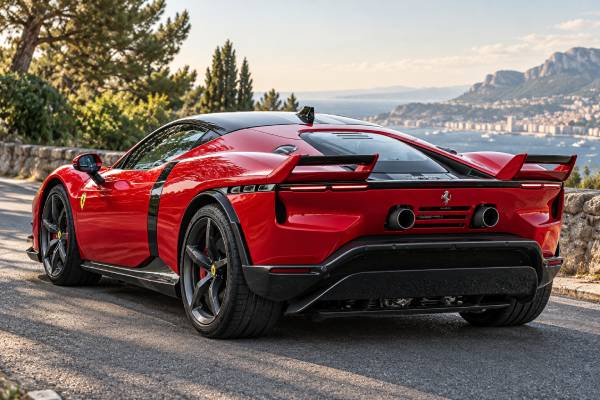
At the rear, the car uses a twin-tail design and an active spoiler. The spoiler can change position to balance drag and downforce. In low-drag mode, the car is cleaner and faster on straights. In high-downforce mode, it gains rear stability for braking and cornering. Ferrari claims peak downforce of about 415 kg at 250 km/h, which is a serious figure for a road car without a huge fixed racing wing.
The design also uses historical suggestion without becoming nostalgic. The rear surfaces and strong horizontal forms recall Ferrari sports prototypes more than the 1980s Testarossa. There are no large side strakes copied from the old flat-12 car. The link is more about drama, width, cooling, and the return of the name.
Cockpit and controls
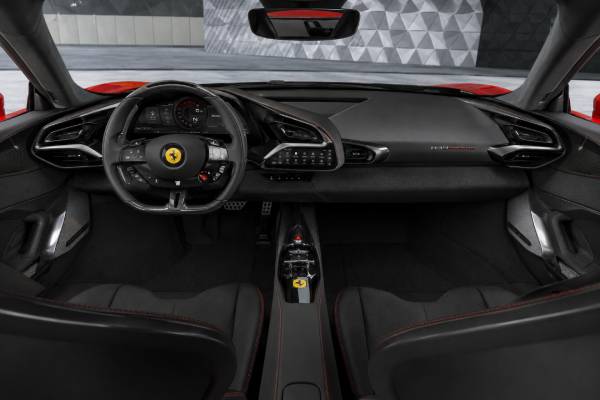
Inside, the 849 Testarossa follows Ferrari’s driver-focused layout but responds to criticism of overly touch-sensitive controls in recent models. The redesigned steering wheel restores a physical start button, which many owners prefer because it gives a more deliberate sense of occasion.
The cabin is built around digital displays, a central driver zone, and a low seating position. The passenger display, available on many modern Ferraris, turns performance data into part of the shared experience. The center console includes Ferrari’s modern interpretation of a gated shifter, not a mechanical manual gate, but a visual and tactile reference to the brand’s past.
For daily use, the important details are visibility, ingress, seat choice, ride height, and heat management. Racing seats can look fantastic and save weight, but comfort seats may be better for owners who plan longer drives. A front lift system is worth considering in areas with steep driveways, speed humps, or urban parking ramps.
Sound and sensory character
Hybrid supercars risk feeling too digital if the powertrain is quiet or overly filtered. Ferrari worked on intake and exhaust character so the V8 remains central to the experience. The electric motors add instant torque, but the car’s emotional peak still comes from the combustion engine rising through the rev range and the gearbox delivering fast, crisp shifts.
That contrast is part of the car’s identity. At low speed, it can be calm and electric. Under load, it becomes a high-output Ferrari V8 with strong turbocharged torque and a harder upper-range character.
Road, Track Performance, and Driving Character
The 849 Testarossa should feel brutally quick, but its real achievement is how it manages that speed. Electric torque, all-wheel drive, active aerodynamics, brake control, and Ferrari’s latest vehicle software are designed to make more than 1,000 hp usable rather than intimidating all the time.
Acceleration is the most obvious sensation. With electric drive helping the V8 before the turbochargers are fully awake, response should be immediate. From rest, the front motors help pull the car forward while the rear powertrain pushes, giving the 849 the kind of launch traction that a rear-drive supercar could not match. Under 2.3 seconds to 100 km/h is hypercar territory.
At higher speeds, the V8 becomes more dominant. The 0–200 km/h time of about 6.35 seconds shows how hard the car continues to pull after the launch phase. This is where the engine’s 830 cv output matters. Many electrified cars feel explosive at low speed but less special as speed rises. The 849 is engineered to keep accelerating with serious force above normal road speeds.
Drive modes and hybrid behavior
Ferrari’s drive-mode logic lets the car change personality. In electric mode, it can move quietly for short distances. In hybrid and performance modes, the car manages battery use to keep response strong. In qualifying-style modes, the system prioritizes maximum output over energy conservation.
For road driving, this means the 849 can be surprisingly calm in traffic, especially compared with older mid-engine Ferraris that had heavier controls, hot cabins, and more demanding low-speed manners. But it is still wide, low, expensive, and extremely fast. The driver must manage visibility, road surface, tire temperature, and the car’s physical size.
On a mountain road, the appeal should come from torque fill, steering precision, and traction. The front motors can help pull the nose through corner exits, while the rear V8 gives the car its main character. The challenge is speed compression: the car can reach illegal speeds almost instantly, so the most satisfying road use may come from rhythm, braking feel, and sound rather than full-throttle acceleration.
Braking and cornering
The braking system is central to the driving experience. The 849 uses advanced electronic control to blend braking force, stability management, and regenerative behavior. In simple terms, the car is constantly estimating grip and load so it can make better use of the tires.
Carbon-ceramic brakes should offer huge stopping power, but they depend on condition, temperature, and correct use. On the road, they can feel firm and powerful. On track, they need proper warm-up and cool-down habits. Repeated heavy braking in a car this fast creates enormous heat, so tire and brake condition are not minor details.
The car’s Fiorano lap time of 1:17.500 places it among Ferrari’s quickest road cars. That figure matters because Fiorano is Ferrari’s own development reference. It shows that the 849 is not just more powerful than the SF90; it is also more effective around a circuit.
Comfort and usability
A modern Ferrari flagship is no longer a weekend-only punishment device. The 849 should be usable for short trips, fast touring, and occasional city driving, especially with the lift system and comfort seats. The Spider adds more sensory drama at lower speeds because the driver can hear more intake, exhaust, and airflow.
Still, usability has limits. The car is wide, tire costs are high, luggage space is limited, and low-profile performance tires are vulnerable to potholes. Owners should think of it as a road-capable supercar, not as a practical grand tourer.
Hybrid Maintenance, Reliability, and Service Risks
The 849 Testarossa is too new for a mature reliability record, so buyers should focus on system complexity, factory warranty coverage, service history, and specialist inspection. Its main risks are not ordinary used-car problems; they are hybrid-system condition, carbon-ceramic brake wear, tire age, software status, cooling performance, and accident repair quality.
Ferrari’s modern maintenance programs help, but they do not remove the need for careful ownership. A 1,036 hp plug-in hybrid with active aero, high-voltage hardware, turbochargers, electric motors, advanced dampers, and many control modules must be maintained exactly by the book.
Powertrain and hybrid system
The F154 engine family has a strong performance reputation, but the 849’s version is highly stressed. The larger turbochargers, high heat output, and hybrid packaging make cooling and oil quality critical. Owners should allow proper warm-up before heavy use and avoid shutting the car down immediately after hard driving unless the system has managed its cool-down cycle.
The hybrid system adds several inspection areas:
- high-voltage battery health
- charging function
- inverter and power electronics status
- front motor operation
- rear motor operation
- software updates
- cooling circuits for electric components
- warning lights or stored fault codes
Battery condition matters more than electric-only range. A weak or fault-prone battery could affect performance, drivability, and resale confidence. Buyers should ask for official diagnostic reports rather than relying only on dashboard messages.
Brakes, tires, and suspension
Carbon-ceramic brakes are expensive, and visual inspection alone is not enough. Discs can look acceptable while being near wear limits or damaged by track heat cycles. A proper pre-purchase inspection should measure disc condition, pad life, and evidence of overheating.
Tires are another major ownership item. A car with low mileage can still need tires if they are old, heat-cycled, mismatched, or flat-spotted. With this level of performance, tire condition affects traction control, braking distance, ride quality, and safety.
Suspension and lift systems should be checked for leaks, uneven operation, warning lights, and abnormal noises. If the car has been used on track or driven hard on poor roads, inspect wheels, underbody panels, front splitter edges, and suspension mounting points.
Electronics and software
Modern Ferraris depend heavily on software. The 849’s systems include hybrid management, brake control, traction systems, active aerodynamics, infotainment, battery management, and driver-interface settings. A car that has missed updates or has unresolved electrical faults can be difficult and expensive to sort.
Before buying, confirm:
- all factory campaigns are complete
- software is current for the market
- no warning lights are present
- charging equipment works
- both keys are present
- infotainment, displays, cameras, and driver controls operate correctly
- active aero and lift systems function as intended
Service documentation and warranty
For a car this new, warranty status is a major value factor. Buyers should verify original in-service date, remaining factory warranty, hybrid-component coverage, maintenance-plan eligibility, and whether the car has been serviced only by authorized Ferrari dealers or recognized specialists.
A missing service record is a red flag even on a low-mileage example. Modern supercars can spend long periods stored, transported, or displayed, and lack of use can create battery, tire, seal, and brake issues. The safest cars are not always the lowest-mileage cars; they are the cars that have been stored correctly, serviced on time, driven enough to stay healthy, and documented thoroughly.
Market Values, Buying Checks, and Collectability
The 849 Testarossa’s market will be shaped by allocation, specification, mileage, warranty, and early demand rather than by age alone. Because it is a new flagship Ferrari with an iconic name, early cars are likely to trade in a narrow, highly scrutinized market where the best specifications command the strongest attention.
Launch pricing varies by country and tax structure. European reports placed early coupe pricing around €460,000 and Spider pricing around €500,000 before local market differences. In the United Kingdom, early published prices were above £400,000 for the coupe and higher for the Spider. U.S. pricing depends on market timing, tariffs, equipment, and dealer allocation, so buyers should treat any simple currency conversion as only a rough guide.
What drives value
The highest-value examples will likely combine desirable factory specification with clean ownership history. The most important value factors are:
- coupe or Spider body style
- Assetto Fiorano package
- special paint or tasteful Tailor Made specification
- carbon racing seats or desirable comfort specification
- low but believable mileage
- complete Ferrari service history
- remaining warranty and maintenance coverage
- no accident history
- original paint and original panels
- complete accessories, books, charger, tools, and keys
- strong color combination with broad resale appeal
The 849 Testarossa is not yet old enough for traditional “collector car” originality debates, but the same principles already apply. Factory-correct specification, clean documentation, and careful ownership will matter more than aftermarket changes.
Buyer inspection checklist
A serious buyer should not inspect an 849 like a normal used car. The correct approach is to combine Ferrari dealer records, diagnostic data, physical inspection, and provenance review.
| Area | What to verify |
|---|---|
| Identity | VIN, build sheet, market version, options, paint, trim, and delivery records |
| Warranty | Factory warranty, hybrid coverage, maintenance plan, and campaign completion |
| Hybrid system | Battery health, charging operation, stored fault codes, and cooling performance |
| Engine and gearbox | Leaks, software status, shift quality, service records, and abnormal noises |
| Brakes | Carbon-ceramic disc condition, pad life, heat damage, and track-use signs |
| Tires and wheels | Tire age, matching fitment, wheel damage, alignment signs, and curb impact |
| Body and aero | Paint depth, panel alignment, underbody damage, splitter wear, and active spoiler function |
| Interior | Seat wear, display function, steering controls, trim damage, and passenger display operation |
| Ownership file | Invoices, original order, accessories, charger, manuals, keys, and storage records |
Examples to seek and avoid
Seek a car with a clear original order, strong factory specification, complete service file, and no unexplained gaps. A tasteful coupe with Assetto Fiorano and a desirable color may appeal to the most performance-focused buyers. A Spider in an elegant specification may be easier to enjoy on road and could be very desirable in warm-weather markets.
Avoid cars with accident ambiguity, missing charging equipment, inconsistent paint readings, unresolved warning lights, or signs of heavy track use without matching maintenance records. Also be cautious with heavily personalized interiors or unusual colors unless the price reflects the narrower resale audience.
Long-term collectability
The 849 Testarossa has several ingredients for future collectability: a famous name, extreme performance, a record-level production-Ferrari output at launch, a major role in Ferrari’s hybrid transition, and a link to the SF90 lineage. It also uses a high-output V8 at a time when long-term combustion-engine production is uncertain.
That does not guarantee appreciation. Modern Ferrari values depend on production volume, replacement models, macroeconomic conditions, mileage, and how the enthusiast community judges the car after real-world use. If the 849 proves reliable, emotionally engaging, and meaningfully better than the SF90, it should hold a strong place in modern Ferrari history.
For most buyers, the best strategy is simple: buy the specification you genuinely want, keep it original, maintain it through the correct channels, preserve every document, and drive it enough to keep the systems healthy. A carefully used, properly serviced 849 Testarossa will almost always be more appealing than a neglected delivery-mile car with weak documentation.
References
- Ferrari 849 Testarossa – Ferrari.com 2025 (Official Model Page)
- 849 Testarossa 2025 (Official Ferrari Article)
- Ferrari 849 Testarossa Spider – Ferrari.com 2025 (Official Model Page)
- Warranties And Official Ferrari Maintenance 2026 (Official Maintenance and Warranty Information)
- Ferrari Testarossa (1984) – Ferrari.com 2025 (Official Historical Model Page)
Disclaimer
This article is for informational purposes only and is not a substitute for professional diagnosis, repair, inspection, or valuation. Specifications, torque values, service intervals, software requirements, and repair procedures can vary by VIN, market, equipment, model year, and factory update. Always verify details against official Ferrari service documentation and have any car inspected by a qualified Ferrari dealer or specialist before purchase.
If you found this guide useful, please consider sharing it on Facebook, X/Twitter, or your favorite enthusiast community to support our work.