
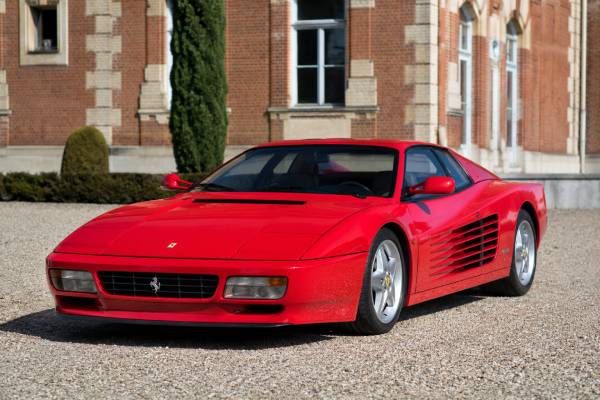
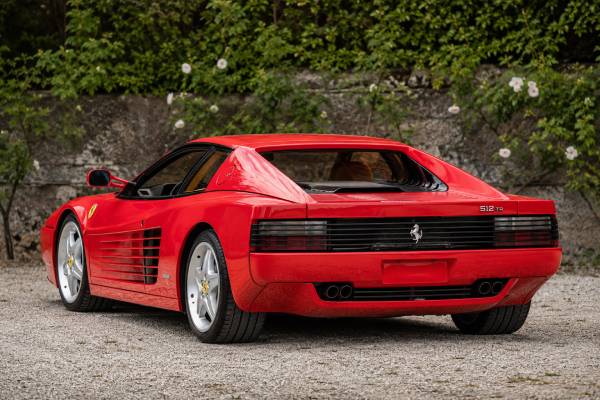
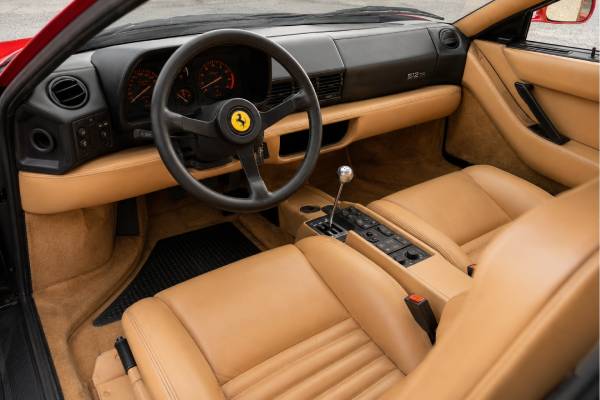
The Ferrari 512 TR is the heavily reworked evolution of the Testarossa, launched for the early 1990s when Ferrari needed its flat-12 flagship to feel sharper, faster, and more modern without losing the drama that made the original famous. It kept the rear-mid-mounted 4.9-liter F113 D flat-12, wide Pininfarina body, side strakes, and open-gate manual gearbox, but gained a stiffer F110 HB chassis, lower-mounted drivetrain, revised suspension, improved cabin ergonomics, larger 18-inch wheels, and a major power increase to 428 hp. Today, the 512 TR matters because it is more than a facelift. It is the best-balanced and most usable Testarossa-era car for many drivers, rarer than the original Testarossa, more analog than the later F512 M, and increasingly important to collectors who want a manual, naturally aspirated, twelve-cylinder Ferrari with genuine 1990s supercar presence.
Table of Contents
- Why the 512 TR Matters
- F113 D Flat-12 Specs and Chassis
- Production, Variants, and Authenticity Clues
- Pininfarina Design and Ferrari Engineering Details
- How the 512 TR Drives
- Maintenance, Reliability, and Restoration Risks
- Market Values and Buying Strategy
Why the 512 TR Matters
The 512 TR matters because it turned the Testarossa from an 1980s poster car into a more serious 1990s driver’s Ferrari. It preserved the drama, width, flat-12 sound, and unmistakable shape, but improved the parts owners actually feel: steering response, seating position, power delivery, braking confidence, and chassis balance.
Ferrari introduced the 512 TR as the successor to the Testarossa, with production beginning in 1991 and customer cars reaching key markets around the 1992 model year. The name followed Ferrari’s traditional logic: “512” for roughly five liters and twelve cylinders, and “TR” for Testa Rossa, meaning red head, a reference to the red-painted cam covers and Ferrari’s famous sports-racing heritage.
It sat at the top of Ferrari’s regular road-car range below the F40 halo car. At the time, Ferrari’s lineup included models such as the 348 and Mondial t, but the 512 TR was the big mid-engine flagship: wide, expensive, fast, and unmistakably exotic. Its closest natural rival was the Lamborghini Diablo, while cars like the Porsche 911 Turbo and Acura NSX challenged it from very different angles.
The 512 TR also arrived after the late-1980s collector boom had cooled. That matters today because many cars lived through changing market attitudes. Some were stored as investments, some were driven hard, and others were maintained unevenly when values softened. A buyer now needs to judge each car on condition, records, originality, and mechanical health rather than assuming all low-mileage examples are automatically better.
Historically, the 512 TR is important because it was one of Ferrari’s last road cars with the classic flat-12 layout. It followed the Berlinetta Boxer and Testarossa tradition, then led to the F512 M before Ferrari moved its front-engine twelve-cylinder flagship role to the 550 Maranello. That makes the 512 TR part of a short and special line of wide-bodied, mid-engine Ferrari twelve-cylinder road cars.
For collectors, its appeal is clear:
- It is rarer than the standard Testarossa.
- It has a gated five-speed manual gearbox.
- It uses a naturally aspirated flat-12 with no hybrid assist, turbocharging, or electronic drive modes.
- It has stronger performance and a better chassis than the earlier Testarossa.
- It retains the original design language more faithfully than the later F512 M.
For enthusiasts, the attraction is more emotional. The 512 TR still feels like an event at low speed. It is wide, low, loud, and mechanical. It has heavy controls compared with modern supercars, but those controls are part of the character. It asks the driver to work, warm it properly, shift carefully, and respect its size. In return, it gives a kind of analog Ferrari experience that modern cars rarely provide.
F113 D Flat-12 Specs and Chassis
The main technical story of the 512 TR is the F113 D flat-12 and the revised F110 HB chassis. Ferrari did not simply add power; it lowered the drivetrain, stiffened the structure, revised the suspension, and gave the car larger wheels and tires to make the extra performance usable.
| Item | Specification |
|---|---|
| Model code | F110 HB |
| Production period | 1991–1994 |
| Body style | Two-seat berlinetta coupe |
| Engine code | F113 D |
| Engine type | Rear-mid-mounted 180-degree V12 / flat-12, naturally aspirated |
| Displacement | 4,943 cc |
| Bore x stroke | 82.0 mm x 78.0 mm |
| Valvetrain | DOHC, 4 valves per cylinder, 48 valves total |
| Fuel and ignition | Bosch Motronic engine management with electronic fuel injection |
| Compression ratio | 10.0:1 |
| Maximum power | 315 kW / 428 hp at 6,750 rpm |
| Maximum torque | 491 Nm / 362 lb-ft at 5,500 rpm |
| Transmission | 5-speed manual with open-gate shifter |
| Drive | Rear-wheel drive with limited-slip differential |
The engine is often casually called a boxer, but technically it is a 180-degree V12 rather than a true boxer. The opposing pistons share crankpins in V12 fashion, so “flat-12” is the clearer everyday description. The layout helps keep weight low and gives the car its broad rear body shape, but it also makes servicing more involved than on many front-engine cars.
Compared with the earlier Testarossa, the 512 TR received revised cylinder heads, larger intake valves, updated intake and exhaust systems, and modernized engine management. The result was not only more peak power but also a stronger, cleaner pull through the middle of the rev range. It still rewards high rpm, but it is less lazy below the top end than the original Testarossa.
| Item | Specification |
|---|---|
| Frame | Tubular steel chassis with body panels in mixed materials |
| Front suspension | Independent unequal-length wishbones, coil springs, telescopic dampers, anti-roll bar |
| Rear suspension | Independent unequal-length wishbones, twin rear spring/damper units per side, anti-roll bar |
| Front brakes | Ventilated discs, about 315 mm |
| Rear brakes | Ventilated discs, about 310 mm |
| Front tires | 235/40 ZR 18 |
| Rear tires | 295/35 ZR 18 |
| Length | 4,480 mm |
| Width | 1,976 mm |
| Height | 1,135 mm |
| Wheelbase | 2,550 mm |
| Dry weight | About 1,473 kg |
| Fuel tank | 100 liters |
| 0–100 km/h | About 4.8 seconds |
| Top speed | About 313.8 km/h / 195 mph |
The move to 18-inch wheels was important. The earlier Testarossa’s 16-inch setup suited the 1980s, but the 512 TR needed a lower-profile tire with more control. The wide rear tires helped the car put down torque more confidently, while the front tire size gave sharper initial response.
The lower engine and gearbox mounting also changed the car’s personality. The original Testarossa could feel wide and dramatic but not always eager. The 512 TR still feels large, yet its center of gravity, structural stiffness, and revised suspension make it more settled when driven quickly.
Production, Variants, and Authenticity Clues
The 512 TR was a limited-production regular model, not a numbered special edition, and total production is commonly quoted at roughly 2,261 cars. For buyers, the important point is not just how many were made, but whether a specific car’s chassis, engine, market equipment, color, documents, and service history all tell one consistent story.
The car was sold in European, North American, and other market specifications. Differences can include lighting, emissions equipment, passive restraint systems, side markers, documentation, and certification labels. U.S.-market cars are especially easy to identify by federalized lighting and VIN/label requirements, while European cars can vary depending on country of original delivery.
The 512 TR was built only as a coupe from Ferrari’s normal production catalog. Factory-related and special cases exist, but they should be treated very carefully by buyers. A standard coupe with complete documentation is easier to value and maintain than a claimed special car with weak paperwork.
Important production and identity points include:
- Chassis numbers are part of the broader Ferrari numbering sequence, so buyers should verify the exact VIN and build information rather than relying only on model-year claims.
- The engine should be the correct F113 D family unit for the car.
- Matching-numbers status matters, especially on high-value examples.
- Factory books, warranty card, tool kit, jack, spare equipment, and original pouch add value.
- Ferrari Classiche certification can help confirm major identity points, though it does not replace a full mechanical inspection.
- Market-specific equipment should match the car’s delivery region.
- A repaint is not automatically bad, but color change or poor paintwork can affect value.
Year and equipment details
Early cars are closest to the launch specification and may show small detail differences such as badging and market equipment. Later cars can be more desirable when they have documented updates, especially braking or drivetrain-related improvements. Some late-production cars are sought after because they represent the most developed version before the F512 M arrived.
Anti-lock braking is a detail worth verifying by VIN and equipment, not by assumption. References to ABS equipment appear in period documentation and owner literature, but not every car in the market should be treated the same without inspection. A specialist should confirm the actual brake system, warning lights, hydraulic condition, and correct function.
There were also unusual special-order and market-specific cars. The Japanese-market 512 TR Speciale, connected with Cornes & Co., is one of the better-known special cases. Pininfarina Spider conversions and Brunei-related cars sit in a very different category and require expert documentation. For ordinary buyers, these rare versions should be approached as collector research projects, not normal used Ferrari purchases.
Factory options and colors
The 512 TR did not have the enormous option lists of modern Ferraris. The most important choices were paint, leather color, carpets, wheels, luggage, and market equipment. Rosso Corsa over black or beige remains the familiar image, but unusual factory colors can be highly desirable when documented.
Buyers should be careful with later modifications. Aftermarket exhausts, non-original wheels, stereo changes, painted trim, carbon-look interior pieces, and lowered suspension can make a car harder to value. Some upgrades are reversible and may improve usability, but originality usually carries more weight in this market than personal taste.
Pininfarina Design and Ferrari Engineering Details
The 512 TR looks familiar because Pininfarina kept the Testarossa’s signature side strakes and wide stance, but nearly every visual change was meant to modernize and refine the car. The design is cleaner, lower-looking, and less black-trim-heavy than the original.
The front end is the easiest place to see the update. The bumper and grille were reshaped, the lower intake was modernized, and the front spoiler became more integrated with the body. The car still has pop-up headlights, but the face looks more like an early-1990s Ferrari than a pure 1980s wedge.
At the rear, the 512 TR kept the horizontal slatted tail treatment, one of the most recognizable Testarossa features. The bumper and exhaust surround were cleaned up, and the engine cover was revised because the drivetrain sat lower in the chassis. This was not just cosmetic. Lowering the engine and gearbox helped reduce the center of gravity and improved the way the car behaved in fast corners.
The side strakes remain the car’s defining feature. They are not decoration alone. They help manage airflow into the side radiators, which were a major packaging decision inherited from the Testarossa. By moving the radiators to the sides, Ferrari avoided the long front coolant-pipe layout used on the Berlinetta Boxer and created the huge side intake graphic that made the car famous.
Inside, the 512 TR is much better than the earlier Testarossa for many drivers. The dashboard, center console, seats, door panels, and controls were updated. The driving position is lower and more natural, and the cabin feels more like a 1990s supercar than an older exotic. It is still not spacious in a modern sense, but it is more comfortable for real driving.
The cockpit’s best details are the ones Ferrari no longer builds into new cars:
- A metal open shift gate.
- A simple three-spoke steering wheel without modern button clutter.
- Large analog instruments.
- Leather trim with a hand-built feel.
- A direct view over broad front fenders and into wide door mirrors.
- A mechanical starter-and-idle ritual that rewards patience.
The sound is another key feature. The flat-12 does not bark like a front-engine Ferrari V12, and it does not have the same high, metallic scream as later five-valve or V12 supercars. It has a layered, wide, hard-edged sound that builds with rpm. Intake noise, exhaust tone, and mechanical vibration all mix together. A healthy 512 TR sounds expensive, busy, and smooth at the same time.
The car’s engineering is also defined by service access. The engine and transaxle sit on a rear subframe, and major belt service typically requires major rear-end disassembly or engine-out work depending on workshop method and scope. That design is part of the car’s exotic nature, but it is also why ownership cannot be treated like a normal sports car.
How the 512 TR Drives
A good 512 TR feels faster, more stable, and more alert than an early Testarossa, but it still feels analog and large. It is not a point-and-squirt modern supercar; it rewards smooth inputs, warm fluids, and a driver who understands weight, width, and mechanical sympathy.
At low speed, the car can feel intimidating. It is very wide, rear visibility is limited, the clutch is heavy compared with modern cars, and the gated shifter prefers patience until the gearbox oil is warm. First-to-second shifts can be stiff when cold. Forcing the lever is a mistake. A well-adjusted car improves greatly once warm, and the shift action becomes one of the best parts of the experience.
The engine is flexible for a twelve-cylinder exotic, but it comes alive above the middle of the rev range. Below that, it is smooth and tractable. Above roughly 4,000 rpm, the 512 TR feels much more urgent, and the last part of the tachometer gives the car its real character. The power delivery is linear, so the speed can build deceptively quickly.
The steering is one of the car’s strongest qualities when the chassis is properly set up. At parking speeds it requires effort, but on the move it gives honest feedback. The long wheelbase and wide rear track make the car stable, while the lowered drivetrain and revised suspension reduce the old Testarossa’s sense of mass sitting high behind the cabin.
The brakes are strong enough for fast road use when properly maintained, but buyers should not expect modern carbon-ceramic endurance. Old fluid, aged hoses, worn discs, sticking calipers, or tired tires can make a 512 TR feel much worse than it should. Brake condition has a huge effect on confidence.
On mountain roads, the car prefers flowing rhythm rather than tight hairpin aggression. It is wide, and the driver must place it carefully. On highways, it is much more at home. The engine settles, the chassis feels stable, and the car covers distance with a sense of occasion. It is loud and warm by modern GT standards, but it is more usable than its shape suggests.
On track, a healthy 512 TR is quick but costly to use. Tires, brakes, clutch wear, heat management, and accident risk all matter. It can be driven hard, but it is better understood as a fast road Ferrari than a track-day tool. Modern track work also exposes old rubber, old fuel hoses, tired cooling systems, and weak electrical connections very quickly.
The best examples feel tight, smooth, and expensive. Tired examples feel heavy, vague, hot, noisy in the wrong ways, and reluctant to shift. That difference is why pre-purchase inspection matters so much. A 512 TR does not hide neglect well once an experienced specialist drives it.
Maintenance, Reliability, and Restoration Risks
The 512 TR can be dependable when maintained by the right specialists, but deferred maintenance is expensive. Its biggest ownership risk is not one single flaw; it is the combined cost of engine-out service, aging fuel and cooling parts, gearbox and differential inspection, electrical issues, trim deterioration, and parts scarcity.
The timing belts are the headline maintenance item. The flat-12 uses belt-driven camshafts, and service access is labor-intensive. Many owners combine belt service with tensioners, water pump inspection, seals, hoses, fuel lines, valve-cover gaskets, clutch inspection, and “while you are in there” work. A cheap belt job that ignores nearby aging parts can become expensive later.
Common maintenance and inspection areas include:
- Timing belts, tensioners, cam seals, and service date.
- Fuel hoses, fuel rails, pump condition, filters, and any smell of fuel.
- Cooling hoses, radiator condition, fans, thermostat, and water pump.
- Clutch wear, release bearing condition, and hydraulic leaks.
- Gearbox synchros, especially if cold shifting has been abused.
- Differential condition and evidence of later updates or careful service.
- Engine mounts and drivetrain alignment.
- Suspension bushings, dampers, ball joints, and wheel bearings.
- Brake calipers, discs, hoses, master cylinder, and ABS function where fitted.
- Alternator, starter, fuse panel, relays, grounds, and battery cables.
- Air-conditioning function and cabin control operation.
- Pop-up headlight motors and exterior lighting.
- Door, window, mirror, and seat mechanisms.
Fuel-system condition deserves special attention. Old fuel hoses and fittings are not acceptable on a hot mid-engine Ferrari. Any fuel odor, dampness, cracking, non-factory routing, or poor clamp choice should be treated seriously. A proper inspection should include visible lines, hidden lines, pump areas, filters, and the tank region where accessible.
Cooling-system health is equally important. The 512 TR’s side radiator layout works when everything is clean and correct, but age can bring clogged cores, tired fans, brittle hoses, weak caps, and poor bleeding. Overheating can cause expensive damage, so stable temperature behavior is essential during a test drive.
Gearbox and differential health are major value issues. The open-gate shifter should feel mechanical, not obstructive once warm. Crunching, jumping out of gear, whining, or metal in the oil are warning signs. The differential is a known area of concern on the Testarossa family, and buyers should ask what has been inspected, repaired, or upgraded.
Body and chassis inspection must be thorough. The 512 TR uses a tubular steel structure, and accident repair quality matters enormously. Look for inconsistent panel gaps, poor paint texture, uneven underbody repairs, damaged jacking points, distorted suspension pickup areas, and evidence of crash damage around the front and rear structures. A glossy repaint can hide poor history.
Interior parts are also expensive. Correct seats, switchgear, leather, carpets, instruments, tool kit, books, and luggage can affect value. Sticky plastics are more associated with later Ferraris, but leather shrinkage, bolster wear, dash lifting, and sun damage still matter. A car stored badly can have surprisingly high cosmetic restoration costs even with low mileage.
A sensible maintenance approach is simple: buy the best-documented car you can, then keep it on a calendar-based service plan rather than waiting for faults. Long idle storage is not kind to this model. A 512 TR that is driven regularly, warmed properly, and serviced by specialists is usually a better ownership bet than a neglected garage queen.
Market Values and Buying Strategy
The 512 TR sits in a strong collector position because it combines rarity, analog controls, Pininfarina drama, and a naturally aspirated twelve-cylinder engine. Values vary widely, but the best cars are separated from average ones by documentation, originality, mileage, color, recent major service, and mechanical inspection results.
As of the mid-2020s, typical public market results and listings often place driver-quality cars in the low-to-mid $200,000 range, stronger documented cars around the high $200,000s to $400,000-plus, and exceptional low-mileage or unusually specified cars higher. Outlier sales can occur when mileage, provenance, color, or celebrity history changes the story, but those should not be used as the baseline for normal cars.
The biggest value drivers are:
- Original engine and gearbox.
- Clear ownership history.
- Factory-correct colors and interior.
- Complete books, tools, pouch, warranty card, and service records.
- Recent belt and major service by a known Ferrari specialist.
- No accident history or high-quality documented repair if damage occurred.
- Original wheels, exhaust, trim, and interior.
- Verified market specification.
- Ferrari Classiche certification where appropriate.
- Sensible mileage backed by records, not just odometer appearance.
Buyers should avoid cars with vague service claims. “Belts done” is not enough. You want invoices, dates, mileage, workshop name, and a clear list of parts replaced. A major service from a respected specialist in the last year is worth real money. A service from ten years ago, even if the car has barely moved, is not current maintenance.
| Area | What to verify |
|---|---|
| Identity | VIN, engine number, market specification, factory colors, and documentation |
| Service history | Timing belts, tensioners, fluids, clutch, fuel lines, cooling system, and specialist invoices |
| Engine | Cold start, leaks, smoke, idle quality, compression/leak-down if needed, and oil pressure |
| Transmission | Warm shift quality, synchros, clutch engagement, differential noise, and oil condition |
| Chassis | Accident evidence, suspension pickup points, underbody repairs, corrosion, and alignment |
| Brakes and tires | Disc condition, caliper function, hoses, fluid age, ABS operation where fitted, and tire date codes |
| Interior | Seat wear, leather shrinkage, switchgear, instruments, HVAC, windows, and originality |
| Completeness | Books, tools, jack, spare items, keys, records, luggage, and factory accessories |
The best 512 TR to buy is usually not the cheapest and not always the lowest-mileage. A very low-mile car can need extensive recommissioning if it has sat for years. A moderate-mile car with excellent care may drive better and cost less to sort. The sweet spot is a car with strong documentation, recent major service, original specification, clean history, and enough use to prove the systems work.
Color matters, but condition matters more. Rosso Corsa is the classic choice and easy to resell. Black, yellow, silver, white, blue, and other unusual factory colors can be more distinctive and sometimes more valuable, but only when documentation is strong. A non-original color change is a different matter and can reduce collector appeal.
For investors, the 512 TR has good long-term fundamentals. It is rarer than the Testarossa, more usable than many older twelve-cylinder Ferraris, more analog than modern supercars, and tied to a design that still has global recognition. For drivers, it offers something values cannot fully explain: a manual Ferrari flat-12 experience with real theatre.
The main buying rule is simple: pay for the right car up front or pay later in repairs. A neglected 512 TR can consume the difference between a bargain and a top-quality example very quickly. A properly inspected, well-kept car is expensive, but it gives the owner the best chance of enjoying what makes the model special rather than spending the first year correcting someone else’s shortcuts.
References
- Ferrari 512 TR (1991) – Ferrari.com 1991 (Manufacturer Specifications)
- Vehicle Detail Search – 1992 FERRARI 512TR | NHTSA 2026 (Recall Database)
- FERRARI 512 TR TECHNICAL MANUAL Pdf Download | ManualsLib 1991 (Technical Manual)
- Ferrari 512 TR Market – CLASSIC.COM 2026 (Market Data)
- 1993 Ferrari 512 TR | Paris 2026 | RM Sotheby’s 2026 (Auction Result)
Disclaimer
This article is for informational purposes only and is not a substitute for professional diagnosis, inspection, repair, or valuation. Specifications, torque values, service intervals, procedures, market equipment, and recall applicability can vary by VIN, country, production date, and installed equipment. Always verify details against the car’s official Ferrari service documentation and have any purchase or repair decision reviewed by a qualified Ferrari specialist.
If you found this guide useful, please consider sharing it on Facebook, X/Twitter, or your favorite car community to support our work.