
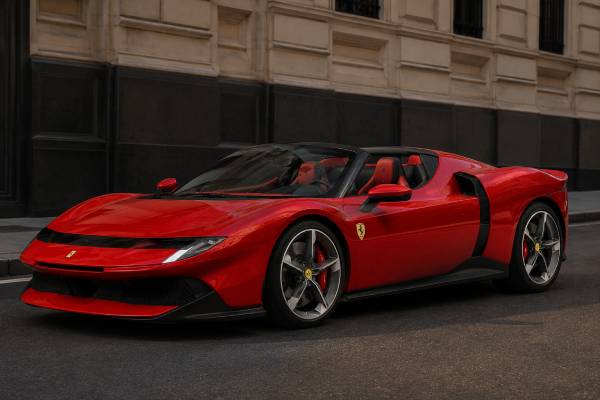
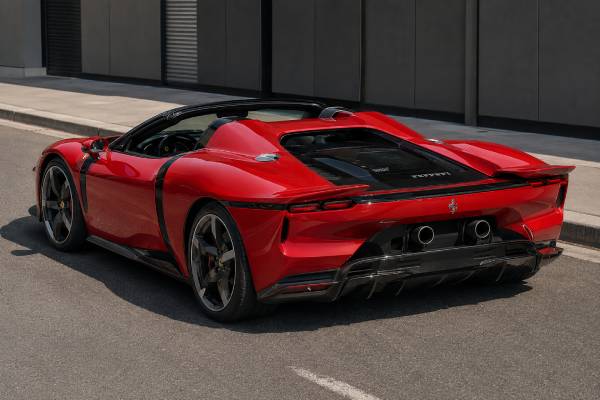
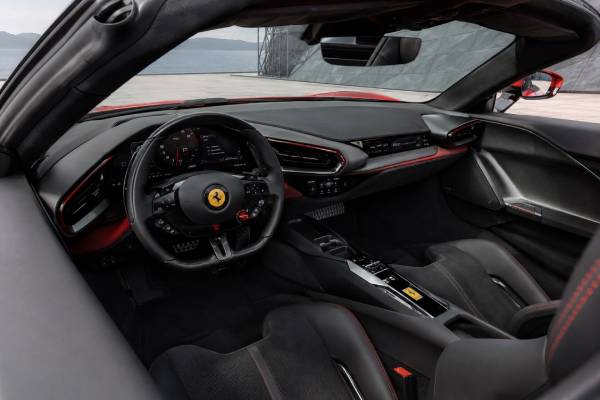
The Ferrari 849 Testarossa Spider is the open-top version of Ferrari’s new mid-rear-engine plug-in hybrid flagship, replacing the SF90 Spider while reviving one of Maranello’s most famous names. Internally known as the F173M, it combines the F154FC 4.0-liter twin-turbo V8 with three electric motors, giving a total output of 1,050 cv, or about 1,036 hp. That makes it one of the most powerful series-production open Ferraris ever offered.
Its importance is not just the number. The Spider brings together Ferrari’s latest hybrid all-wheel-drive system, active aerodynamics, a retractable hard top, track-focused electronics, and a name tied to the 1950s 250 Testa Rossa and the 1980s Testarossa. For buyers, collectors, and enthusiasts, it sits at the point where Ferrari heritage, electrified performance, and modern supercar ownership all overlap.
Table of Contents
- From SF90 Spider to New Testarossa
- F154FC Hybrid Specs and Performance Data
- Spider Versions, Options, and Factory Identity
- Aero, Roof, and Hybrid Engineering Details
- Road and Track Character of the Spider
- Maintenance Risks for the PHEV Testarossa
- Market Pricing and Buying Checklist
From SF90 Spider to New Testarossa
The 849 Testarossa Spider matters because it is not a simple facelift of the SF90 Spider. It is Ferrari’s new open-top hybrid flagship, with more power, sharper aerodynamics, revised control software, and a much more assertive design identity.
Ferrari chose the Testarossa name carefully. The original meaning, “red head,” comes from red-painted cam covers on Ferrari racing engines, especially the legendary 250 Testa Rossa sports racers of the 1950s. Most people, however, connect the name with the wide, side-straked 1980s Testarossa. The 849 does not copy that car. Instead, it uses the name to connect Ferrari’s racing past, 1980s visual memory, and a new electrified performance era.
The “849” name also follows a technical logic. The 8 refers to the V8 engine, while 49 points to the approximate displacement of each cylinder in cubic centimeters. It is a modern Ferrari naming system, not a nostalgia-only badge.
The Spider version is especially important because Ferrari’s open flagship cars often become highly desirable when the market settles. The roof mechanism adds weight and complexity, but it also changes the experience. With the hard top lowered, the driver gets more intake sound, turbo noise, exhaust presence, and speed sensation. For many buyers, that is exactly the point.
The 849 Testarossa Spider fits above the 296 Spider in Ferrari’s range. The 296 is smaller, rear-wheel drive, and powered by a V6 hybrid system. The 849 is larger, more powerful, all-wheel drive through its front electric motors, and positioned as the extreme series-production hybrid Ferrari for buyers who want maximum usable performance.
Its launch period also places it in an interesting moment for Ferrari. The company is not abandoning combustion engines, but it is using hybrid systems to extend performance, improve control, and meet modern expectations. The 849 Testarossa Spider shows how Ferrari is treating electrification: not as a replacement for engine character, but as a tool for traction, torque fill, acceleration, and chassis control.
For collectors, the car’s long-term appeal will likely depend on three things: its role as the SF90 Spider successor, the revived Testarossa name, and how the market views early high-output Ferrari plug-in hybrids over time. For owners, its importance is more immediate. It offers hypercar-level acceleration in a car with a retractable hard top, usable drive modes, and factory support.
F154FC Hybrid Specs and Performance Data
The 849 Testarossa Spider’s core specification is a 4.0-liter F154FC twin-turbo V8 paired with three electric motors. The result is 1,050 cv, about 1,036 hp, all-wheel-drive traction, and performance that pushes the Spider beyond the already extreme SF90 Spider.
| Category | Specification |
|---|---|
| Model | Ferrari 849 Testarossa Spider |
| Internal type | F173M |
| Powertrain | Plug-in hybrid, mid-rear V8 plus three electric motors |
| Engine code | F154FC |
| Engine layout | 90-degree twin-turbocharged V8, dry sump |
| Displacement | 3,990 cc |
| Bore x stroke | 88 mm x 82 mm |
| Combustion-engine output | 830 cv at 7,500 rpm |
| Combustion-engine torque | 842 Nm at 6,500 rpm |
| Electric motor output | 220 cv combined contribution |
| Total system output | 1,050 cv / about 1,036 hp |
| Battery | 7.45 kWh lithium-ion pack |
| Transmission | 8-speed dual-clutch F1 gearbox |
| Drivetrain | Hybrid all-wheel drive with front torque vectoring |
The engine is the latest version of Ferrari’s twin-turbo V8 family. It uses dry-sump lubrication, which helps keep the engine low in the chassis and maintains oil supply under hard cornering, braking, and acceleration. The V8 alone produces more than many complete supercars, but the electric side of the system is just as important.
Two electric motors sit on the front axle. They provide electric all-wheel drive and allow torque vectoring, which means the car can send different amounts of torque to the left and right front wheels. The third electric motor sits at the rear, between the engine and gearbox area, helping with torque fill and hybrid performance.
| Measure | Figure |
|---|---|
| 0–100 km/h | Under 2.3 seconds |
| 0–200 km/h | 6.5 seconds |
| Top speed | Over 330 km/h |
| 100–0 km/h braking | 28.5 meters |
| Fiorano lap time | 1 minute 18.100 seconds |
| Downforce | 415 kg at 250 km/h |
| Dry weight | 1,660 kg, with lightweight specification |
| Weight distribution | 45% front / 55% rear |
| Fuel tank | 68 liters |
| Trunk capacity | 74 liters |
The 849 Testarossa Spider is not just quick from a standing start. Its 0–200 km/h figure shows how hard the car pulls beyond normal road speeds. The electric motors help at lower speeds, while the V8 takes over with huge force as revs rise.
| Item | Specification |
|---|---|
| Length | 4,718 mm |
| Width | 2,304 mm, including mirrors |
| Height | 1,186 mm |
| Wheelbase | 2,650 mm |
| Front track | 1,678 mm |
| Rear track | 1,673 mm |
| Front tires | 265/35 R20 |
| Rear tires | 325/30 R20 |
| Front carbon-ceramic brakes | 410 x 223 x 38 mm |
| Rear carbon-ceramic brakes | 372 x 233 x 34 mm |
The width, tires, and brake sizes tell a lot about the car’s purpose. This is a very wide machine with huge rear tire contact patches and serious braking hardware. The Spider body is lower than the coupe in published dimensional data, but it is heavier because of the retractable roof system and the structural reinforcement needed for an open car.
Spider Versions, Options, and Factory Identity
The most important versions are the standard 849 Testarossa Spider and the Spider with the Assetto Fiorano package. The package is likely to be the key factory specification for buyers who want the most track-focused, collectible, and visually aggressive configuration.
The standard Spider is already extreme. It has the full 1,050 cv hybrid system, retractable hard top, active aerodynamics, carbon-ceramic brakes, advanced electronics, and Ferrari’s normal personalization possibilities. It is the more road-biased version, especially for owners who expect to use the car for weekend drives, events, longer trips, and occasional circuit days.
The Assetto Fiorano package adds a sharper layer. It typically focuses on weight reduction, special aerodynamic parts, more track-focused suspension choices, lighter interior components, and more aggressive tire options. On the 849 Testarossa family, the package is especially visible at the rear, where the standard twin-tail theme can be replaced or enhanced by a more wing-like aerodynamic treatment.
What matters for identification
For a modern Ferrari, identity is not only about the VIN. A serious buyer should confirm the full factory specification, original options, exterior and interior colors, market destination, service records, warranty status, and software history.
Important identification points include:
- VIN and market specification
- Original factory build sheet or official configuration record
- Confirmation of Spider body style and F173M model identity
- Assetto Fiorano package status, if fitted
- Wheel type, tire type, seat type, and carbon-fiber options
- Exterior paint, special-order color, or Tailor Made specification
- Interior trim, stitching, carbon inserts, and seat configuration
- Presence of nose lift, suspension choice, and infotainment specification
- Warranty, maintenance program, and hybrid-system coverage
Factory originality will matter as the cars age. Many modern Ferraris are personalized, but not every unusual specification improves desirability. A tasteful Tailor Made car with strong documentation can be very attractive. A loud or highly unusual color combination may need the right buyer.
Standard Spider versus Assetto Fiorano
| Version | Main appeal | Buyer profile |
|---|---|---|
| 849 Testarossa Spider | Full performance with more road comfort and open-air usability | Owners who want flagship speed without making the car too track-biased |
| 849 Testarossa Spider Assetto Fiorano | Lower weight, sharper aero, more aggressive track character | Collectors and drivers who value the most focused factory specification |
| Tailor Made or special configuration cars | Rare color, material, and trim combinations | Collectors who care about uniqueness, provenance, and presentation |
For long-term value, the safest specifications are often the ones that combine desirable performance options with a coherent color and interior. The best cars will usually have strong documentation, low mileage, careful ownership, and no unexplained changes from factory condition.
Aero, Roof, and Hybrid Engineering Details
The 849 Testarossa Spider is defined by how Ferrari integrates airflow, cooling, roof packaging, and hybrid hardware into one shape. The styling may be dramatic, but much of it serves a practical purpose.
The front end uses sharp, structured volumes and a horizontal visual theme that separates it from the softer surfacing of earlier Ferraris. The body is wide, low, and technical, with strong geometric lines rather than classic rounded curves. This suits the car’s role. It is not trying to be a traditional grand tourer. It is a maximum-performance open supercar.
At the rear, the twin-tail theme is one of the car’s signature details. It recalls Ferrari sports-prototype thinking more than the 1980s road-going Testarossa. The rear bodywork manages airflow over the engine cover, toward the active rear spoiler, and through the cooling paths needed by a high-output hybrid V8.
The active rear spoiler is especially important. In low-drag mode, it helps the car cut through the air. In high-downforce mode, it increases rear grip and stability. This makes the Spider more adaptable: calm and efficient at high speed, but more planted when braking and cornering hard.
Cooling is a major engineering challenge. A 1,050 cv plug-in hybrid Ferrari has to manage heat from the combustion engine, turbochargers, intercoolers, battery, motors, power electronics, brakes, and transmission. The large side intakes and carefully shaped body channels are not decoration. They feed the systems that let the car repeat hard acceleration and braking without quickly losing performance.
Retractable hard top
The Spider’s retractable hard top is central to its character. A hard top gives better refinement, security, and coupe-like weather protection than a fabric roof. When lowered, it changes the whole experience. The driver hears more of the V8, the turbos, the air movement, and the tire noise.
The tradeoff is weight and complexity. A roof mechanism adds parts, motors, linkages, seals, drains, sensors, and calibration requirements. It also requires structural reinforcement because removing a fixed roof changes body stiffness. Ferrari engineers the chassis around this, but the Spider will always be a more complex ownership proposition than the coupe.
Hybrid control systems
The electric motors are not there only to add headline power. They help the car leave corners harder, fill gaps in turbo response, improve traction, and stabilize the chassis. The front electric motors can pull the car out of a corner while the rear V8 and rear motor deliver huge acceleration.
The driver experiences this through modes rather than individual hardware decisions. In quiet or hybrid driving, the car can use electric power for short low-speed running. In performance modes, the system keeps the engine ready and uses the battery to support repeated acceleration. In the most aggressive settings, the car prioritizes lap time and response over electric range.
This is the real engineering story of the 849 Testarossa Spider: it uses software, motors, aero, brakes, and combustion power as one system. The car is not simply a V8 with extra electric boost. It is a software-managed hybrid performance platform.
Road and Track Character of the Spider
The 849 Testarossa Spider should feel brutally fast but not crude. Its main driving character comes from instant electric response, huge V8 power, all-wheel-drive traction, active aero stability, and the added drama of open-air driving.
At low speed, the car can be smoother and less intimidating than the output suggests. The electric motors help fill torque before the turbos are fully awake, so the response should feel immediate. In town, the dual-clutch gearbox and hybrid system reduce the old supercar sense of mechanical effort. This is still a wide, low, expensive Ferrari, but it is not a fragile-feeling analog exotic that demands constant compromise.
On open roads, the car’s performance is difficult to use fully. Under 2.3 seconds to 100 km/h and 6.5 seconds to 200 km/h means the driver reaches serious speeds almost instantly. The Spider’s advantage is that it can make even moderate speeds feel more special. Roof down, the driver gets more sound and sensation without needing to chase maximum numbers.
The gearbox is a major part of the experience. Ferrari’s 8-speed dual-clutch transmission is designed for fast, clean shifts. In automatic driving, it can be smooth enough for normal use. In manual mode, paddle shifts give the driver more involvement, especially when keeping the V8 in the upper rev range.
Steering is expected to be quick and light by modern Ferrari standards. The front electric axle helps with traction, but the driver should still feel the rear-biased balance. The car’s 45/55 weight distribution supports that. It is not a front-heavy all-wheel-drive machine. It remains a mid-engine Ferrari with added front-axle intelligence.
On track
On circuit, the Spider’s systems become easier to understand. The hybrid front axle helps the car fire out of corners. The active aero keeps it more stable through fast sections. The ABS Evo and carbon-ceramic brakes allow very hard braking with less drama than the power figure might suggest.
The main limitation for most drivers will not be the car. It will be tire temperature, track space, driver confidence, and the speed at which everything happens. A car this fast compresses decision-making. Braking points arrive quickly. Corner exits become violent if the driver is not smooth. The electronics help, but they do not cancel physics.
The Assetto Fiorano package makes the most sense for owners who will actually use the car on track. Its lighter parts, sharper aero, and more focused setup may add value and capability. For road use, the standard Spider may be the better-balanced choice, especially if the owner wants better ride comfort and broader usability.
Sound and emotion
The most debated part of the 849 Testarossa driving experience is likely to be the engine character. The F154FC V8 is massively powerful and technically impressive, but modern turbocharged hybrid engines can sound less natural than older naturally aspirated Ferraris.
The Spider body helps. Opening the roof makes the sound more immediate, and the driver hears more intake and exhaust detail. Even so, buyers expecting a screaming V12-style Ferrari soundtrack should be realistic. This car’s emotional punch comes from acceleration, response, grip, design, and open-air intensity more than old-school engine purity.
Maintenance Risks for the PHEV Testarossa
The 849 Testarossa Spider should be treated as a complex hybrid flagship, not as a normal used performance car. The biggest ownership risks are hybrid-system health, roof operation, brake condition, tire age, software status, and incomplete Ferrari service documentation.
Modern Ferraris are far more usable than older exotics, but this car combines several expensive systems. A buyer should assume that specialist inspection is mandatory, even for a nearly new example.
Powertrain and hybrid system
The F154FC V8 is a highly developed twin-turbo engine. It runs high temperatures, high boost, dry-sump lubrication, and complex cooling. Proper warm-up, correct fluids, and timely servicing matter.
Key checks include:
- Evidence of Ferrari dealer or recognized specialist servicing
- Correct oil-service history and fluid records
- No warning lights or stored hybrid-system faults
- Battery state-of-health report, where available
- Cooling-system inspection for leaks, damage, and debris blockage
- Turbocharger, charge-air, and exhaust-system checks
- Transmission behavior in automatic and manual modes
- No harsh engagement, slipping, or unexplained driveline vibration
The hybrid battery is small compared with a pure EV battery, but it is central to performance. A weak or fault-prone battery can affect drive modes, electric range, boost availability, and resale confidence.
Roof system and body structure
The retractable hard top must work perfectly. Slow movement, uneven panel gaps, water leaks, fault messages, or strange noises should be treated seriously.
A proper inspection should include:
- Roof operation through several full open-close cycles
- Seal condition around the roof, side glass, and rear deck
- Drain paths and signs of water entry
- Panel alignment and paint consistency
- Evidence of accident repair or structural work
- Wind noise during a road test
- Sensor and latch operation
Open Ferraris can be extremely desirable, but roof faults are rarely cheap. A car that has been stored badly, washed carelessly, or repaired after body damage can become a long-term nuisance.
Brakes, tires, and suspension
Carbon-ceramic brakes are strong and long-lasting when treated well, but replacement costs are high. Track use, gravel damage, thermal shock, and careless wheel cleaning can all shorten component life.
Check for:
- Rotor surface condition and thickness
- Pad life and even wear
- Brake warning messages
- Brake-pedal feel and ABS behavior
- Tire age, brand, specification, and tread depth
- Wheel damage, especially on carbon wheels if fitted
- Suspension lift operation, where equipped
- Damper leaks or fault codes
Tire choice also changes the car. Track-focused tires give sharper response and more grip when warm, but they can be noisy, less forgiving in the wet, and less suitable for cold road use.
Software, electronics, and documentation
The 849 Testarossa Spider relies heavily on software. The hybrid system, electronic differential, traction control, brake control, torque vectoring, active aero, gearbox, infotainment, driver assistance, and roof operation all depend on sensors and control modules.
A strong service file should show:
- Software updates completed by Ferrari
- Open campaigns or recalls checked
- Warranty status confirmed
- Hybrid warranty or extended coverage details
- Battery and diagnostic reports
- No repeated unresolved fault patterns
- Complete owner’s pack, manuals, keys, charger equipment, and accessories
For a car like this, “full history” does not just mean stamps in a book. It means traceable records, diagnostic evidence, and confidence that the car has been kept within Ferrari’s official support network.
Market Pricing and Buying Checklist
The 849 Testarossa Spider enters the market as a high-priced, high-demand Ferrari flagship, with European Spider pricing reported around the €500,000 level before heavy personalization. Real transaction prices can vary widely because options, taxes, market allocation, delivery timing, and early demand all matter.
Early cars may trade at premiums in some markets, especially if supply is tight. That does not automatically make every car a good investment. Modern Ferrari values depend heavily on specification, mileage, condition, timing, and whether Ferrari later releases more focused limited versions.
For buyers, the safest approach is to treat the car as both a performance machine and a document-driven collectible. A beautiful car with missing records, unclear option history, heavy track wear, or unresolved warning messages should be avoided unless priced accordingly.
What drives value
The strongest examples will likely have:
- Desirable factory colors or tasteful Tailor Made specification
- Assetto Fiorano package, if the buyer wants the most focused version
- Low but realistic mileage
- Complete Ferrari service history
- Clear warranty and maintenance-program status
- No accident history or paintwork concerns
- Excellent roof operation
- Healthy hybrid-system reports
- Original wheels, parts, tools, accessories, and documents
- Careful ownership rather than repeated short-term flipping
Mileage matters, but ultra-low mileage is not always the whole story. A car that has sat unused with a poorly maintained battery or old tires can be less attractive than a lightly used, properly serviced example.
Pre-purchase inspection checklist
| Area | What to verify | Why it matters |
|---|---|---|
| Factory identity | VIN, build sheet, options, market specification | Confirms authenticity and value-critical equipment |
| Hybrid system | Battery health, fault codes, charging equipment | Hybrid repairs can be complex and expensive |
| Engine and gearbox | Service records, leaks, shift quality, warning messages | Powertrain condition defines usability and resale confidence |
| Roof mechanism | Operation, seals, alignment, water ingress | Spider-specific faults can be costly and frustrating |
| Brakes and tires | Carbon-ceramic condition, tire age, wheel damage | Consumables are expensive and reveal usage patterns |
| Body and paint | Panel gaps, paint depth, underside damage | Accident history can heavily reduce value |
| Software and campaigns | Updates, recalls, diagnostic printouts | Modern Ferrari systems depend on current software |
Examples to seek and avoid
Seek cars with clean ownership, coherent specification, and full Ferrari documentation. A well-optioned Spider in a strong color, with careful use and no stories, will be easier to sell later.
Be careful with cars that show heavy track wear, incomplete records, unclear import history, aftermarket modifications, repeated warning lights, or poorly explained paintwork. A modern flagship Ferrari is not the place to accept vague answers.
As a long-term collector car, the 849 Testarossa Spider has several positives: a revived historic name, very high output, open-top body style, and a key role in Ferrari’s hybrid era. Its risk is complexity. If future buyers become wary of early high-performance plug-in hybrid maintenance, condition and records will matter even more.
For owners who plan to drive it, the best strategy is simple: buy the right car, keep it inside Ferrari’s service ecosystem, maintain the battery and tires correctly, document everything, and resist unnecessary modifications. That is the difference between owning a landmark Ferrari and owning a very expensive problem.
References
- Ferrari 849 Testarossa Spider – Ferrari.com 2026 (Manufacturer Model Page) ([Ferrari][1])
- 849 Testarossa Spider 2025 (Manufacturer Publication) ([Ferrari][2])
- Warranties And Official Ferrari Maintenance 2026 (Manufacturer Maintenance Information) ([Ferrari][3])
- Ferrari 849 Testarossa Review 2026 | Top Gear 2026 (Road Test) ([Top Gear][4])
- Ferrari 849 Testarossa First Drive: A Super Smart Supercar With 1,035-HP and Hybrid AWD 2026 (First Drive) ([MotorTrend][5])
Disclaimer
This article is for informational purposes only and is not a substitute for professional diagnosis, repair, valuation, or pre-purchase inspection. Specifications, torque values, service intervals, repair procedures, software requirements, and equipment can vary by VIN, market, production date, and factory options. Always verify details against official Ferrari service documentation and have any 849 Testarossa Spider inspected by a qualified Ferrari dealer or specialist.
If you found this guide useful, please consider sharing it on Facebook, X/Twitter, or your favorite car community to support our work.