


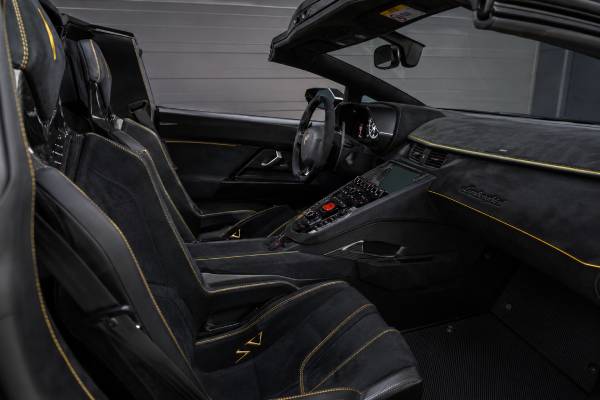
The Lamborghini Aventador LP 750-4 Superveloce Roadster is the open-top version of the most focused early Aventador. It pairs Lamborghini’s L539 naturally aspirated 6.5-liter V12 with all-wheel drive, a carbon-fiber monocoque, fixed aerodynamic hardware, and a removable two-piece carbon roof. Built in very limited numbers, it sits between the original Aventador Roadster and later Aventador S/SVJ models, with a rawer feel than the four-wheel-steer cars that followed. Buyers care about it because it combines the drama of a roof-off V12 Lamborghini with genuine Superveloce weight saving, sharper suspension tuning, and collectable production rarity. Owners and collectors also need to understand the car beyond headline speed: clutch condition, carbon-ceramic brakes, recall completion, original options, paintwork, roof fit, and service history can change the value and ownership risk dramatically.
Table of Contents
- Why the SV Roadster Matters
- L539 V12 Specs and Chassis Data
- Production Numbers, Variants, and Options
- Carbon Aero, Roof, and SV Details
- How the SV Roadster Drives
- Service, Recalls, and Ownership Risk
- Market Values and Buyer Checks
Why the SV Roadster Matters
The Aventador LP 750-4 Superveloce Roadster matters because it made the SV idea work as an open car without turning it into a softer grand tourer. It kept the V12, carbon structure, single-clutch ISR gearbox, and aggressive Superveloce aero, then added a removable roof that made the engine sound and cockpit drama even more direct.
The standard Aventador arrived for the 2011 model year as Lamborghini’s Murciélago replacement. It was a major reset for the brand’s V12 flagship line: a new carbon-fiber monocoque, a new naturally aspirated V12 engine, a compact single-clutch automated manual transmission, and a sharper design language from Lamborghini Centro Stile. The roadster followed later, giving buyers the same basic mechanical layout with open-air usability.
The Superveloce version sharpened that formula. Lamborghini used the SV badge only when it wanted to signal a lighter, louder, more aggressive flagship. The Aventador SV coupe launched first, then the Roadster brought the same core package to buyers who wanted the full V12 experience without a fixed roof. In Lamborghini history, that matters because it was the first series-production open-top Lamborghini to carry the Superveloce name.
The LP 750-4 name also explains the car quickly. “LP” refers to the longitudinal rear-mounted engine layout, “750” refers to 750 metric horsepower, and “4” means all-wheel drive. In SAE terms, the output is often listed around 740 hp, but Lamborghini’s own metric figure is 750 CV, or 552 kW. The engine code is L539, the same basic V12 family used throughout the Aventador line, tuned here for sharper top-end power.
This car also sits at an interesting point in the Aventador timeline. It came before the Aventador S introduced four-wheel steering and revised drivability, before the SVJ added more extreme aero and Nürburgring-focused branding, and before the Ultimae closed the naturally aspirated non-hybrid Aventador chapter. The SV Roadster therefore appeals to people who want the earlier Aventador’s more mechanical, dramatic character but with the lighter, more purposeful SV treatment.
Collectors value it for several reasons:
- Limited production compared with regular Aventador Roadsters
- Open-top Superveloce status
- Naturally aspirated V12 power with no hybrid assistance
- Carbon-fiber monocoque and roof construction
- Strong visual identity from the fixed wing, carbon details, and SV graphics
- Higher emotional value than many technically newer supercars
It is not the easiest Aventador to use every day, and that is part of its appeal. The gearbox is dramatic rather than smooth, the cabin is loud, the roof panels need careful handling, and the car’s width makes city driving deliberate. For many buyers, those traits are not flaws. They are the reason the SV Roadster feels like a proper old-school Lamborghini even though it uses advanced carbon construction and electronic chassis systems.
L539 V12 Specs and Chassis Data
The SV Roadster’s most important specification is its 6,498 cc L539 V12: naturally aspirated, high-revving, and mounted longitudinally behind the cabin. The rest of the car is built around making that engine feel sharper, louder, and more immediate than in the standard Aventador Roadster.
| Item | Specification |
|---|---|
| Production era | 2016–2017 model years, depending on market registration and delivery timing |
| Engine | L539 60-degree naturally aspirated V12 |
| Displacement | 6,498 cc / 6.5 liters |
| Bore x stroke | 95.0 mm x 76.4 mm |
| Fuel system | Multi-point injection |
| Maximum power | 750 CV / 552 kW at 8,400 rpm |
| Maximum torque | 690 Nm / 509 lb-ft at 5,500 rpm |
| Transmission | 7-speed ISR single-clutch automated manual |
| Drivetrain | Electronically controlled all-wheel drive |
| Structure | Carbon-fiber monocoque with aluminum front and rear frames |
| Suspension | Pushrod suspension with magnetorheological dampers |
| Steering | Lamborghini Dynamic Steering |
| Brakes | Carbon-ceramic discs, 400 mm front and 380 mm rear |
| Wheels and tires | 20-inch front / 21-inch rear, typically with Pirelli P Zero Corsa tires |
| Dry weight | About 1,575 kg / 3,472 lb |
| 0–100 km/h | 2.9 seconds |
| Top speed | More than 350 km/h / more than 217 mph |
The engine is oversquare, meaning the bore is larger than the stroke. That helps it rev freely and suits the car’s character. The V12 does not rely on turbochargers, so response is immediate and the sound builds naturally with rpm. At low speed it is tractable, but the SV tune feels most alive when the tachometer climbs toward the top of the dial.
The ISR transmission is central to the car’s personality. It is not a dual-clutch gearbox, and it does not try to behave like one. It uses a single clutch and independent shifting rods to deliver very fast, forceful shifts. In Strada mode it can feel abrupt compared with a modern dual-clutch supercar. In Corsa, at high load, the aggression makes sense and becomes part of the experience.
The all-wheel-drive system helps the SV Roadster deploy its power without making it feel tame. The front axle assists traction, especially in poor conditions or during hard launches, but the car still feels rear-biased in attitude. Tire condition and age matter heavily because the car’s performance envelope is far beyond ordinary road speeds.
The chassis is also more serious than the open roof might suggest. The carbon-fiber monocoque gives the Aventador its basic rigidity, while the Roadster body adds reinforcement and removable roof panels. The SV package cuts weight compared with the standard Roadster through carbon-fiber exterior components, reduced interior insulation, lightweight trim, and a more focused equipment set.
Production Numbers, Variants, and Options
The SV Roadster is rare because Lamborghini limited production to 500 units worldwide. That number is central to its collector status, especially because the related SV coupe was also limited and the regular Aventador Roadster was built in much larger numbers.
| Model | Body style | Key difference | Collector relevance |
|---|---|---|---|
| Aventador LP 700-4 Roadster | Open-top | Standard early Aventador tune with 700 CV | More usable and less rare than SV |
| Aventador LP 750-4 Superveloce | Coupe | Lighter, sharper, fixed-roof SV model | Limited, track-focused early Aventador |
| Aventador LP 750-4 Superveloce Roadster | Open-top | SV performance with removable carbon roof | Limited to 500 units and first open-top SV series model |
| Aventador S Roadster | Open-top | Later chassis with four-wheel steering and revised power | More refined, less raw than SV |
| Aventador SVJ Roadster | Open-top | More power, active aero, later-generation chassis tech | More extreme technically, different character |
Identification matters because many Aventadors have been visually modified. A real SV Roadster should have the correct VIN, factory build record, SV-specific bodywork, fixed rear wing, interior treatment, wheels, carbon trim, and documentation. A standard Roadster with SV-style body parts is not the same car in the collector market.
The most desirable cars usually have a strong combination of originality, low but usable mileage, known ownership, dealer service history, and a high-quality factory specification. Lamborghini’s Ad Personam program allowed buyers to create unusual color and trim combinations, and those can help or hurt value depending on taste and documentation.
Commonly seen or important equipment areas include:
- Exterior paint, including standard, metallic, pearl, matte, and special-order colors
- SV graphics or stripe packages
- Carbon-fiber exterior components and engine-bay trim
- Transparent engine cover on some cars
- High rear wing with manual adjustment
- Front axle lift system
- Center-lock wheel equipment on some specifications
- Carbon-fiber interior trim packages
- Alcantara-heavy cabin trim
- Contrast stitching, piping, and embroidered details
- Branding package
- Rear camera and parking assistance, where fitted
- Audio and infotainment choices
- Telemetry or track-related options on some cars
The two-piece hardtop is one of the most important Roadster-specific items. Each carbon panel is light enough to remove by hand and can be stored in the front luggage compartment. A complete car should include the roof panels, storage hardware, tool kit, books, battery tender, keys, and any factory accessories listed on the build sheet.
Market-specific equipment can also matter. U.S., European, Middle Eastern, and Asian-market cars may differ in lighting, emissions equipment, warning labels, infotainment settings, and certification history. A car imported from another market can still be excellent, but buyers should understand registration, emissions compliance, speedometer units, service access, and resale implications before paying top-tier money.
Documentation is not optional at this level. A serious SV Roadster file should include:
- Original window sticker or invoice where available
- Factory build specification
- Service records with dates, mileage, and dealer or specialist names
- Recall and campaign completion records
- Paint-protection-film and cosmetic repair invoices
- Tire and brake replacement records
- Battery replacement and tender-use history
- Any warranty or extended-warranty paperwork
- Ownership history and import/export documents, if relevant
Mileage affects value, but it should not be read in isolation. A 300-mile car that has sat unused with old tires, an aging battery, and no fluid history can be more risky than a 5,000-mile car serviced annually and driven properly. For collectors, the ideal example is not just low-mileage. It is original, documented, exercised, and correctly maintained.
Carbon Aero, Roof, and SV Details
The SV Roadster looks extreme because most of its visible changes serve airflow, cooling, weight reduction, or emotional impact. The fixed wing, deeper front aero, rear diffuser, carbon vents, and open roof all work together to make it feel more focused than a regular Aventador Roadster.
The base Aventador design already had the familiar Lamborghini wedge, scissor doors, sharp surfacing, and low cab-forward stance. The SV made that shape more aggressive. The front bumper uses larger openings and a more pronounced splitter to improve front-end bite and cooling. The rear uses a larger diffuser, fixed wing, and more exposed carbon elements to add downforce and reduce visual mass.
Lamborghini said the SV design cut weight compared with the standard Roadster. The difference does not make the car small or delicate; the Aventador is still a wide, dramatic V12 flagship. But the reduction is noticeable in the way the car responds, especially combined with revised suspension and steering calibration.
Roof system
The removable roof is a defining feature. Unlike a folding soft-top, the Aventador Roadster uses two carbon-fiber roof panels. They must be removed and installed manually, and care matters. The panels are light, but they are expensive, easy to mark, and important to the car’s completeness.
A buyer should inspect:
- Roof-panel condition on both outer and inner surfaces
- Latch operation and alignment
- Weather seals
- Storage compartment fit
- Wind noise on test drive
- Evidence of roof-panel drops, repairs, or refinishing
- Correct storage bags or hardware, where supplied
A poorly fitting roof can turn an otherwise excellent car into an irritating ownership experience. Water leaks, wind noise, chipped panel edges, and damaged seals should be treated as negotiation points, not minor details.
Interior and sound
The SV cabin is more stripped-back than a regular Aventador. Sound insulation was reduced, carbon-fiber structure is more visible, and Alcantara gives the cabin a motorsport feel. It is not bare like a race car, but it is noticeably more focused than the standard Roadster.
The rear power window is important because it lets the driver control how much V12 sound enters the cabin. With the roof off and the rear glass down, the intake and exhaust noise dominate the experience. This is one of the main reasons the SV Roadster remains so desirable even as newer supercars have become faster.
Aero and cooling
The SV’s cooling openings are not decoration. A naturally aspirated V12 mounted behind the cabin creates serious heat, especially in traffic, hot climates, or track use. The rear bodywork, engine-bay vents, and underbody airflow all help manage temperature. Aftermarket exhausts, missing heat shielding, damaged undertrays, or poorly repaired carbon parts can disturb that balance.
The fixed rear wing is also part of the car’s identity. It gives the SV Roadster a more aggressive stance and helps high-speed stability. Inspect its mounts and finish carefully. A cracked or repainted wing can point to minor parking damage, transport damage, or more serious rear-end repair.
How the SV Roadster Drives
The SV Roadster feels fast, loud, wide, and physical, even by modern supercar standards. Its numbers are still serious, but the real appeal is the way it delivers speed through a naturally aspirated V12 and a dramatic single-clutch gearbox.
Acceleration is instant once the engine is in its power band. There is no turbo lag, no electric torque fill, and no filtered soundtrack. The V12 builds from a mechanical growl into a hard metallic scream, and the last few thousand rpm are the reason many buyers choose this car over more refined alternatives.
At low speeds, the SV Roadster asks for patience. The ISR transmission can feel clunky in stop-and-go traffic, especially if the driver treats it like a torque-converter automatic or dual-clutch gearbox. Smooth driving requires measured throttle, space, and an understanding that the clutch is doing real work. Creeping in traffic is not ideal for clutch life.
In faster driving, the transmission makes much more sense. Shifts become sharp events rather than interruptions. In aggressive modes, full-throttle upshifts hit hard and add drama. Some drivers love this; others prefer the polish of a modern dual-clutch. For an SV Roadster buyer, that preference should be settled before purchase.
The steering is quick and lighter than older Lamborghinis, but the car still feels large. The front end is more alert than the standard Aventador Roadster, helped by tire width, suspension tuning, and aero balance. It does not shrink around the driver like a smaller mid-engine car. Instead, it rewards planning, precision, and respect for its width.
The brakes are powerful, but carbon-ceramic systems need temperature, condition, and proper bedding to feel their best. Around town they can feel less progressive than conventional iron brakes. On a fast road or track, their advantage is heat resistance and repeated stopping power. Replacement cost is high, so buyers should never judge brake condition by a quick glance alone.
Ride quality is firm but not unusable. The magnetorheological dampers help control body motion, yet the SV setup is still busy over poor roads. Tire age and pressure strongly affect ride, noise, and grip. Old high-performance tires can make the car feel nervous, noisy, and less secure, even if tread depth looks acceptable.
Visibility is typical Aventador: forward view is dramatic but low, rear visibility is limited, and the car is very wide. Parking cameras and sensors help, but they do not remove the need for care. The front lift system is useful, not cosmetic, because the splitter and underbody are vulnerable to steep driveways and ramps.
On track, the SV Roadster has the engine, brakes, and chassis to be exciting, but it is still a valuable open-top exotic with expensive consumables. It needs fresh tires, brake inspection, correct fluids, and a careful post-track check. A car that has seen track use is not automatically bad, but the service file should prove that the use was supported properly.
Service, Recalls, and Ownership Risk
The SV Roadster is not unreliable in the ordinary used-car sense, but it is expensive and unforgiving when neglected. The biggest ownership risks are deferred service, clutch wear, old tires, carbon-ceramic brake cost, battery-related faults, front-lift or suspension issues, heat damage, accident repair, and incomplete recall work.
Mechanical and electronic checks
A pre-purchase inspection should be performed by a Lamborghini dealer or a specialist who knows Aventadors. Generic exotic-car familiarity is not enough. The inspection should include diagnostic scans, clutch data where available, lift-system checks, brake measurements, road testing, underbody inspection, and verification of all campaigns by VIN.
Key areas to check include:
- Engine oil leaks around covers, lines, coolers, and fittings
- Cooling system condition, including radiators and hoses
- Exhaust heat shielding and signs of excessive heat
- Transmission operation in all drive modes
- Clutch wear, bite point, adaptation values, and launch history where accessible
- Front lift operation, leaks, and compressor performance
- Magnetorheological damper condition
- Suspension bushings, ball joints, and alignment
- Carbon-ceramic disc thickness, surface condition, and pad life
- Tire date codes, matching specification, and inner-edge wear
- Battery age and evidence of tender use
- Warning lights, stored faults, and module communication
- Door, roof, window, and latch operation
The ISR clutch is a major cost item. Cars driven gently but badly in heavy traffic can wear the clutch faster than cars driven more briskly but correctly. Reversing uphill, creeping in queues, and repeated low-speed maneuvering all add wear. A low-mileage car with high clutch wear deserves deeper investigation.
Battery condition is more important than many owners expect. Aventadors dislike weak batteries. Low voltage can trigger warning lights, module faults, suspension errors, and transmission complaints. A proper battery tender is part of normal ownership, especially for a collector car that may sit for weeks.
Recalls and campaigns
Recall completion should be checked by VIN, not by model year assumptions. Important Aventador-family campaigns include the fuel-system EVAP recall on certain 2012–2017 cars, the engine-stall software recall affecting certain 2012–2018 Aventador Coupe and Roadster models, and a small wheel-hub/centering-bolt recall involving selected SV Coupe and SV Roadster vehicles.
For a buyer, the right question is not “does this model have recalls?” The right question is “has this exact VIN had every required campaign completed and recorded?” A seller should be able to provide dealer documentation. If not, a Lamborghini dealer should confirm the campaign status before money changes hands.
Carbon, bodywork, and accident history
Carbon-fiber repairs are a major value issue. The Aventador’s carbon monocoque is the core structure, and damage to it is different from a scraped bumper or replaced splitter. A specialist should inspect the underbody, jacking points, front splitter, rear diffuser, sill areas, suspension mounts, and subframe attachments.
Paintwork also needs careful evaluation. Many SV Roadsters have paint-protection film, which is good when applied correctly but can hide chips, edges, repaint lines, or yellowing. Matte finishes, pearl colors, and special-order paints are more difficult to repair invisibly. A repainted bumper is not necessarily a problem, but undisclosed structural repair is.
Maintenance rhythm
Most SV Roadsters are low-mileage cars, but low mileage does not reduce the need for time-based maintenance. Fluids age, tires harden, batteries weaken, seals dry, and hydraulic systems can leak. Annual service history is a strong sign that the owner understood the car.
A sound maintenance file should show regular oil service, brake-fluid service, coolant checks, tire replacements by date, battery replacements, recall completion, and attention to small faults before they became major ones. A car that has covered only a few hundred miles in several years may need recommissioning before it is driven hard.
Aftermarket modifications need caution. Exhaust systems are common because the V12 responds emotionally to more sound, but heat, emissions readiness, check-engine lights, and resale value all matter. A reversible, documented system with original parts retained is far less concerning than a mystery exhaust with missing heat shielding and no factory parts.
Market Values and Buyer Checks
The SV Roadster sits in the upper tier of Aventador values because it is rare, open-top, naturally aspirated, and visibly different from the standard Roadster. Public auction data often shows mid-six-figure results, while dealer asking prices for low-mileage, unusual, or highly optioned cars can be much higher.
Market value depends heavily on specification and condition. Two SV Roadsters with similar mileage can differ sharply in value if one has a rare factory color, full Lamborghini service history, original paint, fresh tires, complete accessories, and no modifications, while the other has repaint, missing roof accessories, old tires, aftermarket parts, and unclear service records.
The strongest examples usually have:
- Factory-original paint or fully documented minor cosmetic work
- Desirable color and interior combination
- Low but believable mileage
- Complete service history
- Completed recalls and campaigns
- Original exhaust or retained original exhaust parts
- Excellent carbon trim and underbody condition
- Clean diagnostic report
- Healthy clutch data
- Fresh correct tires
- Strong brake condition
- Complete books, keys, tender, roof equipment, and accessories
- Clear ownership and title history
Cars to approach carefully include:
- Heavily modified examples without original parts
- Cars with unresolved warning lights
- Cars with old tires but “low mileage” marketing
- Cars with weak or missing service records
- Cars with clutch data inconsistent with mileage
- Cars with roof leaks, damaged panels, or missing storage items
- Cars with underbody scraping beyond normal splitter wear
- Cars with accident history involving structural carbon
- Imported cars without clear compliance and registration paperwork
- Cars sold only on appearance, with no specialist inspection allowed
| Priority | What to verify | Why it matters |
|---|---|---|
| Identity | VIN, build sheet, SV Roadster specification, market version | Confirms the car is a genuine limited-production SV Roadster |
| Service history | Annual records, dealer stamps, invoices, fluids, campaigns | Shows whether the car was preserved or merely stored |
| Clutch and gearbox | Diagnostic data, shift quality, adaptations, low-speed behavior | ISR repairs are expensive and affect drivability |
| Brakes and tires | Carbon-ceramic disc condition, pad life, tire date codes | Consumables can add a large immediate cost |
| Carbon structure | Monocoque, underbody, sills, splitter, diffuser, wing mounts | Carbon damage can seriously reduce value |
| Roof system | Panels, seals, latches, storage, wind noise, leaks | Roadster-specific parts are costly and important to completeness |
| Originality | Exhaust, wheels, trim, paint, electronics, factory parts | Original examples usually hold collector value better |
For long-term collectability, the SV Roadster has a strong case. It is not the final Aventador, not the most powerful Aventador, and not the most advanced Aventador. Its appeal is different: it is a limited, open-air, naturally aspirated V12 Superveloce with a rawer early-Aventador feel. As hybrid supercars become normal and naturally aspirated V12 production becomes rarer, that emotional and mechanical identity should continue to matter.
The best buying strategy is simple but strict: buy the best-documented, most original car you can afford, then budget for maintenance even if the car looks perfect. A bargain SV Roadster can become expensive quickly. A premium example with the right history, clean inspection, fresh consumables, and complete accessories is usually the safer purchase.
References
- Lamborghini Aventador SuperVeloce Roadster – Pictures, Videos 2025 (Manufacturer Specifications)
- Used Lamborghini Aventador Superveloce Roadster | Lamborghini.com 2026 (Manufacturer Certified Pre-Owned Overview)
- Part 573 Safety Recall Report 17V-073 2017 (Recall Database)
- Part 573 Safety Recall Report 18V-391 2018 (Recall Database)
- Lamborghini Aventador LP750-4 SV Roadster Market – CLASSIC.COM 2026 (Market Data)
Disclaimer
This article is for informational purposes only and is not a substitute for professional diagnosis, repair, inspection, valuation, or legal advice. Specifications, torque values, service intervals, recall status, parts, procedures, and equipment can vary by VIN, market, build date, and factory option package. Always verify details against official Lamborghini service documentation and have any specific vehicle inspected by a qualified Lamborghini dealer or specialist before purchase or repair.
If you found this guide useful, please consider sharing it on Facebook, X/Twitter, or your preferred automotive community to support our work.