


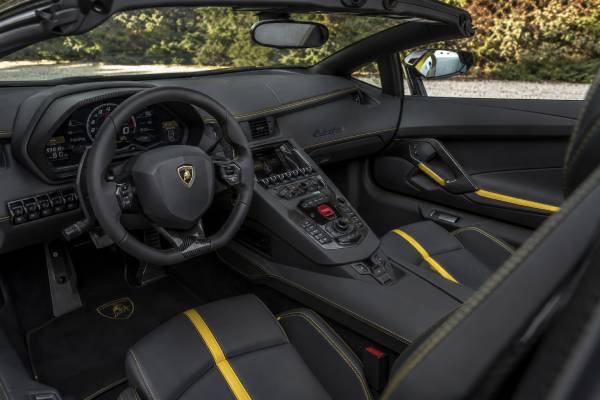
The Lamborghini Aventador S Roadster 50th Anniversary Japan is a five-car, Japan-only special series built around the Aventador S Roadster platform and the L539 6.5-liter naturally aspirated V12. Created for Lamborghini’s 50th anniversary in Japan, it combined the open-top LP740-4 S mechanical package with Ad Personam paint, carbon-fiber details, and one-off themes based on five natural elements: water, earth, fire, wind, and sky. Its importance is not just speed, although 740 CV, 350 km/h capability, four-wheel steering, and permanent all-wheel drive give it serious performance. The real draw is rarity, factory personalization, and provenance. For collectors, the car sits at the meeting point of modern V12 drama, Japanese-market exclusivity, and documented Lamborghini craftsmanship. For owners and buyers, originality matters as much as mileage.
Table of Contents
- A Japan-Only Aventador S With Real Significance
- L539 V12 Specs and Chassis Data
- Five-Element Production and Authenticity
- Carbon Roadster Design and Active Systems
- Open-Top V12 Driving Character
- Aventador S Roadster Maintenance Risks
- Market Value and Buying Checks
A Japan-Only Aventador S With Real Significance
The 50th Anniversary Japan edition matters because it is not a cosmetic trim sold in normal volume. It is a five-unit, factory-backed Ad Personam series created for one of Lamborghini’s most important enthusiast markets.
The Aventador itself arrived as Lamborghini’s V12 flagship successor to the Murciélago. It introduced a carbon-fiber monocoque to the series-production V12 line, kept the classic mid-engine all-wheel-drive Lamborghini layout, and used the L539 V12 instead of an inherited Bizzarrini-derived engine family. By the time the Aventador S appeared, the model had moved from shock-value flagship to a more mature, more technically controlled supercar.
The Aventador S Coupe was introduced as the more developed LP740-4 evolution, with extra power, revised aerodynamics, Lamborghini Dynamic Steering, rear-wheel steering, updated suspension control, and a fourth drive mode called EGO. The Aventador S Roadster followed with the same core engineering but added two removable roof panels and the extra sensory drama that comes with an uncovered V12 engine note.
The 50th Anniversary Japan edition was shown during Lamborghini Day 2017 in Tokyo. It marked 50 years since Lamborghini’s early presence in Japan, beginning with imports of the 400 GT. Rather than build a larger numbered edition, Lamborghini created five individual Aventador S Roadsters, each inspired by a natural element from Japanese culture. That makes each car both part of a five-car series and a one-off specification.
Collectors care because the car has several value signals in one package:
- Factory origin: The themes were developed through Lamborghini Ad Personam and Centro Stile, not through a later tuner or dealer repaint.
- Extremely low production: Five total cars gives it a rarity level beyond most regular Aventador special trims.
- Open V12 format: It keeps the drama of the naturally aspirated Aventador engine while adding the removable-roof experience.
- Market story: Japan has a deep Lamborghini collector culture, and this edition was built specifically for that relationship.
- Documentation importance: The car’s story is easy to weaken if paperwork, original photos, Ad Personam records, or factory identifiers are missing.
Its reputation today depends less on lap times and more on completeness. A standard Aventador S Roadster can be judged by mileage, condition, color, and service history. This edition needs that and more: proof that the paint, embroidery, carbon details, plate, roof treatment, and elemental theme all match the original factory build.
L539 V12 Specs and Chassis Data
The Japan edition uses the standard Aventador S Roadster mechanical package, so the important technical base is the LP740-4 S Roadster. Its defining feature is the high-revving, naturally aspirated L539 V12 paired with a seven-speed ISR automated manual and permanent all-wheel drive.
Lamborghini rated the engine at 740 CV, or 544 kW, at 8,400 rpm. In many English-language listings this is rounded or described as 740 hp, while SAE-style brake horsepower figures may appear closer to 730 bhp. The important point for buyers is that this is the Aventador S tune, not the earlier 700 CV LP700-4 tune and not the later SVJ or Ultimae tune.
| Item | Specification |
|---|---|
| Engine code | L539 |
| Engine layout | 60-degree naturally aspirated V12, mid-mounted longitudinally |
| Displacement | 6,498 cc |
| Bore x stroke | 95 mm x 76.4 mm |
| Induction | Naturally aspirated |
| Fuel system | Multi-point injection |
| Valvetrain | Four valves per cylinder, variable electronic valve timing |
| Compression ratio | 11.8 ± 0.2:1 |
| Maximum power | 740 CV / 544 kW at 8,400 rpm |
| Maximum torque | 690 Nm at 5,500 rpm |
| Maximum engine speed | 8,500 rpm |
| Lubrication | Dry sump |
| Transmission | Seven-speed ISR automated manual |
| Clutch | Twin-plate clutch, 235 mm |
| Drivetrain | Permanent all-wheel drive with Haldex Generation IV coupling |
The Aventador S Roadster is not a light car by modern limited-supercar standards, but its carbon monocoque gives it strong structure, and the roadster body adds only a limited dry-weight increase over the coupe. The dry weight is 1,625 kg, with a rear-biased 43:57 front-to-rear distribution.
| Item | Specification |
|---|---|
| Structure | Carbon-fiber monocoque with aluminum front and rear subframes |
| Suspension | Aluminum double wishbones with pushrod magneto-rheological dampers |
| Steering | Lamborghini Dynamic Steering with rear-wheel steering |
| Steering ratio | 10:1 to 18:1 |
| Brakes | Carbon-ceramic discs, 400 x 38 mm front and 380 x 38 mm rear |
| Brake calipers | Six-piston front, four-piston rear |
| Wheels | 20-inch front, 21-inch rear |
| Tires | Pirelli P Zero, 255/30 ZR20 front and 355/25 ZR21 rear |
| Wheelbase | 2,700 mm |
| Length | 4,797 mm |
| Width | 2,030 mm |
| Height | 1,136 mm |
| Dry weight | 1,625 kg |
| Fuel capacity | 85 liters |
| Engine oil capacity | 13 liters |
| Luggage capacity | 140 liters |
| 0–100 km/h | 3.0 seconds |
| 0–200 km/h | 9.0 seconds |
| 0–300 km/h | 25.0 seconds |
| Top speed | 350 km/h |
| 100–0 km/h braking | 31 meters |
The numbers only tell part of the story. The ISR gearbox is a single-clutch automated manual, not a modern dual-clutch unit. It can shift very quickly in aggressive modes, but it gives a distinct interruption in power delivery. That feel is part of the Aventador’s character, though it also means buyers should pay close attention to clutch condition, calibration, and service records.
Five-Element Production and Authenticity
The Japan edition was built as five unique cars, not a normal run of identical cars with numbered badges. Each car was tied to one elemental theme: water, earth, fire, wind, or sky.
That distinction is important when inspecting or valuing one. A buyer should not expect every car in the series to share the same color, stitching, or cabin detailing. The shared identity is the anniversary concept, Japanese-market purpose, Aventador S Roadster base, and Ad Personam/Centro Stile execution.
The publicly shown “Water” car used a special blue-to-black paint effect. Lamborghini described the paint creation as a major artisan job, requiring many hours of labor and a team of specialists. The interior used Nero Ade black leather and Nero Cosmus black Alcantara, with stitching that echoed the exterior’s color graduation. The seats and hardtop included embroidery inspired by the Japanese symbol for bamboo, and the cabin was finished with a hexagonal carbon-fiber plate carrying the symbol for the car’s element.
For collectors, the key is not simply whether the car looks like a Japan edition. It must be proven as one.
Documents and identifiers that matter
A serious file should include as many of these items as possible:
- Original Lamborghini Ad Personam or factory build documentation.
- Japanese-market delivery paperwork and first registration history.
- Chassis number and VIN history matching the car’s factory identity.
- Service records from authorized Lamborghini dealers or recognized Aventador specialists.
- Photos from delivery, early ownership, or known public appearances.
- Proof of the correct elemental theme, interior plate, embroidery, roof finish, and paint description.
- Any Lamborghini certificate, heritage confirmation, or dealer correspondence that confirms the edition.
The regular Aventador S Roadster also had meaningful factory options and finishes. Buyers may see transparent engine covers, carbon-fiber exterior packages, gloss or matte carbon roof finishes, interior carbon packages, Carbon Skin trim, branded interior details, special stitching, high-end audio, lifting systems, and extensive Ad Personam choices. On the Japan edition, however, the bespoke features are part of the identity, not just value-adding extras.
Be careful with cars that have later cosmetic work. A repaint, re-trim, missing interior plate, altered roof panels, or non-original carbon finish can reduce the car’s collector value even if the mechanical condition is excellent. This is especially true with gradient paint and matching cabin stitching, because reproducing the original factory effect is difficult and expensive.
Carbon Roadster Design and Active Systems
The Aventador S Roadster 50th Anniversary Japan stands out because its design details serve both drama and engineering. The special paint and carbon details make it collectible, while the S Roadster hardware makes it sharper than the original LP700-4 Roadster.
The roadster uses two removable carbon-fiber roof panels. Each panel weighs less than 6 kg and can be stored in the front luggage compartment. With the roof removed, the car becomes more dramatic without turning into a soft, relaxed grand tourer. The carbon monocoque remains the core structure, while roadster-specific reinforcement adds weight but preserves the rigid feel expected from an Aventador.
The rear deck is different from the coupe’s design and creates a distinct open-car profile. The electric rear window is also useful. With the roof on, it can reduce turbulence and noise. With the roof off, lowering it lets more of the V12 intake and exhaust sound into the cabin.
The S update brought four major dynamic technologies together:
- Lamborghini Dynamic Steering: Variable steering response based on speed and drive mode.
- Rear-wheel steering: The rear wheels help agility at lower speeds and stability at higher speeds.
- Magneto-rheological suspension: The dampers adjust continuously to road conditions and selected mode.
- Permanent all-wheel drive: Torque distribution changes according to mode and grip conditions.
The active rear wing works with the car’s speed and selected drive mode. The Aventador S also brought more aggressive front-end aero, a revised rear diffuser, and the now-familiar central triple-exit exhaust layout. Lamborghini claimed a major increase in front downforce compared with the earlier Aventador, which helps explain why the S feels more tied down and less blunt than the original car.
For the Japan edition, the design story adds another layer. The exposed carbon windshield frame and hardtop, the elemental paint theme, the bamboo-inspired embroidery, and the element plate turn a highly technical car into a cultural anniversary object. That is why condition around these details matters. A stone-chipped bumper can be repaired; an incorrect recreation of the original gradient paint can permanently weaken the car’s provenance.
Open-Top V12 Driving Character
The Aventador S Roadster is fast, loud, physical, and more interactive than its size suggests. The S hardware makes it easier to place than the early Aventador, but it never becomes a quiet or invisible daily supercar.
The engine dominates the experience. The L539 V12 pulls hard from midrange but rewards revs, with peak power arriving at 8,400 rpm. It does not have turbocharged softness or electric torque fill. The response is sharp, the sound rises with real mechanical intensity, and the last part of the tachometer is the reason many buyers still prefer this era to newer hybrid supercars.
The ISR gearbox gives the car a special rhythm. In Strada, it can feel deliberate and sometimes abrupt compared with a dual-clutch transmission. In Sport and Corsa, shifts become more forceful and theatrical. Some drivers love that violence because it makes the car feel alive. Others prefer the smoother manners of a Huracán or newer dual-clutch supercar. A test drive should include low-speed traffic, rolling shifts, hard acceleration, and downshifts so the buyer can feel whether the gearbox behaves correctly.
The four-wheel steering is the key dynamic change from earlier Aventadors. At low speeds, it makes the car feel smaller than its width suggests. On faster roads, it adds stability and confidence. The car is still wide, low, and sensitive to tire condition, but the S is more cooperative on mountain roads and fast sweepers than the original LP700-4 Roadster.
Ride quality depends heavily on mode, tire age, and road surface. Strada is usable for normal driving, but the car still has large wheels, very wide rear tires, and little tolerance for rough city streets. Corsa is best saved for smooth roads or track use. Carbon-ceramic brakes are powerful and consistent, but buyers should check pedal feel, disc condition, pad wear, and whether the brakes have been overheated or chipped.
Open-top usability is better than many expect. The removable panels are light enough to handle carefully, but they still require clean storage and patience. The cabin can become hot and loud, rear visibility is limited, and the low nose needs the lifting system on steep driveways. None of that is unusual for a flagship Lamborghini. It is part of the car’s character, and owners who accept it tend to enjoy the car more.
Aventador S Roadster Maintenance Risks
The safest Aventador S Roadster to buy is the one with complete records, current software updates, measured clutch condition, healthy carbon-ceramic brakes, and no questionable cosmetic work. Low mileage alone is not enough.
This is an exotic V12 Lamborghini, so ownership risk is concentrated in parts cost, specialist labor, electronics, and originality. A neglected low-mileage car can be more expensive than a properly used and serviced car.
Service reality
Many Aventador service schedules are built around annual or mileage-based maintenance, often around 12 months or roughly 9,000 miles, depending on market and documentation. The exact schedule must be verified by VIN, market, and the car’s official service booklet. Track use, long storage, extreme heat, or repeated short trips can shorten sensible service intervals.
Routine ownership should include:
- Annual inspection by a Lamborghini dealer or experienced Aventador specialist.
- Engine oil and filter service using the correct dry-sump procedure.
- Brake fluid and coolant checks based on age and usage.
- Tire age inspection, not just tread-depth inspection.
- Battery condition checks and use of a proper conditioner during storage.
- Diagnostic scans for clutch wear, gearbox behavior, suspension, lift system, and stored faults.
- Software and recall verification through Lamborghini systems.
High-cost inspection areas
| Area | Why It Matters | What to Check |
|---|---|---|
| ISR clutch and gearbox | Wear depends heavily on traffic, launch use, and calibration | Diagnostic clutch reading, shift quality, adaptation history, leaks, warning lights |
| Carbon-ceramic brakes | Replacement is very expensive | Disc condition, chips, cracks, pad life, uneven wear, track heat signs |
| Front lift system | Failure affects usability and can lead to underside damage | Lift operation speed, hydraulic leaks, warning lights, service history |
| Suspension dampers | Magneto-rheological systems are costly to replace | Leaks, fault codes, mode changes, uneven ride height |
| Cooling system | The V12 produces serious heat | Radiators, fans, hoses, coolant condition, temperature stability |
| Electrical modules | Storage and weak batteries create faults | Battery health, module communication, infotainment, instrument display, key systems |
| Roof panels | Damage or poor fit affects value and usability | Panel condition, seals, latches, storage bags, wind noise, water leaks |
| Japan-edition trim | Original details define the car | Element plate, stitching, embroidery, paint match, carbon hardtop and frame |
Recalls and software campaigns must be checked by VIN. Aventador S Coupe and Roadster models from 2017 to 2019 were included in an engine-stall-at-idle software campaign in some markets. The fix was an engine software update, and Lamborghini recall repairs should be completed through authorized dealers. Do not rely on a seller’s statement that “it has no problems.” Ask for the dealer printout.
Modifications need special caution. Exhaust changes are common on Aventadors, but they can affect emissions equipment, heat management, warranty history, and collector appeal. Lowering kits, aftermarket wheels, ECU tunes, repainted carbon parts, and non-factory interior changes may make the car less valuable than a clean, documented original.
The most expensive Japan-edition risk is not mechanical. It is identity loss. A repaired ordinary Aventador S Roadster can still be a good driver’s car. A Japan edition with incorrect paintwork, missing special trim, or unclear provenance loses the reason it is special.
Market Value and Buying Checks
The Japan edition should not be valued like an ordinary Aventador S Roadster, but ordinary S Roadster values are still the baseline. The premium comes from rarity, documentation, originality, and the specific desirability of the elemental theme.
Public market data for standard Aventador LP740-4 S Roadsters has generally placed good examples in the low-to-mid six-figure supercar range, with mileage, color, carbon options, service history, and market location moving prices significantly. Public sales or listings for the 50th Anniversary Japan cars are much rarer, so a precise market value is difficult to prove from open data alone.
That lack of public data cuts both ways. Sellers may ask a large premium because only five exist. Buyers should be willing to pay more only when the car’s identity is fully documented and condition supports the price.
What drives value
| Factor | Higher-Value Example | Lower-Value Example |
|---|---|---|
| Provenance | Full factory, dealer, and Japanese-market documentation | Unclear import history or missing Ad Personam records |
| Originality | Original paint, trim, wheels, exhaust, roof panels, and interior details | Repainted panels, aftermarket exhaust, missing special identifiers |
| Condition | Clean carbon structure, healthy drivetrain, fresh tires, no accident history | Paint mismatch, damaged carbon, old tires, weak service history |
| Mileage | Low but exercised regularly and serviced correctly | Very low but stored poorly with stale fluids and battery issues |
| Element theme | Clearly documented theme with correct exterior and interior execution | Theme uncertain or details changed after delivery |
| Service status | Recent dealer service, recalls complete, diagnostic report available | Skipped services, open campaigns, no clutch or brake data |
Buyer checklist
Before committing, complete these steps in order:
- Verify the VIN with Lamborghini or an authorized dealer.
- Confirm the car is one of the five factory 50th Anniversary Japan examples.
- Match the elemental theme to the original paint, stitching, plate, and trim.
- Request service history from new, not only the current owner’s records.
- Run a full diagnostic scan, including clutch wear and gearbox faults.
- Inspect carbon-ceramic brakes and tires by condition and age.
- Inspect the carbon monocoque, underside, front splitter, lift points, and suspension for accident or curb damage.
- Confirm recall and software-campaign completion.
- Check roof panels, seals, latches, storage bags, and fit.
- Use a Lamborghini specialist who understands both Aventador mechanical issues and limited-edition provenance.
The best cars to seek are complete, original, properly serviced examples with unbroken identity. The cars to avoid are those presented mainly on rarity but lacking proof. A seller should be able to explain exactly which elemental car it is, how it was delivered, what makes it original, and what work has been done since new.
Long-term collectability looks strong because the car combines final-era naturally aspirated V12 appeal with a tiny production number and a clear anniversary story. It is not as track-focused as an SVJ and not the final Aventador like the Ultimae, but it has a different kind of appeal: cultural specificity and one-off factory craftsmanship. That makes it especially attractive to collectors who value story, scarcity, and originality over headline Nürburgring times.
References
- Lamborghini Aventador S Roadster | Lamborghini.com 2026 (Technical Specifications)
- Aventador S Roadster_DE 2017 (Press Release)
- Lamborghini Day Tokyo 2017_EN – NMPRO 2017 (Press Release)
- Microsoft Word – FAQ_engine software update_ENG 2019 (Recall FAQ)
- Lamborghini Aventador LP740-4 S Roadster Market 2026 (Market Data)
Disclaimer
This article is for informational purposes only and is not a substitute for professional diagnosis, repair, appraisal, or pre-purchase inspection. Specifications, torque values, service intervals, recall status, software versions, and repair procedures can vary by VIN, market, equipment, and production date. Always verify details against official Lamborghini service documentation and a qualified Lamborghini technician.
If this guide helped, please consider sharing it on Facebook, X/Twitter, or another platform to support our work.