


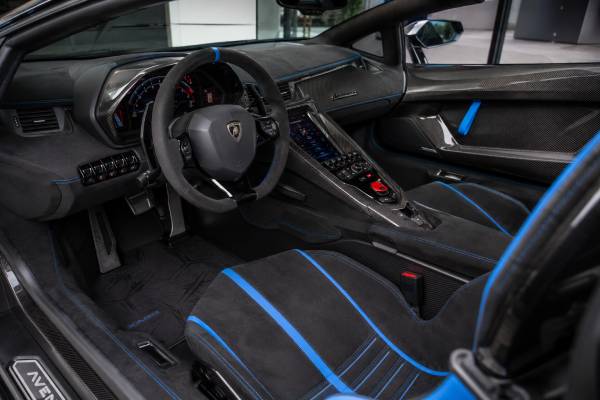
The Lamborghini Aventador SVJ Roadster Xago Edition is one of the rarest open-top Aventador variants: a ten-car Ad Personam special based on the 770 hp Aventador SVJ Roadster. It keeps the LB835 Roadster structure, the L539 6.5-liter naturally aspirated V12, all-wheel drive, rear-wheel steering, carbon-ceramic brakes, and ALA 2.0 active aerodynamics, then adds a highly specific design package tied to Lamborghini’s virtual Ad Personam studio. For collectors, the Xago matters because it combines three high-value traits in one car: final-era naturally aspirated V12 drama, open-roof SVJ performance, and numbered ultra-low production. For owners and buyers, it also needs careful due diligence. The car is not just a louder Aventador with special paint; it is a complex carbon-structure supercar with expensive consumables, tight documentation demands, and market value driven heavily by provenance, mileage, specification, and originality.
Table of Contents
- Why the Xago SVJ Roadster matters
- L539 V12 specs and chassis data
- Production, Xago details, and options
- Aero, design, and special engineering
- How the Xago drives
- Maintenance risks and service priorities
- Market value and buyer checks
Why the Xago SVJ Roadster matters
The Xago Edition matters because it is a ten-unit design and personalization special built on the most extreme open Aventador platform. It sits at the intersection of collectible rarity, final-generation Lamborghini V12 character, and the SVJ Roadster’s track-focused chassis technology.
The Aventador line began as Lamborghini’s V12 flagship successor to the Murciélago. By the time the SVJ arrived, the platform had moved far beyond the original LP 700-4 formula. The SVJ, short for Superveloce Jota, brought sharper aero, more power, less weight, rear-wheel steering, active suspension, and more aggressive chassis control. The Roadster added the appeal of a removable hardtop without changing the basic purpose: it remained a high-speed, aero-led, naturally aspirated V12 supercar.
The Xago Edition arrived in 2020 as a special Aventador SVJ Roadster for clients using Lamborghini’s virtual Ad Personam studio. Its importance is less about mechanical changes and more about provenance. Unlike a normal Ad Personam car, the Xago was a named edition with a fixed theme, numbered identification, and a production run of only ten cars. That makes it far more collectible than a one-off color combination on a standard SVJ Roadster.
Its position in Lamborghini history is also helped by timing. The Aventador was one of the last pure non-hybrid V12 Lamborghinis. Later flagship development moved toward electrification, with the Revuelto replacing the Aventador as Lamborghini’s plug-in hybrid V12 flagship. That change has made the most special Aventador variants more interesting to collectors who want the raw, mechanical, pre-hybrid V12 experience.
For enthusiasts, the appeal is simple: the Xago has the full SVJ Roadster hardware. It uses the 6,498 cc L539 V12, rated at 770 CV at 8,500 rpm, with a high-mounted lightweight exhaust and the sharp ISR single-clutch automated manual gearbox. It also has Lamborghini’s active ALA 2.0 aero system, all-wheel drive, rear-wheel steering, and magneto-rheological pushrod suspension. In plain terms, it is loud, intense, fast, and visually unmistakable.
For buyers, the car’s significance creates a different challenge. A normal Aventador SVJ Roadster is already rare, limited to 800 examples. The Xago is much rarer, so public sales data is thin. Value depends on the numbered plaque, original Xago specification, factory records, paint and interior originality, mileage, service history, and whether the car still has its accessories, books, charging equipment, tools, cover, window sticker, and Ad Personam documentation.
L539 V12 specs and chassis data
The Xago Edition uses the same core mechanical specification as the Aventador SVJ Roadster. The headline facts are a 6.5-liter naturally aspirated V12, 770 CV, 720 Nm of torque, all-wheel drive, a seven-speed ISR gearbox, and a dry weight of about 1,575 kg.
| Item | Specification |
|---|---|
| Model | Lamborghini Aventador SVJ Roadster Xago Edition |
| Platform / body code | LB835 Roadster family |
| Engine code | L539 |
| Engine layout | Mid-mounted 60-degree V12 |
| Displacement | 6,498 cc |
| Induction | Naturally aspirated |
| Maximum power | 770 CV / 566 kW at 8,500 rpm |
| Maximum torque | 720 Nm at 6,750 rpm |
| Lubrication | Dry sump |
| Transmission | Seven-speed ISR automated manual |
| Drivetrain | Electronically controlled all-wheel drive |
| Steering systems | Lamborghini Dynamic Steering and rear-wheel steering |
| Suspension | Pushrod suspension with magneto-rheological dampers |
| Body / structure | Carbon-fiber monocoque with carbon body elements and removable carbon roof panels |
| Dry weight | About 1,575 kg |
| 0–100 km/h | 2.9 seconds |
| Top speed | Over 350 km/h |
The L539 V12 is central to the car’s value. It is not turbocharged, and it does not rely on hybrid assistance. Its character comes from displacement, revs, throttle response, intake sound, and exhaust volume. The SVJ calibration extracts more power than earlier Aventador versions, and the engine’s 8,500 rpm power peak gives the car its urgent, rising top-end feel.
The dry-sump oiling system matters because the engine is mounted low in the chassis and must survive high lateral loads. In an SVJ Roadster, the engine is not just an expensive centerpiece; it is part of a system that includes cooling, aero, torque management, gearbox behavior, and chassis electronics. A neglected example can become costly very quickly, even if it has covered few miles.
The seven-speed ISR gearbox is one of the car’s most distinctive mechanical features. It is not a smooth dual-clutch transmission. It is a single-clutch automated manual designed for low weight, compact packaging, and dramatic shift feel. In Strada mode it can feel abrupt at parking speed. In Sport and Corsa, it suits the car better, delivering hard, physical shifts that match the V12’s personality.
The chassis specification is equally important. The carbon monocoque gives the Aventador family much of its stiffness, while aluminum substructures support crash and suspension loads. The Roadster’s removable roof panels are carbon fiber and store under the front hood. Lamborghini added weight compared with the coupe, but the SVJ Roadster still feels tightly connected for an open car.
Carbon-ceramic brakes are standard on this class of Aventador and suit the car’s speed, heat load, and track intent. They are durable when used correctly, but damage, glazing, chips, or heavy track wear can make replacement extremely expensive. Tires also matter. The SVJ Roadster was developed around high-performance Pirelli rubber, and old or incorrect tires can make the car feel nervous, noisy, or less precise than it should.
Production, Xago details, and options
The Xago Edition was limited to ten Aventador SVJ Roadsters, and each car should be treated as a numbered factory special rather than a normal optioned SVJ. The key buying point is simple: the car’s identity must be proven by factory documentation, not just by paint, trim, or seller description.
Lamborghini created the Xago Edition to promote the virtual version of its Ad Personam personalization studio. The timing was important. In 2020, many clients could not easily travel to Sant’Agata Bolognese, so Lamborghini offered guided remote consultations with specialists, live design proposals, close-up video walkarounds, renderings, and material samples. The Xago was built around that new method of configuring a highly personalized Lamborghini.
The design theme came from hexagonal forms, including the hexagon cloud pattern associated with Saturn’s north pole. That sounds abstract, but on the car it became a very specific visual package:
- A specially created fading hexagonal silver exterior effect
- A unique contrasting Ad Personam color livery for each car
- Gloss black Nireo Ad Personam wheels
- Interior trim with an exclusive seat pattern
- Hexagonita-pattern detailing
- Contrast color inside matched to the exterior theme
- A numbered plate identifying each Xago car
The factory stated that the exterior work took 120 hours and the interior took 80 hours. That matters for collectors because the Xago is not only a paint-code story. Its value is tied to labor-intensive factory execution, interior coordination, and named-series identity.
How the Xago differs from a normal SVJ Roadster
Mechanically, the Xago is not a separate performance model. It uses the Aventador SVJ Roadster’s V12, gearbox, chassis, aero, roof system, and braking package. The difference is specification, rarity, and factory design identity.
| Area | SVJ Roadster | Xago Edition |
|---|---|---|
| Production | Limited to 800 examples | Limited to 10 examples |
| Engine | 6.5L L539 V12, 770 CV | Same mechanical specification |
| Aerodynamics | ALA 2.0 active aero | Same aero hardware |
| Exterior identity | Standard or Ad Personam finish | Fading hexagonal silver effect with unique contrast livery |
| Interior identity | Standard or Ad Personam trim | Exclusive Xago seat and hexagonita pattern |
| Collector proof | VIN, build sheet, service history | VIN, build sheet, numbered plate, Xago documentation |
Factory options still matter, even on a special edition. Important equipment and configuration details can include front axle lift, parking sensors and camera equipment, exterior carbon packages, transparent engine cover, forged carbon engine bay trim, brake caliper color, audio upgrades, smartphone interface, seat type, stitching, carbon interior trim, and market-specific equipment. A heavily personalized car can be desirable, but only if the specification is coherent and original.
For identification, check more than the visible plaque. A serious buyer should match the VIN, factory build record, exterior and interior descriptions, options list, service records, and ownership documents. Repainted or re-trimmed areas must be examined carefully because Xago finishes are part of the car’s identity. Correcting a damaged Xago exterior or interior is not like repainting a normal Aventador panel.
Aero, design, and special engineering
The Xago’s shape is not decorative; it is built around the SVJ Roadster’s active aero and cooling demands. The visual aggression has a job: reduce drag on straights, add downforce in corners, cool the V12, and keep the open-top body stable at very high speed.
The biggest technical feature is ALA 2.0, short for Aerodinamica Lamborghini Attiva. It uses electronically controlled flaps in the front and rear aero channels to change airflow depending on speed, steering, braking, throttle, and drive mode. When low drag is useful, the system opens airflow paths to reduce resistance. When cornering or braking requires more load, it closes or redirects airflow to increase downforce.
The aero-vectoring effect is especially important. Instead of treating the rear wing as one fixed device, the system can influence airflow side to side. In a corner, that helps load the car in a way that improves stability and response. It is one reason the SVJ feels different from earlier Aventador variants, which depended more on static aero and mechanical grip.
The body also communicates the engineering. The SVJ Roadster has larger air intakes, extended side skirts, more aggressive aero profiles, and a high-mounted lightweight exhaust. The high exhaust placement shortens routing, reduces weight, and changes the visual focus of the rear end. It also places the sound closer to the cabin and the open roof area, which is a major part of the Roadster’s appeal.
The removable roof is more than a lifestyle feature. Each panel is a rigid carbon-fiber piece, produced with high-pressure RTM technology. The panels remove by quick-release levers and store under the front hood. This is practical by exotic-car standards, but it also means buyers must inspect roof-panel fit, latches, seals, storage wear, and paint or clear-coat condition.
Inside, the Aventador cockpit remains low, wide, and theatrical. Carbon fiber appears throughout the structure and cabin, including the monocoque, doors, center tunnel, console, and seat areas. The Xago adds the hexagonita pattern and contrast detailing, giving the interior a stronger link to the exterior theme.
The scissor doors are part of the V12 Lamborghini identity, but they are also an inspection point. Door alignment, hinge behavior, latch operation, handle function, and gas strut strength matter because the doors are large, expensive, and highly visible. Any sign of poor door fit can point to minor adjustment needs, careless servicing, or previous body repair.
The most important design point is that the Xago does not need extra visual drama beyond the SVJ base. The base car already has active aero, a carbon roof, open V12 sound, huge rear intakes, and a motorsport-like stance. The Xago package adds rarity and theme without changing the engineering balance.
How the Xago drives
The Xago drives like an Aventador SVJ Roadster: explosive, loud, physical, and more demanding than a modern dual-clutch supercar. It is fast enough to feel almost excessive on public roads, but its real personality comes from the engine, shift shock, aero stability, and open-roof sound.
The V12 dominates the experience. At low revs it has enough torque to move the car easily, but the engine becomes more serious as the revs climb. The response is immediate because there are no turbos to wait for and no electric motor smoothing the delivery. Above the midrange, the engine hardens, the intake and exhaust become sharper, and the last stretch toward 8,500 rpm feels urgent and mechanical.
The gearbox is part of the character, not something to ignore. In normal traffic, the ISR can feel clumsy compared with a modern dual-clutch unit. It may rock the car during low-speed shifts, and it rewards smooth throttle use. Driven hard, it makes more sense. The shift hits are quick, dramatic, and physical, giving the car the old-school violence that many owners actually want from an Aventador.
The all-wheel-drive system gives the SVJ Roadster huge traction, especially during hard launches or fast corner exits. It does not make the car feel small, though. This is still a wide, low, expensive V12 roadster, and it needs space. On a tight road, rear-wheel steering helps turn-in and makes the car feel less reluctant than earlier Aventadors. At higher speeds, the same system adds stability.
Steering feel is direct rather than delicate. Lamborghini Dynamic Steering changes response based on speed and drive mode, so the car can feel sharper in aggressive settings and more manageable at normal speeds. Some drivers prefer a fixed-ratio hydraulic feel, but the SVJ’s steering setup works with the rear-steer and aero systems rather than standing alone.
Ride quality depends heavily on mode, tire condition, road quality, and alignment. In Strada, the car is usable enough for short trips and careful city driving, especially with the front lift system. In Sport and Corsa, it becomes firmer, more immediate, and more intense. The open roof adds noise and sensation, but also makes the car feel more exposed.
Braking performance is massive when the carbon-ceramic system is healthy and warm enough. The pedal can feel firm, and the system is designed for repeated high-speed stops. On a used car, do not judge brake health by pad thickness alone. Disc surface condition, chips, heat marks, wear readings, and track use matter.
On track, the SVJ Roadster can be extremely capable, but it is not cheap to use hard. Tires, brakes, fluids, alignment, and underbody aero parts all face real stress. The car rewards commitment and smooth inputs. It punishes carelessness, cold tires, and casual curb strikes. An owner who wants regular track days should budget like a supercar owner, not like a sports-car hobbyist.
In everyday use, visibility is limited, the nose is low, the cabin is wide, and parking needs patience. Heat, noise, clutch behavior, tire scrub, and road surface sensitivity are part of the deal. The Xago is usable for special drives, events, and careful touring, but it is not relaxed in the way a grand tourer is relaxed. Its whole point is intensity.
Maintenance risks and service priorities
The Xago is not a fragile car when maintained correctly, but it is expensive to inspect, service, and repair. The safest ownership approach is to treat every system as high-value: V12, ISR gearbox, clutch, carbon brakes, tires, lift system, suspension, electronics, roof, paint, trim, and aero parts.
Annual servicing by an authorized Lamborghini dealer or a respected Aventador specialist is the baseline. Low mileage does not remove the need for fluid changes, battery care, software checks, tire replacement by age, and inspection of seals, hoses, fasteners, and suspension parts. Cars that sit can develop different problems from cars that are driven.
Known ownership risk areas
The most important inspection areas are predictable for an Aventador SVJ Roadster:
- ISR clutch wear: The single-clutch gearbox can consume clutch life quickly if the car is used in traffic, reversed uphill, launched often, or driven poorly at parking speed.
- Carbon-ceramic brakes: Check disc wear, chips, cracks, glazing, pad life, caliper condition, and evidence of track heat.
- Tire age and type: Correct tires are essential. Old tires can make the car feel unstable and can reduce braking and traction.
- Front lift system: Confirm smooth operation, no leaks, and no warning lights.
- Magneto-rheological dampers: Look for leaks, fault codes, uneven ride height, and poor damping behavior.
- Rear-wheel steering: Scan for faults and check for correct alignment; the system is central to how the SVJ behaves.
- ALA active aero: Inspect flap operation, control faults, damaged ducts, underbody pieces, and evidence of impact.
- Cooling system: Look for leaks, corrosion, fan issues, and signs of overheating.
- Battery and modules: Weak batteries can create confusing electronic faults in modern Lamborghinis.
- Roof panels and seals: Check fit, latch function, wind noise, water sealing, and storage damage.
- Paint and trim: Xago-specific finishes and interior work must be protected because restoration is difficult and costly.
The Xago’s special finish raises the stakes. A repaint on a normal car can be a value issue; a repaint on a Xago can become an identity issue. Because the exterior effect and livery are part of the edition, paint depth readings, panel history, factory photos, and repair invoices matter. A small accident repair may not make the car unbuyable, but it must be disclosed and priced correctly.
Recall completion also matters. Certain 2020 Aventador SVJ Coupe and Roadster cars were subject to recalls covering internal door-handle mechanism concerns and front frame suspension arm anchor bolt issues. A buyer should not assume any recall applies or does not apply by model name alone. The correct process is to check the VIN through Lamborghini and the official recall database, then confirm the work appears in dealer records.
Service records that matter most
A strong file should include:
- Original sales invoice or window sticker
- Factory build sheet and Ad Personam specification
- Xago numbered-edition documentation
- Complete Lamborghini dealer or specialist service history
- Recall and campaign completion records
- Battery replacement and tender history
- Tire replacement dates and tire model
- Brake wear reports, especially for carbon-ceramic discs
- Clutch wear readings or gearbox service notes
- Paint protection film records, if fitted
- Any body, wheel, glass, roof, or trim repair documentation
Do not dismiss missing records because the car has low mileage. On a ten-unit special, documentation is part of the value. A poorly documented Xago may still be real, but it is harder to price, harder to insure correctly, and harder to resell to serious collectors.
Market value and buyer checks
The Xago Edition should be valued as a numbered ten-car special, not as a normal SVJ Roadster with custom paint. Public market data is limited, so the best approach is to start with SVJ Roadster benchmarks, then adjust for Xago rarity, mileage, condition, provenance, and originality.
As of the current high-end collector market, Aventador SVJ Roadsters generally sit in high-six-figure to low-seven-figure territory, with exceptional cars, ultra-low mileage examples, rare specifications, and unusual auction results going higher. Public market benchmarks for the broader SVJ Roadster have shown values around the upper six figures, with average reported sales over seven figures and some outlier results far above that. A Xago should usually command a premium over a comparable standard SVJ Roadster, but the exact premium depends on how complete and desirable the individual car is.
Do not price a Xago by mileage alone. A 500-mile car with missing Xago documentation, weak service history, old tires, dead battery issues, or unclear paintwork can be less attractive than a slightly higher-mile car with perfect records and clear factory provenance. For a ten-car edition, the story must be clean.
What drives value
| Factor | Why it matters |
|---|---|
| Numbered Xago identity | Confirms it is one of the ten factory Xago cars, not a replica specification |
| Original paint and interior | The Xago finish and hexagonita trim are central to collector value |
| Factory documentation | Supports provenance, options, color, and authenticity |
| Mileage | Low mileage helps, but only with proper servicing and care |
| Service history | Proves the car was maintained despite limited use |
| Brake and clutch condition | Major cost drivers on an Aventador SVJ |
| Accident history | Carbon structure, aero parts, and Xago finishes make repairs serious |
| Accessories and books | Small missing items can hurt presentation and resale confidence |
| Market-specific title history | Some cars may be titled differently by market or registration year |
Pre-purchase inspection checklist
A proper inspection should be done by a Lamborghini dealer or Aventador specialist with diagnostic access and experience with carbon-bodied V12 cars. The inspection should cover:
- VIN match against factory and title records
- Xago numbered plaque and factory confirmation
- Full Ad Personam build specification
- Paint depth readings on every panel
- Clear paint-protection-film history
- Carbon-fiber panel condition
- Roof-panel fit, seals, latches, and storage area
- Front lift operation and leakage check
- Suspension fault scan and ride-height check
- Rear-wheel steering fault scan and alignment
- ALA active-aero system operation
- Gearbox behavior and clutch wear report
- Brake disc condition and wear readings
- Tire brand, size, age, and tread condition
- Cooling-system leak and pressure checks
- Battery, charging, and module health
- Recall and service-campaign completion
- Underbody, splitter, diffuser, and aero duct damage
- Evidence of track use, launch use, or repeated tire replacement
- Completeness of manuals, keys, tools, cover, tender, and accessories
The best cars are original, documented, correctly serviced, and easy to explain. The worst cars are the ones that rely on rarity to hide problems: unclear import history, missing factory paperwork, paintwork with no invoices, old tires, weak batteries, skipped service, unresolved warning lights, or vague seller claims about limited production.
Long-term collectability looks strong because the Xago combines low production, V12 purity, open-roof SVJ hardware, and a named factory personalization story. The risk is liquidity. With only ten cars, a seller may need the right buyer rather than any buyer. That can be good for value when the car is exceptional, but difficult when the car has questions.
For an enthusiast-owner, the right Xago is a spectacular occasion car. For an investor, the right Xago is a documentation-first asset. For either buyer, the rule is the same: buy the best-proven car, not merely the lowest-mile car or the loudest listing.
References
- Lamborghini Aventador SVJ Roadster | Lamborghini.com 2020
- Aventador SVJ Xago Edition and Ad Personam Virtual Studio 2020
- California Dreaming aboard Aventador SVJ Roadster 2020
- Vehicle Detail Search – 2020 LAMBORGHINI AVENTADOR SVJ ROADSTER | NHTSA 2020 (Recall Database)
- Lamborghini Aventador LP770-4 SVJ Roadster Market – CLASSIC.COM 2026 (Market Data)
Disclaimer
This article is for informational purposes only and is not a substitute for professional diagnosis, repair, valuation, or pre-purchase inspection. Specifications, torque values, maintenance intervals, recall status, service procedures, and equipment can vary by VIN, market, production date, and option package. Always verify details against official Lamborghini service documentation and have any car inspected by a qualified Lamborghini dealer or specialist before purchase or repair.
If this guide helped you, please share it on Facebook, X/Twitter, or your favorite car community to support our work.