

The Lamborghini Aventador S Roadster is the open-top LP740-4 evolution of Lamborghini’s carbon-fiber V12 flagship. Unveiled in 2017 and sold through the final years of the Aventador line, it combined the L539 6.5-liter naturally aspirated V12, all-wheel drive, rear-wheel steering, active magnetorheological suspension, carbon-ceramic brakes, and a removable hardtop roof. It sits between the original LP700-4 Roadster and the more extreme SVJ Roadster, making it one of the most usable and emotionally complete Aventador variants.
Collectors and buyers still care because it represents a late pure-combustion Lamborghini V12 without hybrid assistance. Enthusiasts care because it keeps the dramatic scissor-door, mid-engine, open-air formula while adding better steering response, sharper chassis control, and more power than the early Aventador. For ownership, the appeal is clear: huge presence, a naturally aspirated twelve-cylinder engine, and enough modern control systems to make the car more manageable than its looks suggest.
Table of Contents
- Where the Aventador S Roadster Fits
- V12 Specs and Chassis Data
- Variants, Options, and Identification
- Carbon Structure, Aero, and Open-Roof Details
- How the LP740-4 Roadster Drives
- Maintenance Risks and Specialist Care
- Market Values and Buying Checklist
Where the Aventador S Roadster Fits
The Aventador S Roadster is best understood as the matured, open-top version of Lamborghini’s second-generation Aventador formula. It kept the drama of the original LP700-4 Roadster but gained the chassis technology and revised power output that made the Aventador S easier to drive quickly.
The Aventador replaced the Murciélago as Lamborghini’s V12 flagship and introduced a carbon-fiber monocoque, a new in-house 6.5-liter V12, pushrod suspension, and a single-clutch ISR transmission. The first LP700-4 was brutally fast and visually unmistakable, but it was also wide, heavy, and prone to understeer when pushed hard. The S update answered that criticism with more power, rear-wheel steering, revised suspension tuning, recalibrated all-wheel drive, and improved aerodynamics.
The Roadster version added the emotional layer the coupe could not offer: open-air V12 sound. It was not a soft-top cruiser. It used removable roof panels rather than a folding fabric roof, so the car kept the same basic supercar silhouette and retained the Aventador’s scissor doors, carbon tub, and mid-engine layout. With the roof off, the Roadster turned the engine note, induction noise, exhaust pulses, and mechanical gearshifts into the main event.
In the Aventador family, the S Roadster sits in a useful middle position. The early LP700-4 Roadster is cleaner and simpler in concept, but less resolved dynamically. The SV Roadster is more limited and more focused, but it lacks the full later S control package. The SVJ Roadster is quicker, rarer, and more valuable, but it is also more aggressive and expensive to buy. The Aventador S Roadster gives many buyers the balance they want: open-top theatre, 740 hp, four-wheel steering, road usability, and a less track-obsessed character than the SVJ.
Its historical importance has grown because the Aventador line closed the chapter on Lamborghini’s non-hybrid production V12 flagship. The later Revuelto moved the brand into plug-in hybrid V12 territory, so the Aventador S Roadster now stands as one of the final open-top Lamborghinis powered only by a large naturally aspirated engine. That matters for collectors because the car’s appeal is tied not only to performance, but also to a powertrain experience that is becoming rare.
The model was never a numbered limited edition in the way the SVJ 63 or Ultimae Roadster were, and Lamborghini did not publish a clean public production total for the S Roadster alone. Even so, it is not a common car. Specification, color, mileage, service history, and factory options make individual examples feel very different in the market.
V12 Specs and Chassis Data
The Aventador S Roadster’s core specification is simple: a 6.5-liter naturally aspirated V12, 740 CV, all-wheel drive, and a 7-speed ISR automated manual gearbox. The important detail is that the chassis systems are as central to the car as the engine.
| Item | Specification |
|---|---|
| Model | Lamborghini Aventador S Roadster LP740-4 |
| Internal code | LB835 |
| Engine code | L539 |
| Engine type | 60-degree naturally aspirated V12 |
| Displacement | 6,498 cc / 6.5 liters |
| Induction | Naturally aspirated |
| Fuel system | Multi-point injection |
| Maximum power | 740 CV / 544 kW at 8,400 rpm |
| Maximum torque | 690 Nm / 509 lb-ft at 5,500 rpm |
| Transmission | 7-speed ISR single-clutch automated manual |
| Drivetrain | Mid-engine, all-wheel drive |
| Steering systems | Lamborghini Dynamic Steering and rear-wheel steering |
| Suspension | Pushrod suspension with magnetorheological dampers |
| Brakes | Carbon-ceramic discs with fixed multi-piston calipers |
| Front tires | 255/30 ZR20 |
| Rear tires | 355/25 ZR21 |
| Wheelbase | 2,700 mm |
| Length | 4,797 mm |
| Width excluding mirrors | 2,030 mm |
| Height | 1,136 mm |
| Dry weight | About 1,625 kg |
| 0–100 km/h | 3.0 seconds |
| Top speed | 350 km/h / 217 mph |
The L539 V12 is the defining part of the car. It is not turbocharged, hybrid-assisted, or tuned for low-rpm smoothness above all else. It builds speed and sound as revs rise, with its peak power arriving near the top of the tachometer. That is why the Aventador S Roadster feels different from newer forced-induction supercars: it rewards revs, throttle commitment, and space.
The LP740-4 name explains the basic formula. “740” refers to metric horsepower, and “4” refers to all-wheel drive. The system constantly works with the steering, suspension, stability control, and drive modes rather than acting like a simple traction aid. In normal driving, it gives the car security. In faster driving, the rear-biased calibration helps the S Roadster feel more agile than its size suggests.
The ISR gearbox is one of the car’s most debated features. It is not a dual-clutch transmission. It is a robotized single-clutch gearbox designed for speed, compact size, and low weight. At full throttle in a sportier mode, it can shift with the violent mechanical character many owners expect from an Aventador. In slow traffic, it can feel less polished than a modern dual-clutch unit. Buyers should see that as part of the car’s identity, not a defect, unless the gearbox is jerky because of clutch wear, calibration issues, or hydraulic faults.
Variants, Options, and Identification
The Aventador S Roadster is the open-roof version of the Aventador S, not a separate limited-edition model. The most important buying differences come from color, carbon-fiber packages, wheels, interior trim, service history, and whether the car still matches its factory specification.
The basic Aventador S family included coupe and Roadster body styles. The coupe arrived first, while the Roadster followed as the open-top version with removable roof panels. Both used the 740 CV V12 and the S chassis package, but the Roadster carried additional structural reinforcement and a different upper rear body treatment around the roof and engine cover.
| Variant | Role in the range | Buying relevance |
|---|---|---|
| LP700-4 Roadster | Original open-top Aventador | Earlier, slightly less powerful, less advanced chassis control |
| LP740-4 S Roadster | Updated open-top model with 740 CV and rear-wheel steering | Strong balance of usability, drama, and collectability |
| SV Roadster | Lighter, more focused pre-S special model | More limited and more collectible, but less refined |
| SVJ Roadster | Track-focused later roadster with active aero | Higher value, sharper character, greater inspection sensitivity |
| Ultimae Roadster | Final Aventador roadster series | More limited and historically important as the send-off model |
Factory options can change desirability significantly. Many cars were ordered through Lamborghini’s Ad Personam personalization program, so paint, stitching, seat trim, carbon-fiber details, wheels, caliper colors, and interior materials vary widely. A conservative black or grey car may appeal to some buyers, while a bright Arancio, Verde, Blu, Viola, or special matte finish can carry a stronger emotional pull.
Common value-enhancing factory features include:
- exterior carbon-fiber packages
- transparent engine cover or carbon engine-bay trim where fitted
- forged wheel designs in desirable finishes
- front-axle lift system
- carbon interior trim and Carbon Skin material
- sport bucket-style seats or high-spec comfort seats, depending on buyer preference
- premium audio, parking sensors, rear camera, and smartphone integration
- special-order paint or Ad Personam interior combinations
- documented factory build sheet or dealer order record
Identification should start with the VIN, build plate, service records, and factory specification. A true S Roadster should have the S bodywork, triple central exhaust outlets, updated front and rear design, rear-wheel steering system, S-specific drive mode logic, and LP740-4 powertrain calibration. Because many Aventadors receive aftermarket exhausts, wheels, wraps, carbon add-ons, and interior changes, buyers should distinguish factory personalization from later modifications.
Originality matters more as these cars age. A reversible exhaust or paint-protection film is usually less concerning than structural carbon repair, undeclared accident damage, missing factory parts, or poorly coded electronic changes. For the best examples, the file should include original order details, annual service invoices, recall completion records, tire records, battery history, and any warranty or extended-warranty documentation.
Carbon Structure, Aero, and Open-Roof Details
The Aventador S Roadster feels special because its drama is built into the structure, not added as decoration. The carbon-fiber monocoque, removable roof panels, scissor doors, mid-mounted V12, and active chassis systems all shape the way the car looks and behaves.
The carbon tub is the heart of the Aventador platform. It gives the car a rigid central cell, while aluminum front and rear frames carry crash structures, suspension components, and powertrain loads. This matters for ownership because accident damage is not like damage on a normal steel-bodied car. A light bumper scrape is one thing; damage to the tub, roof mounting points, suspension pickup areas, or bonded structures is another. Any car with a crash history needs specialist inspection before value can be judged.
The Roadster’s removable roof is part of the appeal. The panels can be removed and stored in the front compartment, turning the car from a coupe-like supercar into an open-air V12 theatre. The tradeoff is practical: with the roof stored, front luggage space is limited, and the process is manual rather than push-button. Buyers should inspect roof panel fit, seals, latches, storage bags, and paint or carbon finish on the panels themselves.
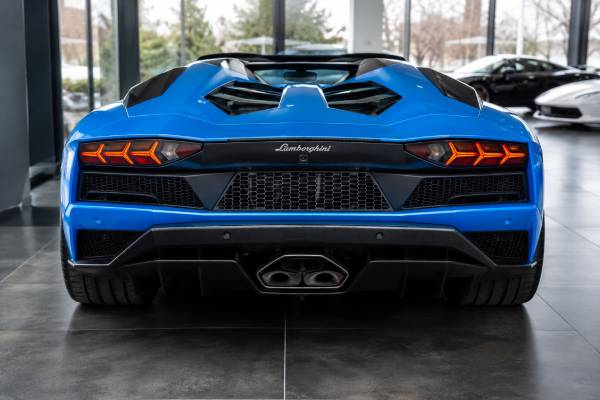
The S exterior was not just a facelift. The front end, side surfaces, rear diffuser, and exhaust arrangement were reshaped to make the car more stable and visually sharper. The triple exhaust outlets are one of the quickest ways to recognize the S. Cooling is also a major design concern. The side intakes, rear openings, and engine-bay airflow are there because the naturally aspirated V12 creates serious heat, especially in traffic or hard use.
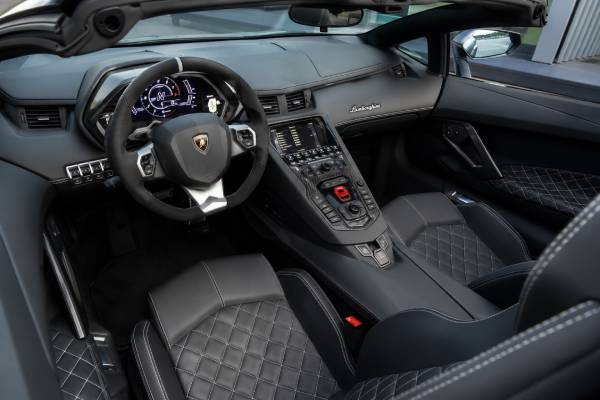
The cockpit is low, wide, and dramatic. The starter cover, digital display, drive-mode selector, carbon trim, and high center tunnel all reinforce the sense that the car is closer to a fighter-like supercar than a luxury convertible. Visibility is better forward than backward, and the car’s width is always present. Parking cameras and sensors are helpful, but they do not make the car small.
Four-wheel steering and active control
The rear-wheel steering system is one of the S Roadster’s most important upgrades. At lower speeds, the rear wheels turn opposite the fronts, making the car feel shorter and more willing to rotate. At higher speeds, the rear wheels turn with the fronts, increasing stability. This does not make the Aventador light, but it makes it less stubborn.
The active suspension uses magnetorheological dampers with pushrod geometry. In plain terms, the dampers can change their behavior quickly as the road surface, speed, and drive mode change. The system works with the steering, all-wheel drive, and stability control to give each mode a distinct feel.
The four main drive modes are Strada, Sport, Corsa, and Ego. Strada is the easiest for daily road use. Sport adds aggression and a more playful calibration. Corsa is the sharpest, most track-focused setting. Ego lets the driver mix settings for powertrain, steering, suspension, and stability control. That flexibility is one reason the S is more livable than the earlier LP700-4.
How the LP740-4 Roadster Drives
The Aventador S Roadster drives like a large, dramatic V12 supercar that has been taught better manners. It is still raw compared with modern dual-clutch supercars, but the S chassis systems make it far more precise than the original Aventador Roadster.
The engine dominates everything. At low revs, it feels muscular but not especially relaxed; at higher revs, it becomes urgent, loud, and theatrical. The throttle response is immediate because there are no turbochargers waiting to build boost. The reward comes from letting the V12 climb, where the sound hardens and the car feels increasingly alive.
Acceleration is fierce rather than clinical. Many newer supercars can match or beat the S Roadster’s numbers, but fewer deliver the same sensation. The combination of engine noise, gearshift shock, all-wheel-drive traction, and open roof makes the car feel faster than a stopwatch alone can explain.
The ISR transmission is central to that feeling. In Strada, it can be clunky if the driver expects a luxury automatic. In Sport or Corsa under load, it gives the car its signature kick between gears. Smooth driving requires learning the gearbox: lift slightly at low speed, be deliberate with throttle inputs, and avoid creeping in traffic for long periods. A driver who treats it like a dual-clutch car may find it frustrating. A driver who understands it as a robotized manual will enjoy it more.
Steering is quick and mode-dependent. The rear-wheel steering helps the car turn in with less effort than its width and weight suggest. On a mountain road, the S Roadster feels more responsive than the early Aventador, but it is still a wide car that needs room. Narrow lanes, rough surfaces, and blind corners demand respect.
Ride quality depends heavily on mode, tire age, and road surface. Strada is firm but usable for a supercar. Sport and Corsa make the car feel more alert but less forgiving. Old or heat-cycled tires can make the car tramline, skip, or feel nervous. Fresh, correct-spec tires are not just a maintenance item; they are part of the chassis tuning.
Braking performance is huge, but carbon-ceramic brakes need proper inspection. They can last a long time on road-driven cars, yet track use, stone damage, overheating, or careless cleaning can shorten their life. Pedal feel is strong, and the system suits high-speed driving, but replacement costs are serious enough to affect purchase price.
As an open-top car, the Roadster adds wind, noise, and exposure. With the roof removed, the V12 becomes the cabin soundtrack. With the rear window lowered, the driver can bring even more engine sound into the cockpit. The compromise is less refinement, more cabin heat, and less luggage space. That is not a flaw. It is the point.
Maintenance Risks and Specialist Care
The Aventador S Roadster is not a normal used exotic; it is a carbon-tub V12 Lamborghini with expensive consumables and complex control systems. A good car can be reliable for its type, but deferred maintenance quickly becomes costly.
The first rule is simple: buy condition and history, not just mileage. Very low mileage is attractive, but cars that sit can suffer from battery weakness, tire aging, sticky mechanisms, seal issues, and incomplete software campaigns. A slightly higher-mileage car with annual specialist servicing can be a safer purchase than a garage queen with gaps.
Key maintenance and inspection areas include:
- Engine health: Check for oil leaks, coolant leaks, misfires, heat damage, catalyst issues, and evidence of poor aftermarket tuning.
- ISR clutch wear: A specialist scan should report clutch wear, calibration status, fault codes, and actuator behavior.
- Transmission operation: Jerky takeoff, harsh low-speed behavior beyond normal ISR character, warning lights, or missed shifts need investigation.
- Cooling system: Inspect radiators, fans, hoses, expansion tank, and heat shielding, especially on cars used in hot climates.
- Carbon-ceramic brakes: Measure disc condition correctly, inspect for chips or cracking, and check pad life.
- Suspension and lift system: Look for leaks, uneven ride height, lift faults, and worn joints.
- Tires: Check date codes, matching specification, tread condition, and signs of flat-spotting.
- Battery and electronics: A weak battery can trigger warning messages and module faults, so tender use and battery history matter.
- Roof and seals: Inspect removable panels, alignment, latch operation, water sealing, and storage hardware.
- Body and carbon structure: Confirm panel gaps, paint depth, tub condition, underbody damage, and suspension pickup integrity.
| Area | Why it matters | Buyer action |
|---|---|---|
| ISR clutch | Wear depends on driving style and traffic use | Request diagnostic clutch-wear reading and road test from cold |
| Carbon brakes | Replacement can be very expensive | Have discs and pads measured by a Lamborghini specialist |
| Front lift | Faults affect usability and repair cost | Cycle the system several times and inspect for leaks |
| Battery | Low voltage can create false electronic faults | Check battery age, tender use, and stored fault codes |
| Aftermarket exhaust | Can affect emissions, warranty, heat, and value | Confirm original parts are included and inspect installation quality |
| Accident damage | Carbon-tub repair affects safety and value | Inspect structure, underbody, suspension points, and history reports |
Recalls and software campaigns are especially important on the Aventador S Roadster. Some Aventador and Aventador S vehicles were subject to engine-stall software recalls. A buyer should verify by VIN that all applicable recall work and dealer campaigns have been completed. This is not optional paperwork; it directly affects drivability and safety.
Service should be handled by an authorized Lamborghini dealer or an independent specialist with real Aventador experience. The car needs the correct diagnostic equipment, correct fluids, correct procedures, and technicians who understand ISR calibration, lift-system behavior, electronic modules, and carbon-ceramic brake inspection. Saving money with a general workshop can become expensive if a fault is misdiagnosed.
For long-term preservation, keep the car on a battery maintainer, warm it properly before hard use, avoid extended clutch slip in traffic, keep tires fresh, store the roof panels correctly, and resist irreversible modifications. The best examples in the future will be the cars that retain their factory specification and have clean, continuous documentation.
Market Values and Buying Checklist
The Aventador S Roadster market rewards originality, color, low mileage, factory options, and clean service history. As of 2026 public market data, many examples sit roughly from the low-$400,000s into the mid-$500,000s, with outliers depending on mileage, specification, location, and seller expectations.
The S Roadster is not usually priced like an SVJ or Ultimae, but it often commands a premium over early LP700-4 Roadsters because it offers the improved S chassis package and the 740 CV engine. Cars with desirable exterior carbon, front lift, strong Ad Personam colors, low miles, clean paint, and excellent documentation tend to attract the best buyers. Cars with accident history, unclear modifications, missing records, tired tires, worn brakes, or clutch uncertainty need a discount.
What drives value
The most valuable S Roadsters usually have a combination of the following:
- low but believable mileage
- annual Lamborghini or recognized-specialist service history
- completed recall and campaign records
- desirable factory color or documented Ad Personam specification
- factory carbon exterior and interior packages
- clean roof panels and correct storage accessories
- original exhaust or included factory exhaust parts
- no structural damage, paint mismatch, or tub repair history
- fresh tires in the correct sizes and specification
- healthy clutch reading and clean diagnostic report
Mileage matters, but it should not be treated alone. A 2,000-mile car on old tires with missing services and a weak battery may be less appealing than an 8,000-mile car with perfect records and fresh consumables. Use mileage as one value factor, not the whole decision.
Pre-purchase inspection priorities
A proper inspection should include both physical and electronic checks. The buyer should not rely on a short dealer test drive or a clean listing description.
Use this order:
- Confirm VIN, model identity, factory build specification, and title status.
- Review all service invoices, recall completions, warranty records, and ownership history.
- Scan all control modules for current and stored faults.
- Check ISR clutch wear, gearbox calibration, and actuator behavior.
- Inspect carbon-ceramic brakes, tires, suspension, lift system, and wheel condition.
- Inspect carbon structure, underbody panels, roof mounts, and evidence of accident repair.
- Road test the car from cold and hot in multiple drive modes.
- Confirm all keys, books, tools, battery tender, roof bags, and factory parts are present.
Avoid cars with vague service history, unexplained warning lights, missing original parts after modifications, clutch data the seller will not disclose, or signs of cosmetic repair around structural areas. Also be careful with cars advertised only by horsepower and color. On an Aventador S Roadster, the expensive story is often hidden in the diagnostics, underside, service file, and option sheet.
The long-term collectability case is strong but not risk-free. The Aventador S Roadster has the right ingredients: naturally aspirated V12, open roof, scissor doors, carbon construction, Lamborghini flagship status, and final-era non-hybrid identity. It is also not as rare as the most valuable limited Aventadors. That means future value will likely separate sharply by condition and specification. Ordinary cars may track the broader Aventador market, while exceptional cars with rare colors, low mileage, and perfect records should remain easier to sell.
For most buyers, the best example is not the cheapest one. It is the car with the cleanest history, most complete records, strongest factory specification, and lowest near-term maintenance risk. Paying more for the right Aventador S Roadster is often cheaper than repairing the wrong one.
References
- Lamborghini Aventador S Roadster | Lamborghini.com 2026 (Manufacturer Specifications) ([Lamborghini.com][1])
- End of an Era with the Last Lamborghini Aventador 2022 (Manufacturer Publication) ([Lamborghini.com][2])
- Part 573 Safety Recall Report 19V-696 2019 (Recall Database) ([NHTSA Static Files][3])
- Part 573 Safety Recall Report 18V-391 2018 (Recall Database) ([NHTSA Static Files][4])
- Lamborghini Aventador LP740-4 S Roadster Market – CLASSIC.COM 2026 (Market Data) ([Classic.com][5])
Disclaimer
This article is for informational purposes only and is not a substitute for professional diagnosis, repair advice, or a pre-purchase inspection. Specifications, torque values, service intervals, procedures, software campaigns, and equipment can vary by VIN, market, model year, and factory configuration. Always verify details against official Lamborghini service documentation and have any car inspected by a qualified Lamborghini specialist before purchase or repair.
If this guide helped, please share it on Facebook, X/Twitter, or your favorite enthusiast community to support our work.