
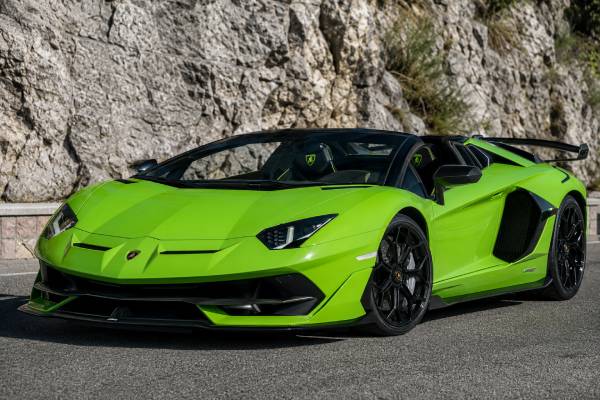
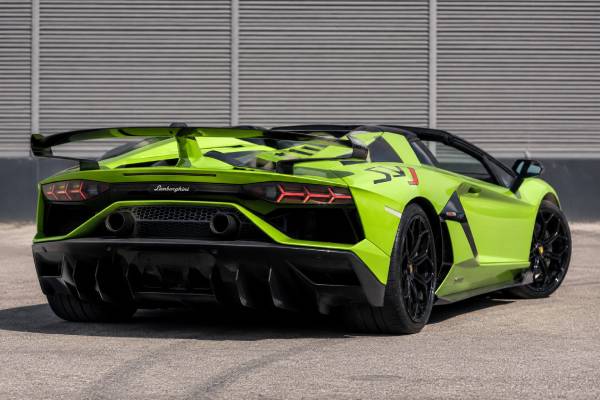
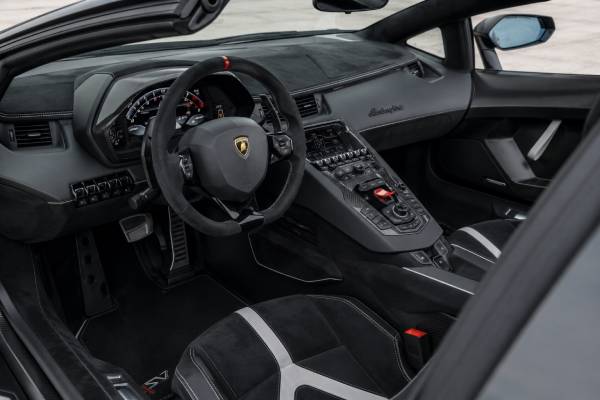
The Lamborghini Aventador SVJ Roadster is the open-top version of the wildest Aventador before the final Ultimae. Built around the LB835 Aventador architecture and the L539 6.5-liter naturally aspirated V12, it combines 770 hp, all-wheel drive, rear-wheel steering, carbon-ceramic brakes, active suspension, and Lamborghini’s ALA 2.0 active aerodynamics in a limited-production roadster body. Lamborghini capped SVJ Roadster production at 800 units, making it rarer than many standard Aventador variants and especially interesting to collectors who want the drama of the V12 flagship without a fixed roof. It matters because it sits near the end of Lamborghini’s pure naturally aspirated V12 era: no hybrid assist, no turbochargers, no softening of the single-clutch ISR gearbox, and a character that feels raw even by modern supercar standards.
Table of Contents
- Why the SVJ Roadster Still Matters
- V12 Specs, Chassis, and Performance Data
- Production, Variants, and Factory Options
- Aero, Roof, and Signature Engineering
- How the SVJ Roadster Drives
- Maintenance, Reliability, and VIN Checks
- Market Value and Buyer Inspection
Why the SVJ Roadster Still Matters
The Aventador SVJ Roadster matters because it is one of the last Lamborghini flagships to offer a naturally aspirated V12 in its most theatrical open-air form. It is not merely an Aventador S Roadster with more power; it is the roadster version of the SVJ, with a sharper chassis setup, active aero, more aggressive bodywork, and a more focused driving character.
The Aventador line began as the Murciélago replacement and carried Lamborghini’s V12 flagship tradition into the carbon-monocoque era. By the time the SVJ arrived, the Aventador had already evolved through the original LP 700-4, the SuperVeloce, and the four-wheel-steering Aventador S. The SVJ was the most extreme development before the LP 780-4 Ultimae closed the generation.
“SVJ” stands for Super Veloce Jota. In Lamborghini language, Super Veloce points to a lighter, faster, more focused version, while Jota links the car to the brand’s historic track-focused special models. The coupe’s Nürburgring record gave the SVJ name real engineering weight, but the Roadster added another layer: it kept the same 770 hp powertrain and ALA 2.0 concept while allowing the driver to remove the two carbon roof panels and hear the V12 without a fixed roof between engine and sky.
The Roadster was presented in 2019 and built in a limited run of 800 units. That number is important for buyers because it creates a clear separation from ordinary Aventador Roadsters and Aventador S Roadsters. It is not as tiny a run as the SVJ 63 Roadster or Xago Edition, but it is rare enough that color, mileage, options, and provenance make a major difference.
Collectors pay attention to the SVJ Roadster for five main reasons:
- It belongs to the final naturally aspirated V12 Aventador generation.
- It uses the highest-output non-Ultimae SVJ tune of the L539 engine.
- It combines open-top bodywork with the SVJ’s active aero and chassis package.
- It was limited to 800 units worldwide.
- It has a distinct driving personality that newer hybrid V12 Lamborghinis cannot fully copy.
Enthusiasts care for a simpler reason: few modern road cars feel this dramatic. The Aventador SVJ Roadster is wide, loud, low, visually extreme, and mechanically intense. It does not try to be subtle, and it does not disguise its mechanical harshness as much as newer supercars do. That is part of its appeal.
V12 Specs, Chassis, and Performance Data
The SVJ Roadster’s core specification is simple: a 6,498 cc naturally aspirated V12, 770 hp, a 7-speed ISR automated manual gearbox, all-wheel drive, carbon monocoque construction, and a dry weight of 1,575 kg. The important detail is how those parts work together: this is a high-revving, non-hybrid, active-aero V12 roadster with old-school drama and modern control systems.
| Category | Specification |
|---|---|
| Model code | LB835 Aventador Roadster family |
| Engine code | L539 |
| Engine type | 60-degree naturally aspirated V12, MPI |
| Displacement | 6,498 cc |
| Bore x stroke | 95.0 mm x 76.4 mm |
| Compression ratio | 11.8:1 nominal |
| Maximum power | 770 hp at 8,500 rpm |
| Maximum torque | 720 Nm at 6,750 rpm |
| Maximum engine speed | 8,700 rpm |
| Lubrication | Dry sump |
| Transmission | 7-speed ISR automated manual |
| Drivetrain | All-wheel drive with Haldex generation IV |
| Clutch | Dry double-plate clutch |
The V12 uses variable valve timing, a dry-sump oiling system, revised intake hardware, titanium intake valves, and SVJ-specific calibration. It is not turbocharged and it does not use hybrid torque fill, so the engine’s character comes from revs, intake response, exhaust flow, and throttle mapping rather than boost.
| Area | Specification |
|---|---|
| Structure | Carbon-fiber monocoque with aluminum front and rear frames |
| Suspension | Pushrod magneto-rheological active suspension |
| Steering | Hydraulic assistance, Lamborghini Dynamic Steering, rear-wheel steering |
| Front brakes | 400 x 38 mm carbon-ceramic discs, 6-piston calipers |
| Rear brakes | 380 x 38 mm carbon-ceramic discs, 4-piston calipers |
| Front wheels and tires | 20 x 9 in wheels, 255/30 ZR20 Pirelli P Zero Corsa |
| Rear wheels and tires | 21 x 13 in wheels, 355/25 ZR21 Pirelli P Zero Corsa |
| Dry weight | 1,575 kg |
| Weight distribution | 43 percent front, 57 percent rear |
| Wheelbase | 2,700 mm |
| Length | 4,943 mm |
| Width excluding mirrors | 2,098 mm |
| Height | 1,136 mm |
| Fuel tank | 85 liters |
| 0–100 km/h | 2.9 seconds |
| 0–200 km/h | 8.8 seconds |
| Top speed | More than 350 km/h |
| 100–0 km/h braking | 31 meters |
These numbers place the SVJ Roadster in the top tier of road-going Aventadors. The coupe is fractionally lighter and quoted at 2.8 seconds to 100 km/h, while the Roadster adds about 50 kg because of its removable roof structure and body reinforcement. In real use, the difference matters less than tires, surface, temperature, and driver confidence.
Production, Variants, and Factory Options
The standard SVJ Roadster was limited to 800 units, but not all examples are equal in the collector market. Special editions, Ad Personam specifications, visible carbon choices, wheel finishes, interior trim, and documentation can change desirability sharply.
The regular SVJ Roadster is the main version covered here. It uses the same 770 hp L539 V12 and the same core chassis systems as the SVJ coupe, but with a removable two-piece carbon-fiber roof. Lamborghini also built special versions around the same mechanical package.
SVJ Roadster, SVJ 63 Roadster, and Xago Edition
The SVJ Roadster was the standard limited-run open model. The SVJ 63 Roadster was a more exclusive special series, limited to 63 examples and styled with more specific exterior and interior details. The number 63 refers to Lamborghini’s founding year, 1963.
The Xago Edition was even rarer, with only 10 examples. It was tied to Lamborghini’s virtual Ad Personam personalization program and used a design theme inspired by hexagonal forms. Mechanically, it did not need extra output to be special; rarity and specification did the work.
For buyers, the hierarchy is usually clear:
- SVJ Roadster: the core 800-unit model and the broadest market.
- SVJ 63 Roadster: more collectible because of the 63-unit allocation and special design treatment.
- Xago Edition: extremely scarce, bought more as a collectible specification than a different driving experience.
Options that affect value
The Aventador SVJ Roadster could be heavily personalized. Lamborghini’s Ad Personam program allowed unusual paint, contrast liveries, visible carbon-fiber panels, stitching, seat treatments, and interior color combinations. A restrained specification can appeal to traditional collectors, while bold factory colors can bring strong money when the spec is coherent and documented.
Important factory and personalization items include:
- Exterior paint, especially launch-style matte finishes, rare colors, and documented Ad Personam colors.
- Visible carbon-fiber roof panels, engine cover details, splitter, side skirts, mirror housings, and rear diffuser trim.
- Nireo wheels and wheel finish.
- Standard Pirelli P Zero Corsa tires or optional P Zero Trofeo R fitment.
- Interior leather and Alcantara combinations.
- Contrast stitching, seat embroidery, SVJ plaques, and special livery details.
- Front axle lift, which is essential for real-world use.
- Sensonum audio, telemetry or infotainment options, and Apple CarPlay availability.
- Market-specific safety and emissions equipment.
Avoid judging value only by sticker price. On an SVJ Roadster, a factory-original, well-documented, tasteful Ad Personam build can be worth more than an example with aftermarket carbon parts, non-original wraps, non-factory exhaust changes, missing books, or uncertain service history.
Aero, Roof, and Signature Engineering
The SVJ Roadster’s engineering identity comes from active aerodynamics, a removable carbon roof, four-wheel steering, active suspension, and the high-mounted exhaust around the V12. It is dramatic by design, but the drama is tied to functional changes.
ALA 2.0 and aero vectoring
ALA stands for Aerodinamica Lamborghini Attiva. In simple terms, it is Lamborghini’s active aerodynamics system. Instead of using only fixed wings and splitters, ALA opens and closes flaps to change airflow depending on whether the car needs lower drag or more downforce.
On the SVJ Roadster, the system includes active elements in the front splitter and rear wing area. When the system prioritizes speed, flaps open to reduce drag. When the car needs grip under braking or cornering, flaps close to increase aerodynamic load. The system can also work side-to-side at the rear, helping the car during high-speed cornering by managing downforce across the wing.
This is why the SVJ Roadster feels more purposeful than a normal Aventador Roadster. The large wing, vents, side intakes, front treatment, rear diffuser, and high-mounted exhaust are not simply styling pieces. They support cooling, airflow, stability, and downforce management.
Carbon roof and roadster structure
The roof uses two removable carbon-fiber panels. Each section is light enough to be removed by hand using quick-release levers, then stored under the front hood. That storage solution is practical for short trips, but it also uses the front luggage area, so owners who tour with the roof off need to pack carefully.
The Roadster adds around 50 kg compared with the SVJ coupe. That increase is the tradeoff for roof removal and structural changes. Lamborghini worked to preserve rigidity, and the SVJ Roadster still feels very stiff for an open car, but it has a slightly different personality from the coupe. With the roof removed, wind, sound, and exposure become part of the performance experience.
Four-wheel steering and active suspension
The SVJ Roadster uses Lamborghini Dynamic Steering at the front and Lamborghini Rear-wheel Steering at the rear. At lower speeds, rear steering helps the car feel shorter and easier to place. At higher speeds, it supports stability. This matters because the Aventador is physically large: over two meters wide without mirrors and nearly five meters long.
The magneto-rheological pushrod suspension adjusts damper behavior quickly. Drive modes alter steering, gearbox behavior, stability control, damping, power delivery, and all-wheel-drive behavior. STRADA is the calmest setting, SPORT adds more aggression and slip character, CORSA is the track-focused mode, and EGO allows custom combinations.
The result is a car that can be driven gently, but never feels ordinary. Even in its calm modes, the SVJ Roadster remains wide, low, stiff, loud, and expensive-feeling in every movement.
How the SVJ Roadster Drives
The SVJ Roadster drives like a raw V12 flagship with modern grip and aero, not like a quiet, seamless luxury convertible. Its best qualities are engine response, sound, braking strength, front-end precision, and the sense that the whole car is built around event rather than ease.
The L539 V12 dominates the experience. At low rpm, it is tractable enough for city movement, but the engine comes alive as the revs rise. It does not deliver the instant low-end shove of a turbocharged engine. Instead, it builds toward a hard, metallic top-end rush. That makes the driver work for the best part of the engine, which is exactly why many owners value it.
The single-clutch ISR gearbox is a major part of the character. It is fast and physical, but it is not smooth like a modern dual-clutch gearbox. In automatic mode at low speeds, it can feel abrupt. In manual mode, with the driver timing throttle inputs and using the paddles deliberately, it becomes part of the theater. Buyers coming from newer dual-clutch supercars should drive one before buying. The gearbox is not a flaw, but it is not subtle.
Road driving
On the road, the SVJ Roadster feels most natural on open highways, mountain roads, and fast sweeping routes. The front axle has strong bite, the rear-wheel steering helps the car rotate, and the all-wheel-drive system gives confidence when traction is less than perfect. The width is the main limit. Narrow city streets, parking ramps, speed bumps, and poor road surfaces demand patience.
Ride quality is firm, but not unusable. The front lift is important because the splitter and underbody are vulnerable. Tire temperature also matters. The huge Pirelli tires need heat to perform properly, and old or cold tires can make the car feel nervous.
Visibility is better forward than many people expect, but rear visibility is limited. The Roadster adds wind noise and roof-off turbulence, though the open rear window can be used to manage airflow and amplify the V12 sound.
Track use
On track, the SVJ Roadster is fast enough to expose weak preparation. Tires, brake condition, alignment, fluid age, and driver discipline matter more than the brochure numbers. Carbon-ceramic brakes are strong, but replacement costs are high. Track use also accelerates tire wear, brake wear, heat cycling, and inspection needs.
The car’s active aero and chassis systems help stability, but they do not make the SVJ Roadster small or light. It remains a large, powerful V12 roadster. It rewards smooth inputs and confidence, not careless aggression.
The best examples feel tight, immediate, and alert. Tired examples feel expensive in a different way: clunks, lazy shifts, uneven tire wear, warning lights, or damaged carbon parts can turn a dream car into a costly correction project.
Maintenance, Reliability, and VIN Checks
The SVJ Roadster is not unreliable in the ordinary sense, but it is an exotic V12 Lamborghini with expensive parts, specialist labor, low production volume, and costly wear items. A well-maintained example is the safest buy; a cheap one with gaps in history can become the most expensive car in the room.
The L539 V12 is a strong engine when serviced correctly, warmed properly, and kept close to factory specification. Problems usually come from age, neglect, accident damage, deferred maintenance, incorrect repairs, weak batteries, leaking seals, damaged undertrays, or modifications that were not documented or reversed properly.
Service realities
Annual service is the practical baseline for most low-mileage SVJ Roadsters, even when mileage is tiny. Fluids age, tires age, batteries weaken, and seals do not benefit from long storage. Always verify the correct service schedule by VIN and market through Lamborghini’s official service documentation.
Important service and inspection areas include:
- Engine oil condition and evidence of correct dry-sump service procedure.
- Gearbox behavior, clutch wear data, and adaptation history.
- Haldex all-wheel-drive service and differential fluid history.
- Coolant condition, radiator health, and signs of heat-related leaks.
- Brake fluid age and carbon-ceramic disc condition.
- Tire age, tire model, and correct front/rear sizing.
- Front lift operation and any hydraulic leaks.
- Magneto-rheological damper function.
- Battery condition and battery tender use.
- Software updates and stored fault codes.
Because the Aventador uses a dry-sump system and complex underbody panels, oil service is not the same as changing oil on a normal car. Incorrect filling, missed drain points, wrong oil specification, damaged fasteners, or sloppy undertray refit can create problems later.
Known ownership risks
The most expensive issues are often not engine failures. They are body, carbon, brake, suspension, clutch, and electronic concerns.
Watch for:
- Front splitter damage from steep driveways or transport ramps.
- Cracked or scraped carbon-fiber aero pieces.
- Worn carbon-ceramic brake discs or pads.
- Old tires with plenty of tread but poor grip.
- Clutch wear from low-speed slipping, heavy traffic, or repeated launch use.
- Gearbox hesitation, harsh engagement beyond normal ISR behavior, or warning lights.
- Battery-related electronic faults after storage.
- Cooling system seepage.
- Poorly fitted aftermarket exhausts or emissions hardware.
- Non-factory carbon add-ons that replace original parts.
- Roof panel damage, latch wear, or water sealing concerns.
A pre-purchase inspection should include a scan with Lamborghini-compatible diagnostic equipment. A generic scan tool is not enough. The inspection should check clutch data, stored fault codes, lift system operation, damper status, brake measurements, tire dates, body alignment, paint depth, carbon condition, underbody damage, recall status, and service records.
Recall and campaign checks
VIN checks are essential. A 2020 recall affected a small number of Aventador SVJ Coupe and Roadster models because the internal door handle mechanism could fail and prevent the door from being unlocked from inside. Some 2021 SVJ Roadster recall information also involved heat exchanger oil line mounting on a very small population. In addition, there was a separate SVJ coupe hood-hinge recall that buyers sometimes confuse with the Roadster; confirm the exact model, VIN, and campaign status rather than assuming.
Ask a Lamborghini dealer to confirm:
- Open recall status.
- Completed recall and campaign history.
- Warranty or extended-warranty eligibility.
- Factory service records.
- Whether any software updates remain outstanding.
- Whether modifications affect warranty or certification.
For a collector-grade SVJ Roadster, documentation is not just paperwork. It protects value.
Market Value and Buyer Inspection
The SVJ Roadster sits above ordinary Aventador Roadsters and Aventador S Roadsters because of rarity, performance, and final-era V12 appeal. Current asking prices and auction results vary widely, but the strongest examples usually combine low mileage, original paint, desirable factory colors, clean carbon, complete records, and no questionable modifications.
Market databases and public listings show SVJ Roadsters trading at a clear premium over SVJ coupes, with exceptional specifications, very low mileage, or special editions pushing much higher. That does not mean every expensive listing is a good buy. Some cars are priced on wishful thinking. Others deserve a premium because they have the right color, the right options, the right mileage, and clean provenance.
What drives value
The most valuable SVJ Roadsters are not simply the lowest-mile cars. They are the cars that make sense as complete objects: factory specification, condition, records, ownership story, and inspection result all line up.
Strong value factors include:
- Original factory paint and documented Ad Personam specification.
- Complete Lamborghini service history.
- Low but believable mileage.
- No accident history or structural carbon repair.
- Original wheels, exhaust, aero pieces, and interior trim.
- Fresh tires in correct sizes and specification.
- Clean carbon-ceramic brake measurements.
- No open recalls or unresolved campaigns.
- Complete books, keys, window sticker, build sheet, and accessories.
- Factory roof panels, storage bags, tools, and battery tender equipment.
- Clear title and clean import/export paperwork where relevant.
Weak value factors include:
- Missing service records.
- Aftermarket exhaust without original parts.
- Repainted panels without a convincing explanation.
- Heavy track use with no supporting maintenance.
- Old tires, worn brakes, or tired clutch data.
- Underbody scrapes hidden by photos.
- Sticky interior switches, warning lights, or weak battery behavior.
- Non-factory carbon parts fitted in place of original parts.
- Seller resistance to a specialist inspection.
Inspection checklist
| Area | What to verify |
|---|---|
| Identity | VIN, model year, build specification, market version, and special-edition status |
| Documentation | Service records, books, keys, warranty history, recall completion, and factory options |
| Body and carbon | Splitter, diffuser, side skirts, roof panels, engine cover, underbody, and paint depth |
| Powertrain | Cold start, leaks, engine data, gearbox behavior, clutch wear, and drivetrain fluids |
| Chassis | Dampers, lift system, rear steering, alignment, suspension joints, and wheel condition |
| Brakes and tires | Carbon-ceramic disc condition, pad life, tire age, tire model, and heat-cycle evidence |
| Interior | Seat wear, Alcantara condition, switchgear, infotainment, plaques, stitching, and trim fit |
| Electronics | Stored fault codes, battery condition, drive modes, ALA status display, and software updates |
Best examples to seek
The best SVJ Roadster to buy is a factory-original car with a clear history, strong options, clean inspection, and a specification you genuinely like. For long-term collectability, originality usually beats dramatic aftermarket changes. Even when an exhaust or visual upgrade is tasteful, buyers should insist that original parts come with the car.
Mileage should be viewed in context. A delivery-mile car may be collectible, but it may also need recommissioning if it has sat for years. A carefully used 2,000-to-6,000-mile car with annual service, fresh tires, and clean diagnostics can be a better ownership car than a static garage queen. Higher-mile examples can be excellent if priced correctly and maintained properly, but they should not be valued like museum pieces.
For serious collectors, the SVJ 63 Roadster and Xago Edition are the obvious special targets. For drivers, the standard SVJ Roadster may be the better choice because it gives the full experience without the same fear of adding miles to a tiny-run special edition.
The safest buying rule is simple: buy the best-documented car, not the cheapest advertised car. On an Aventador SVJ Roadster, one missed detail can cost more than the price difference between a questionable example and a properly sorted one.
References
- Automobili Lamborghini launches the Aventador SVJ Roadster at Geneva Motor Show 2019: exclusive open air driving perfection 2019 (Manufacturer Press Release)
- Lamborghini Aventador SVJ Roadster | Lamborghini.com 2019 (Manufacturer Model Page)
- Part 573 Safety Recall Report 20V-151 2020 (Recall Database)
- Part 573 Safety Recall Report 21V-927 2021 (Recall Database)
- Lamborghini Aventador Market – CLASSIC.COM 2026 (Market Database)
Disclaimer
This article is for informational purposes only and is not a substitute for professional diagnosis, repair, valuation, or inspection. Specifications, torque values, fluids, service intervals, recalls, procedures, and equipment can vary by VIN, model year, market, and factory configuration. Always verify details against official Lamborghini service documentation and use a qualified Lamborghini specialist before buying, servicing, or modifying an Aventador SVJ Roadster.
If this guide helped you, please share it on Facebook, X/Twitter, or your favorite car community to support our work.