


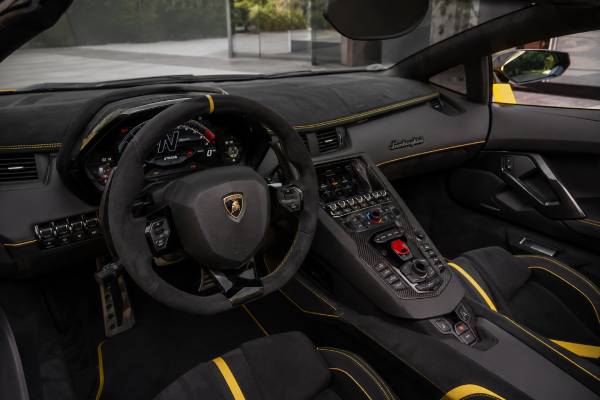
The Lamborghini Aventador S Japan Limited Edition Roadster is a rare Ad Personam interpretation of the open-top Aventador S, built around the LB835 Roadster body and Lamborghini’s L539 6.5-liter naturally aspirated V12. Mechanically, it follows the Aventador S Roadster formula: 740 hp, all-wheel drive, rear-wheel steering, carbon-fiber structure, ISR single-clutch automated manual transmission, and a removable two-piece carbon roof. Its importance comes from the mix of late-era naturally aspirated V12 drama, highly specific Japan-market presentation, and extremely limited special-edition identity. For buyers and collectors, the core questions are not only speed or rarity, but whether the car still has its original Ad Personam specification, factory documentation, paint integrity, roof hardware, service history, and correct provenance.
Table of Contents
- Why the Japan Limited Roadster Matters
- L539 V12 Specs and Chassis Data
- Production Identity and Factory Options
- Carbon Roadster Design and Active Systems
- Driving Character and Real Performance
- Maintenance Risks and Specialist Care
- Market Value and Buying Checks
Why the Japan Limited Roadster Matters
The Aventador S Japan Limited Edition Roadster matters because it combines the Aventador’s most emotional body style with one of Lamborghini’s most collectible modern formulas: a few-off, market-specific, Ad Personam V12 roadster. It is not a separate engineering model from the Aventador S Roadster, but its specification, delivery context, and rarity make it far more interesting than a normal production example.
The Aventador line replaced the Murciélago and became Lamborghini’s flagship V12 model for the 2010s. The original LP700-4 introduced a carbon-fiber monocoque, a new L539 V12, and a dramatic ISR gearbox. The Aventador S improved that foundation with sharper aerodynamics, four-wheel steering, retuned all-wheel drive, updated suspension control, and 740 hp. In Roadster form, the car added open-air theatre without losing the main character of the coupe: a longitudinal mid-mounted V12, scissor doors, aggressive wedge styling, and a very physical driving feel.
The Japan Limited Edition sits inside that story as a collector-grade special specification rather than a homologation special. The best-known Japan-market Aventador S Roadster special series was tied to Lamborghini’s 50-year presence in Japan and was presented around Lamborghini Day Tokyo. Public references often describe five examples, each inspired by Japanese natural-element themes such as water, earth, fire, wind, and sky. The requested 2021–2021 framing should therefore be treated carefully: many cars are described by registration year, import year, model year, or listing year, while the limited-edition concept itself belongs to the late Aventador S period rather than a separate 2021 mechanical generation.
That nuance matters for buyers. A real Japan Limited Edition car should be judged by its VIN, factory build data, Ad Personam file, original market paperwork, and the exact specification applied by Lamborghini. A standard Aventador S Roadster with later paintwork, a themed wrap, or dealer-installed cosmetic changes is not equivalent.
Collectors care because the Aventador S Roadster marks one of the last open Lamborghini V12 cars before the Aventador Ultimae closed the naturally aspirated, non-hybrid Aventador era. Enthusiasts care because it keeps the old Lamborghini recipe alive: huge engine, compact cabin, wild sound, exposed roof panels, and a gearbox that shifts with drama rather than smoothness. Owners care because the car is valuable enough that small originality mistakes can become expensive later.
Its lasting significance comes from four traits:
- Naturally aspirated V12 identity: The L539 is central to the car’s value and emotion.
- Roadster body: The removable roof makes the sound and sensation stronger.
- Few-off Japan-market specification: The edition’s rarity depends on proof, not just appearance.
- Late Aventador S engineering: Four-wheel steering and active systems make it sharper than the early LP700-4.
The result is a car that sits between usable modern supercar and fragile collector object. It can be driven hard, but it should be documented and maintained like a serious limited-production asset.
L539 V12 Specs and Chassis Data
The essential specification is simple: a 6.5-liter L539 naturally aspirated V12, 740 hp, all-wheel drive, a carbon monocoque, and a 350 km/h top speed. The Japan Limited Edition’s main differences are visual, market, and provenance-related; the mechanical base is the Aventador S Roadster.
| Item | Lamborghini Aventador S Japan Limited Edition Roadster |
|---|---|
| Body/platform | LB835 Aventador S Roadster |
| Engine code | L539 |
| Engine type | 6.5-liter naturally aspirated 60-degree V12 |
| Displacement | 6,498 cc |
| Maximum power | 740 CV / 544 kW at 8,400 rpm |
| Maximum torque | 690 Nm at 5,500 rpm |
| Transmission | 7-speed ISR automated manual |
| Drivetrain | Electronically controlled all-wheel drive |
| Steering | Lamborghini Dynamic Steering with rear-wheel steering |
| Suspension | Pushrod suspension with magnetorheological adaptive dampers |
| Brakes | Carbon-ceramic discs, 400 mm front and 380 mm rear |
| Top speed | 350 km/h / 217 mph |
| 0–100 km/h | 3.0 seconds |
| Fuel tank | 90 liters |
The L539 is the heart of the car. It is not turbocharged and does not use hybrid assistance. That makes the power delivery very different from newer electrified or boosted supercars. The engine builds speed with revs, gets harder and louder as it climbs, and reaches peak power near the top of the tachometer. It is one of the main reasons collectors treat late Aventadors with care: the engine is both a performance part and the emotional center of the car.
The ISR gearbox is equally important to the car’s personality. It is a single-clutch automated manual, not a dual-clutch transmission. In gentle traffic it can feel abrupt, especially compared with a modern Huracán, Revuelto, Ferrari, or McLaren. In hard driving it gives the Aventador its signature mechanical punch. The shift is not invisible; it is part of the event.
| Item | Figure or description |
|---|---|
| Length | 4,797 mm |
| Width | 2,030 mm excluding mirrors |
| Height | 1,136 mm |
| Wheelbase | 2,700 mm |
| Roof | Two removable carbon-fiber hard-top panels |
| Structure | Carbon-fiber monocoque with aluminum front and rear frames |
| Typical tire sizing | 255/30 ZR20 front and 355/25 ZR21 rear |
The chassis is more sophisticated than the Aventador’s brutal image suggests. The carbon tub provides the core stiffness. The aluminum subframes carry crash structures, suspension loads, and serviceable assemblies. The Roadster adds roof-removal hardware and body changes, but it keeps the main carbon-fiber structure that defines the Aventador family.
The Aventador S also added rear-wheel steering. At low speeds, the rear wheels steer opposite the fronts to make the car feel shorter and more agile. At higher speeds, they steer with the fronts to improve stability. This matters because the Aventador is wide, low, and heavy by modern supercar standards. Four-wheel steering makes it easier to place and gives it more confidence in fast corners.
Production Identity and Factory Options
The Japan Limited Edition should be identified by documentation before appearance. The safest buying position is to treat every claimed example as unproven until the VIN, Ad Personam file, selling dealer records, original market paperwork, and factory specification are checked together.
A standard Aventador S Roadster is already a low-volume supercar, but the Japan Limited Edition layer changes the ownership discussion. The value is tied to originality. A buyer should not rely on a seller’s description such as “Japan edition,” “1 of 5,” or “limited” without supporting records.
Key identity checks include:
- VIN and model code confirming the Aventador S Roadster base.
- Original supplying dealer and market records.
- Factory Ad Personam build specification.
- Original paint name, interior trim description, stitching details, and exterior theme.
- Proof that special graphics, gradients, or finishes were factory-applied.
- Books, warranty documents, service invoices, roof-panel bags, tools, keys, and accessories.
- Import/export documents if the car left Japan.
The Japan-themed cars are generally understood as five unique designs rather than five identical cars. That makes ordinary comparison difficult. One car may have a water-inspired finish, another a fire or wind theme, and another a sky-related theme. Each one needs to be assessed as an individual object.
| Version | Main character | Collector relevance |
|---|---|---|
| Aventador LP700-4 Roadster | Original open Aventador with 700 hp | Important first-generation model |
| Aventador S Roadster | 740 hp, rear-wheel steering, updated aero and chassis control | Stronger road car and direct base for Japan edition |
| Aventador S Japan Limited Edition Roadster | Few-off Japan-market Ad Personam specification | Value depends heavily on provenance and originality |
| Aventador SVJ Roadster | 770 hp, ALA active aero, track-focused setup | More extreme and separately collectible |
| Aventador Ultimae Roadster | Final-series Aventador with 780 hp | Historically important end-of-line model |
Options also matter. On modern Lamborghinis, personalization is not a small side issue. Carbon exterior parts, exposed carbon details, forged wheels, brake-caliper colors, interior carbon, Alcantara, contrast stitching, seat embroidery, telemetry equipment, front-lift systems, audio upgrades, and protective films can all affect desirability.
For a Japan Limited Edition, though, the best option is the one that belongs to the original theme. Replacing factory wheels, repainting brake calipers, retrimming seats, or applying later carbon parts may make the car look fresher, but it can weaken the collector story if those changes are not documented. Factory-correct special paint and interior details should usually be preserved rather than “improved.”
A buyer should also be careful with the 2021 model-year label. If a car is advertised as a 2021 Japan Limited Edition, confirm whether that means factory build year, first registration, market listing year, import date, or model-year paperwork. This distinction is not just academic. Taxes, emissions compliance, insurance valuation, and collector authenticity can all depend on the exact record.
Carbon Roadster Design and Active Systems
The Aventador S Roadster looks extreme because its design follows cooling, aero, roof packaging, and V12 theatre. The Japan Limited Edition adds cultural and visual storytelling, but the underlying design is still pure Aventador: low nose, hard edges, scissor doors, deep side intakes, and a wide rear built around heat extraction.
The removable roof is a central feature. It uses two carbon-fiber panels that can be removed by hand and stored in the front compartment. This is not as convenient as a power-folding hardtop, but it saves complexity and keeps the car’s structure close to the coupe. It also creates a more deliberate ownership ritual: remove the panels, store them correctly, check the seals, and accept that luggage space is limited when the roof is off.
The Aventador S design update brought sharper front aero and a more aggressive rear. The nose uses larger openings and a stronger splitter treatment. The rear uses a central exhaust layout, diffuser fins, and a movable rear wing. The car does not have the SVJ’s ALA aero-vectoring system, but it still uses active aerodynamic management and cooling-focused bodywork.
The active systems work together through Lamborghini’s vehicle-dynamics logic. The main pieces are:
- Lamborghini Dynamic Steering: Variable steering response depending on speed and drive mode.
- Rear-wheel steering: Improves low-speed agility and high-speed stability.
- Adaptive magnetorheological dampers: Adjust damping quickly to match road surface and selected mode.
- All-wheel drive: Varies torque distribution to support traction and handling.
- Drive modes: Strada, Sport, Corsa, and Ego alter the engine, gearbox, steering, suspension, stability control, and drivetrain behavior.
This is why the Aventador S feels more modern than the early LP700-4. The original Aventador could feel heavy and reluctant in tighter corners. The S still feels large, but it turns in more cleanly and gives the driver more confidence.
The Japan Limited Edition’s design value comes from the details. A few-off Ad Personam car may have layered paint, unique color transitions, contrast stitching, themed interior accents, and special trim combinations. These details are difficult to restore perfectly. A stone chip on a normal painted panel is one thing; a chip through a unique gradient or multi-tone finish is another. Repair quality can become a major value factor.
The cockpit is also part of the appeal. The Aventador cabin is low, narrow, and dramatic. The start button sits under a fighter-jet-style cover. The digital instrument display changes with the mode. The view forward is theatrical, while rear visibility is limited. It is not a calm grand-tourer cabin, and that is part of the charm. In Roadster form, the V12 sound floods the interior, especially with the roof removed and the rear window area open to the engine’s voice.
Driving Character and Real Performance
The Aventador S Roadster is fast in a way that feels mechanical, loud, and physical. Many newer supercars are smoother, quicker-shifting, and easier to drive quickly, but the Aventador S Roadster feels more dramatic at every speed.
Acceleration is immediate once the V12 is awake, but the engine’s best character is at high rpm. Below the middle of the rev range it is tractable and strong. Above that, it becomes sharper, louder, and more urgent. The lack of turbocharging gives the throttle a clean relationship to engine speed. The driver hears intake, exhaust, valvetrain, and gear changes rather than a filtered soundtrack.
The gearbox defines much of the experience. In Strada, it is usable but never invisible. It can hesitate, nod the cabin, or feel clumsy in stop-start traffic. In Sport and Corsa, the shifts become harder and more exciting. Lift slightly during gentle driving and the car smooths out; keep the throttle pinned and it delivers the famous Aventador kick between gears.
The steering is not light in the way many modern electric systems are. It has weight, and the car is wide enough that the driver must plan road position. The rear-wheel steering helps, especially in city turns, tight mountain-road corners, and fast lane changes. It does not make the Aventador small, but it makes it less intimidating.
Ride quality depends heavily on tires, road surface, and mode. The car rides on very low-profile tires, and the Roadster can feel firm over poor pavement. The front lift system, where fitted, is important for ramps, speed humps, and steep driveways. Owners who ignore approach angles can damage front carbon parts quickly.
Braking is powerful, but carbon-ceramic brakes need proper assessment. They can last a long time on road cars, but track use, gravel damage, heat cycling, and careless wheel cleaning can change the story. The pedal can feel firm, and cold response may differ from steel-brake daily drivers. A proper inspection should measure condition rather than judge by appearance alone.
On track, the Aventador S Roadster is capable but not as focused as an SVJ. It has huge power, strong brakes, and active chassis systems, but it is still a heavy, valuable, open-top V12 car. Heat management, tire wear, brake wear, and insurance conditions matter. For many owners, its best use is fast road driving, events, mountain routes, and occasional controlled track sessions rather than repeated hard lapping.
Its daily usability is limited but real. It has climate control, modern infotainment for its era, a front compartment, parking aids on many cars, and reasonable seating comfort for short trips. The limits are width, visibility, noise, fuel consumption, tire cost, roof-panel storage, and the attention it attracts. It is less a commuter and more a car for deliberate drives.
Maintenance Risks and Specialist Care
The Aventador S Japan Limited Edition Roadster should be maintained like a high-value collector car, not a normal used exotic. The biggest risks are not only mechanical failure, but poor documentation, weak paint repairs, deferred servicing, worn carbon-ceramic brakes, roof damage, and non-factory changes that reduce originality.
Annual servicing is the baseline even for low-mileage cars. Low use does not stop fluids aging, batteries weakening, tires hardening, seals drying, or electronic faults appearing. A car that has covered very few kilometers but sat for long periods can need more attention than one that has been used and serviced correctly.
Important maintenance areas include:
- Engine oil and fluids: The L539 needs correct fluids, correct procedures, and technicians familiar with the car.
- Cooling system: Radiators and cooling ducts sit in areas exposed to debris; leaks, blocked fins, and damaged ducting need attention.
- ISR clutch and gearbox behavior: Jerky low-speed use, repeated launches, and city driving can accelerate clutch wear.
- All-wheel-drive system: Check for warning lights, fluid service history, and abnormal noises.
- Magnetorheological dampers: Look for leaks, uneven ride behavior, and electronic faults.
- Front lift system: Inspect hydraulic operation, leaks, speed of movement, and warning messages.
- Carbon-ceramic brakes: Check disc condition, chips, cracks, pad thickness, and heat history.
- Tires: Replace old tires even if tread remains; correct size and rating are essential.
- Battery and electronics: Use a maintainer; low voltage can trigger confusing faults.
- Roof panels: Inspect latches, locating pins, seals, bags, panel edges, and storage damage.
The Roadster adds specific concerns. Roof panels must fit cleanly and seal properly. Wind noise, water marks, damaged seals, rattles, and scratched panel edges can point to poor handling or incorrect storage. The roof bags and related accessories matter for originality and practical use.
Paint and bodywork require special care. On a Japan Limited Edition, the paint is not just a color; it is part of the car’s identity. A normal respray may make the panel glossy, but it may not recreate the factory theme, fade, edge transition, or special-effect finish. Before purchase, inspect the car under natural light, workshop lighting, and paint-depth readings. Also check the carbon structure, aluminum subframes, suspension pickup points, underbody, and front splitter for accident or curb damage.
A specialist pre-purchase inspection should include:
- Confirm VIN, build specification, and market documents.
- Read all control modules for stored and current faults.
- Check clutch wear data and gearbox adaptation history where available.
- Inspect underside, front lift, suspension, and brake condition.
- Measure paint and inspect special-edition finishes for repair work.
- Verify roof-panel fit, seals, bags, tools, and accessories.
- Review every service invoice, not just stamped books.
- Check recall and campaign status by VIN with an authorized Lamborghini source.
Parts availability is generally better than for older classics, but costs are high and delays can happen. Carbon trim, special paintwork, unique interior details, and limited-edition cosmetic pieces may be far harder to source than ordinary service parts. That is why prevention matters: careful storage, battery maintenance, correct washing, proper PPF, and specialist servicing can protect both condition and value.
Market Value and Buying Checks
The Japan Limited Edition Roadster is best valued as a documented few-off collector Aventador, not as a normal Aventador S Roadster with unusual paint. Standard Aventador S Roadsters trade mainly on mileage, condition, color, options, and service history; a true Japan Limited Edition adds provenance, originality, and rarity as the main value drivers.
Public market data for the exact Japan Limited Edition is thin because cars like this often sell privately. Standard Aventador S Roadsters in strong condition have generally occupied the mid-to-high six-figure range in major markets, while rarer Aventador variants such as SV, SVJ, and Ultimae models can sit much higher depending on specification. A real one-of-five Japan-market car can command a premium, but the premium is only defensible when the documentation is clear.
The strongest examples usually have:
- Original factory paint and themed details.
- Complete Ad Personam documentation.
- Low but credible mileage.
- Continuous authorized or recognized specialist service history.
- No accident history.
- Original roof panels, bags, tools, books, keys, and accessories.
- Clean import/export paperwork if moved between countries.
- No questionable aftermarket wheels, wraps, tunes, exhaust modifications, or retrims.
- Recent tires, healthy battery, and no unresolved warning lights.
The examples to avoid are the ones that look tempting but cannot prove the story. A wrapped standard Aventador S Roadster, a repaint in a Japan-inspired color scheme, or a car with missing factory records should be priced as what it can prove itself to be. Claims do not create collector value.
| Area | What to check | Why it matters |
|---|---|---|
| Provenance | VIN, Ad Personam file, original market documents | Confirms whether the car is a genuine limited-edition example |
| Paint | Paint depth, panel match, gradient accuracy, chip repairs | Special finishes are hard to repair correctly |
| Roof | Panel condition, seal fit, latches, bags | Roadster hardware affects usability and originality |
| Powertrain | Service records, leaks, gearbox data, clutch wear | Major repairs are expensive and specialist-only |
| Brakes and tires | Carbon-ceramic condition, tire age, correct sizing | Replacement cost is high and affects safety |
| Electronics | Module scan, lift system, suspension modes, infotainment | Low-voltage or module issues can be time-consuming |
| Originality | Wheels, exhaust, interior trim, carbon parts | Aftermarket changes can reduce collector value |
Ownership risk is manageable for the right buyer, but only with the right support. This is not a car to buy without a Lamborghini specialist, enclosed storage, battery maintenance, proper insurance, and a budget for annual service even when it is barely driven. The most expensive Aventador S Roadster is often the one bought cheaply with missing records, old tires, weak battery, hidden paintwork, and no recent specialist inspection.
Long-term collectability looks strong for the best examples. The Aventador was Lamborghini’s last long-running pre-hybrid V12 flagship, and the S Roadster is one of its most balanced open versions. The Japan Limited Edition adds rarity and story, but the market will reward only cars that keep that story intact. Buy the documentation first, the condition second, and the drama third. The drama is guaranteed; the provenance is what must be proven.
References
- Lamborghini Aventador S Roadster | Lamborghini.com 2017 (Manufacturer Specifications)
- The Yamamoto Aventador S at Lamborghini Lounge Tokyo 2020 (Manufacturer News)
- A Thrilling Lamborghini Day Japan 2021 (Manufacturer News)
- Gas Mileage of 2021 Lamborghini Aventador 2021 (EPA Fuel Economy)
- Part 573 Safety Recall Report 21V-927 2021 (Recall Database)
Disclaimer
This article is for informational purposes only and is not a substitute for professional diagnosis, inspection, repair, or valuation. Specifications, torque values, service intervals, campaign status, repair procedures, and equipment can vary by VIN, market, software version, and original specification. Always verify details against the official Lamborghini service documentation for the exact vehicle and consult a qualified Lamborghini specialist before buying, servicing, or restoring the car.
If this guide helped you, please share it on Facebook, X/Twitter, or your preferred car community to support our work.