
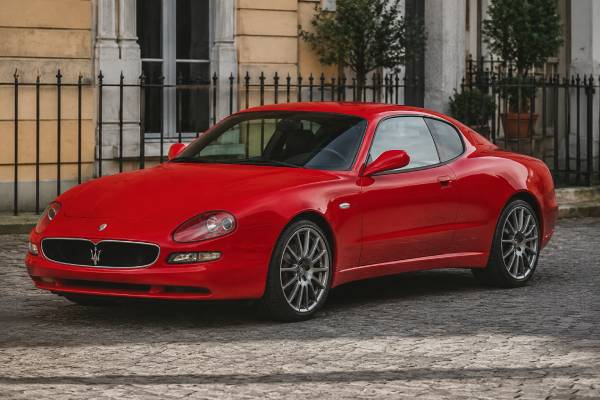
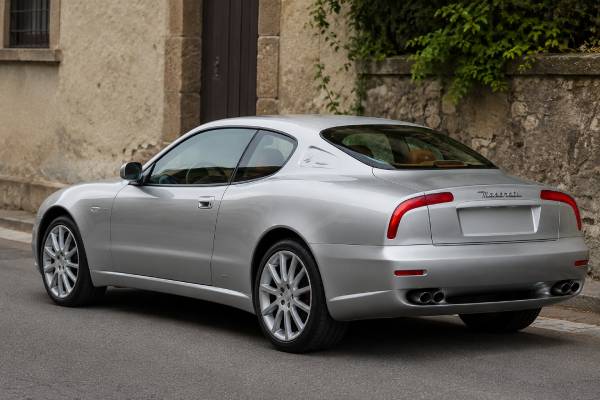
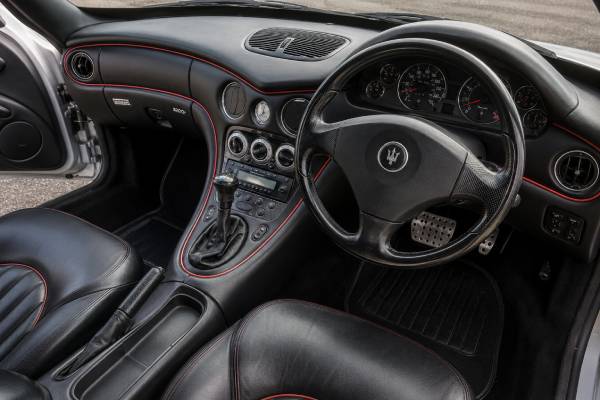
The Maserati 3200 GT Assetto Corsa is the rare, factory-sharpened version of Maserati’s twin-turbo grand tourer, combining a six-speed manual gearbox with a lower, firmer chassis and stronger track-focused details. Its 3.2-litre AM 585 V8 still produces 370 hp, but the Assetto Corsa package improves steering response, body control, braking consistency, and tyre grip rather than chasing a larger headline power figure.
Built near the end of 3200 GT production, this version represents the most focused form of the manual car. It retains the four-seat cabin, leather trim, and long-distance ability of the standard model while adding a more deliberate connection between the driver, gearbox, and rear axle. It also preserves features that disappeared from the later Maserati Coupé, including the twin-turbo Maserati V8 and the famous boomerang LED rear lights. Today, rarity strengthens its appeal, but condition remains decisive. A properly maintained example is fast, distinctive, and deeply engaging; a neglected one can require major spending.
Table of Contents
- The Most Focused Twin-Turbo 3200
- AM 585 Engine, Gearbox, and Chassis Specs
- Production Numbers, Variants, and Authenticity
- Giugiaro Design and Assetto Corsa Hardware
- Manual Gearbox, Road Feel, and Performance
- Reliability, Servicing, and Major Cost Risks
- Buying and Inspecting a Manual Assetto Corsa
The Most Focused Twin-Turbo 3200
The manual Assetto Corsa is the sharpest factory road-going version of the 3200 GT. Maserati left its engine output unchanged and instead refined the suspension, steering, brakes, wheels, and tyres to create a more controlled and responsive grand tourer.
Introduced in 1998, the 3200 GT marked an important turning point for Maserati. The company needed to move beyond the uneven reputation of its Biturbo-era cars while retaining the style, performance, and individuality expected from a Modena-built grand tourer. The new coupé had to compete with established cars such as the Porsche 911, Jaguar XKR, and Aston Martin DB7 without simply copying their approach.
The 3200 GT used a front-mounted V8, rear-wheel drive, four proper seats, and an elegant Giorgetto Giugiaro body. Beneath its softer exterior was sophisticated hardware: twin turbochargers, electronic throttle control, aluminium suspension components, a limited-slip differential, and large Brembo brakes.
It also arrived while Ferrari’s influence over Maserati was increasing. Factory processes, quality control, and product development were being modernised, yet the 3200 retained an engine derived from Maserati’s own twin-turbo V8 family. This gives it a different character from the later 4.2-litre Maserati Coupé, which used a naturally aspirated Ferrari-derived engine.
Maserati introduced the Assetto Corsa at the 2001 Geneva Motor Show. The name translates roughly as “race setup” or “track setup,” but the car was not stripped of comfort. It retained its leather-lined interior, climate control, rear seats, and grand-touring role. The changes concentrated on how the car responded when driven quickly.
The package included firmer springs, a lower ride height, a larger front anti-roll bar, revised damping, quicker steering response, special brake cooling, performance brake pads, 18-inch BBS wheels, and Pirelli P Zero Corsa tyres. These changes gave the car greater precision without altering the 370 hp engine.
The manual version is especially desirable because its six-speed Getrag gearbox gives the driver direct control over the engine’s boost and torque. The automatic GTA Assetto Corsa is rarer in absolute terms, but the manual offers the more involved experience associated with the edition’s sporting purpose.
The model remains significant for several reasons:
- It is the final factory development of the original 3200 GT chassis.
- It uses Maserati’s own twin-turbo AM 585 V8.
- It retains the six-speed manual transmission.
- It combines a limited-production identity with four-seat usability.
- It carries the original boomerang-shaped LED rear lamps.
- It was among the last Maseratis developed before the company shifted toward the Ferrari-powered Coupé.
Its reputation today is divided between admiration and caution. Enthusiasts value its design, rarity, performance, and mechanical personality. Specialists also recognise that poor maintenance can turn an inexpensive purchase into an expensive restoration. The difference between a rewarding car and a troublesome one usually lies in documentation, correct diagnosis, and regular use.
AM 585 Engine, Gearbox, and Chassis Specs
The manual Assetto Corsa uses the same 3,217 cc twin-turbo V8 and six-speed Getrag gearbox as the standard 3200 GT. Its performance advantage comes from chassis control and grip rather than greater power or reduced weight.
| Item | Specification |
|---|---|
| Engine code | AM 585 |
| Engine layout | Front-mounted 90-degree V8 |
| Construction | Aluminium block and cylinder heads |
| Displacement | 3,217 cc |
| Bore × stroke | 80.0 × 80.0 mm |
| Valve gear | Double overhead camshafts, four valves per cylinder |
| Induction | Twin turbochargers with twin intercoolers |
| Fuel system | Electronic fuel injection |
| Throttle | Electronic drive-by-wire control |
| Maximum output | 370 PS at 6,250 rpm |
| Maximum torque | 491 Nm at 4,500 rpm |
| Transmission | Getrag 226 six-speed manual |
| Driven wheels | Rear-wheel drive |
| Differential | Limited-slip differential |
The AM 585 uses an equal 80 mm bore and stroke. Its two turbochargers feed separate intercoolers before compressed air reaches the engine. This arrangement helps produce strong torque from a relatively compact displacement, but it also fills the engine bay with heat-sensitive hoses, wiring, seals, and control hardware.
Power delivery is shaped by turbo response. At modest throttle openings, the engine can feel flexible and civilised. Under heavier load, boost builds and acceleration becomes much stronger. The transition is exciting, but it requires careful throttle control when the rear tyres are cold, worn, or operating on a wet surface.
The six-speed Getrag gearbox gives the manual car a higher top speed and quicker quoted acceleration than the four-speed automatic. Its closely spaced ratios help keep the engine in the effective part of its power band, while sixth gear supports high-speed touring.
| Item | Specification |
|---|---|
| Body style | Steel two-door 2+2 coupé |
| Structure | Steel unitary body with front and rear subframes |
| Front suspension | Independent double wishbones with aluminium components |
| Rear suspension | Independent double wishbones with aluminium components |
| Assetto Corsa setup | Lower ride height, firmer springs, revised damping, larger front anti-roll bar |
| Steering | Hydraulically assisted rack and pinion with quicker response |
| Brakes | Brembo four-piston calipers with ventilated, cross-drilled discs |
| Wheels | 18-inch 15-spoke BBS alloy wheels |
| Tyres | 235/40 ZR18 front and 265/35 ZR18 rear |
| Wheelbase | 2,660 mm |
| Length | 4,510 mm |
| Width | 1,822 mm |
| Height | Approximately 1,290 mm |
| Kerb weight | Approximately 1,590 kg |
| Fuel capacity | 90 litres |
| Drag coefficient | 0.34 |
| 0–100 km/h | Approximately 5.2 seconds |
| Top speed | Approximately 280 km/h |
Period acceleration results vary because of launch technique, temperature, road surface, fuel, and tyre condition. A healthy manual 3200 GT is extremely quick, but its character is more important than a single number. The strongest sensation comes when boost builds in second, third, or fourth gear and the car delivers sustained acceleration rather than a brief launch.
The Assetto Corsa’s firmer chassis does not make it substantially lighter. Instead, it reduces unwanted movement and allows the tyres to work more consistently. Its performance therefore depends heavily on correct suspension components, accurate alignment, and suitable tyres.
Production Numbers, Variants, and Authenticity
A genuine manual Assetto Corsa should be authenticated through its VIN, factory build information, original specification, and documented history. Wheels, badges, painted brake calipers, or a numbered plaque are not enough on their own.
The most widely documented production breakdown is 259 Assetto Corsa cars, including 163 manuals and 96 automatics. Three cars are often described as special orders outside the three standard colour combinations. Other published totals differ, which may reflect counting methods, market allocations, announced production, or incomplete factory records.
The 163 manual cars form the larger part of Assetto Corsa production, but they remain rare compared with the 2,689 manual 3200 GTs built across the full model range. Rarity alone does not guarantee value. A poorly maintained Assetto Corsa may be less desirable than an excellent standard 3200 GT.
The edition was generally offered in three standard exterior colours:
- Grigio Touring.
- Nero Carbonio.
- Rosso Mondiale.
Special-order colours may exist, but unusual specifications require stronger supporting evidence. Buyers should compare the paint code, interior colour, factory record, first registration documents, and early photographs or invoices.
| Area | Expected specification | What to verify |
|---|---|---|
| Transmission | Six-speed Getrag manual | Correct gearbox, clutch operation, shift quality |
| Wheels | 18-inch 15-spoke BBS alloys | Part numbers, finish, cracks, repairs, buckling |
| Brakes | Red calipers, performance pads, cooling ducts | Correct hardware, duct presence, disc condition |
| Suspension | Lower and firmer Assetto Corsa setup | Correct springs, dampers, anti-roll bar, ride height |
| Interior | Perforated Connolly leather with contrasting stitching | Original trim pattern, wear, repairs, retrimming |
| Sill trim | Assetto Corsa identification | Condition, originality, consistency with records |
| Documentation | Factory and dealer evidence | VIN, build data, service book, invoices, ownership trail |
The BBS wheels are among the easiest features to copy or lose. Confirm their dimensions and markings, inspect for welding or distortion, and check that all four match. Refurbishment is acceptable when correctly completed, but an inaccurate finish can reduce originality.
The suspension deserves the same care. Standard 3200 components may physically fit, and some cars have been altered with aftermarket springs or dampers. These changes can affect ride height, balance, comfort, and value. A seller should be able to explain what is installed and provide invoices.
Originality does not require retaining unsafe aged components. Modern tyres, rebuilt dampers, improved hoses, restored throttle electronics, and repaired LED lights can make the car more dependable. Good upgrades should be documented, technically sound, and sympathetic to the original engineering.
Giugiaro Design and Assetto Corsa Hardware
The Assetto Corsa’s appeal comes from the contrast between its elegant grand-touring shape and its serious mechanical hardware. It looks restrained beside many modern performance cars, yet its twin-turbo V8, manual gearbox, sophisticated suspension, and large brakes give it genuine high-speed ability.
Giorgetto Giugiaro and Italdesign created the exterior. The shape uses a low nose, broad rear shoulders, a flowing roof, and a compact tail. Hood vents help release heat and visually distinguish the car’s turbocharged character without dominating the design.
The interior was developed separately, with extensive leather covering the dashboard, console, doors, and seats. The cabin offers a more luxurious atmosphere than a typical sports car, while the rear seats are useful enough for passengers on shorter journeys.
The boomerang rear lights remain the car’s defining detail. Their curved LED elements give the 3200 an unmistakable night-time signature. They were technically advanced when the car appeared, but they can now be difficult and costly to repair. Water entry, cracked housings, failed LED sections, and previous poor repairs must be checked carefully.
The steel body uses front and rear subframes to carry important mechanical components. Double-wishbone suspension at each corner uses forged aluminium arms and uprights, reducing unsprung weight and helping maintain wheel control.
The Assetto Corsa package alters how this hardware behaves:
- Firmer springs reduce pitch, roll, and squat.
- A lower ride height reduces the centre of gravity.
- A larger front anti-roll bar sharpens initial response.
- Revised damping improves body control during quick transitions.
- Quicker steering makes the car more immediate.
- Soft-compound tyres improve dry grip and turn-in.
- Brake cooling ducts support repeated heavy braking.
- Performance pads increase high-temperature consistency.
These elements must be considered together. Installing comfort-oriented tyres may make the steering less precise. Fitting very stiff aftermarket suspension can damage the balance and make the car skittish on imperfect roads. Extreme track tyres may add grip but place greater loads on ageing bushes, wheel bearings, dampers, and body mounts.
The original Pirelli P Zero Corsa tyres were central to the factory setup, but surviving period tyres should not be used simply for authenticity. Tyres harden with age even when tread remains. A modern matching set in the correct size and speed rating is safer and usually transforms the car’s behaviour.
Cooling is another major engineering theme. The compact twin-turbo V8, two intercoolers, exhaust manifolds, catalysts, and associated plumbing generate considerable heat. Clean radiator surfaces, healthy fans, intact ducts, and secure hoses are therefore essential rather than optional details.
The manual gearbox adds a physical connection missing from the GTA. The clutch, gear lever, engine response, and limited-slip differential interact directly, making the car feel more mechanical. This also adds wear points that must be inspected carefully.
Manual Gearbox, Road Feel, and Performance
The manual Assetto Corsa feels fast, alert, and demanding rather than effortless. Its six-speed gearbox gives the driver direct control over boost, but smooth progress requires careful coordination of clutch, throttle, steering, and rear-tyre grip.
At low engine speeds, the V8 is flexible enough for normal traffic. The throttle should respond progressively on a healthy late-production car, although it remains more sensitive than the control systems in a modern grand tourer.
As the revs rise and the turbochargers build pressure, the engine changes character. The car moves from strong naturally aspirated-style response into a harder surge of torque. This transition is one of its greatest attractions, but it can also unsettle the rear axle if the driver applies too much throttle while cornering.
The six-speed Getrag gearbox should feel positive and mechanical. It is not expected to have the light action of a modern compact sports car, but the lever should move cleanly through each gate without grinding, jumping out of gear, or resisting shifts after the oil is warm.
Clutch weight can be substantial. Engagement should remain predictable, with no slipping under boost, judder when moving away, or noise when the pedal is pressed. A very high biting point may indicate wear, although hydraulic condition and adjustment also affect feel.
The Assetto Corsa chassis reduces the standard car’s body movement and makes steering response more immediate. The front end should react accurately without darting unpredictably. Excessive tramlining, wandering, or nervousness often points to tyre condition, wheel damage, worn suspension joints, or incorrect alignment.
The rear remains powerful and active. The limited-slip differential helps distribute torque, but period traction control cannot overcome poor tyres or careless inputs. In wet weather, boost can arrive after the driver has already committed to a throttle opening. Smooth steering and progressive acceleration are essential.
Ride quality is firm but should remain controlled. On good roads, the car settles into a stable, confident rhythm. On broken surfaces, the low-profile tyres and stiffer suspension transmit more impact. Repeated crashing, bouncing, or knocking suggests worn dampers, bushes, mounts, or incorrect replacement parts.
The Brembo brakes should provide strong stopping power with a progressive pedal. The performance pads may require some temperature before delivering their best feel, and different replacement compounds can change pedal response significantly.
The car is particularly effective in several environments:
- Fast open roads allow the engine and chassis to work together.
- Motorways suit the stable high-speed balance and sixth gear.
- Flowing mountain roads reward accurate gear selection.
- Urban driving exposes clutch weight, heat, width, and poor rear visibility.
- Track use demands fresh fluids, healthy cooling, suitable tyres, and brake monitoring.
Visibility ahead is good, and the seating position suits long journeys. The low nose and long doors require care in car parks, while the broad rear pillars make reversing more difficult.
A well-sorted example feels cohesive rather than simply powerful. The steering, clutch, gearbox, boost, brakes, and chassis should communicate clearly. When one system is worn or incorrectly set up, the entire driving experience can feel less controlled.
Reliability, Servicing, and Major Cost Risks
The 3200 GT Assetto Corsa rewards preventative maintenance and punishes deferred work. Its major risks involve the timing-belt system, electronic throttle, cooling circuit, clutch, suspension, brakes, turbo plumbing, electrical equipment, and hard-to-source trim.
Engine and Timing-Belt System
The AM 585 can be durable when serviced properly, warmed before hard use, and supplied with clean oil and stable coolant temperature. Buyers should reject vague claims that an engine is healthy merely because it starts easily or has low mileage.
Timing-belt history is essential. Ask for invoices showing the date, mileage, parts replaced, and workshop. The belt should be treated as age-sensitive, not only mileage-sensitive. When evidence is incomplete, budget for immediate replacement with the related tensioning and front-engine service items recommended by a specialist.
Inspect for:
- Oil leaks around cam covers, seals, and turbo plumbing.
- Coolant staining around hoses, tanks, radiator connections, and pump areas.
- Blue smoke after idling or during acceleration.
- White exhaust vapour that persists after warm-up.
- Uneven idle, misfires, or weak boost.
- Abnormal mechanical noise during cold and hot operation.
- Evidence of previous overheating.
Turbocharger faults can cause smoke, noise, oil use, or poor performance, but similar symptoms may come from intake leaks, crankcase ventilation, ignition faults, or damaged hoses. Diagnosis should come before replacement.
Throttle and Electrical Systems
The electronic throttle is one of the model’s best-known weaknesses. Problems can involve the throttle body, accelerator-pedal sensor, wiring, connectors, control electronics, or unstable voltage.
Symptoms may include warning lights, limp mode, erratic idle, delayed response, sudden loss of power, or inconsistent throttle behaviour. A professionally rebuilt or updated system can be preferable to an untouched original component, provided the work is documented.
Battery condition is especially important. Low voltage, poor grounds, weak charging, or corroded connections can trigger misleading faults. A correct diagnosis should include battery testing, alternator output, grounds, wiring inspection, and stored fault codes.
Clutch, Gearbox, and Driveline
The manual car adds clutch and gearbox risks that the automatic avoids. Test the clutch cold and hot, on inclines, during gentle starts, and under full boost in a high gear.
Warning signs include:
- Slipping as boost rises.
- Judder when moving away.
- Noise when the clutch pedal is pressed.
- Difficulty selecting first or reverse.
- A biting point that changes during the test.
- Fluid leakage or inconsistent pedal movement.
The Getrag gearbox should not grind during quick or slow shifts. Synchro wear may first appear on particular ratios when cold or during downshifts. Check the propshaft, couplings, differential mounts, and rear axle for vibration, clunks, or excessive backlash.
Cooling, Suspension, Brakes, and Tyres
The cooling system must hold a stable temperature in traffic, after hard acceleration, and during hot restarts. Inspect the radiator, electric fans, relays, thermostat behaviour, expansion tank, hoses, and coolant condition. Any history of overheating deserves deeper investigation.
Assetto Corsa suspension components are important to authenticity and handling. Check dampers for leakage, springs for corrosion or breakage, and all bushes, ball joints, links, and mounts for play. Uneven ride height can indicate tired parts, incorrect replacements, or accident damage.
Inspect the brake discs for cracking, heavy lips, corrosion, and uneven wear. Check calipers for sticking, hoses for age, and cooling ducts for damage or removal. The brake fluid should have a documented replacement history.
Tyre age is as important as tread depth. All four tyres should match in type, with correct sizes and suitable ratings. Mismatched or hardened tyres can make the car feel unstable and can overwhelm its traction control.
Body, Interior, and Parts Availability
Inspect the wheelarches, sills, jacking points, floor edges, subframe mounting areas, trunk seals, drains, and window surrounds. The low front bumper and wheels are vulnerable to damage.
Test every electrical function, including:
- Boomerang rear lights.
- Headlamps and fog lights.
- Windows and central locking.
- Seat adjustment.
- Climate control.
- Instruments and warning lamps.
- Audio and display equipment.
- Mirrors and interior switches.
Leather may shrink around vents or lift from the dashboard. Seat bolsters, headlining, sill plates, and soft-touch surfaces can also deteriorate.
Routine service parts are often obtainable, but unique body, lighting, interior, and electronic pieces may require specialist repair or used stock. Buying a complete car is usually cheaper than restoring a cosmetically incomplete example.
Buying and Inspecting a Manual Assetto Corsa
The best manual Assetto Corsa is the car with verified identity, continuous specialist care, correct mechanical components, and no unresolved hot-running faults. Mileage matters, but evidence and condition matter more.
Begin with the VIN and factory specification. Confirm that the car was built as a manual Assetto Corsa rather than converted or cosmetically modified. Compare the recorded exterior colour, interior trim, transmission, market, and equipment with the physical car.
Ask for photographs and documents before travelling:
- VIN and identification plates.
- Service-book pages.
- Timing-belt invoices.
- Clutch and gearbox work.
- Throttle-body or pedal-sensor repairs.
- Cooling-system repairs.
- Suspension and brake invoices.
- Wheel markings and tyre date codes.
- Underside, sills, wheelarches, and brake ducts.
- Assetto Corsa interior and sill details.
Build a chronological maintenance record. A thick folder is useful only when the work can be connected to dates, mileage, and specific repairs. One large invoice immediately before sale does not prove the car was cared for throughout its life.
The inspection should begin with a completely cold engine. Confirm that the seller has not warmed the car before arrival. Watch the warning-light self-test, listen for abnormal noise, and examine the exhaust during startup.
Allow the engine to reach full operating temperature. The test must include traffic, open-road driving, repeated gear changes, boost, braking, and a hot restart after several minutes of heat soak. Some throttle, cooling, and electrical faults only appear when components are hot.
| Finding | Likely meaning | Recommended action |
|---|---|---|
| Verified VIN and complete history | Strong foundation for ownership | Proceed to specialist inspection |
| Low mileage with long storage periods | Potential belt, seal, hose, tyre, and brake deterioration | Budget for full recommissioning |
| Throttle warning or intermittent limp mode | Possible sensor, throttle, wiring, or voltage fault | Require diagnostic evidence before purchase |
| Clutch slips under boost | Likely clutch wear or contamination | Price a complete clutch repair |
| Gearbox crunches on one ratio | Possible synchro or internal wear | Obtain gearbox-specialist assessment |
| Incorrect suspension or wheels | Reduced originality and altered handling | Confirm replacement cost and availability |
| Temperature rises in traffic | Cooling-system or fan-control problem | Do not continue without diagnosis |
| Fresh paint without repair records | Possible accident or corrosion repair | Measure paint and inspect the structure |
A pre-purchase inspection should be completed by a workshop familiar with the 3200 GT. A general inspection may identify obvious wear but miss edition-specific suspension, known throttle faults, incorrect brake ducts, or signs of previous overheating.
Keep a substantial first-year maintenance reserve even after a positive inspection. A newly purchased car may still need fluids, tyres, alignment, air-conditioning work, battery replacement, hose renewal, trim repair, or minor electrical diagnosis.
The manual Assetto Corsa suits an owner who values interaction, rarity, and old-school turbocharged performance. It is less suitable for someone expecting modern parts supply, low fuel use, light controls, or trouble-free long-term storage.
When chosen carefully, it offers a combination no later Maserati fully reproduces: Giugiaro styling, boomerang LED lamps, a Maserati-developed twin-turbo V8, a six-speed manual gearbox, four-seat usability, and the most focused factory 3200 GT chassis.
References
- Maserati 3200 GT (Official Classic Model Page)
- Maserati 3200GT (1998 – 2002) used car review 2006
- Le Maserati in kimono 2001
- Maserati, un coupé per stupire il mondo 1998
Disclaimer
This article is for informational purposes and is not a substitute for professional diagnosis, repair, or a model-specific pre-purchase inspection. Specifications, torque values, service intervals, and procedures can vary by VIN, market, production date, and equipment. Verify all technical work against the official service documentation for the individual vehicle.
Please share this article on Facebook, X/Twitter, or your preferred enthusiast community if it was useful. Sharing supports the continued creation of detailed vehicle guides.