
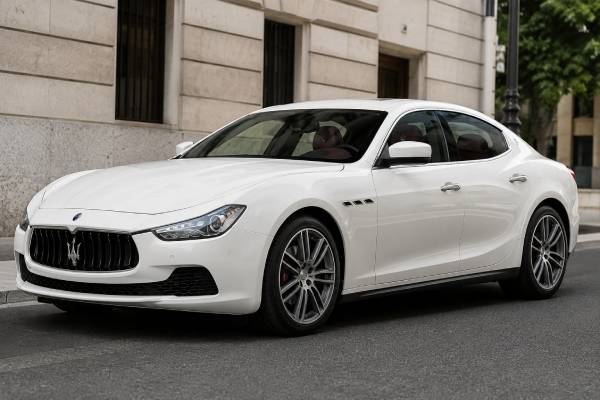
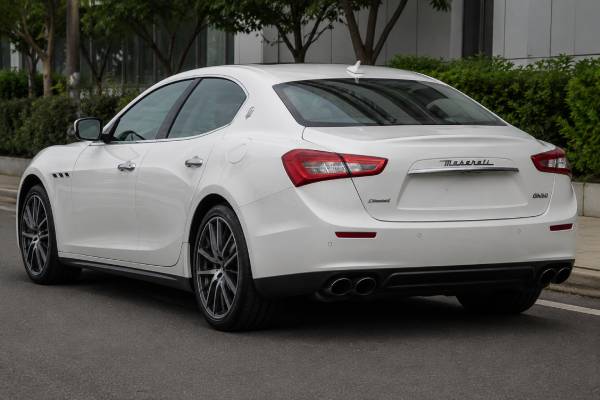
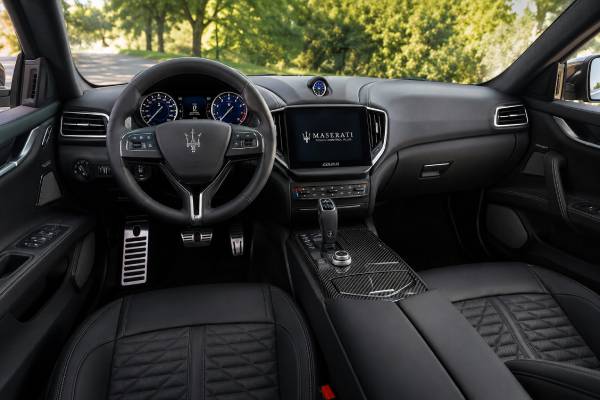
The 250 hp Maserati Ghibli Diesel is a market-specific version created mainly for countries where company-car rules, insurance, or taxation made a lower official output valuable. It uses the same basic A630 HP 3.0-liter V6 diesel architecture and 600 Nm torque rating associated with the 275 hp Ghibli Diesel, but its peak power is limited to 250 CV. That distinction makes the car easy to misidentify, especially when advertisements omit the output or assume every diesel is the better-known 275 hp model. The 250 remains a capable long-distance sedan: rear-wheel drive, an eight-speed ZF automatic, a 70-liter tank, and abundant low-rpm torque give it effortless motorway pace. Its long 2013–2021 production window also spans major changes in steering, styling, infotainment, emissions equipment, and driver assistance. Ownership depends less on headline performance than on how the car has been used. Regular long runs support the diesel particulate filter and emissions system; repeated short trips, neglected oil, low battery voltage, or unresolved EGR and sensor faults create risk. This guide focuses on the exact 250 hp version, its identification, road manners, maintenance demands, and the checks that matter before purchase.
Table of Contents
- The Purpose of the 250 hp Diesel
- A630 Diesel Specifications and Running Gear
- Markets, Updates, and Equipment Lines
- A Maserati Diesel with Distinctive Details
- Torque-Led Road Manners and Economy
- Diesel Emissions Hardware and Ownership Risks
- Buying a 250 hp Ghibli Diesel Carefully
The Purpose of the 250 hp Diesel
The 250 hp Ghibli Diesel exists because official output can matter as much as actual road pace in some tax and fleet systems. Maserati retained the diesel’s 600 Nm character while lowering the declared peak power from 275 to 250 CV.
That strategy made the car attractive to business users and buyers in markets such as Italy, where a specific rating could reduce financial penalties or simplify fleet policy. The resulting model is not a weak or stripped Ghibli. It keeps the same rear-drive executive-sedan layout, V6 diesel configuration, eight-speed automatic, substantial brakes, and broad luxury option list.
The diesel itself was historically important because the M157 became the first production Maserati offered with compression ignition. The decision reflected the European market of the early 2010s, when premium diesel sedans dominated high-mileage business use. Maserati needed range and torque without giving up the shape, cabin atmosphere, and high-speed confidence expected from the badge.
For the 250 hp version, the useful performance number is 600 Nm rather than 250 hp. Peak torque arrives around 2,000 rpm, so the car can pass traffic or climb a motorway grade without reaching high engine speed. The official 0–100 km/h time is roughly 6.8 seconds, and top speed is around 242 km/h. Those figures trail the 275 hp model but remain ample for real-world touring.
The lower output does not guarantee lower maintenance cost. Emissions hardware, turbo control, injection equipment, cooling, transmission, suspension, and electronics remain those of a complex luxury diesel. A 250 hp badge should not be used to justify generic oil, cheap diagnostic tools, or repeated short journeys.
Used-market confusion is common. Some sellers call any Ghibli Diesel a 275, while others advertise a 250 after a software tune as though it were factory-equivalent to the higher-output car. The VIN, original market record, engine-control calibration, and build documentation should identify the genuine version. Insurance and legal implications can follow if the declared output no longer matches the approved specification.
The car’s reputation today depends strongly on use pattern. High-mileage examples with steady motorway histories can be healthier than low-mileage urban cars that rarely completed a particulate-filter regeneration. Maintenance records should therefore be read alongside journey type, not mileage alone.
A630 Diesel Specifications and Running Gear
The Ghibli Diesel 250 uses a 2,987 cc, 60-degree V6 turbodiesel with common-rail injection, variable-geometry turbocharging, 250 CV, and 600 Nm. Power reaches the rear wheels through an eight-speed automatic.
| Platform code | M157 |
|---|---|
| Engine designation | A630 HP |
| Engine | 60-degree V6 turbodiesel |
| Displacement | 2,987 cc |
| Induction | Single variable-geometry turbocharger |
| Fuel system | High-pressure common-rail direct injection |
| Maximum output | 250 CV, approximately 184 kW at 4,000 rpm |
| Maximum torque | 600 Nm at approximately 2,000–2,600 rpm |
| Transmission | ZF eight-speed automatic |
| Drivetrain | Rear-wheel drive |
| 0–100 km/h | Approximately 6.8 seconds |
| Top speed | Approximately 242 km/h |
The variable-geometry turbo changes the angle of its internal vanes to build boost at low exhaust flow while avoiding excessive restriction at higher flow. An electronic actuator controls that movement. Soot, heat, actuator wear, air leaks, or sensor errors can disturb response, so a flat engine should be diagnosed through live data rather than treated as normal for the 250 hp tune.
Common-rail injection allows several precisely timed fuel events per cycle. That improves refinement and emissions but makes clean fuel, correct filtration, and healthy injectors important. Poor starting, uneven idle, excessive correction values, fuel dilution, or smoke deserve investigation. High-pressure components are expensive, and random replacement is not a substitute for leak-off testing and system diagnosis.
| Body | Four-door, five-seat sports sedan |
|---|---|
| Length | Approximately 4,971 mm |
| Width | Approximately 1,945 mm excluding mirrors |
| Height | Approximately 1,461 mm |
| Wheelbase | 2,998 mm |
| Trunk volume | Approximately 500 liters |
| Fuel tank | 70 liters |
| Representative curb weight | Roughly 1,835–2,030 kg by market method and equipment |
| Front suspension | Double wishbones |
| Rear suspension | Five-link independent system |
Early cars use hydraulic steering, while the major 2018 update brought electric assistance. The change affects feel and supporting driver-assistance functions. Hydraulic cars often provide more road texture; later electric cars are lighter in town and enable features that need electronic steering control.
Wheel size has a large effect on a diesel Ghibli. Eighteen-inch tires match the long-distance mission and reduce road noise, rim damage, and replacement cost. Nineteen-inch wheels give a useful visual and handling compromise. Twenty-inch or larger packages can look impressive but add harshness to a heavy car carrying a high-torque engine over the front axle.
Markets, Updates, and Equipment Lines
A 2013 Ghibli Diesel 250 and a 2021 example share an engine concept but differ enough that they should not be treated as one fixed specification. The 2018 model-year update is the most important dividing line.
Launch-era cars have the original bumpers, lamp design, hydraulic steering, early 8.4-inch multimedia system, and first console selector. Equipment varied widely, but the overall cabin and control layout remained recognizable. As production progressed, Maserati improved connectivity, safety functions, trim choices, and software.
The 2018 update introduced revised front and rear styling, electric power steering, expanded driver-assistance capability, and GranLusso and GranSport equipment themes. GranLusso emphasized comfort, leather, wood, and an elegant appearance. GranSport used more assertive bumpers, wheels, seats, and trim. These lines do not alter the fundamental 250 hp diesel identity, and components can be retrofitted, so the build record remains essential.
Later cars gained further infotainment and visual updates. The 2021-era rear lamps used a boomerang-inspired graphic, and multimedia hardware became more modern. Availability of diesel, trim, and options differed by country as emissions rules changed.
What to verify on the build record
- Original 250 CV output and sales market.
- Emissions standard and aftertreatment specification.
- Hydraulic or electric steering by production date.
- Passive or Skyhook adaptive dampers.
- GranLusso, GranSport, or other market equipment designation.
- Factory wheel, brake, seat, lighting, and driver-assistance options.
- Navigation region, radio equipment, and connected-service capability.
Imported cars need special attention. A vehicle may be legal and well maintained yet require market-specific lamps, maps, emissions parts, or coding. Warranty and recall support can also depend on region. Buyers should resolve those points before purchase rather than after a module or exhaust component fails.
The 250’s relative rarity makes documentation valuable. Original order papers, tax-category records, homologation details, and engine-control information help prove that it was built as a 250 rather than converted later. That distinction may influence insurance, registration, and resale.
A Maserati Diesel with Distinctive Details
The Diesel 250 looks like a Ghibli first and a fuel-economy model second. Its long hood, concave grille, three side vents, low roof, and strong rear haunches give it the same visual identity as the petrol range.
Maserati Centro Stile shaped the M157 to suggest a four-door grand tourer. The proportions hide much of the car’s nearly five-meter length, but its width is obvious in narrow parking spaces. The roofline improves style at the cost of rear headroom, and the rear pillars make cameras and sensors useful daily equipment.
The body uses steel for the main structure and aluminum for selected panels and suspension parts. Any previous crash near the front can involve cooling, emissions sensors, aluminum bodywork, suspension geometry, and undertrays. A good paint finish alone does not prove a correct repair.
Diesel-specific packaging includes the turbocharger, intercooling path, high-pressure fuel equipment, particulate filter, oxidation catalyst, EGR system, and other market-dependent aftertreatment. Heat shields and underbody covers protect these components. Missing shields, improvised exhaust work, or cut wiring are serious concerns.
The Active Sound system is the most unusual sensory feature. Actuators reinforce selected frequencies to make Sport mode more engaging than a muted executive diesel. It cannot duplicate the firing character of the petrol V6, but it helps the car maintain a distinct identity. A non-working system affects theater rather than basic propulsion, yet it can reveal module or wiring faults.
Inside, the low driving position, large fixed paddles, analog clock, and available leather, wood, carbon fiber, or Alcantara create a proper Maserati atmosphere. Early touch screens now feel dated; later systems are more responsive. Every screen, camera, speaker, seat motor, climate zone, and driver-assistance function should be tested because multiple small faults can create a large repair bill.
Age-sensitive areas around the body and cabin
- Sunroof drains, door membranes, lamp seals, trunk seals, and battery-area moisture.
- Dashboard leather shrinkage and lifting clearcoat on carbon trim.
- Cracked lower grilles, undertrays, parking sensors, and radar covers.
- Bent inner wheel barrels and tire sidewall damage.
- Seat wiring, memory functions, and lumbar motors.
- Headlamp leveling, adaptive functions, and condensation.
The 500-liter trunk is useful for touring, though the opening is less generous than the capacity suggests. A space-saver spare may not be present, so confirm the compressor kit, sealant date, tools, wheel-lock key, and towing provisions.
Torque-Led Road Manners and Economy
The 250 hp diesel feels stronger in everyday driving than its power figure suggests because 600 Nm arrives where the gearbox spends most of its time. It is built for effortless distance, not high-rpm excitement.
From a rolling start, a modest throttle input produces a deep surge without needing several downshifts. The eight-speed automatic uses the torque to reach higher ratios early, keeping noise and fuel consumption under control. Sport mode holds gears and sharpens response, but the best progress usually comes from short-shifting rather than extending the engine to its limit.
The difference from the 275 hp version appears most clearly at higher speed and higher rpm. The 250 loses some upper-range pull, while low- and midrange behavior remains broadly familiar because peak torque is unchanged. Owners should not expect a dramatic deficit in normal commuting; they should expect slower acceleration when the car is already traveling quickly.
Rear-wheel drive gives the diesel a clear chassis attitude. The heavy torque is manageable with good tires and functioning stability control, but wet or cold roads require measured throttle. Winter users should fit an appropriate set rather than assuming the weight of the diesel engine creates traction.
Steering feel depends on year. Hydraulic cars are heavier and more communicative, while later electric cars are easier at parking speed and integrate with lane and assistance functions. Both require correct alignment. Inner-edge tire wear, a tilted wheel, or tramlining can point to worn control arms or bent wheels.
Ride comfort is one of the model’s strengths on sensible tires. Eighteen- and 19-inch wheels allow the suspension to absorb motorway joints and broken urban surfaces. Larger wheels add impact noise and increase the chance of cracked rims. Skyhook cars can control body movement well, but failed adaptive dampers are expensive.
The diesel’s economy varies with traffic, temperature, wheel size, regeneration activity, and driving style. Long steady trips suit it. Short journeys can produce poor economy while preventing the exhaust from reaching the conditions needed for complete particulate-filter regeneration. A sudden rise in consumption may indicate frequent active regeneration or another fault.
Brake feel should remain firm despite the car’s mass. Vibration, pull, long travel, or hot-wheel odor needs diagnosis. The transmission should engage without a long delay and shift without flare. A test drive should include low-speed maneuvering, steady cruising, moderate full-load acceleration, and a return inspection for fluid or exhaust odor.
Diesel Emissions Hardware and Ownership Risks
The most important maintenance question is whether the car’s operating pattern allows the diesel aftertreatment to work. A Ghibli Diesel used mainly for short cold trips is a poor match regardless of mileage.
The diesel particulate filter traps soot and periodically burns it during regeneration. That process needs suitable temperature and uninterrupted running. Frequent aborted cycles can increase soot load and dilute engine oil with fuel. Warning messages, cooling fans running after shutdown, elevated idle, changed exhaust note, or a temporary economy drop can accompany regeneration, but diagnostic data is needed to distinguish normal operation from a problem.
EGR recirculates a controlled amount of exhaust to reduce nitrogen oxides. Soot and oil vapor can contaminate valves and intake passages over time. A sticking EGR valve may cause rough running, slow response, smoke, fault codes, or regeneration difficulty. Cleaning or replacement should follow diagnosis, not a generic schedule.
Turbo control depends on vacuum or electronic commands, the variable-vane mechanism, sensors, hoses, and the intercooler path. Underboost and overboost can have different causes, including split hoses, actuator problems, restricted flow, or faulty readings. Live pressure data and a smoke test are more useful than replacing the turbo by assumption.
Other diesel ownership checks
- Verify oil level and condition, and investigate any rise that could indicate fuel dilution.
- Test glow plugs and control systems if cold starting is slow or uneven.
- Check injector correction values and fuel-system pressure where symptoms exist.
- Pressure-test the cooling system and inspect pumps, thermostats, fans, and plastic connections.
- Examine engine and gearbox mounts for vibration under load.
- Scan all modules with a Maserati-capable tool and retain readiness information.
Battery health affects the entire car. Low voltage can produce emissions, transmission, steering, suspension, parking-brake, and comfort-system faults. Fit the correct battery type, verify charging, and use a maintainer during storage.
Later diesel cars have more assistance sensors and electronic steering functions, while all years can suffer from infotainment, seat, window, camera, parking-sensor, and climate faults. Water entry or poor aftermarket wiring can create repeated network errors. A repair should begin with power, ground, wiring, and configuration checks.
Recall status must be checked by VIN. Campaigns affecting certain M157 populations included fuel-system components, seat wiring, and other safety items. Market and production date determine applicability. Obtain official proof rather than relying on a dashboard with no warning lights.
Buying a 250 hp Ghibli Diesel Carefully
The best purchase is an authentic 250 hp car with a long-distance use pattern, complete emissions history, clean scan data, and enough budget for immediate baseline work. Do not buy one solely because diesel fuel economy appears attractive.
Begin by proving the specification. The VIN and homologation data should show the 250 CV market version. Check whether the engine software is original, because a tuned 250 may be advertised as a factory 275. Modifications can affect registration, insurance, emissions testing, thermal load, and transmission torque management.
Ask for invoices showing oil and filters, fuel filters, batteries, brakes, tires, cooling repairs, emissions diagnosis, alignment, and transmission or differential work. A stamped book without detail cannot show whether the correct low-ash oil or approved components were used.
Pre-purchase inspection sequence
- Examine paint, panel gaps, underbody covers, exhaust hardware, wheels, tires, and signs of front-end repair.
- Start the engine fully cold and watch cranking time, smoke, idle smoothness, warning lights, and charging voltage.
- Read every module with suitable diagnostic equipment before codes are erased.
- Review particulate-filter soot and ash estimates, regeneration history, EGR data, boost values, and readiness monitors.
- Test all cabin electronics, lighting, assistance systems, seats, cameras, climate functions, and both keys.
- Drive until fully warm, then assess boost, shifting, steering, suspension, braking, and regeneration behavior.
- Inspect the hot car on a lift for leaks, exhaust modifications, damaged shields, suspension wear, and driveline seals.
A knowledgeable Maserati or diesel specialist should produce a written estimate. Separate legal or safety issues from routine maintenance, near-term wear, and cosmetic preferences. A blocked aftertreatment system, failed turbo actuator, four old tires, large brakes, and adaptive dampers can overwhelm a low purchase price.
Avoid cars with deleted particulate filters, disabled EGR, improvised software, persistent smoke, unexplained oil-level rise, or an inspection system that is not ready. Even where enforcement is weak, altered emissions equipment can cause resale, insurance, registration, and diagnostic problems.
The 250 hp Ghibli Diesel suits a driver who covers regular long distances and wants Maserati styling with lower fuel use and strong low-speed torque. It is a poor choice for short urban trips, extended storage without battery support, or ownership on a minimal maintenance budget.
Make the final decision only after the output, market, structure, emissions health, electronics, and chassis are verified. A genuine, well-documented 250 can be an unusual and effective touring sedan. An unclear or modified example should be treated as a project and priced accordingly—or left for someone prepared to resolve its legal and mechanical history.
References
- indice 2020 (Model Brochure)
- EN_Maserati-MY19-MiniBook-Ghibli.pdf 2019 (Model Brochure)
- Management Summary of Maserati Safety Recall Campaign 378 2018 (Recall Database)
- Part 573 Safety Recall Report 17V-046 2017 (Recall Database)
Disclaimer
This material is for information only and is not a substitute for professional diagnosis, repair, emissions testing, or a vehicle-specific inspection. Specifications, torque settings, fluids, intervals, aftertreatment systems, and procedures vary by VIN, market, build date, and equipment. Use the official service and campaign documentation for the exact car.
Please share the guide on Facebook, X/Twitter, or a relevant owner community if it helped. Sharing supports the production of more detailed technical articles.