
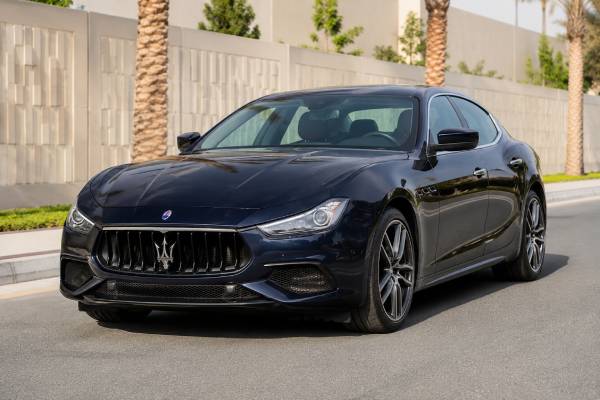
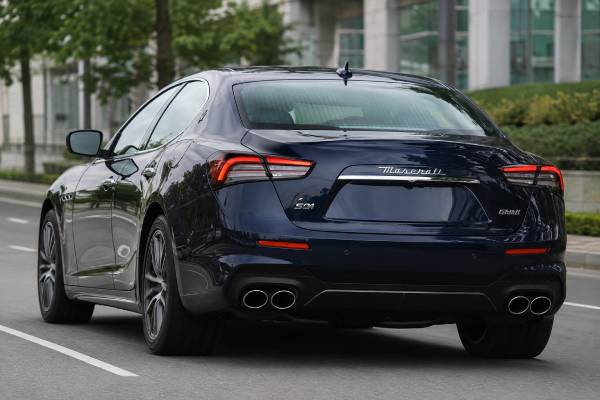
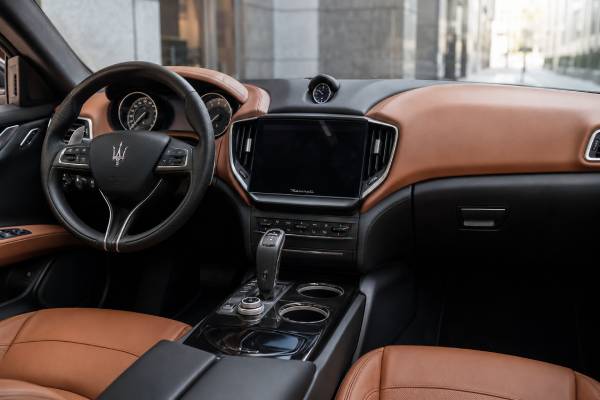
The Maserati Ghibli Modena S Q4 is the full high-output V6 specification in the late international Ghibli range: 430 hp, 580 Nm, an eight-speed automatic, and Maserati’s rear-biased all-wheel-drive system. It combines the stronger F160 twin-turbo V6 identified by the “S” with Q4 traction, making it the quickest-launching six-cylinder Ghibli of its period at about 4.7 seconds from 0–100 km/h. The name is market-sensitive. North American brochures usually call the comparable 424 SAE-hp car Modena Q4, while countries that offered a 350 hp Modena used Modena S Q4 for the 430 hp version. Used listings frequently mix these labels, and cosmetic emblems cannot resolve the issue. The VIN, factory order data, original invoice, engine rating, and physical front driveline must all agree. The model is appealing because it offers near-Trofeo daily pace with better foul-weather deployment and without the V8’s collection premium. Its complexity is also real. Four tires must remain closely matched, transfer and front-driveline hardware need inspection, and battery, sensors, alignment, software, cooling, ignition, transmission, and driver-assistance systems must work as one coordinated vehicle.
Table of Contents
- The Full Modena S Q4 Formula
- Engine, Q4, Brakes, and Dimensions
- Regional Availability and Equipment Changes
- Design Cues of the AWD Flagship V6
- Traction, Balance, and Long-Distance Pace
- Keeping the Q4 System Healthy
- Selecting a Well-Sorted Modena S Q4
The Full Modena S Q4 Formula
Modena S Q4 sits at the top of the late V6 range because each part of its name has a mechanical meaning. Modena marks the sporting trim, S identifies the 430 hp calibration in relevant markets, and Q4 adds electronically controlled all-wheel drive.
This version emerged during the M157’s final naming cycle. Maserati had already improved the Ghibli through power increases, revised driver aids, electric steering, updated styling, and new infotainment. The GT, Modena, and Trofeo families were intended to simplify the showroom story, but regional engine availability meant the names could not be identical worldwide.
In an international range with both 350 hp and 430 hp V6 cars, Modena S Q4 is unambiguous when the factory documents are present. A plain Modena Q4 listing may describe a North American equivalent, an incorrectly shortened name, or a different vehicle. Buyers should keep the car’s original market identity rather than applying a badge convention from another region.
The model inherits the role of the earlier Ghibli S Q4. It is still based on a rear-drive chassis, and Q4 introduces front torque only when demanded by grip and vehicle dynamics. That strategy helps preserve the sedan’s rear-driven balance while improving launch and low-grip acceleration.
Against the rear-drive Modena S, the Q4 car is slightly heavier and mechanically more involved. Against Trofeo, it gives away a large amount of peak power and V8 drama but gains all-wheel-drive deployment and usually lower purchase and running costs. For many climates, it is the more complete single-car proposition.
The present used-market challenge is that late cars often have complex histories. They may cross borders, lose connected-service support, receive replacement wheels, or be advertised with converted horsepower. A strong example has coherent documentation and no mystery around its engine, drivetrain, option codes, or software configuration.
Its reputation should be judged by execution, not theory. Q4 feels secure only when tire circumference, wheel-speed data, transfer control, alignment, and suspension are right. The high-output V6 feels effortless only when ignition, fueling, boost, and cooling are healthy. This integration is what makes the model impressive—and what makes a specialist inspection mandatory.
Engine, Q4, Brakes, and Dimensions
The Modena S Q4 uses Maserati’s 2,979 cc F160 twin-turbo V6, rated at 430 hp and 580 Nm, with an eight-speed ZF automatic and on-demand front-axle drive. Official performance is approximately 4.7 seconds to 100 km/h and 286 km/h maximum speed.
| Item | Specification |
|---|---|
| Engine | F160 aluminum 60-degree twin-turbo V6 |
| Displacement | 2,979 cc |
| Injection | Direct petrol injection |
| Maximum power | 430 hp at approximately 5,750 rpm |
| Maximum torque | 580 Nm from approximately 2,250 rpm |
| Transmission | ZF eight-speed automatic |
| Drive system | Q4 rear-biased electronically managed all-wheel drive |
| 0–100 km/h | Approximately 4.7 seconds |
| Top speed | Approximately 286 km/h |
| Front suspension | Double wishbones |
| Rear suspension | Five-link independent setup |
| Steering | Electric power-assisted rack |
| Wheelbase | 2,998 mm |
| Fuel capacity | About 80 liters |
The engine uses two turbochargers, variable valve timing, direct injection, and a Maserati calibration designed to deliver strong torque across the middle of the rev range. It should build power in one continuous sweep. A step, surge, or inconsistent boost transition points to a fault in ignition, fueling, intake sealing, sensors, turbo control, or software.
The eight-speed transmission is the central torque distributor. It drives the rear axle under normal rear-biased operation and works with a controlled transfer arrangement for the front axle. Wheel-speed, steering-angle, yaw, brake, throttle, and stability data influence how the system responds. A warning in ABS or steering can therefore affect Q4 availability even when the transfer hardware itself is sound.
During stable travel, front torque demand can be minimal. Under launch or low grip, the controller can involve the front wheels rapidly. The driver should experience traction rather than a distinct mechanical engagement. Tight-turn hopping, driveline wind-up, repeated clunks, or a message that Q4 is unavailable requires diagnosis.
The chassis uses front double wishbones and a five-link rear axle, with Skyhook adaptive damping commonly fitted. The front suspension must accommodate driven half-shafts as well as steering geometry. Boots, joints, bearings, and clearances become additional inspection points compared with the rear-drive car.
Large ventilated brakes and performance tires provide the stopping and cornering capacity. Exact brake dimensions, wheel widths, offsets, and tire sizes depend on market and option. Q4 cars may use staggered widths while preserving compatible overall rolling diameters. Never infer tire suitability from diameter alone.
The published sprint advantage over rear drive comes from better launch traction. At higher speed, both 430 hp versions rely on the same broad engine output. Repeated launch attempts are not a useful buying test because they add heat and wear without revealing the source of a subtle fault.
Regional Availability and Equipment Changes
The original market determines whether “Modena S Q4” is the correct published name and which equipment should be present. A VIN-based build record is the only reliable way to resolve regional naming, option bundles, and production timing.
In many international markets, the S badge separates 430 hp from the 350 hp Modena. North American cars often omit S and state 424 SAE hp, which is broadly equivalent to 430 metric hp. Registration systems may shorten the commercial name, while dealer databases can import another region’s terminology.
Late-production equipment generally includes the 10.1-inch MIA touchscreen, electric steering, modern driver aids, sport exterior treatment, and a broad comfort package. However, standard versus optional content differs. A car may have basic audio and no surround view while another carries premium sound, a full assistance pack, ventilated seats, and extensive leather.
The MIA system should be judged by function, not screen appearance. Test navigation region, smartphone connection, phone microphones, every audio channel, camera switching, settings memory, and connected services. Reboots, slow wake-up, or functions that disappear intermittently may be related to voltage, software, network modules, or prior retrofits.
Useful original records
- Factory order or invoice naming Modena S Q4 and the 430 hp engine.
- Build sheet listing wheel, brake, trim, audio, assistance, and seat options.
- Registration and emissions records matching 2,979 cc petrol and Q4.
- Dealer invoices for recalls, software, calibration, windscreen, and bumper work.
- Both keys, manuals, wheel-lock equipment, compressor kit, and original removable parts.
Common exterior choices include dark grille and window details, colored calipers, and 20- or 21-inch wheels. Interior choices can include black, tan, red, or two-tone leather, open-pore wood, piano black, or carbon trim. These features help describe a car but do not prove the engine or drive system.
A 2021 registration may belong to a car built during the previous naming phase. A 2023 car may have been manufactured earlier and held in stock. Production date, model-year coding, and factory paperwork are more precise than the first-registration date.
Cross-border vehicles require checks for headlamps, rear fog lights, speed display, navigation, radio, emissions approvals, warranty transfer, and cellular support. Improvised coding can leave dormant faults. A professional conversion should be documented and reversible where possible.
Replacement wheels are common because large originals bend easily. Verify part numbers, widths, offsets, load ratings, and tire circumference. A set may look correct while being assembled from two different applications, creating vibration or Q4 intervention.
Design Cues of the AWD Flagship V6
The Modena S Q4 is visually restrained for its capability. Its most important distinctions lie beneath the surface, while Modena trim supplies dark details, sport seating, wheels, and a more assertive stance.
The Ghibli’s long bonnet and rearward cabin suggest rear drive even though this version can power the front axle. The front driveline is packaged within the existing double-wishbone architecture, maintaining the familiar exterior proportions. Underbody shields and heat protection are therefore important; missing pieces can expose joints and alter airflow.
The late grille and boomerang rear lights identify the final design evolution. Three side vents, frameless glass, and a short rear deck remain core M157 features. Modena S Q4 may have black window surrounds, dark grille vanes, sport bumpers, and distinctive wheels, but option packages and owner changes can blur those cues.
The front fascia serves several engineering purposes. It directs air through stacked heat exchangers, feeds the brakes, houses parking sensors, and supports radar equipment. Even a low-speed collision can bend brackets, close air paths, disturb camera or radar calibration, and damage undertrays while leaving acceptable paintwork.
In the cockpit, fixed shift paddles and a low driving position reinforce the performance role. Drive-mode controls adjust throttle, transmission, exhaust, and adaptive damping. Q4 operation remains automatic; there is no need to select a fixed front/rear torque split.
The valved exhaust gives the V6 two personalities. Normal use is subdued enough for long trips, while Sport increases sound and shift drama. A persistent metallic rattle, asymmetric exhaust note, or heavy drone can indicate valve, shield, catalyst, or aftermarket-pipe problems.
The cabin’s luxury depends greatly on condition. Full leather and Alcantara age well only when protected from heat and neglect. Inspect dashboard seams, seat bolsters, door tops, headliner, carbon edges, glossy surfaces, switch coatings, and roof drains. Water entry near electronics can create faults long after the visible stain dries.
The all-wheel-drive identity should be confirmed underneath. Front shafts, boots, transfer components, mounting points, and shields should appear factory-correct and undamaged. A Q4 badge without corresponding records and clean hardware is not enough.
Traction, Balance, and Long-Distance Pace
The Modena S Q4 is quick because it converts torque into motion with very little drama. Its rear-biased behavior remains engaging, while front assistance makes acceleration more repeatable on damp or cold surfaces.
At parking speed, the car should maneuver without binding. Wide tires can scrub slightly on coarse surfaces, but repeated hopping, shuddering, or clunks during full-lock circles are warning signs. Check tire mismatch, transfer behavior, front joints, mounts, steering angle, and wheel-speed data.
Normal mode uses high gears and the V6’s torque. A healthy car creeps smoothly, responds without a dead zone, and shifts almost unnoticed. Surging, delayed engagement, or a sudden torque step may come from engine or gearbox control rather than the Q4 hardware.
Sport opens the exhaust and keeps the engine ready. Acceleration from low speed is especially effective because the system can share torque before the rear tires spin. The 4.7-second figure describes ideal conditions; on public roads, the practical benefit is secure merging and passing rather than repeated maximum-effort launches.
The chassis still communicates a rear-driven attitude. The car turns in cleanly, then uses its rear axle for much of the acceleration work. Front torque is assistance, not a permanent heavy pull. If the steering feels nervous or the car follows grooves, inspect tire construction, pressures, wheel runout, alignment, and front arms.
Winter ability depends on tires. Q4 with old summer tires can be less controllable than rear drive with quality winters. All-wheel drive helps the vehicle move, while braking and lateral grip remain limited by four contact patches. Owners should select a complete seasonal set and preserve compatible rolling circumference.
Skyhook provides useful body control when functioning correctly. Comfort mode should not float excessively; the firmer setting should not crash over every edge. Wheel size can overpower the damper’s ability to isolate impacts. Twenty-inch wheels often suit mixed roads better than the largest option.
Brakes must be evaluated after both gentle and firm use. A straight stop with a stable pedal is expected. Vibration, pull, odor, or one hot wheel points toward disc, pad, caliper, hose, tire, or bearing issues. Inner disc faces are easy to miss without a lift.
At highway speed, the long wheelbase, broad torque curve, and tall eighth gear make the car a natural grand tourer. Listen for wheel-bearing hum, tire roar, front-driveline whine, or a floor vibration that changes with throttle. Load-sensitive noises can help separate driveline sources from wheel balance.
The car is capable of very high speed but not intended to ignore heat and mass. Track use places heavy demands on tires, brakes, fluids, and cooling. Its most convincing performance is sustained road pace with weather security, not repeated lap times.
Keeping the Q4 System Healthy
A healthy Q4 system begins with four correct tires and accurate sensor data. Mechanical parts cannot operate properly when rolling circumference, pressure, alignment, voltage, or wheel-speed signals are wrong.
Record tire make, model, size, date, and tread depth at each corner. Replace incompatible or widely mismatched tires as a set appropriate to the factory stagger. A single new tire beside three worn ones can create a persistent speed difference. Pressure must follow the vehicle label, not a generic tire-shop recommendation.
Inspect the transfer system, front shafts, boots, seals, bearings, mounts, and shields for leaks, damage, or play. Fluid type and service procedure must come from official information for the VIN. A universal gear oil or incorrect level can cause more harm than a delayed service performed correctly.
The engine requires the approved oil, time-based changes, sound ignition components, sealed intake plumbing, and a clean cooling system. Misfire under load increases catalyst temperature and can disturb transmission and Q4 torque management. Read misfire counters, fuel trims, boost targets, and pending codes.
Cooling checks should cover reservoirs, pumps, hoses, radiators, charge-air cooling, fans, and debris between heat exchangers. A sweet odor, dried residue, or repeated top-up needs pressure testing. Heat-related power reduction can be mistaken for a drivetrain issue.
Battery condition is equally important. Load-test the 12-volt battery, inspect grounds, and verify charging. Low voltage can set ABS, stability, steering, Q4, transmission, parking-brake, camera, radar, and infotainment warnings. Use a correct maintainer when the car is stored.
Q4 service warning signs
- Unequal tire wear or repeated one-at-a-time replacement.
- Vibration or shudder during low-speed steering lock.
- Q4, ABS, stability, or wheel-speed messages.
- Load-dependent whine from the center or front of the car.
- Fluid staining near transfer or front-drive components.
- Harsh engagement accompanied by engine or transmission faults.
The ZF automatic should be assessed at several temperatures. Fluid service requires the correct product, pan or filter procedure where applicable, fill temperature, and adaptations. A transmission complaint may actually originate in mounts, engine torque delivery, propeller-shaft joints, or transfer control.
Suspension and brakes are substantial cost items. Inspect Skyhook dampers, front arms, rear links, bearings, disc thickness, inner disc condition, calipers, parking brake, and fluid. Correct alignment protects both handling and the expensive four-tire set.
Late electronics require factory-level diagnosis. Cameras and radar may need calibration after glass, body, or suspension repair. Software updates can correct behavior, but should not be applied as a substitute for mechanical diagnosis. Verify recalls and campaigns by VIN through official channels.
Selecting a Well-Sorted Modena S Q4
Select the car with the clearest identity and the best integrated condition, not the lowest odometer. A specialist should inspect documents, structure, powertrain, Q4 hardware, tires, brakes, and every electronic module before purchase.
Start remotely by requesting the VIN, original invoice, build sheet, registration, production label, service records, and photographs of the engine and underbody. Confirm the 430 hp Modena S Q4 description for the source market. Check whether the car was imported and what was changed.
The physical inspection should begin cold. Watch the full cluster self-test, evaluate cranking and idle, and listen for belt, turbo, exhaust, and driveline noise. Select Drive and Reverse without rushing. A seller who warms the vehicle or clears codes removes valuable evidence.
Complete buying checklist
- Save a full diagnostic report, including engine, transmission, Q4, ABS, steering, battery, cameras, radar, and readiness data.
- Measure paint and inspect structural seams, front corners, subframes, glass, sensors, ducts, shields, and jacking points.
- Verify all four wheels and tires by part number, size, offset, age, model, pressure, and full-width tread depth.
- Inspect fluids, leaks, cooling, turbo plumbing, transfer hardware, shafts, boots, mounts, suspension, brakes, and exhaust on a lift.
- Drive tight circles, rough roads, steady cruise, moderate boost, manual shifts, bends, and controlled stops.
- Test MIA, audio, cameras, driver aids, lights, climate, seats, roof, locks, parking brake, Skyhook, Sport, and both keys.
- Re-scan hot, compare new faults, and obtain itemized estimates before valuing the car.
During the road test, note whether vibration follows road speed, engine load, gear, or steering angle. That observation helps distinguish wheels, bearings, propeller shaft, transfer system, front joints, and engine mounts. Do not accept a vague promise that “they all do it.”
Check modifications especially carefully. Engine tunes, nonstandard tire dimensions, lowering, spacers, oversized wheels, exhaust work, and electrical accessories can disturb the systems that make Q4 effective. Factory calibration and geometry are preferable unless every change is engineered and documented.
Calculate immediate costs using actual part and labor quotations. Four tires, large brake discs, a battery, plugs, fluids, alignment, a key, windscreen calibration, or transfer service can exceed a tempting discount. A car with recent documented work may be cheaper to own despite a higher asking price.
Choose Modena S Q4 when year-round acceleration and security matter. Choose rear-drive Modena S for a mild climate and reduced front-driveline complexity. Choose Trofeo for V8 significance only after accepting its fuel, tire, brake, heat, and value-preservation demands.
The right example should circle tightly without shudder, run through its torque cleanly, shift consistently, wear all four tires evenly, show no active or pending Q4 faults, and match its factory records. When those conditions are met, Modena S Q4 is the most complete six-cylinder expression of the final M157: fast, discreet, weather-capable, and still unmistakably a Maserati grand tourer.
References
- Maserati Ghibli Modena S Q4: perfect grip and traction (Manufacturer Model Page)
- Maserati 2022 new trims: GT, Modena and Trofeo 2021 (Manufacturer News)
- Maserati_Ghibli_Digital_Catalogue_EN.pdf (Manufacturer Brochure)
- Part 573 Safety Recall Report 21V-703 2021 (Recall Database)
Disclaimer
This article is for informational purposes and does not replace professional diagnosis, repair, coding, calibration, or a vehicle-specific inspection. Specifications, horsepower standards, tire requirements, equipment, fluids, intervals, software, and warranty terms vary by VIN, market, and production date. Verify all important details with official documentation for the exact vehicle.
Please share this guide on Facebook, X/Twitter, or an enthusiast community if it was helpful. Sharing supports more detailed model-specific resources.