
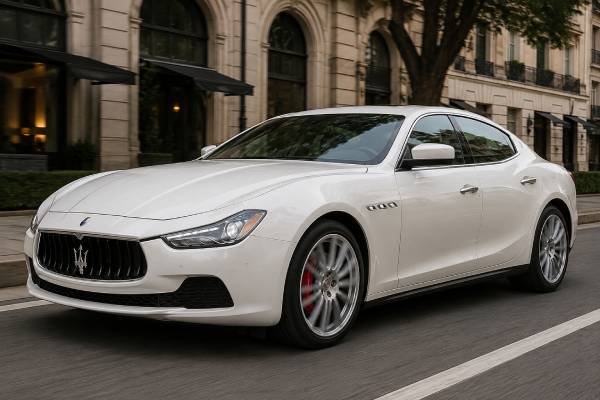
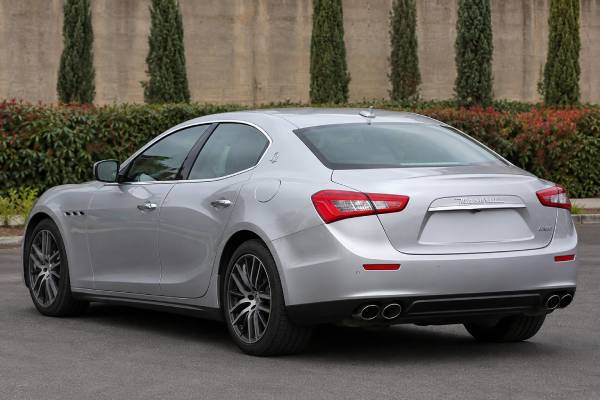
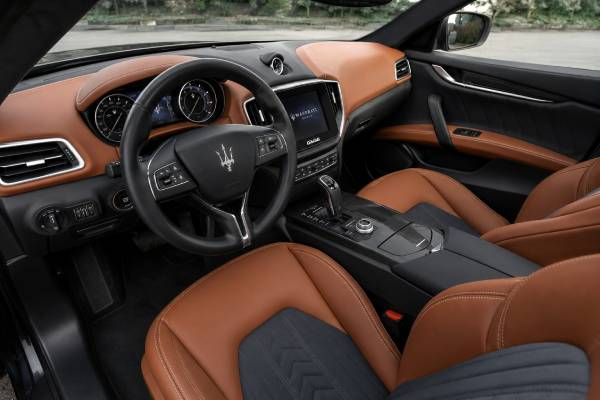
The 275 hp Ghibli Diesel was Maserati’s first production diesel and one of the M157 range’s most commercially important versions. Its appeal was simple: a 3.0-liter V6 turbodiesel, 600 Nm of torque, rear-wheel drive, and an eight-speed automatic gave the Ghibli the range and low-rpm strength expected by high-mileage European buyers, while the body, cockpit, steering, and road presence remained recognizably Maserati. Official performance of about 6.3 seconds from 0–100 km/h and 250 km/h at the top end made it far more than an economy model. The long 2013–2021 run, however, covers several technical eras. Early examples use hydraulic steering and the original cabin; later cars add electric steering, revised styling, more driver assistance, newer infotainment, and stricter emissions hardware. Used-car quality now depends heavily on journey pattern and maintenance. A diesel that regularly completed long trips may be a safer buy than a low-mileage city car with interrupted particulate-filter regenerations, diluted oil, weak battery voltage, or repeated EGR faults. This article explains the exact 275 hp version, its engineering, how it changed, what it feels like, and the practical evidence a buyer should demand.
Table of Contents
- Maserati’s First Diesel Explained
- The 275 hp V6 Diesel Package
- Production Evolution Through 2021
- Design Character Beyond the Engine
- Long-Distance Pace and Everyday Behavior
- DPF, EGR, Cooling, and Service Reality
- What to Inspect Before Buying
Maserati’s First Diesel Explained
The Ghibli Diesel marked a major break with Maserati tradition, but it was a rational response to the premium-car market of the early 2010s. European executive buyers wanted long range, lower fuel use, and strong motorway torque, and the 275 hp V6 delivered all three.
Maserati introduced the M157 Ghibli as a smaller companion to the Quattroporte and a direct rival for established German and British sedans. A petrol-only range would have limited its appeal in fleets and high-mileage private use. The diesel broadened the audience without changing the car’s rear-drive platform, dramatic exterior, low seating position, or four-door practicality.
The engine’s 600 Nm output shaped the model more than its 275 hp headline. It produces its strongest effort between roughly 2,000 and 2,600 rpm, exactly where an automatic sedan spends much of its time. Overtaking usually requires only a measured throttle input, and motorway gradients barely disturb the pace. Peak power at 4,000 rpm supports a 250 km/h maximum speed, but the engine’s natural style is to work through torque rather than chase revs.
The model also needed to sound and feel less ordinary than a fleet diesel. Maserati used an Active Sound system to reinforce selected exhaust frequencies, particularly in Sport mode. The result cannot replicate the petrol V6, yet it gives the car a more purposeful tone than a muted compression-ignition sedan. Fixed aluminum paddles, a weighty steering wheel, and the long hood reinforce the sense that the driver is in a Maserati, not a generic diesel wearing a Trident.
Its historical importance does not make every example collectible. Production volume was meaningful, specifications varied by market, and depreciation was substantial. The car’s current value is determined mainly by condition, emissions-system health, documentation, and equipment. Rare colors or GranSport trim can help, but they do not outweigh a blocked DPF, an uncertain tune, or neglected suspension.
The 275 should also be separated from the 250 hp market version. Both share 2,987 cc and 600 Nm, but their approved output and performance differ. Badges do not reliably identify them. The VIN, original market paperwork, build record, and calibration information provide the proper answer.
The 275 hp V6 Diesel Package
The A630 HP diesel is a 60-degree, 2,987 cc V6 with common-rail injection and a variable-geometry turbocharger. In Ghibli form it produces 275 CV and drives the rear wheels through a ZF eight-speed automatic.
| Platform | M157 |
|---|---|
| Engine designation | A630 HP |
| Configuration | 60-degree V6 turbodiesel |
| Displacement | 2,987 cc |
| Bore and stroke | Approximately 83 mm × 92 mm |
| Compression ratio | Approximately 16.5:1 |
| Maximum power | 275 CV, approximately 202 kW at 4,000 rpm |
| Maximum torque | 600 Nm at approximately 2,000–2,600 rpm |
| Transmission | Eight-speed ZF automatic |
| Drive | Rear-wheel drive |
| 0–100 km/h | Approximately 6.3 seconds |
| Top speed | Approximately 250 km/h |
A variable-geometry turbo can alter vane position to accelerate exhaust flow at low rpm and open the flow path at higher load. This reduces lag while maintaining useful high-speed breathing. The system relies on an actuator, clean movement, accurate pressure readings, sealed charge pipes, and a healthy exhaust path. Flat response can come from many causes, so replacing the turbo without data is poor practice.
The common-rail system operates at very high pressure and allows multiple injection events for noise, torque, and emissions control. Correct fuel filters and clean fuel are essential. Injector imbalance may show up as rough idle, difficult starting, smoke, or large correction values. Leak-off and pressure testing should guide repair.
| Body type | Four-door luxury sports sedan |
|---|---|
| Overall length | Approximately 4,971 mm |
| Width excluding mirrors | Approximately 1,945 mm |
| Height | Approximately 1,461 mm |
| Wheelbase | 2,998 mm |
| Luggage capacity | Approximately 500 liters |
| Fuel capacity | 70 liters |
| Representative curb weight | About 1,835–2,030 kg, depending on equipment and measurement method |
| Suspension | Double-wishbone front and five-link rear |
| Brakes | Ventilated discs with Brembo hardware |
The transmission’s wide ratio spread lets the car use torque in the lower gears while dropping engine speed on the motorway. Normal mode prioritizes smoothness and economy. Sport mode delays upshifts, increases response, and changes the sound character. Manual selection through the fixed paddles is useful on descents or fast roads, although the diesel rarely needs to reach its upper limit.
Early models use hydraulic steering; later cars use electric assistance. Optional Skyhook dampers provide variable damping, while passive suspension remains mechanically simpler. Wheel choice is critical. Eighteen-inch tires best suit distance and ride, 19-inch sets balance appearance with compliance, and larger wheels increase road noise and rim-damage risk.
Production Evolution Through 2021
The Diesel’s eight-year span includes more change than the unchanged engine name suggests. Buyers should divide the run into launch-era cars, the 2018 facelift period, and the final 2021 specification.
The first cars carry the original front bumper, grille treatment, rear lamps, hydraulic steering, early center console, and 8.4-inch multimedia system. Their steering feedback can be appealing, but their infotainment and phone support now feel dated. The spring-return gear selector also requires a deliberate hand until the driver learns its movement.
For the 2018 model year, Maserati revised exterior details and introduced electric power steering. That change made lane-support and other assistance features possible. The range also adopted GranLusso and GranSport identities. GranLusso favored elegant wheels, wood, fine leather, and a more formal appearance. GranSport added assertive bumpers, sportier seating, darker trim, and larger wheels. Option bundles still differed by country.
Later production received updated connectivity and rear lamp graphics inspired by the boomerang shape of older Maseratis. Emissions standards and aftertreatment specifications also evolved. A component that fits an early Euro 5 or early Euro 6 car may not suit a later Euro 6D vehicle, even when the engine block looks similar.
Records that establish the exact specification
- VIN decoding and the original factory build list.
- First-market homologation and emissions classification.
- Production date rather than registration date alone.
- Steering type, suspension type, and driver-assistance package.
- GranLusso, GranSport, or base equipment line.
- Original wheel, brake, lighting, seat, and multimedia configuration.
- Campaign completion and dealer software history.
Market origin is especially important for a diesel. Different countries can use different nitrogen-oxide control strategies, software, sensors, and legal inspection requirements. Imports may also have incompatible navigation, radio, connected services, or headlamps. Resolve those details before purchase because a bargain import can become difficult to register or diagnose.
Options influence both pleasure and risk. Ventilated seats, a sunroof, adaptive lights, premium audio, cameras, soft-close doors, and advanced assistance are valuable when functional. Test them all. A long equipment list with several failed modules is not a premium specification; it is a repair schedule.
Design Character Beyond the Engine
The Ghibli Diesel retains the proportions and visual drama of the petrol models, which is why it avoids looking like a fleet-special derivative. Its design puts the emphasis on long-hood stance and rear-wheel-drive proportions rather than diesel economy.
The front is defined by a deep grille with the Trident, narrow headlamps, and three vents behind each front wheel. The roof falls toward a compact rear deck, and the rear doors blend into a strong shoulder. The shape is elegant but imposes compromises: the body is wide, rear visibility is limited, and tall passengers may find rear headroom only adequate.
Steel forms most of the structure, while aluminum appears in selected panels and suspension components. Collision inspection should account for both materials. A poor front-end repair may disturb cooling airflow, radar alignment, suspension points, intercooler pipes, and exhaust-temperature sensors even if the paint looks acceptable.
Diesel hardware fills the engine bay and underbody with additional systems. The turbo, intercooler, EGR circuit, oxidation catalyst, particulate filter, temperature and pressure sensors, and market-dependent nitrogen-oxide controls all need heat management. Missing undertrays or heat shields can expose wiring and alter airflow. Any cut exhaust or welded sensor boss deserves close scrutiny.
Active Sound gives the model a deliberately engineered voice. In Sport mode, actuators add resonance to the natural diesel note. Owners may enjoy or dislike the effect, but a buyer should make sure it works as designed and has not been replaced by a crude exhaust modification.
The cabin can range from sober business specification to a rich combination of stitched leather, wood, carbon fiber, Alcantara, and colored detailing. The driving position is low and the fixed paddles feel substantial. Some lower plastics and shared switchgear are ordinary, but the architecture, analog clock, and material choices create a distinct atmosphere.
Design-related condition checks
- Inspect grille slats, front intakes, radar covers, lower panels, and underbody shields.
- Look for water staining around the sunroof, lamps, trunk, footwells, and battery compartment.
- Check aluminum doors and hood for uneven gaps or poor refinishing.
- Test every lamp, camera, parking sensor, seat motor, window, and climate outlet.
- Examine leather for shrinkage and carbon trim for cloudy or lifting clearcoat.
- Confirm the screen, amplifier, navigation, Bluetooth, and steering-wheel controls operate consistently.
The trunk is useful for long journeys, and the 70-liter tank supports the model’s touring mission. Check the compressor kit, towing eye, tools, key set, and luggage-area trim. Water near the battery or modules can create electrical problems far beyond a damp carpet.
Long-Distance Pace and Everyday Behavior
The 275 hp Diesel is at its best on open roads. It settles into a high gear, produces immediate passing torque, and covers distance with less effort and fuel than the petrol V6 versions.
Throttle response at low speed is measured, and the turbo builds useful boost without requiring high rpm. The strongest acceleration occurs through the middle of the rev range. Beyond 4,000 rpm, the engine has little reason to continue, so the gearbox’s intelligent upshifts suit it better than chasing a redline.
The eight-speed automatic should feel almost invisible during light driving and more decisive in Sport. Delayed engagement, repeated flare, hard thumps, or hunting may involve adaptation, software, engine torque faults, mounts, fluid condition, or internal wear. A single rough cold shift is not enough for a verdict, but a pattern is not normal.
Rear-wheel drive gives the car a pleasingly natural response. The front tires handle steering while the rear tires transmit 600 Nm. On wet roads, throttle discipline and tire quality matter. Stability control is well calibrated, but it cannot make summer tires work in winter conditions.
The early hydraulic system provides more road texture, whereas later electric steering feels lighter and supports assistance features. Neither changes the car’s size. The Ghibli needs space in parking garages, and its long nose and wide rear quarters reward working cameras and sensors.
Ride quality can be excellent on 18- or 19-inch wheels. The long wheelbase filters motorway undulations, and the suspension controls body movement without making the car feel isolated. Large wheels increase impact harshness and often reveal bent rims through vibration. Skyhook improves versatility when healthy, though replacement cost should be considered.
The diesel is not silent. At cold idle, compression ignition is obvious; under load, Active Sound adds a more dramatic layer. At cruise, the engine becomes subdued and tire noise often dominates. Excessive drone can indicate an exhaust modification, failed mount, or missing insulation.
Fuel economy is sensitive to regeneration. During an active particulate-filter burn, consumption rises and cooling fans may remain active. A car driven mainly on short trips may regenerate often or fail to complete the process. The best test drive reaches full temperature and includes enough steady running to assess normal behavior.
Brakes need to manage nearly two tonnes and high motorway speed. A good pedal is firm, progressive, and free from shake. Uneven wheel temperature after ordinary driving can reveal a dragging caliper. Old fluid and low-quality pads reduce confidence quickly.
DPF, EGR, Cooling, and Service Reality
The central reliability issue is not simply “the DPF”; it is the relationship between journey pattern, oil condition, sensors, EGR flow, turbo control, and successful regeneration. These systems must be evaluated together.
The particulate filter stores soot and burns it when operating conditions permit. Ash from oil additives and normal combustion remains in the filter, so soot can be regenerated but ash eventually accumulates. Diagnostic tools may show calculated soot load, ash estimate, pressure difference, exhaust temperatures, and regeneration history. Those values are more useful than a seller’s claim that the filter was “cleaned.”
Interrupted regeneration can allow fuel to enter the engine oil. Rising oil level, thin oil, or fuel odor demands attention because diluted lubricant reduces protection for bearings and turbo hardware. Oil should meet the exact low-ash specification and be changed at a sensible interval for the car’s use, not stretched simply because the dashboard permits it.
EGR faults may cause hesitation, roughness, smoke, poor economy, or emissions warnings. Carbon can affect the valve and intake path, but sensors, wiring, cooling, and software also matter. Removing or disabling the system can make the car illegal and complicate future diagnostics.
Turbo performance depends on the variable vanes, actuator, pressure sensors, vacuum or electrical control, charge hoses, intercooler, and exhaust flow. A boost fault should be tested under load with recorded data. Smoke testing often finds leaks that are invisible during a static inspection.
Service priorities beyond emissions
- Load-test the battery and verify charging output before chasing network faults.
- Pressure-test the cooling system and inspect pumps, thermostats, reservoirs, hoses, and fans.
- Check injector balance, glow-plug operation, and fuel pressure when starting is poor.
- Inspect engine, gearbox, and differential mounts for vibration.
- Examine control arms, rear links, wheel bearings, dampers, and alignment.
- Measure brake discs and confirm the electronic parking brake releases fully.
Low voltage can generate multiple warnings across steering, transmission, suspension, parking, and convenience systems. A correct battery and clean grounds are basic requirements. Cars stored for weeks benefit from an appropriate maintainer.
Electrical age also affects the touch screen, amplifier, cameras, seat wiring, keyless functions, lamps, and climate actuators. Water entry or aftermarket wiring should be ruled out before modules are replaced. Used electronic parts may need coding to the car.
Safety campaigns vary by VIN. Certain Ghiblis were subject to fuel-system, seat-wiring, and other recalls during the production run. Official completion records matter, especially on imports. A dashboard without warnings does not prove campaign work was performed.
What to Inspect Before Buying
Choose a Diesel 275 for its documented health and suitable use history, not for low mileage or a low monthly payment. The ideal car has regular long-distance use, clean emissions data, correct oil history, and no evidence of deleted hardware.
Ask for the VIN, build sheet, invoices, tire dates, both keys, and permission for a cold start and independent inspection. Confirm the 275 CV specification rather than the 250 version. Establish the original market and emissions standard, then verify that the hardware and software still match the approved configuration.
Practical buying sequence
- Inspect body structure, paint, front cooling openings, undertrays, wheels, tires, and exhaust for repair or modification.
- Start completely cold and note cranking speed, smoke, glow-plug behavior, idle quality, warning lamps, and charging voltage.
- Scan all control units and save the original report, including readiness monitors and freeze-frame data.
- Review DPF pressure, soot and ash calculations, regeneration records, EGR command, injector corrections, and boost behavior.
- Operate all cabin electronics, driver assistance, lighting, seats, cameras, climate controls, locks, and multimedia.
- Drive until fully warm, using steady cruise, moderate load, low-speed maneuvering, rough pavement, and controlled braking.
- Reinspect on a lift for fluid leaks, exhaust alterations, damaged shields, suspension wear, mounts, brake condition, and driveline seals.
A specialist report should divide needs into immediate safety work, overdue servicing, likely near-term repairs, and cosmetic items. Price a full set of premium tires, large brakes, adaptive dampers, cooling repairs, emissions components, and a replacement key before negotiating. Several ordinary needs can total more than the difference to a better car.
Avoid an example with a removed DPF, disabled EGR, smoke under load, unexplained oil-level rise, recurring limp mode, missing readiness data, or an undocumented tune. A software change that increases torque can affect heat, transmission management, emissions legality, and insurance.
The Ghibli Diesel is most rewarding for an owner who drives enough distance to keep it warm and who will use proper diagnostics when a warning appears. It is poorly matched to repeated two-kilometer trips or long outdoor storage without battery care.
A well-maintained 275 offers a rare combination: true 600 Nm touring performance, attractive Italian design, a practical cabin, and realistic fuel range. A neglected diesel can turn every saving at the pump into a repair bill. Verify the exact car, understand its journey history, and buy only after the emissions system, cooling, electronics, and chassis pass an informed inspection.
References
- EN_Maserati-MY19-MiniBook-Ghibli.pdf 2019 (Model Brochure)
- Catalogo_Ghibli.pdf 2021 (Technical Guide)
- Management Summary of Maserati Safety Recall Campaign 378 2018 (Recall Database)
- Part 573 Safety Recall Report 17V-046 2017 (Recall Database)
Disclaimer
This article is general information, not a replacement for professional diagnosis, emissions-system assessment, repair, or a pre-purchase inspection. Specifications, service intervals, fluids, torque values, software procedures, and aftertreatment designs differ by VIN, market, production date, and equipment. Verify all work with the official documentation for the individual vehicle.
Please share this article on Facebook, X/Twitter, or an owner group if it was useful. Your support helps fund additional detailed vehicle guides.