
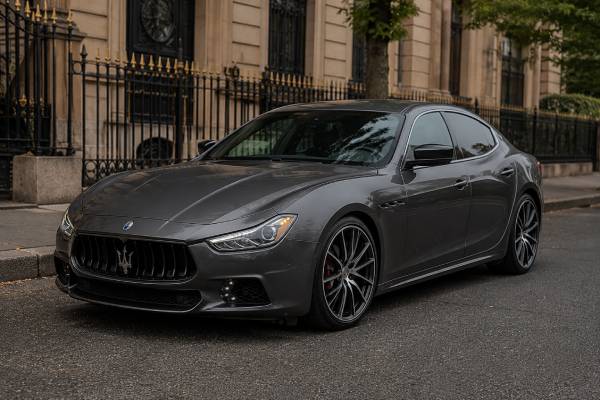
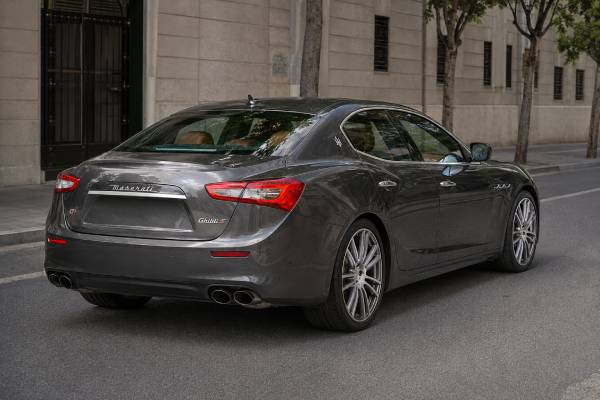
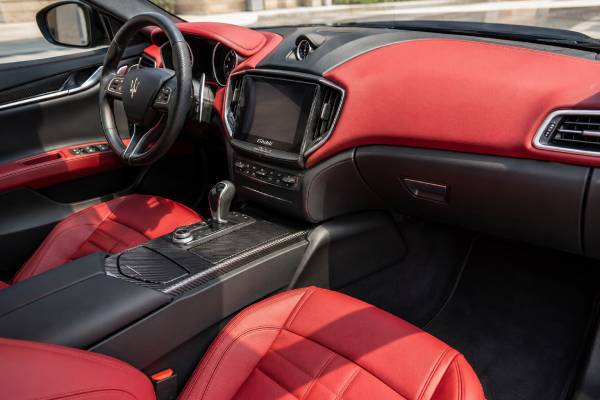
The 430 hp Maserati Ghibli S Q4 is the peak six-cylinder all-wheel-drive M157 before the later trim-name reset. It combines the strongest factory F160 V6 tune of the period with 580 Nm, a ZF eight-speed automatic, and a Q4 system that keeps the car rear-biased in normal running while adding front-axle torque when conditions require it. The result is repeatable acceleration—about 4.7 seconds from 0–100 km/h—plus more confidence in cold or wet weather than the rear-drive S. This is not simply a faster early S Q4. The 2017–2021 range includes the 2018 styling and steering update, GranLusso and GranSport equipment, more advanced driver assistance, and the 2021 infotainment and rear-lamp refresh. Its complexity also raises the standard for used-car inspection. Four compatible tires, correct wheel diameters, quiet transfer operation, sound front shafts, stable battery voltage, and accurate alignment are essential. Buyers must also distinguish factory 430 CV cars from earlier 410 hp models, later Modena S Q4 naming, and cosmetically upgraded examples. This guide explains the exact model, how its hardware works, what changes across the years, and how to buy one without inheriting an expensive driveline or electronic problem.
Table of Contents
- The Six-Cylinder Q4 Performance Peak
- 430 hp, Q4, and Core Dimensions
- Equipment Evolution and Market Differences
- Engineering the Ghibli for Four-Season Speed
- Acceleration, Grip, and Steering Feel
- Protecting the Q4 Driveline and Chassis
- How to Select a Ghibli S Q4
The Six-Cylinder Q4 Performance Peak
The 430 hp S Q4 is the mature form of Maserati’s original all-wheel-drive Ghibli idea. It adds output and technology to the launch formula while preserving the longitudinal, rear-led layout that keeps the car from feeling like a front-drive conversion.
Maserati raised the F160’s output to 430 CV and torque to 580 Nm as the M157 entered its facelift years. The stronger calibration improved overtaking and high-speed acceleration, while Q4 gave the car a traction advantage from a stop. In many markets, this combination became the most complete V6 performance specification.
Q4 is important because of how it behaves, not because all four wheels can be driven. Under stable conditions, the system favors the rear axle. It monitors throttle, steering, wheel speed, yaw, and other inputs, then transfers torque toward the front when slip is expected or detected. The driver generally feels the benefit as clean acceleration rather than obvious mechanical intervention.
The S Q4’s place in the range changed over time. Before Trofeo, it was the quickest Ghibli and the obvious all-weather flagship. After the V8 arrived, it remained the more discreet and efficient high-performance choice. Later, similar 430 hp hardware appeared under Modena and Modena S naming, which is why production date and market matter when identifying a car.
Compared with the rear-drive S, the Q4 gains launch security and winter usefulness but carries additional mass and components. The front transfer path, differential, shafts, and bearings need inspection, and all four tires must remain compatible. The system is not inherently weak; it is less tolerant of mismatched rolling circumference and careless servicing.
The model still feels special today because it combines hydraulic steering on some early examples or electric assistance on later cars with a powerful V6 and an Italian body. It can be a year-round performance sedan, but only when the owner budgets for premium tires, alignment, brakes, and specialist diagnosis.
Used prices often obscure that reality. A Q4 needing four tires, two wheels, front driveline work, adaptive dampers, and a battery can consume the saving over a better car immediately. Condition and documentation should rank above color, wheel size, or mileage.
430 hp, Q4, and Core Dimensions
The Ghibli S Q4 uses a 2,979 cc twin-turbo V6 producing 430 CV and 580 Nm. Its eight-speed automatic feeds a rear-biased Q4 system, helping the car reach 100 km/h in about 4.7 seconds.
| Platform code | M157 |
|---|---|
| Engine code | F160 |
| Engine configuration | 60-degree twin-turbo V6 |
| Displacement | 2,979 cc |
| Fuel system | Direct petrol injection |
| Maximum output | 430 CV, approximately 316 kW at 5,750 rpm |
| Maximum torque | 580 Nm at approximately 2,250–4,000 rpm |
| Transmission | Eight-speed ZF automatic |
| Drivetrain | Q4 intelligent all-wheel drive |
| 0–100 km/h | Approximately 4.7 seconds |
| Maximum speed | Approximately 286 km/h |
| Fuel tank | 80 liters |
The engine’s two turbochargers create a strong central torque band and continue supporting power toward 5,750 rpm. In normal mode, the automatic uses high gears and subdued exhaust settings. Sport mode increases pedal sensitivity, delays upshifts, commands more urgent downshifts, and opens the valved exhaust.
The driveline adds a transfer unit, front propeller shaft, front differential, and half-shafts. Control software varies torque distribution constantly. Marketing references to a maximum front split describe capability, not a fixed condition. A healthy car should transition without shudder, binding, or steering disturbance.
| Body | Four-door, five-seat luxury sports sedan |
|---|---|
| Length | Approximately 4,971 mm |
| Width | Approximately 1,945 mm excluding mirrors |
| Height | Approximately 1,461 mm |
| Wheelbase | 2,998 mm |
| Representative curb weight | About 1,935–2,020 kg by market and equipment |
| Suspension | Double-wishbone front and five-link rear |
| Steering | Hydraulic on the earliest cars; electric on the main facelift specification |
| Brakes | Ventilated Brembo system, often with six-piston front calipers |
| Trunk volume | Approximately 500 liters |
Tire compatibility is a technical requirement. Tread depth, pressure, brand construction, and actual circumference influence wheel-speed differences. A visibly good pair at one axle can still be unsuitable beside a worn pair at the other. Specialists should judge allowable variation using the exact wheel and tire specification.
The car often uses staggered 19-, 20-, or 21-inch wheels. Larger diameters increase steering response and visual presence but reduce sidewall protection. A cracked or welded inner barrel is a serious finding on a car capable of high speed.
Skyhook adaptive dampers were widely specified. Their ability to vary body control suits the Q4’s dual role, but leaking or weak units are expensive. Passive suspension can be an attractive alternative when properly aligned and paired with sensible wheels.
Equipment Evolution and Market Differences
The Ghibli S Q4 changed materially between 2017 and 2021 even when the output remained 430 CV. Steering type, bumpers, lamps, assistance hardware, trim names, and infotainment can all identify a different ownership experience.
The 2017 transition cars may combine the higher-output engine with much of the original M157 design. In some markets, these retain hydraulic steering. They appeal to drivers who prioritize feedback and do not need the newest assistance functions.
The 2018 facelift brought electric power steering, revised front and rear styling, available adaptive LED lighting, and more active-safety capability. GranLusso and GranSport divided the range into luxury and sport themes. GranLusso commonly uses formal wheels, wood, and fine leather; GranSport adds aggressive intakes, sport seats, dark trim, and larger wheels.
For 2021, the Ghibli received boomerang-inspired rear light graphics and a larger multimedia interface in many regions. Connected services and over-time support depend on country. A functioning screen does not guarantee that every subscription or data feature remains available.
Factory identity checks
- Confirm a 430 CV S Q4 rather than an earlier 410 hp car.
- Note whether the market quotes 430 CV or about 424 SAE hp.
- Verify original sales region, emissions equipment, and production date.
- Establish hydraulic or electric steering and the fitted assistance package.
- Match GranLusso, GranSport, wheels, brakes, seats, and suspension to the build sheet.
- Check whether later lamps, bumper parts, or multimedia hardware were retrofitted.
Badges are easily changed. “S,” “Q4,” “GranSport,” and later “Modena” parts can appear on cars that did not leave the factory that way. The VIN, underbody driveline, module data, and original order record settle the question.
Imported examples require practical research. Headlamps, radio frequencies, navigation, emissions parts, warranty history, and recall support can differ. A properly documented import can be excellent, but unclear origin reduces confidence and may complicate future parts ordering.
Option quantity should not override function. Test soft-close doors, sunroof, seat ventilation, premium audio, cameras, adaptive cruise, blind-spot monitoring, and all lighting. Every failed option should be priced before purchase.
Engineering the Ghibli for Four-Season Speed
The S Q4 keeps the Ghibli’s low, rear-drive proportions despite adding a complete front torque path. Its engineering challenge was to gain traction without making the car look or feel like a raised winter appliance.
The M157 body uses a steel-intensive passenger structure with aluminum doors, hood, and selected suspension parts. The engine remains longitudinal, and the front differential fits around the suspension and steering package. That arrangement preserves the long hood and short front overhang that define the design.
Maserati Centro Stile used the grille, fender vents, swept glass, and rear haunches to create movement even at rest. GranSport trim can make the Q4 more aggressive, but the hardware itself remains hidden. The body’s width and low bumper require care in snow banks, steep driveways, and narrow garages.
Underbody condition matters more on an all-season car. Winter use exposes fasteners, brake pipes, heat shields, suspension arms, electrical connectors, and front driveline components to salt and debris. Missing covers can allow ice or water to reach areas designed to remain protected.
The cabin centers the driver with a low seat, visible hood, large fixed paddles, and broad console. Electric-steering versions add controls and displays for assistance functions. Replacement windscreens, cameras, radar panels, and wheel alignment may require calibration before those systems work correctly.
Engineering and body inspection points
- Examine the front subframe, shaft paths, boots, and undertrays for impact or corrosion.
- Check all four wheels for cracks, bends, welds, and incorrect offsets.
- Inspect cooling openings, radiator faces, radar covers, and lower grilles.
- Look for water in the battery area, trunk, headliner, and front carpets.
- Test adaptive lamps, cameras, parking sensors, lane systems, and blind-spot alerts.
- Verify seat wiring, climate operation, screen stability, and amplifier output.
The valved exhaust gives the V6 a controlled split personality. Normal mode keeps the car quiet enough for distance; Sport opens a shorter path and makes the engine more expressive. Rattles, a one-sided note, or permanently open valves may signal wear or modification.
Rear-seat space benefits from the long wheelbase, though the sloping roof limits headroom. The 500-liter luggage area supports touring. Check seals and the battery compartment carefully because water near control modules can cause broad electrical symptoms.
Acceleration, Grip, and Steering Feel
The S Q4’s main dynamic advantage is that it can use 580 Nm early and consistently. It launches harder than the rear-drive S and remains confident when the surface is damp or cold.
At small throttle openings, the system is nearly invisible. The car feels rear-driven, and the gearbox settles into high ratios. A strong request brings a rapid downshift and a firm surge. Q4 moves torque forward as needed, but the driver should not feel repeated grabbing or release.
A test does not require launch control or repeated full-throttle starts. Accelerate smoothly from low speed in several gears and listen for clunks, whine, floor vibration, or a momentary flare. Then drive at a steady speed where wheel, shaft, and bearing vibration becomes easier to isolate.
The front axle’s added hardware slightly changes steering compared with the rear-drive S. Hydraulic cars remain weighty and communicative. Electric cars are easier in town and support active systems but provide less surface texture. Either should return smoothly to center and track without constant correction.
Q4 helps corner exits, yet tire quality still sets the limit. On snow, a proper winter set matters far more than the badge. On dry summer roads, mismatched tires can make the car feel inconsistent as electronic systems respond to different grip levels.
The long wheelbase gives excellent stability through fast sweepers. Body motion should settle after one movement. Repeated bouncing suggests weak dampers; rear steer or nervousness under power can point to links, alignment, or tires. Tight bends reveal the mass, so the S Q4 rewards a clean line rather than abrupt direction changes.
Wheel diameter controls ride. Nineteen-inch tires allow useful compliance, 20-inch wheels are a common compromise, and 21-inch sets can become harsh. Correct pressure is important because underinflation changes rolling circumference, increases heat, and risks rim damage.
Braking should feel strong and even. A pulsing pedal, steering shake, pull, or hot-wheel smell needs diagnosis. Because the car is heavy, cheap pads and old fluid become obvious during repeated stops. Brake condition should be measured, not judged through wheel spokes.
At motorway speed, the S Q4 becomes a relaxed grand tourer. The eighth gear reduces engine speed, the cabin remains stable, and all-wheel drive adds confidence when rain arrives. Wind or tire noise far above expectations may reveal poor alignment, worn bearings, or previous body repair.
Protecting the Q4 Driveline and Chassis
Matched tires, correct fluids, stable voltage, and early diagnosis are the foundations of Q4 reliability. Ignoring one vibration or mixing tire types can create a much larger bill.
Begin with a four-corner tire audit. Record size, brand, model, manufacture date, tread depth, pressure, and visible damage. Compare actual wear across axles. If the car has replacement wheels, confirm offset, width, diameter, and clearance from shafts and suspension.
Road-test the transfer system at full steering lock, light acceleration, moderate load, steady cruise, and coast. Binding, hopping, shudder, or a repeating knock is not normal. Possible causes range from tires and CV joints to mounts, bearings, shafts, or transfer hardware. A specialist should reproduce and isolate the symptom.
Battery health affects Q4 control as well as the rest of the vehicle. Low voltage can trigger drivetrain, transmission, steering, suspension, parking-brake, and assistance warnings. Load-test the battery and verify charging before replacing expensive modules.
Additional high-priority maintenance areas
- F160 coils, spark plugs, injectors, fuel pressure, air leaks, and boost control.
- Reservoirs, radiators, pumps, fans, hoses, and coolant connections.
- Engine, transmission, transfer, and differential mounts.
- Front control arms, rear links, wheel bearings, dampers, and alignment.
- Brake discs, pads, calipers, hoses, and electronic parking brake.
- Cameras, radar, screen, amplifier, seat modules, and water-sensitive wiring.
The V6 should start cold without smoke or persistent rattle. Under load, it should build boost smoothly and show no misfire. Read stored and pending faults, readiness monitors, fuel trims, and misfire data. A recently cleared computer can hide a problem long enough for a test drive.
Transmission behavior can reflect engine torque quality, adaptation, software, mounts, or fluid condition. Delayed engagement and repeated flare deserve investigation. Service must follow the correct fluid and temperature procedure.
Check recall completion by VIN. Campaigns affecting some cars in these years involved fuel-system and seat-belt components. Documentation is especially important for imports, where history may be split between countries.
Aftermarket software deserves caution. More torque travels through every part of the Q4 system. A tuned car needs calibration details, fuel requirements, supporting maintenance, and evidence that tire and driveline limits were respected.
How to Select a Ghibli S Q4
A good S Q4 should prove three things: it is the correct 430 hp specification, all four corners work as one system, and its electronics have not been kept alive by repeated code clearing. Documentation and an independent inspection are mandatory.
Ask for the VIN, factory build list, original market, service invoices, tire information, both keys, and a cold-start appointment. Confirm whether the car is a 2017 transition model, a 2018-on facelift, or a 2021 refresh. Establish the steering, assistance, suspension, brake, wheel, and trim package.
Seven-stage purchase inspection
- Inspect paint, panel fit, structural points, front corners, undertrays, wheel barrels, and tire wear.
- Start completely cold and note cranking, smoke, noise, idle, charging voltage, warning lamps, and coolant condition.
- Scan every module and save fault, readiness, freeze-frame, and configuration data.
- Test all seats, lights, cameras, sensors, climate functions, locks, audio, navigation, and assistance systems.
- Drive at full lock, over rough surfaces, at steady speed, under moderate boost, and during controlled braking.
- Recheck the hot car for leaks, odors, fan activity, unequal wheel temperatures, and new codes.
- Use a lift to inspect transfer components, shafts, boots, differentials, mounts, suspension, brakes, cooling, and exhaust.
A specialist estimate should include a matched tire set if needed, wheel repair, brakes, dampers, control arms, driveline seals, battery, cooling work, calibration, and any non-working option. The combined number matters more than whether each item seems manageable alone.
Service history should show a pattern of proactive work. Repeated alignment without suspension replacement, multiple tires of different types, or recurring drivetrain warnings suggest an unresolved issue. A long folder of detailed invoices is more valuable than a vague statement that the car was dealer maintained.
Avoid nonstandard tire sizes, wheel spacers, extreme lowering, undocumented tunes, and deleted exhaust or emissions equipment unless you specifically want a modified project. These changes can affect circumference, geometry, heat, legality, and resale.
The 430 hp S Q4 suits an owner who needs all-weather traction but still wants a rear-led performance character. It requires more diligence than the rear-drive S, yet a sorted example delivers rapid acceleration, high-speed refinement, and genuine year-round usability. When tire compatibility, driveline condition, structure, and scan data are all convincing, it is one of the most complete six-cylinder Ghiblis. When any of them is unclear, the correct decision is to keep looking.
References
- EN_Maserati-MY19-MiniBook-Ghibli.pdf 2019 (Model Brochure)
- Maserati_Ghibli_Digital_Catalogue_EN.pdf 2021 (Model Brochure)
- Management Summary of Maserati Safety Recall Campaign 378 2018 (Recall Database)
- Part 573 Safety Recall Report 21V-703 2021 (Recall Database)
Disclaimer
This article supplies general information and cannot replace professional diagnosis, repair, calibration, or a vehicle-specific inspection. Specifications, torque values, fluids, service intervals, software routines, and procedures vary by VIN, market, production date, and equipment. Confirm all work through the official documentation for the exact car.
Please share this guide on Facebook, X/Twitter, or an enthusiast group if it was useful. Sharing helps support more detailed technical and buying resources.