
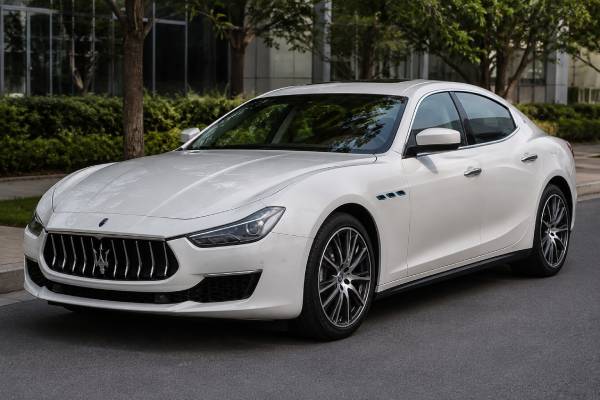
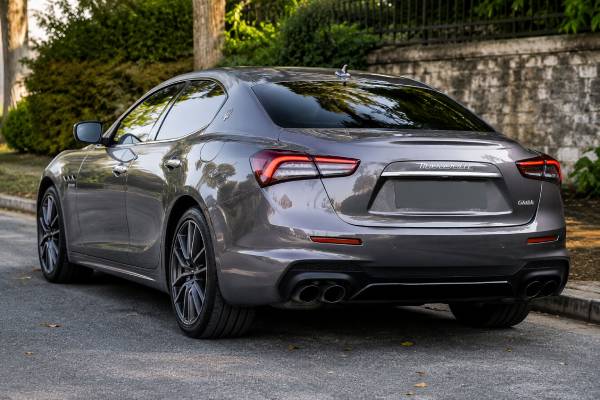
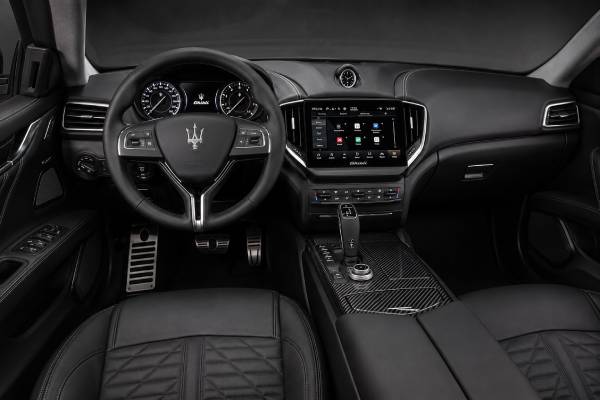
The late Maserati Ghibli GT with the 3.0-liter F160 V6 is a market-dependent comfort-oriented version that can be confusing because “GT” did not mean the same powertrain everywhere. In North American material, the V6 GT is commonly listed at 345 SAE hp, broadly corresponding to the 350 CV specification used in other markets. Elsewhere, GT often identified the 330 hp mild hybrid, while the 350 hp V6 was called Modena. The assignment therefore describes the petrol V6 GT configuration sold in selected markets from the 2021–2023 period, not the GT Hybrid. Its hardware is familiar but mature: 500 Nm, rear-wheel drive, a ZF eight-speed automatic, electric steering, boomerang-style rear lamps, and the 10.1-inch Maserati Intelligent Assistant interface. The GT theme favors grand-touring comfort and understated trim rather than the aggressive detailing of Modena or Trofeo. For used buyers, the first task is proving exactly what the badge represents. VIN data, market origin, engine output, trim code, and factory equipment must all agree. Once identified, the car offers strong everyday performance and late-M157 refinement, provided its battery, cooling system, electronics, tires, suspension, and service history are sound.
Table of Contents
- Where the V6 GT Fits
- GT Specifications and Comfort Hardware
- Badge Logic and Regional Configurations
- A Luxury-Led Interpretation of the Ghibli
- The 350 hp GT on Daily Roads
- Later-Car Electronics and V6 Upkeep
- How to Verify a True Ghibli GT
Where the V6 GT Fits
The V6 Ghibli GT is best understood as a late-market grand-touring specification, not one universal global model. Its purpose was to offer the familiar 3.0-liter petrol engine with a luxury-led presentation below the higher-output Modena and Trofeo versions.
Maserati reorganized much of its range around GT, Modena, and Trofeo for the 2022 era. GT represented the brand’s traditional long-distance philosophy, Modena emphasized sport, and Trofeo marked maximum performance. The idea was simple, but regional engine availability made the name complicated.
In many international markets, Ghibli GT meant the 330 hp mild hybrid. In the United States, official late brochures show a Ghibli GT with the 3.0-liter V6 at 345 SAE hp, 369 lb-ft, rear-wheel drive, and a 166 mph maximum speed. The engine corresponds closely to the 350 CV F160 specification listed elsewhere. This difference comes from both market lineup and horsepower measurement, not from one seller inventing a model.
The car’s mechanical role is familiar. It sits below the 430 CV or 424 SAE hp Modena variants and well below the V8 Trofeo, while providing stronger sound and a more traditional feel than the four-cylinder mild hybrid. Its 500 Nm torque plateau makes it effortless in traffic and on the motorway.
Late production also brings the most developed version of the standard M157 cabin and assistance package. Electric steering, updated lights, newer infotainment, and connected functions make it easier to live with than an early car. That maturity does not eliminate complexity. Cameras, radar, touch-screen electronics, seat modules, keyless systems, and software all need stable voltage and correct configuration.
Used values may overlap with earlier S or S Q4 cars that offer more power. The GT should not be judged only by acceleration. Its appeal lies in a calmer specification, lower driveline complexity than Q4, and the possibility of a well-equipped, understated touring car.
Because the name is easy to misapply, identity is the first buying issue. A late 350 hp V6 with a GT badge may be correct for its market, a rebadged Modena, or a base car wearing later trim. The build record decides.
GT Specifications and Comfort Hardware
The V6 GT uses the 2,979 cc F160 twin-turbo engine with about 350 CV, or 345 SAE hp in North American specifications, and 500 Nm. Rear-wheel drive and an eight-speed automatic keep the powertrain straightforward.
| Platform | M157 |
|---|---|
| Engine code | F160 |
| Engine | 60-degree 3.0-liter twin-turbo V6 |
| Displacement | 2,979 cc |
| Fuel system | Direct petrol injection |
| Maximum output | 350 CV or approximately 345 SAE hp, depending on market convention |
| Maximum torque | 500 Nm, approximately 369 lb-ft |
| Transmission | ZF eight-speed automatic |
| Drivetrain | Rear-wheel drive |
| 0–100 km/h | Approximately 5.5 seconds |
| Top speed | Approximately 267 km/h or 166 mph |
| Fuel capacity | 80 liters |
The engine’s two turbochargers provide a broad response from roughly 1,750 rpm. Normal mode keeps the accelerator progressive and the gearbox in taller ratios. Sport mode holds gears longer, opens the exhaust valves, and makes the car feel more urgent without changing the underlying output.
The rear limited-slip differential helps transfer torque through bends. The GT does not have a Q4 transfer case or front shafts, so its front axle is free of drive torque. This layout reduces components and preserves a natural steering attitude, though winter traction depends on fitting appropriate tires.
| Body style | Four-door, five-seat luxury sports sedan |
|---|---|
| Length | Approximately 4,971 mm |
| Width | Approximately 1,945 mm excluding mirrors |
| Height | Approximately 1,461 mm |
| Wheelbase | 2,998 mm |
| Trunk capacity | Approximately 500 liters |
| Representative curb weight | About 1,850–1,950 kg by market and equipment |
| Suspension | Double-wishbone front and five-link rear |
| Steering | Electric power assistance |
| Brakes | Ventilated Brembo system |
GT equipment generally emphasizes comfort and elegant details. Exact seats, leather, wood, wheels, audio, assistance systems, and Skyhook availability vary by market. The trim name should never be used as a substitute for the factory option list.
Nineteen-inch wheels suit the car’s touring purpose. Larger factory wheels add visual impact but reduce sidewall protection and increase tire cost. A late GT on the correct moderate-size wheels may ride better than a more expensive-looking example on damaged 21-inch rims.
Badge Logic and Regional Configurations
The GT badge is the most important source of confusion on this model. The same name can identify a V6 petrol car, a mild hybrid, or a market-specific equipment line depending on country and year.
The 2022 global trim strategy presented GT as the entry luxury theme. Official global announcements commonly paired Ghibli GT with the 330 hp four-cylinder hybrid. North American technical material, however, lists a V6 Ghibli GT with 345 hp. Some Asian material also uses naming combinations that differ from the main European catalog.
A 2021 registration date adds another complication. Cars built during the transition may carry pre-reset equipment, dealer-applied badges, or a market introduction that began before the globally promoted 2022 lineup. Production date, model year, and registration year are not interchangeable.
Documents needed to decode a GT
- VIN-based factory build sheet and model code.
- Original market brochure or window sticker.
- Engine designation and approved output.
- Production date and local model-year classification.
- Trim code, wheel and brake package, seat type, and interior materials.
- Driver-assistance, suspension, lighting, and multimedia options.
- Evidence of any dealer or previous-owner badge changes.
Horsepower units need careful reading. A car advertised at 345 hp may correspond to the 350 CV engine rather than a separate detuned version. Conversely, a 350 hp advertisement may simply round the North American figure. Torque, acceleration, engine code, and original paperwork help confirm the specification.
Imported cars can be attractive but may bring navigation, radio, headlamp, connected-service, emissions, warranty, and recall differences. A U.S. GT imported to Europe is not automatically equivalent to a local Modena, even when the engine output is similar.
Late Ghibli body parts are easy to interchange. GT, Modena, Trofeo, and Ultima badges can be fitted in minutes, while wheels and bumpers can be swapped after collision repair or for appearance. Cosmetic clues should support the paperwork, not replace it.
A Luxury-Led Interpretation of the Ghibli
The V6 GT uses restrained design to express grand touring rather than maximum aggression. Its visual appeal comes from the mature Ghibli shape, late lighting, and carefully chosen materials rather than hood vents or oversized aero pieces.
Maserati Centro Stile’s original M157 proportions remain effective: long hood, deep grille, three fender vents, narrow side glass, and a strong rear shoulder. The 2021-era boomerang lamp graphic references the 3200 GT and gives the rear a more distinctive nighttime identity.
The body is steel-intensive, with aluminum used for the hood, doors, and selected suspension components. Mixed-material collision repair requires correct methods. Uneven door gaps, disturbed fasteners, overspray, or alignment values at the end of adjustment range deserve further investigation.
Late front bumpers carry cameras, parking sensors, and radar surfaces that may need calibration after repair. A small parking impact can create assistance warnings even when the paint looks acceptable. Replacement windscreens can also affect the forward camera.
Inside, the 10.1-inch Maserati Intelligent Assistant screen is a major improvement over the early interface. It should start quickly, retain settings, display cameras, and connect to a phone. Connected functions depend on market support, account status, and software; an inactive service does not always mean hardware failure.
The low front seats, fixed aluminum paddles, analog clock, and visible hood preserve the Maserati atmosphere. GT cabins may favor leather, wood, and quieter color combinations. Carbon fiber and sport seats can still appear through options, so one car may look much more aggressive than another.
Condition details that affect the GT experience
- Inspect lower grilles, radar covers, parking sensors, and undertrays for impact damage.
- Look for lamp condensation and water in the trunk, battery area, carpets, or headliner.
- Test every seat motor, memory setting, heater, ventilation function, and lumbar support.
- Check dashboard leather, wood veneer, carbon trim, and headliner for lifting or shrinkage.
- Verify camera, lane, blind-spot, adaptive-cruise, and lighting operation.
- Confirm both keys, manuals, wheel-lock key, compressor kit, and original accessories.
The valved exhaust should remain quiet in normal use and become more expressive in Sport. A rattle, one-sided note, or permanently loud system can indicate failed valves, loose shields, or modification. A GT does not need an aftermarket exhaust to sound distinctive.
The 350 hp GT on Daily Roads
The V6 GT is tuned for easy speed rather than dramatic launches. Its 500 Nm torque band and eight-speed automatic make it responsive in normal driving while preserving a relaxed motorway character.
In town, the throttle is progressive and the gearbox shifts early. The car can creep smoothly when the battery, engine mounts, and transmission adaptation are healthy. Delayed engagement or a heavy thump into Drive is not a normal luxury feature and should be investigated.
Sport mode brings a clearer change than the GT badge might suggest. The transmission holds lower ratios, the accelerator reacts more quickly, and the exhaust opens. The engine pulls strongly through the middle range and continues to 5,500 rpm, though the car’s natural rhythm is to use torque rather than chase every final revolution.
Rear-wheel drive gives the steering a clean role. The electric system is lighter than the hydraulic setup in early Ghiblis and provides less surface detail, but it is accurate and supports lane assistance. A healthy car should track straight, return to center, and show no steering warning after a battery disconnect or alignment.
Ride quality can be excellent with sensible wheels. Nineteen-inch tires leave enough sidewall for broken surfaces, while 20- and 21-inch packages add impact harshness. Skyhook should reduce float and respond to mode changes without leaking dampers or stored faults.
The long wheelbase makes the GT stable on fast roads. It feels substantial rather than agile like a small sports sedan, but the double-wishbone front suspension keeps the nose composed. Worn control arms or poor alignment can make the car tramline and wear inner tire shoulders.
Brakes should feel firm, progressive, and free from vibration. Large discs are expensive, so measure thickness and surface condition. A hot wheel after gentle driving may indicate a sticking caliper or parking-brake issue.
Highway use is the car’s strength. The eighth gear lowers revs, the cabin settles, and the 80-liter tank supports long journeys. Excessive tire roar, vibration, or wind noise may reveal wheel damage, bearings, alignment, or previous body repair.
The GT is slower than the 430 hp Modena but does not feel underpowered. Its appeal is the ease with which it moves from quiet cruise to brisk overtaking. A flat, surging, smoky, or misfiring example is not displaying “normal base-model behavior”; it needs diagnosis.
Later-Car Electronics and V6 Upkeep
The late GT combines a proven engine family with the M157’s most complex electronics. Stable battery voltage and correct software are as important as oil and coolant.
The conventional battery should be load-tested, not judged by starting alone. Low voltage can set faults in the transmission, steering, parking brake, cameras, radar, seats, infotainment, and keyless system. A stored car benefits from an appropriate maintainer.
The F160 needs a clean cold start, even idle, and smooth boost. Spark plugs, coils, injectors, fuel pressure, sensors, intake leaks, and turbo-control components can cause misfire or reduced power. Scan stored and pending codes, readiness monitors, fuel trims, and misfire counters before accepting a clear dashboard.
Cooling inspection should cover reservoirs, pumps, hoses, radiators, fans, and dried traces. A pressure test is worthwhile when records are incomplete. Repeated coolant top-ups or a sweet odor after shutdown indicate a fault, not normal evaporation.
Late-GT cost drivers
- MIA screen, amplifier, cameras, radar, blind-spot modules, and software calibration.
- Adaptive LED lamps and replacement windscreen-camera setup.
- Skyhook dampers, control arms, rear links, and alignment.
- Large brake discs, caliper work, and high-speed-rated tires.
- Engine and transmission mounts, wheel bearings, and driveshaft joints.
- Missing keys, connected-service hardware, and coded control modules.
The gearbox should be assessed with the engine because uneven torque can create rough shifts. Repeated flare, delayed engagement, or hard changes need diagnosis of adaptation, software, mounts, fluid condition, and internal operation. Service must use the exact procedure.
After body or glass repair, assistance systems may need static or dynamic calibration. A warning that disappears after a restart still deserves attention. Check whether replacement modules were coded to the car rather than merely plugged in.
VIN-specific recalls and campaigns should be verified. Late M157 populations were included in seat-belt and fuel-system actions in some markets. A manufacturer service history may also show software or technical updates that are not public recalls.
Parts are generally available for routine service, but late electronics, trim, and market-specific lamps can be expensive. Identify a workshop with Maserati diagnostic access before purchase, especially for an imported V6 GT.
A late car may still be advertised with remaining factory or dealer-backed coverage, but eligibility is not transferable by assumption. Check the in-service date, mileage limit, country of origin, servicing conditions, and whether modifications have affected coverage. Connected services can also expire or depend on a supported cellular network. These details do not determine the mechanical quality of the car, yet they change the practical value of two otherwise similar GTs and should be documented before the price is agreed.
How to Verify a True Ghibli GT
Verification is the central buying task. Do not pay a GT premium until the VIN, market paperwork, engine output, and factory equipment all support the badge.
Ask for the build sheet, original window sticker or invoice, service records, both keys, and a cold-start appointment. Compare the model code with official market material. Confirm whether the car is rated at 345 SAE hp or 350 CV and whether it is rear-wheel drive.
Inspection process
- Inspect paint, panel gaps, lower body, glass, wheel barrels, tires, and evidence of bumper or windscreen replacement.
- Start fully cold and observe cranking, smoke, noise, idle, charging voltage, coolant level, and warning lamps.
- Scan every control module before codes are cleared and save fault, readiness, and configuration data.
- Test the MIA screen, audio, cameras, radar, lighting, seats, locks, climate, and all driver-assistance functions.
- Drive at parking speed, on rough surfaces, at steady cruise, under moderate boost, and during controlled braking.
- Recheck the hot car for leaks, odors, fan activity, unequal wheel temperature, and newly stored faults.
- Use a lift to inspect structure, cooling connections, mounts, suspension, brakes, driveline seals, and exhaust.
A specialist estimate should include overdue service and every non-working option. Tires, brakes, dampers, control arms, a battery, a windscreen-camera calibration, and a missing key can change the value materially.
Compare the estimate with recent invoices rather than accepting a service stamp as proof of condition. A stamped book may not show which battery was fitted, whether the alignment corrected inner-edge wear, or whether a warning was diagnosed instead of erased. Detailed receipts make it easier to separate routine age-related work from repeated faults and help establish a sensible first-year reserve.
Review modifications carefully. A reversible phone interface or paint-protection film can be useful. Unknown engine software, lowering, spacers, nonstandard wheels, exhaust alterations, or added electrical devices create heat, geometry, network, and resale risks. Documentation and original parts matter.
Choose the V6 GT for late-M157 comfort, petrol sound, and rear-drive simplicity. Buyers seeking the global GT Hybrid should verify the four-cylinder 48-volt system instead; buyers wanting maximum V6 output should look at Modena or Modena S specifications.
The correct V6 GT is a market-specific car with evidence, not a badge-based assumption. When the identity is clear, the electronics work, the structure is honest, and a specialist approves the mechanical condition, it can be one of the most comfortable and mature ways to own a petrol Ghibli. When the seller cannot explain the model code or horsepower convention, walk away until the facts are resolved.
References
- Maserati_Ghibli_Digital_Catalogue_EN.pdf 2022 (U.S. Model Brochure)
- Maserati 2022 new trims: GT, Modena and Trofeo 2021 (Manufacturer News)
- Ghibli | 1966 2022 (Model Brochure)
- Part 573 Safety Recall Report 21V-703 2021 (Recall Database)
Disclaimer
This article is for informational purposes and does not replace professional diagnosis, repair, coding, calibration, or a vehicle-specific inspection. Specifications, horsepower conventions, torque values, fluids, intervals, software procedures, and equipment vary by VIN, market, production date, and trim. Verify all details with official documentation for the exact vehicle.
Please share this guide on Facebook, X/Twitter, or an enthusiast community if it was helpful. Sharing supports more detailed model-specific resources.