
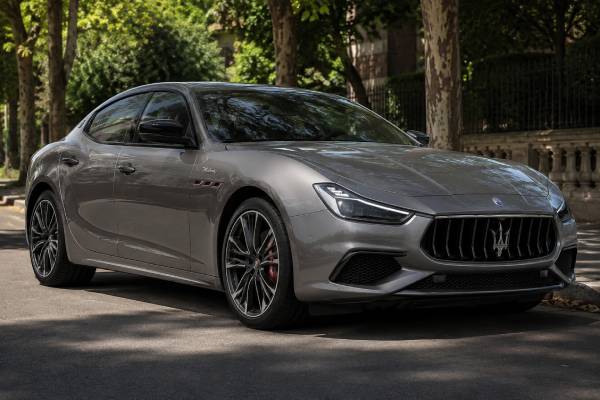
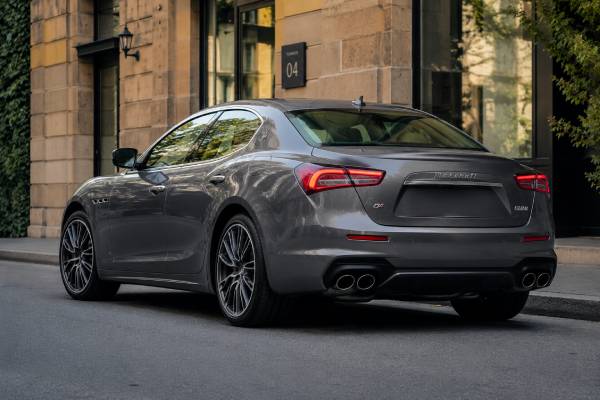
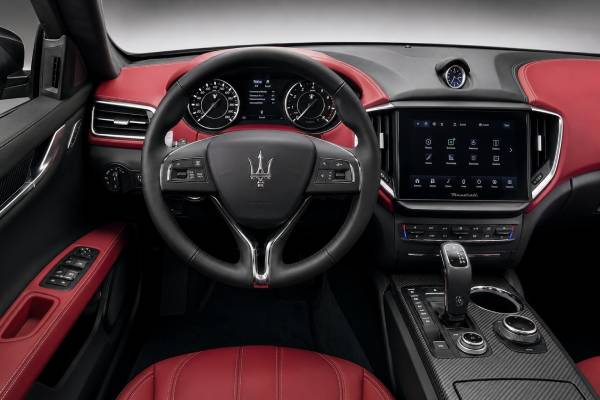
The Maserati Ghibli Modena Q4 is the late high-output V6 Ghibli for drivers who wanted all-weather traction without stepping up to the V8 Trofeo. In North American literature it is normally rated at 424 SAE hp and 428 lb-ft, figures commonly expressed as about 430 metric horsepower and 580 Nm. Q4 adds an electronically managed transfer case and front driveline to the rear-biased M157 platform, helping the sedan reach 60 mph in roughly 4.7 seconds while retaining the feel of a rear-driven car in ordinary conditions. The name still needs careful verification. Other markets used Modena S Q4 for the 430 hp version, while “Modena Q4” could be absent or differently configured. A genuine car should be supported by its VIN, original window sticker or invoice, market build sheet, and physical Q4 hardware. The system’s advantages are clear on wet, cold, or uneven roads, but the ownership obligations are also specific: four closely matched tires, correct alignment, transfer-case and front-driveline inspection, stable battery voltage, and complete software diagnosis. A properly maintained example is a rapid and secure grand tourer; a neglected one can turn tire mismatch or a small driveline fault into a large repair.
Table of Contents
- Why Modena Q4 Suited North America
- The 430 hp Q4 Technical Package
- Model Years, Options, and Identification
- Sport Trim Meets Intelligent All-Wheel Drive
- Real-World Speed in Every Season
- Q4 Tire, Transfer Case, and Service Concerns
- A Complete Modena Q4 Inspection Plan
Why Modena Q4 Suited North America
Modena Q4 matched the North American market because it paired the strongest V6 with traction for snow-belt climates and the equipment expected in a premium daily sedan. It became the practical performance choice below Trofeo during the M157’s final trim cycle.
The Ghibli had offered Q4 since its 2013 launch, but the meaning of the surrounding badge changed over time. Early cars were called S Q4. Later models gained GranLusso and GranSport packages. For the 2022-style range, Maserati promoted GT, Modena, and Trofeo as distinct personalities. In the United States and Canada, Modena Q4 generally inherited the high-output engine and all-wheel-drive role.
Official U.S. brochures quote 424 SAE horsepower rather than 430. That is not a 6 hp detune in the usual sense; it reflects the relationship between SAE horsepower and metric horsepower plus rounding. The 428 lb-ft torque figure corresponds closely to 580 Nm. Advertisements may use either convention, so the original market document is the correct reference.
The Q4 system is designed around a rear-drive platform. Under stable cruising, the car behaves primarily like a rear-wheel-drive sedan. When sensors detect acceleration demand, wheel slip, steering input, yaw, or low grip, the transfer system can send torque toward the front axle. The objective is traction without the permanently front-driven sensation of some all-wheel-drive layouts.
This architecture suited buyers who wanted one luxury car for year-round use. The strong V6 can overwhelm poor rear tires in wet weather, while Q4 gives the launch and stability systems more options. It does not repeal the laws of grip: worn summer tires remain dangerous in snow, and all-wheel drive does not shorten braking distance on ice.
The system also changes the ownership equation. Four tires must be compatible in brand, model, size, wear, and rolling circumference. The transfer case, front differential area, shafts, boots, bearings, and related mounts add inspection points. A rear-drive Modena may be simpler, but it cannot reproduce Q4’s confident acceleration on a cold, damp road.
Today, Modena Q4 is often one of the most usable late Ghiblis. It combines the final infotainment generation, broad comfort equipment, strong performance, and winter capability. Its value depends on whether previous owners treated the drivetrain as a coordinated system rather than replacing one tire at a time and ignoring vibration.
The 430 hp Q4 Technical Package
The Modena Q4 uses the F160 3.0-liter twin-turbo V6, an eight-speed automatic, and an electronically controlled all-wheel-drive system. Its faster launch compared with the rear-drive Modena comes mainly from traction, not a higher engine rating.
| Item | Specification |
|---|---|
| Engine | F160 twin-turbocharged 60-degree V6 |
| Displacement | 2,979 cc |
| Output | 424 SAE hp; approximately 430 metric hp |
| Torque | 428 lb-ft; approximately 580 Nm |
| Transmission | ZF eight-speed automatic |
| Drivetrain | Q4 electronically managed all-wheel drive |
| 0–60 mph | Approximately 4.7 seconds |
| Top speed | Approximately 178 mph; 286 km/h |
| Front suspension | Independent double wishbones |
| Rear suspension | Independent five-link arrangement |
| Steering | Electric power assistance |
| Wheelbase | 2,998 mm |
| Fuel tank | Approximately 80 liters |
The V6 combines aluminum construction, twin turbochargers, direct injection, and variable valve timing. Its torque plateau begins low in the rev range, which is useful for everyday response but also means the driveline must manage a large torque increase before road speed is high. Proper fuel, ignition condition, boost control, and cooling are essential to repeatable performance.
Power passes through the ZF automatic to the rear driveline, with Q4 able to engage the front axle through its transfer hardware. Control is coordinated with wheel-speed sensors, stability control, steering angle, throttle position, and other vehicle data. A fault in a seemingly unrelated sensor can therefore disable or limit all-wheel-drive operation.
Q4 does not make the car a permanent equal-split vehicle. Maserati’s strategy favors rear-drive behavior and brings in front torque when required. Drivers may not feel a dramatic engagement. The expected result is simply cleaner traction and reduced rear-wheel spin. Binding, hopping, clunking, or shudder during tight turns is not a desirable characteristic.
The additional front driveline adds weight compared with the rear-drive model. The Q4’s launch is still quicker because it can use more of the engine’s torque immediately. At motorway speed, both versions have similar top-end intent, and tire condition or aerodynamic load matters more than the first few tenths of acceleration.
Skyhook adaptive dampers, large ventilated brakes, and 19- to 21-inch wheel choices complete the package. Equipment varies, so disc size, caliper type, wheel width, and tire combination must be confirmed for the actual VIN. A wheel that fits physically may have the wrong offset or load rating for the Q4 setup.
The performance numbers describe a properly functioning car on appropriate tires. A slow or inconsistent example may have engine faults, but it may also be protecting the driveline because of tire mismatch, transfer-case errors, low voltage, wheel-speed data, or stability-system intervention.
Model Years, Options, and Identification
A Modena Q4 should be verified as a complete factory specification, not assembled from badges and cosmetic parts. The VIN and original sales document should show both the high-output V6 and Q4 drivetrain.
The 2021–2023 date range overlaps a naming transition. Depending on build date and country, an early car may still use S Q4 or GranSport language even if it was first registered in 2021. Conversely, a late-built Modena Q4 may be titled in a later calendar year. Production labels and factory option records resolve that timing more accurately than registration alone.
North American Modena Q4 cars typically feature dark exterior trim, a sport-oriented grille and bumper treatment, larger wheels, sport seats, and the 10.1-inch MIA touchscreen. The exact combination can include carbon-fiber interior trim, colored calipers, full leather, Alcantara headlining, ventilated seats, heated rear seats, premium audio, and a power sunroof.
Advanced driver aids may include adaptive cruise, lane-keeping assistance, forward-collision warning, automatic emergency braking, traffic-sign recognition, active blind-spot assistance, parking sensors, and surround cameras. These features rely on correct glass, bumper brackets, wheel alignment, sensor calibration, software, and battery voltage.
How to prove Q4 identity
- Match the full VIN to an original window sticker, invoice, or factory build sheet.
- Confirm the Q4 model description in registration or market data.
- Inspect the front driveline, transfer hardware, shafts, boots, and related underbody shields.
- Scan the all-wheel-drive, stability, transmission, and wheel-speed modules.
- Verify that factory tire sizes and wheel specifications are fitted on all four corners.
Exterior Q4 badges can be removed or added. Black grille pieces and wheels are equally easy to swap. Even underbody hardware should be checked carefully on repaired vehicles because accident damage can leave missing shields or replaced components with incomplete coding.
The MIA system is a useful late-model feature but should be exercised fully. Test navigation, phone pairing, smartphone projection, audio, vehicle settings, camera views, voice control, and connected functions. Some online services may have expired, and an imported car may not support the local network.
Wheel options deserve more attention on Q4 than on a rear-drive version. Staggered factory sizes may use different front and rear widths while maintaining a compatible rolling circumference. Replacement tires must preserve that relationship. A visually matching tire with a different model or wear level can still create a meaningful diameter difference.
Color and trim influence resale, yet condition is the deciding factor. Inspect seat bolsters, dash leather, headliner, glossy console surfaces, carbon edges, door seals, and the panoramic or power roof. Water stains or a damp boot can point to drain, seal, or body-repair issues that may affect nearby electronics.
Sport Trim Meets Intelligent All-Wheel Drive
The distinctive engineering feature is the way Q4 is integrated into a shape and cockpit designed around rear-drive proportions. The car looks like the standard Ghibli, but its front underbody and control network carry a more complex torque path.
The long bonnet, rearward cabin, frameless doors, and short rear deck give the M157 a classic sports-sedan stance. The front wheel openings must accommodate both double-wishbone suspension and driven half-shafts without changing the exterior proportions. Packaging, heat shielding, and clearance around the front driveline should be inspected after any collision or suspension work.
Modena styling commonly darkens the grille, window surrounds, side details, and wheels. The late boomerang tail lamps help distinguish this production phase. Q4 itself is communicated discreetly, which is useful for design purity but reinforces the need for paperwork when buying.
Cooling air enters through a front bumper crowded with heat exchangers, ducts, parking sensors, and radar equipment. The twin-turbo V6 and automatic generate substantial heat, while the front driveline occupies additional space. Broken ducts, debris-packed radiator faces, or missing undertrays can reduce thermal margin without being obvious from above.
Inside, the driver faces large fixed shift paddles, a conventional transmission selector, physical drive-mode controls, and the MIA screen. The layout keeps major dynamic functions accessible. Sport changes engine, gearbox, exhaust, and damper behavior; the all-wheel-drive controller operates in the background rather than through a driver-selected locked mode.
The sensory character remains strongly V6. The valved exhaust becomes more vocal in Sport, and the engine gives a deeper, more complex sound than the Hybrid four-cylinder. Q4 does not change that note, but its extra grip can make full-throttle acceleration feel less dramatic because the car simply leaves without prolonged wheelspin.
The all-wheel-drive system’s intelligence depends on accurate information. Matching tires, correct pressures, calibrated steering angle, healthy wheel-speed sensors, and stable voltage are part of the engineering package. Treating those items as unrelated consumables undermines the system’s operation.
Body repair also has a systems consequence. A replaced windscreen may require camera calibration; a bumper repair may affect radar; a suspension impact can alter alignment and wheel-speed behavior. The most attractive paint finish does not compensate for a network full of intermittent driver-assistance or Q4 faults.
Real-World Speed in Every Season
The Modena Q4’s defining road quality is effortless traction. It can deploy 580 Nm earlier than the rear-drive car on poor surfaces, yet it still feels rear-biased and responsive when the road is dry.
A cold start should be clean and the first engagement smooth. At parking speed, tight turns must occur without hopping, binding, repeated clunks, or driveline wind-up. Some tire scrub is possible with wide performance tires, but a pronounced shudder calls for checking circumference mismatch, transfer operation, mounts, or front joints.
In normal mode, the transmission uses the V6’s torque to keep revs low. The car moves quickly with small throttle inputs and settles into eighth gear on the highway. Hesitation, surging, or repeated downshift indecision is not simply the complexity of Q4; engine torque quality, software, battery voltage, and transmission adaptations should be examined.
Sport makes the accelerator more immediate, opens the exhaust, and keeps the engine in its responsive range. The system can use front traction during a hard launch, which explains the roughly 4.7-second 0–60 mph claim. Repeated launch-style starts are unnecessary for evaluation and add heat to tires, transmission, transfer hardware, and brakes.
On a wet road, the Q4’s benefit is most obvious when accelerating out of a junction or onto a motorway. It reduces rear-wheel spin and stabilizes the car as torque arrives. It cannot create grip where the tire compound is unsuitable. Summer tires near freezing may provide less security than a rear-drive car on proper winter tires.
Steering is electrically assisted and slightly filtered, but it should be accurate. The added front hardware can make the nose feel a little more substantial than the rear-drive Modena. Worn control arms, bent wheels, mixed tires, or poor alignment exaggerate that difference and can make the car follow road grooves.
Ride quality depends on wheel size. A Q4 on 19- or 20-inch wheels can cover broken winter roads with useful compliance. Twenty-one-inch packages look dramatic but leave less sidewall to absorb potholes. A bent front wheel may create a vibration that is mistaken for a transfer-case fault, so wheel runout should be measured first.
Braking performance remains tire-limited. All-wheel drive improves acceleration, not stopping. The pedal should be firm and the car should stop straight. Corroded inner disc faces, sticking calipers, old fluid, or mismatched tires can produce pull and vibration even when the visible outer surfaces look acceptable.
On long journeys, the car is stable, quiet in normal mode, and capable of immediate passing acceleration. Excessive driveline hum, floor vibration, or a noise that changes under load should be investigated. Front and rear wheel bearings, tire patterns, propeller shaft, transfer hardware, and differential components can produce similar symptoms.
The Q4 is not an off-road system. Ground clearance, large wheels, low-profile tires, and vulnerable bodywork remain those of a sports sedan. Its purpose is to make fast road use more secure across seasons, not to compensate for deep snow, poor tires, or neglected maintenance.
Q4 Tire, Transfer Case, and Service Concerns
Tire matching is the first Q4 maintenance rule. Significant differences in rolling circumference force the system to manage a speed difference continuously, increasing heat and wear while confusing stability and all-wheel-drive control.
Replace tires in compatible sets and measure tread across all four corners. Follow the approved size, load index, speed rating, and pressure. If the car uses staggered front and rear sizes, the intended overall diameter relationship must still be preserved. Mixing tire models with different construction can change rolling behavior even when the sidewall numbers match.
Inspect the transfer case and front driveline for leaks, damaged seals, torn boots, impact marks, loose shields, and abnormal play. Fluid requirements and service procedures should be confirmed by VIN and official workshop information. A generic all-wheel-drive service recommendation may use the wrong fluid or fill process.
The F160 engine has the same core needs as the rear-drive car: correct oil, healthy plugs and coils, clean boost control, sound cooling, and prompt diagnosis of misfires. Q4 does not mask an engine problem; irregular torque can make driveline behavior feel worse and can trigger protective intervention.
The 12-volt battery is another system component, not a convenience item. Low voltage can set faults in Q4, transmission, steering, brakes, parking sensors, cameras, radar, and infotainment. Load-test the battery, check charging and grounds, and scan the whole vehicle. Repeated jump starts can create a misleading history of unrelated warnings.
Symptoms that need specialist diagnosis
- Binding, shudder, or hopping on tight low-speed turns.
- Q4 unavailable, stability-control, ABS, or wheel-speed warnings.
- A vibration that changes with throttle rather than road speed alone.
- Fluid residue around transfer, front differential, shafts, or seals.
- Unequal tire wear or a replacement history showing one tire at a time.
- Clunks during Drive/Reverse selection or on-and-off throttle transitions.
The ZF automatic should engage promptly and shift consistently cold and hot. Diagnosis must separate transmission faults from engine mounts, torque delivery, driveshaft joints, transfer behavior, and software. Fluid service is worthwhile only when performed to the correct procedure; indiscriminate power flushing can create new problems.
Suspension and brake costs remain substantial. Check Skyhook dampers, front arms, rear links, wheel bearings, brake discs, calipers, parking brake, and alignment. A Q4 with uneven alignment can wear four expensive tires quickly. Measure inner tread and disc surfaces, not just what is visible from outside.
Late electronics add another layer. Camera or radar warnings after a windscreen or bumper repair may require calibration rather than replacement. MIA reboots can follow low voltage, software faults, or module problems. Obtain diagnostic reports and invoices instead of accepting that a warning “comes and goes.”
Check recalls and campaigns by VIN. Safety actions cover specific production populations, not every Ghibli. Manufacturer software or technical updates may also exist outside public recall databases. A specialist with Maserati access can verify completion and current configuration.
A Complete Modena Q4 Inspection Plan
Buy a Modena Q4 only after a cold, lift-based, full-module inspection. A conventional road test cannot prove tire compatibility, front-driveline condition, software health, or the car’s true factory identity.
Start with documents. Obtain the original window sticker or invoice, build sheet, registration, production label, service history, and both keys. Confirm 424 SAE hp or the corresponding 430 metric-hp rating, Q4 designation, original market, and factory wheel sizes.
Inspect the four tires before starting the engine. Record brand, model, size, date code, pressure, and tread depth at inner, center, and outer positions. A nearly new single tire among three worn tires is a warning, not a benefit. Look for wheel repairs, bends, cracks, spacers, and nonstandard offsets.
Inspection sequence
- Scan every module and save Q4, ABS, transmission, engine, steering, battery, camera, and radar data before clearing codes.
- Start fully cold; assess cranking, idle, smoke, belts, turbo noise, charging voltage, and initial gear engagement.
- Raise the car and inspect structure, undertrays, transfer case, shafts, boots, seals, mounts, suspension, brakes, and exhaust.
- Drive tight circles in both directions, then test rough roads, steady cruise, moderate acceleration, manual shifts, and controlled braking.
- Test Sport, Skyhook, exhaust valves, parking brake, MIA, cameras, driver aids, lighting, climate, seats, audio, locks, and both keys.
- Recheck hot for leaks, odors, fan operation, uneven wheel temperature, fresh codes, and fluid movement.
- Obtain written estimates for tires, wheels, alignment, driveline work, overdue service, electronics, and cosmetic repairs.
Paint and accident inspection should focus on the front corners and underbody. A wheel impact can affect control arms, subframe position, shafts, bearings, steering calibration, and radar alignment. Measure paint depth and examine welds, fasteners, glass dates, sensor brackets, and cooling ducts.
Modifications require restraint. Unknown engine tuning, lowering, spacers, mismatched wheel packages, exhaust changes, or added electrical accessories increase the diagnostic burden. Even a tire-size change that looks minor can affect Q4 operation. Prefer factory geometry and documented reversible work.
Compare the car with a rear-drive Modena honestly. Q4 is worth choosing when the vehicle will see winter, frequent rain, steep surfaces, or full-torque use on imperfect roads. Rear drive is the better choice when climate is mild and lower complexity is the priority. Neither is universally superior.
Set aside a reserve for baseline service. Four matched tires, brake discs, a battery, fluids, plugs, alignment, a missing key, or a transfer leak can exceed the apparent discount on a cheap example. A pre-purchase estimate gives the negotiation a factual basis.
A strong Modena Q4 will turn smoothly at parking speed, accelerate without vibration, show even tire wear, remain fault-free after a hot re-scan, and have paperwork that agrees with its hardware. With those checks satisfied, it delivers the M157’s most useful V6 combination: high output, late technology, rear-biased handling, and traction that can be used throughout the year.
References
- Maserati_Ghibli_Digital_Catalogue_EN.pdf 2022 (U.S. Model Brochure)
- Maserati 2022 new trims: GT, Modena and Trofeo 2021 (Manufacturer News)
- Ghibli | 1966 2022 (Model Brochure)
- Part 573 Safety Recall Report 21V-703 2021 (Recall Database)
Disclaimer
This article is for informational purposes and does not replace professional diagnosis, repair, coding, calibration, or a vehicle-specific inspection. Specifications, horsepower standards, tire requirements, fluids, intervals, equipment, software, and warranty terms vary by VIN, market, and production date. Verify all details with official documentation for the exact vehicle.
Please share this guide on Facebook, X/Twitter, or an enthusiast community if it was helpful. Sharing supports more detailed model-specific resources.