
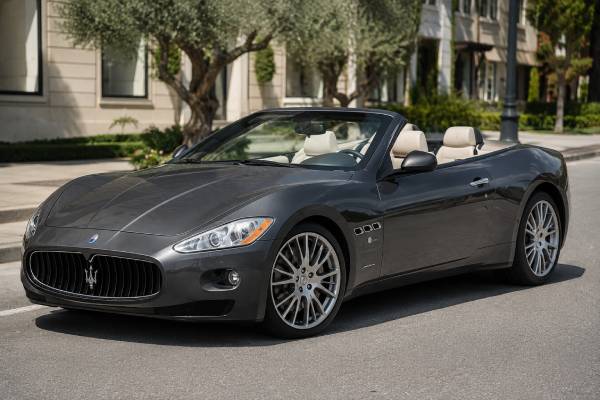
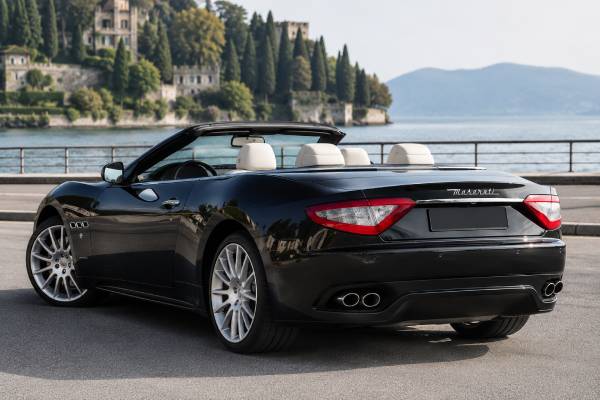
The 2010–2011 Maserati GranCabrio is a rare kind of luxury convertible: a genuinely spacious four-seater built around a naturally aspirated V8, rear-wheel drive, and long-distance comfort rather than a cramped sports-car cabin. Known as the GranTurismo Convertible in North America, the M145 GranCabrio paired Pininfarina styling with a 4.7-liter, 440 hp engine and a conventional six-speed automatic. That combination gives it an easier, more relaxed personality than later MC-branded versions while preserving the sound and high-revving response that made this Maserati generation special.
Age now matters more than mileage. A carefully serviced example can feel solid, elegant, and deeply characterful, but deferred maintenance can turn a tempting purchase price into a costly restoration. Buyers should focus on service history, roof operation, suspension condition, cooling-system health, electrical stability, and evidence that the car has been used regularly. This guide explains the model’s engineering, performance, ownership needs, and the inspections that separate a satisfying GranCabrio from an expensive project.
Table of Contents
- The First Full-Size Maserati Convertible
- 440 hp V8 and Chassis Specifications
- Production Details, Colors, and Options
- Pininfarina Form and Open-Top Engineering
- How the Original GranCabrio Drives
- Age-Related Faults and Service Needs
- Buying a 440 hp GranCabrio Wisely
The First Full-Size Maserati Convertible
The original GranCabrio matters because it translated the GranTurismo coupe into a usable four-seat convertible without reducing it to a token 2+2. Maserati launched it for the 2010 model year as the brand’s first production convertible designed to carry four adults, positioning it above smaller sports cabriolets and closer to a hand-finished open grand tourer.
The 2010–2011 version sits at the beginning of the GranCabrio family. It uses the 4.7-liter V8 in 440 hp form with 490 Nm of torque and a ZF six-speed automatic mounted directly behind the engine. Later GranCabrio Sport and MC models gained more power, sharper transmission programming, firmer chassis tuning, and more aggressive bodywork. The early car is therefore the calmest interpretation: fast enough to be special, but tuned around ride quality, progressive responses, and effortless touring.
That distinction is important in today’s market. The base 440 hp car is not the model to buy merely because it is the cheapest M145 convertible. It is the right version for an owner who values the original Pininfarina shape, the smoother suspension setup, restrained exterior detailing, and a less demanding driving character. It also tends to attract less track-style use than an MC, though poor maintenance can affect any trim.
The GranCabrio’s reputation today rests on three qualities. First, its naturally aspirated V8 delivers an experience that modern turbocharged and electric luxury cars cannot duplicate. Second, its cabin and rear-seat accommodation make it practical for weekends and long trips. Third, its depreciation has placed it within reach of buyers who may not be prepared for Maserati-level parts and labor costs. The last point explains why condition varies so widely.
This is now a modern classic rather than an ordinary used luxury car. Its appeal is emotional, but the purchase decision must be technical. A strong example should feel tightly assembled, start cleanly, shift smoothly, track straight, operate every roof and cabin function, and come with invoices that show continuous specialist attention.
440 hp V8 and Chassis Specifications
The 440 hp GranCabrio combines a 4,691 cc naturally aspirated V8 with rear-wheel drive and a six-speed torque-converter automatic. Its performance is substantial rather than supercar-like, with the strongest impression coming from the engine’s linear pull and sound above midrange speeds.
| Category | Specification |
|---|---|
| Engine | 90-degree naturally aspirated V8, aluminum block and heads |
| Displacement | 4,691 cc |
| Fuel system | Multi-point electronic injection |
| Maximum power | 440 hp at 7,000 rpm |
| Maximum torque | 490 Nm at 4,750 rpm |
| Transmission | ZF six-speed automatic with paddle shift |
| Drivetrain | Rear-wheel drive with limited-slip differential |
| Suspension | Double wishbones front and rear; Skyhook adaptive damping where fitted |
| Steering | Hydraulic power-assisted rack and pinion |
| Front brakes | Ventilated discs with fixed Brembo calipers |
| Rear brakes | Ventilated discs with Brembo calipers |
| Wheels and tires | 20-inch wheels; typically 245/35 ZR20 front and 285/35 ZR20 rear |
| Wheelbase | 2,942 mm |
| Length | Approximately 4,881 mm |
| Width | 1,915 mm excluding mirrors |
| Height | Approximately 1,380 mm |
| Fuel capacity | 75 liters |
| Luggage capacity | Approximately 173 liters |
| 0–100 km/h | About 5.3 seconds |
| Maximum speed | Approximately 283 km/h |
The M139S-family V8 uses a cross-plane crankshaft, four overhead camshafts, four valves per cylinder, and variable valve timing. It does not deliver the low-rpm surge of a modern twin-turbo engine. Instead, response builds cleanly as revs rise, with peak power arriving at 7,000 rpm. This encourages the driver to use the upper half of the tachometer, where intake and exhaust sound become central to the experience.
The ZF automatic suits the car’s touring role. In normal driving it shifts unobtrusively and uses the engine’s flexibility rather than chasing revs. Sport mode sharpens throttle response, holds lower gears, speeds shifts, and alters the exhaust character. The steering-wheel paddles provide manual control, though shift speed remains more measured than in a modern dual-clutch gearbox.
Chassis balance benefits from locating the engine behind the front axle. The car carries considerable mass, and the convertible’s structural reinforcements add weight over the coupe, but the long wheelbase and modest rearward weight bias help it remain stable. Double-wishbone suspension at both ends keeps wheel geometry controlled in corners. Cars equipped with Skyhook use electronically controlled dampers to vary firmness according to road movement and driver inputs.
The braking system uses large ventilated discs and multi-piston Brembo calipers. Brake feel should be progressive and firm. A soft pedal, steering shake under braking, or vibration through the body can indicate worn discs, uneven pad deposits, tired suspension joints, or neglected brake fluid. Because the car is heavy and fast, cheap tires or mixed tire types noticeably reduce steering quality and wet-road confidence.
Production Details, Colors, and Options
The 2010–2011 440 hp car is identifiable by its original, relatively understated GranCabrio appearance and by documentation confirming the early powertrain specification. Because badges and wheels are easily changed, the VIN, build sheet, engine data, and original sales invoice are more useful than exterior cues alone.
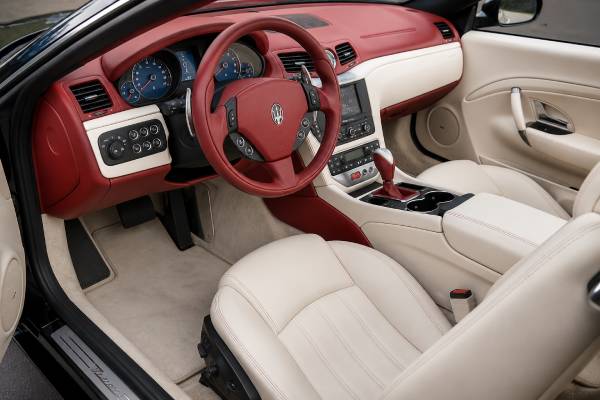
Maserati assembled the M145 in Modena. The body was painted and trimmed with a high degree of customer choice, so two apparently similar cars can differ greatly in leather color, stitching, wood or lacquer trim, audio equipment, wheel finish, and convenience options. Poltrona Frau leather was a major cabin feature, often paired with contrast piping or stitching and an embroidered Trident on the head restraints.
Common factory equipment and options included:
- Skyhook adaptive suspension, depending on market specification.
- Heated and electrically adjustable front seats with driver memory.
- Front and rear parking sensors.
- Bose audio and navigation equipment.
- Different 20-inch wheel designs and brake-caliper colors.
- Wood, piano-black, or carbon-look cabin trim.
- Wind deflector for reduced turbulence when driving with two occupants.
- Multiple fabric-roof colors coordinated with exterior paint and leather.
Regional naming creates confusion. In Europe and many other markets, this is the GranCabrio. In the United States and Canada, the equivalent model was sold as the GranTurismo Convertible. Horsepower may be listed as 433 hp in SAE net terms or 440 CV in metric horsepower, even though the cars refer to the same basic output level. Buyers should not assume a discrepancy automatically means an engine change.
The early car also overlaps in registration date with later developments. A vehicle first registered in 2011 may be either the original 440 hp version or a later Sport, depending on production date and market. The engine label, VIN decoding, build record, brake and suspension equipment, front-end design, and original paperwork should all agree.
Authenticity matters most on unusually low-mileage or highly specified cars. Replacement wheels, updated infotainment, exhaust modifications, or suspension changes can make a driver-quality example more usable, but a collector should demand the original parts and reversible installation. Poorly integrated electronics are a particular concern because aftermarket modules can introduce battery drain, warning lights, and interference with the factory audio or roof systems.
Pininfarina Form and Open-Top Engineering
The GranCabrio’s defining feature is not simply that the roof folds; it is that the convertible retains the GranTurismo’s long, low shape while providing four real seating positions. Pininfarina achieved this with a short front overhang, a long hood, a rising shoulder line, and a fabric top that follows the coupe-like arc of the roof when raised.
The steel-and-aluminum roof frame carries a multilayer fabric covering and a heated glass rear window. It stows beneath a hard cover rather than remaining visible behind the cabin. The mechanism was designed to preserve luggage space better than a bulky folding hardtop, though the trunk is still modest. Roof operation should be smooth, coordinated, and free of hesitations. Both windows should drop and rise correctly during the cycle, the header should latch without impact, and the rear cover should sit flush.
Removing a fixed roof forces engineers to manage torsional stiffness through the floor, sills, bulkheads, and underbody. Maserati added structural reinforcement and used aluminum for selected moving panels to control weight. Some body movement over sharp diagonal bumps is normal for a large convertible of this era, but persistent rattling, steering-column shake, or visible movement at the windshield frame can point to worn suspension, loose braces, poor accident repair, or a body that has been repeatedly stressed on rough roads.
The cabin reflects a pre-touchscreen view of luxury. Physical switches control climate, roof, transmission modes, and many comfort functions. The analog instruments are clear, and the traditional Maserati clock gives the dashboard a distinct identity. The center navigation system now looks dated, but its age is less troublesome than the fragile soft-touch coatings and leather shrinkage that can affect neglected cars.
Packaging is unusually generous for the body style. Rear passengers have meaningful legroom, individual seat forms, and a relatively low beltline. Access still requires tilting the long front seats, and adults will not mistake the rear for a sedan, but the car can genuinely take four people to dinner or cover a weekend trip. With the wind deflector fitted, the rear seats become unavailable but front-cabin turbulence falls substantially.
The exhaust is part of the design experience. In normal mode the V8 remains subdued enough for highway travel. Sport mode opens the character, bringing more volume and sharper response without the constant drone associated with some aftermarket systems. An original exhaust in good condition is valuable. Modified cars should be checked for poor welding, valve faults, warning lights, excessive resonance, and missing factory components.
Compared with later GranCabrio Sport and MC versions, the original car has a cleaner nose, less overt aero treatment, and a more formal grand-touring stance. That restraint has aged well. It also means cosmetic repairs must be judged carefully: panel gaps, metallic-paint match, headlamp condition, grille alignment, and the fit of the long doors reveal whether work was completed to an appropriate standard.
How the Original GranCabrio Drives
The 440 hp GranCabrio feels best as a fast, flowing road car. It is not as sharp as the later MC, but its smoother ride, hydraulic steering, and progressive V8 make it unusually satisfying on long routes where speed, sound, and comfort matter more than lap times.
At low speeds, the car feels wide and substantial. The long doors need space, rear visibility with the roof raised is limited, and the nose is difficult to judge in tight parking areas. Parking sensors are therefore important, and their operation should be tested. Steering effort is moderate, with more natural build-up than many later electric systems. The turning circle and overall length demand patience in city use.
The engine is docile around town. It accepts light throttle without surging and works well with the torque-converter transmission. The soundtrack remains distant until the driver asks for more. Once the tachometer passes the middle of its range, the V8 becomes urgent and increasingly vocal, pulling strongly to 7,000 rpm. The response is immediate because there are no turbochargers to build boost.
The gearbox is smooth in automatic mode and more engaging through the paddles. Manual commands are not instantaneous, so the driver learns to request a downshift before turn-in rather than at the last moment. Sport mode is useful on winding roads because it holds gears and keeps the engine ready. A healthy transmission should not bang into drive, flare between ratios, or hesitate repeatedly when hot.
Ride quality is one of the early model’s strengths. The long wheelbase filters broad undulations, while the suspension retains enough control to prevent floating. Sharp impacts still reach the structure through the low-profile 20-inch tires. Skyhook-equipped cars should show a clear but not extreme difference between normal and sport settings. A car that crashes over small bumps likely has old tires, worn dampers, damaged wheels, or tired suspension joints.
Cornering balance is stable and predictable. The front end responds accurately rather than instantly, and the car prefers smooth steering inputs. Mid-corner bumps reveal its mass, but the rear-biased layout helps it rotate progressively under power. Hydraulic assistance provides useful information through the rim, particularly compared with many newer grand tourers.
The brakes are strong enough for fast road driving, though repeated hard stops in a heavy convertible generate heat. A test drive should include gentle and firm braking from different speeds. The car should remain straight, the pedal should stay consistent, and no vibration should appear. Owners planning mountain use should prioritize fresh high-temperature brake fluid, quality pads, correct tire pressures, and enough cooling time.
Age-Related Faults and Service Needs
Reliability depends less on the odometer than on continuous care, correct battery voltage, and prompt repair of small faults. A low-mileage GranCabrio that has sat unused can require more work than a regularly driven car with double the distance.
The V8 itself is generally durable when serviced correctly, but surrounding systems deserve close inspection. Oil leaks can develop around cam covers, front covers, seals, and ancillary connections. A light mist is different from oil reaching the exhaust or undertray. Cold-start rattle, persistent ticking, smoke, low oil pressure warnings, or metallic debris in service records demand specialist diagnosis.
Cooling-system condition is critical. Check the expansion tank, hoses, radiator faces, thermostat behavior, fans, and water-pump area. The temperature should stabilize and remain steady in traffic with the air conditioning operating. Coolant smell after a drive, dried residue, fan warnings, or fluctuating temperature can signal leaks or control problems. Old coolant and blocked radiator fins increase risk even if the gauge appears normal during a short test.
The six-speed ZF automatic benefits from fluid and filter service even where early schedules treated the unit as filled for life. Fresh fluid cannot repair internal wear, but sensible preventive servicing reduces heat and contamination. Inspect the transmission pan, cooler lines, mounts, and driveline joints. Clunks when taking up drive may come from mounts, differential bushings, prop-shaft components, or excessive driveline play rather than the gearbox itself.
Common ownership concerns include:
- Weak batteries causing multiple unrelated warning messages.
- Sticky interior buttons and deteriorating soft-touch finishes.
- Window indexing faults that interfere with roof sealing.
- Roof microswitch, hydraulic, latch, or position-sensor problems.
- Worn front control-arm bushings and ball joints.
- Leaking or tired Skyhook dampers.
- Cracked wheels or inner-rim bends from potholes.
- Parking-sensor and tire-pressure-monitoring faults.
- Leather shrinkage on the dashboard or rear trim in hot climates.
- Failing audio, navigation, Bluetooth, or display components.
Battery care deserves special emphasis. The car contains numerous control modules, and low voltage can produce roof, transmission, suspension, airbag, and stability warnings that disappear after proper diagnosis and charging. A quality maintainer is sensible when the car is stored, but repeated battery failure may indicate an aging battery, incorrect battery type, poor charging, or parasitic draw.
The roof should be exercised regularly in suitable conditions. Dirt in drains and seals can lead to water entry. Inspect carpets, the trunk, rear trim, and the area around roof storage for moisture or staining. Water damage to control modules can be far more costly than replacing a seal. Never accept a seller’s claim that a nonworking roof merely needs calibration without a documented diagnosis.
Suspension wear changes the entire personality of the car. Listen for knocks at low speed, feel for shimmy, and inspect tire wear across the full tread. Replacement should use quality parts and be followed by a specialist alignment. Mixing worn and new components can leave the car pulling or tramlining even after substantial expense.
Annual servicing is wise regardless of mileage. Engine oil, brake fluid, filters, coolant age, accessory belts, spark plugs, transmission fluid, differential oil, and air-conditioning performance should be evaluated by time as well as distance. Service intervals vary by market and build specification, so the official schedule for the VIN remains the controlling document.
Buying a 440 hp GranCabrio Wisely
Buy the best documented car, not the lowest-mileage or lowest-priced example. A thorough pre-purchase inspection by a Maserati specialist is essential because one roof, suspension, cooling, or electrical repair can erase the apparent saving of a bargain car.
Begin with identity. Confirm that the VIN and build data describe the 440 hp version, especially on 2011 registrations that may overlap with later trims. Compare paint codes, interior codes, wheel style, brake equipment, and option records with the car. Verify that the title history, mileage progression, and service invoices tell one consistent story.
Inspect the body in strong daylight. Look for paint mismatch across the long rear quarters, overspray around seals, uneven door gaps, disturbed fasteners, cracked undertrays, and damage beneath the front bumper. The long doors should stay open without dropping, latch cleanly, and align with the rear quarter. Check the roof fabric for abrasion, shrinking, stains, damaged seams, and a cloudy or delaminating rear window surround.
A sensible inspection sequence is:
- Start the engine from cold and watch for smoke, warning lights, rattle, or unstable idle.
- Test every roof cycle, window, seat, parking sensor, climate function, and infotainment control.
- Scan all modules, not only the engine computer, and record stored or pending faults.
- Inspect the underside for leaks, corrosion, impact damage, and missing fasteners.
- Measure tire age and tread, then check wheels for bends and repairs.
- Evaluate brake-disc thickness, pad life, fluid condition, and caliper operation.
- Drive until fully warm and repeat transmission, roof, and electrical checks.
- Review invoices for time-based maintenance rather than relying on stamped books alone.
During the road test, the car should track straight on a flat road, steer smoothly through center, and remain quiet over small bumps. Accelerate at light and heavy throttle, use every transmission mode, and check for delayed engagement after a hot restart. Brake repeatedly with increasing pressure. Any vibration, warning, odor, or change in pedal feel needs explanation before purchase.
Budgeting should assume immediate baseline work unless recent invoices prove otherwise. Even a good car may need fluids, filters, a battery, tires, alignment, and small electrical repairs. Keep a separate reserve for unexpected faults rather than spending the entire budget on the purchase. Ownership is much more enjoyable when a roof sensor or leaking damper does not become a financial crisis.
Modifications require judgment. A high-quality, reversible exhaust or modern infotainment integration may improve use, but lowered suspension, oversized wheels, poorly routed wiring, aggressive engine tuning, and removed exhaust valves can reduce comfort and reliability. Original parts add value and make future restoration easier.
The best 440 hp GranCabrio is not necessarily a collector-perfect garage queen. A regularly driven example with clear annual maintenance, an intact roof, smooth gearbox, dry engine, fresh tires, and honest cosmetics can be the more dependable choice. Its value lies in use: long journeys, open-air V8 sound, and the rare ability to share the experience with three passengers.
Choose the early car over a Sport or MC when you prefer a more elegant appearance, softer road manners, and lower-pressure grand touring. Choose a later version when maximum acceleration, sharper suspension, and more aggressive styling matter more. Whichever trim fits, condition and history remain more important than badge hierarchy.
References
- A Maserati GranCabrio for Fernando Alonso 2010
- Geneva Motor Show 2010 – Worldwide debut for the Maserati Quattroporte Sport GT S “Awards Edition” 2010
- Maserati Guides & Documentation for your vehicle 2026 (Owner Documentation)
Disclaimer
This article is for informational purposes and is not a substitute for professional diagnosis, inspection, or repair. Specifications, torque values, service intervals, and procedures can vary by VIN, market, production date, and equipment; verify all work against the official service documentation for the specific vehicle.
Please share this guide on Facebook, X/Twitter, or your preferred enthusiast community if it helped your research and you would like to support our work.