
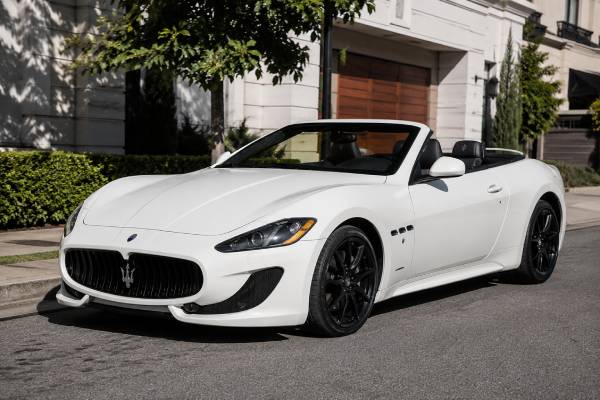
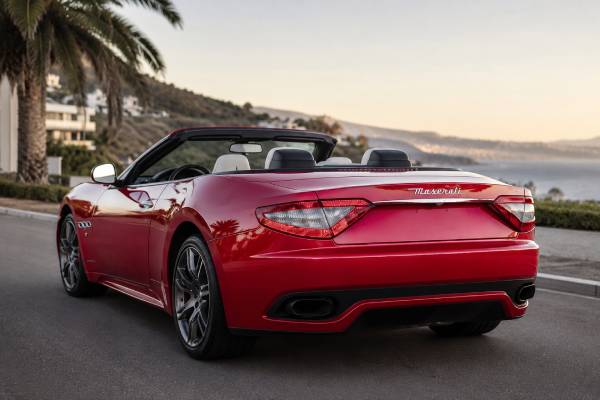
The 460 hp Maserati GranCabrio Sport is the most broadly usable high-performance version of the M145 convertible. It adds the final, stronger tune of Maserati’s naturally aspirated 4.7-liter V8, sharper transmission programming, adaptive Sport Skyhook damping, firmer chassis calibration, and more assertive styling without adopting the full aerodynamic body and fixed-rate suspension of the GranCabrio MC. For buyers who want the sound and response of the late V8 cars but still plan to tour, carry passengers, and drive on ordinary roads, the Sport often represents the range’s best balance.
The 2012–2019 period includes early 460 hp cars, numerous market-specific options, limited editions, and the substantial Model Year 2018 visual and infotainment update. Registration dates can also extend beyond the final build period, so a year in an advertisement does not define the exact specification. The VIN, factory build data, and physical equipment must agree. This article covers the M145B 460 hp Sport rather than the earlier 450 hp Sport, the standard GranCabrio, or the longer-bodied MC. It explains the technical details, production changes, road character, known ownership risks, and the inspection steps that matter before purchase.
Table of Contents
- The Sweet Spot of the M145 Range
- Late Sport Powertrain and Chassis
- Early Cars, MY18 Update, and Options
- Sport Details Without the MC Extremes
- Road Manners, Sound, and Speed
- Age-Related Faults and Service Needs
- Choosing a Healthy GranCabrio Sport
The Sweet Spot of the M145 Range
The 460 hp GranCabrio Sport combines most of the MC’s engine performance with a more adaptable suspension and less extreme bodywork. That makes it the logical M145 for drivers who value both dynamic response and long-distance comfort.
Maserati introduced the GranCabrio as the open version of the Pininfarina-designed GranTurismo. Its central promise was unusual: a dramatic Italian convertible that could seat four adults rather than two adults and two emergency passengers. The long 2,942 mm wheelbase, reinforced structure, multilayer fabric roof, and full-size rear seats made that possible, although the engineering also produced a car weighing close to two tonnes.
The first Sport used a 450 hp version of the 4.7-liter V8. The later M145B specification raised output to 460 hp and torque to 520 N·m, matching the GranCabrio MC’s basic engine figures. The two cars remained distinct. The Sport retained electronically controlled Skyhook dampers and a body closer to the standard GranCabrio, while the MC used more extensive aerodynamic changes, a longer nose-and-tail treatment, and a more focused fixed-rate suspension arrangement.
That separation shapes the ownership experience. The Sport is supple enough for motorway travel, urban surfaces, and mixed-road touring when its tires and dampers are healthy. It still tightens its responses in Sport mode, opens the exhaust under the proper conditions, and lets the engine reach its 7,000 rpm power peak. The driver receives a more energetic car than the standard 450 hp model without giving up the adaptability that matters on public roads.
The model also represents the final period of Maserati’s naturally aspirated V8 grand tourers. The engine was assembled by Ferrari in Maranello and is remembered for its progressive throttle response, high-rev power delivery, and complex exhaust note. Later turbocharged and electric GranCabrios are substantially quicker, yet their performance arrives in a different way. The M145 Sport asks the driver to use revs, plan shifts, and enjoy the rise in sound rather than rely on immediate boost.
Interest today spans several buyer types. Some want a usable modern classic, some prioritize the V8 soundtrack, and others seek one of the last Pininfarina-era Maseratis. The best cars serve all three groups. Poor examples can be deceptively cheap because the purchase price has fallen faster than the cost of brakes, dampers, roof parts, trim, diagnostic work, and specialist labor.
Late Sport Powertrain and Chassis
The defining hardware is a 4,691 cc naturally aspirated V8 rated at 460 hp and 520 N·m, connected to a six-speed ZF automatic and rear-wheel drive. The Sport’s performance figures are close to the MC’s, but its adaptive suspension gives it a wider comfort range.
| Item | Specification |
|---|---|
| Engine type | 90-degree naturally aspirated V8 |
| Displacement | 4,691 cc |
| Construction | Aluminum block and cylinder heads |
| Maximum output | 460 hp at 7,000 rpm |
| Maximum torque | 520 N·m at 4,750 rpm |
| Transmission | Six-speed MC Auto Shift automatic |
| Drive | Rear-wheel drive with limited-slip differential |
| 0–100 km/h | About 5.0 seconds |
| Top speed | Approximately 285–288 km/h, by market |
The automatic is mounted directly behind the engine rather than at the rear axle. A torque converter enables smooth creeping and relaxed shifts, which suits a convertible expected to operate in traffic. MC Auto Shift software provides more assertive shift logic in Sport mode and allows manual paddle control, but the gearbox is not a dual-clutch unit. It feels deliberate rather than instantaneous by current standards.
| Item | Specification |
|---|---|
| Body structure | Reinforced steel unitary convertible |
| Front suspension | Double wishbones |
| Rear suspension | Multi-link |
| Dampers | Sport Skyhook electronic adaptive damping |
| Steering | Hydraulic power-assisted rack and pinion |
| Brakes | Ventilated Brembo discs; multi-piston calipers |
| Wheel size | 20 inches |
| Typical tire sizes | 245/35 ZR20 front; 285/35 ZR20 rear |
| Wheelbase | 2,942 mm |
| Length | About 4,910 mm |
| Width | 1,915 mm excluding mirrors |
| Height | About 1,380 mm |
| Fuel tank | 75 liters |
| Trunk | About 173 liters |
Maserati strengthened the Sport’s rear anti-roll behavior and body response relative to the earlier standard car. The intent was not to eliminate movement but to control it more decisively. Healthy Skyhook dampers should let the body breathe over long undulations in normal use and reduce roll and pitch in the sportier setting.
Performance figures deserve context. The 0–100 km/h claim of about five seconds assumes a healthy engine, correct tires, favorable surface, and proper launch. The more meaningful test for a used car is whether it accelerates cleanly without misfire, holds stable temperatures, shifts consistently when hot, tracks straight under braking, and remains composed over a rough road.
Early Cars, MY18 Update, and Options
The largest visual and cabin change arrived for Model Year 2018, while the 460 hp engine specification remained. Buyers should decide whether they prefer the original Pininfarina-era front treatment or the later interface and sharper restyling rather than assuming the newest car is automatically best.
Earlier 460 hp Sports continued the familiar oval grille, sculpted nose, analog-centered cabin, and period infotainment layout. They can feel visually purer, and many enthusiasts prefer the original front end. Equipment was highly configurable, so leather colors, stitching, carbon-fiber trim, wheels, brake calipers, audio, and comfort features vary widely.
For MY18, Maserati simplified the GranTurismo and GranCabrio range around Sport and MC versions. The exterior received a hexagonal “sharknose” grille influenced by the Alfieri concept, revised lower air intakes, and redesigned rear bumper treatments. The changes reduced the GranCabrio’s quoted drag coefficient from 0.35 to 0.33 while keeping the basic Pininfarina body architecture.
The cabin update is more significant in daily use. An 8.4-inch Maserati Touch Control Plus system brought a higher-resolution capacitive screen, Apple CarPlay, Android Auto, and a rotary controller on the redesigned center console. Maserati also repositioned drive-mode controls, revised the dashboard clock, and fitted a Harman Kardon audio system as standard in many markets. The update makes a late car easier to live with, though it does not turn the M145 into a current-generation connected vehicle.
Common factory choices and packages include:
A car fitted with many options can be desirable, but specification quality matters more than option count. A harmonious color combination and intact materials often command stronger demand than a heavily optioned but visually difficult car. Sun-damaged leather, cloudy carbon lacquer, sticky soft-touch coatings, scratched switches, and deformed dashboard leather are expensive to correct neatly.
Modifications are common. Exhaust systems, suspension springs, wheel spacers, infotainment interfaces, cameras, and MC-style exterior parts can alter the car’s character. Favor reversible, documented work by recognized specialists. Keep original components, and inspect any modified wiring or lowered suspension carefully for secondary damage.
Sport Details Without the MC Extremes
The GranCabrio Sport looks and feels more assertive than the standard car, but it keeps the elegant proportions and road-oriented engineering that distinguish it from the MC. Its appeal lies in restraint: the car announces performance without abandoning the grand-touring brief.
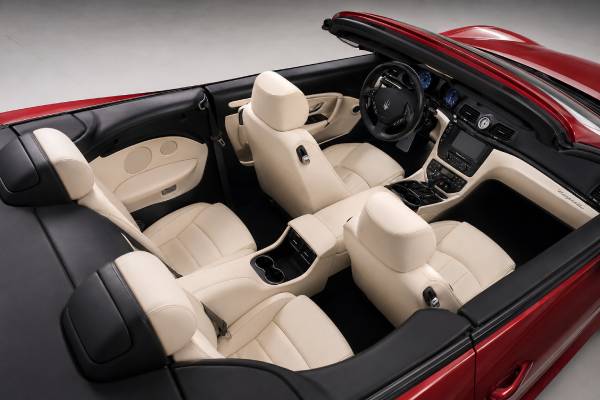
Pininfarina’s basic shape uses a long hood, short front overhang, broad rear haunches, and a low fabric roof. Removing the coupe’s steel roof required reinforcement through the sills, floor, bulkheads, and other structural paths. The resulting shell is heavy but unusually practical for an exotic convertible. Four individual seats provide adult space, and the rear seats remain usable when the roof is raised.
The Sport adds more aggressive bumpers, darkened or body-color details depending on year, larger wheels, sport seats, revised exhaust behavior, and chassis tuning. It does not receive the MC’s complete aerodynamic package or additional body length. This makes parking and replacement bodywork slightly less intimidating, although the car remains wide and low.
The multilayer soft top is a major engineering component, not decorative fabric. It must insulate the cabin, fold compactly, seal around frameless windows, and retain the roofline. The mechanism operates in about 20 seconds for the top itself, with a longer total sequence when all windows move. A correctly adjusted roof should latch without strain, align evenly on both sides, and avoid wrinkles that suggest frame or tension problems.
Aerodynamics became more visible in the MY18 update. The new grille and lower duct arrangement improved airflow management and reduced drag without radical changes to the body. The Sport rear bumper remained visually distinct from the MC version. Buyers replacing damaged panels should confirm the correct model-year components because mixing early and late parts can produce poor fit and authenticity questions.
The cockpit emphasizes tactile materials. Leather covers the seats and large dashboard areas, metal paddles sit behind the steering wheel, and the central clock provides a traditional focal point. The seating position is more upright than in a low supercar, which helps visibility forward. Rearward visibility with the roof raised is limited, making parking sensors and a properly installed camera useful.
Sound is integral to the design. The naturally aspirated V8 produces a relatively smooth low-speed note, a stronger induction voice under load, and a hard-edged exhaust tone near the upper rev range. Sport mode controls more than volume; it changes throttle, transmission, damping, and exhaust strategy. Aftermarket systems can make the car louder, but excessive drone can undermine the touring mission and may hide rattles or valve faults.
The car’s engineering choices make sense as a complete package. Hydraulic steering gives natural effort. Adaptive dampers cover varied surfaces. The automatic reduces low-speed strain. The long wheelbase improves stability and passenger room. None of these choices maximizes lap time, but together they create a convertible that can travel quickly and comfortably for hours.
Road Manners, Sound, and Speed
The 460 hp Sport is engaging because it combines progressive V8 performance with communicative steering and a stable chassis. It feels best on open, flowing roads, where its size and weight become confidence rather than obstruction.
At ordinary speeds, the engine is smooth and the automatic favors higher gears. There is enough torque for easy progress, yet the car does not leap forward with the instant force of a turbocharged modern GT. The reward comes after 4,000 rpm. Throttle response remains linear, the exhaust gains layers, and the engine pulls strongly toward 7,000 rpm.
Sport mode is central to the experience. It sharpens pedal response, changes shift strategy, firms damping, and permits a more prominent exhaust note. Manual paddle shifts are satisfying when timed with the engine’s power band. They are not as fast as current dual-clutch shifts, and the system may refuse a request that would over-rev or lug the engine. This protection is normal; inconsistent or delayed responses accompanied by faults are not.
The steering loads up naturally through bends. Initial response is not nervous, which suits the long wheelbase and wide body. Once settled, the front tires communicate grip clearly enough for road driving. The rear follows progressively, and the limited-slip differential helps deploy power. Stability control should remain active on public roads because cold tires, wet surfaces, and the V8’s upper-rev delivery can still overwhelm rear grip.
Ride quality is a useful condition test. A good Sport feels firm but rounded in normal mode, then more controlled in Sport. Harsh impacts, float, repeated bouncing, or tramlining often trace to tire age, pressures, bent wheels, alignment, worn bushings, or tired dampers. Owners sometimes blame the model when the real cause is neglected running gear.
The Brembo brakes deliver strong initial confidence, but vehicle mass creates heat. Repeated hard use accelerates pad, disc, and fluid wear. The pedal should stay firm and the car should stop without vibration or pulling. A road test should include gentle stops, a few firm controlled stops, and checks after the brakes warm.
Roof-down airflow is manageable in the front seats, especially with a wind deflector installed when only two occupants travel. The rear seats receive more turbulence. On the highway with the top raised, the cabin should be refined enough for conversation. Whistling around one window, water marks, or a headliner that moves excessively points to adjustment or seal issues.
City driving exposes the compromises: wide mirrors, long doors, modest trunk space, poor rear visibility, and expensive wheels close to curbs. Motorway and cross-country travel reveal the strengths: settled straight-line behavior, comfortable front seats, real rear accommodation, and a large fuel tank. The Sport can serve as a usable weekend GT, but it deserves secure parking and routes that suit its dimensions.
Age-Related Faults and Service Needs
Maintenance history is more important than mileage. A low-mileage Sport can still need thousands in tires, dampers, fluids, roof work, leather repair, and electronic diagnosis if it spent years parked without disciplined care.
Engine and temperature control
Inspect the V8 from cold. It should start promptly, settle into a stable idle, and avoid persistent metallic rattles, knocks, or smoke. Check for oil seepage at covers and seals, then inspect underneath. Misfires can involve plugs, coils, injectors, intake leaks, wiring, or mechanical faults, so a stored code is only the beginning of diagnosis.
Cooling health deserves equal attention. Look for residue around the expansion tank, hose joints, radiator, pump area, and underbody. Confirm fan operation and stable temperature in traffic. Old coolant, blocked radiators, weak caps, and deteriorated hoses can create expensive consequences. Regular oil changes and time-based renewal of fluids, filters, plugs, and belts should be documented.
Automatic gearbox and driveline
Test the six-speed both cold and fully hot. Drive and reverse should engage without a long pause. Shifts should be smooth in normal use and decisive in Sport. Flare, shudder, harsh engagement, or repeated adaptation faults require specialist investigation. Inspect transmission and differential leaks, mounts, driveshaft components, and wheel bearings. Differential whine should not be accepted as inevitable.
Skyhook, brakes, wheels, and tires
Electronic dampers may lose control gradually without triggering a warning. Check for leakage, mismatched corner behavior, knocks, and excessive body movement. Control arms, ball joints, bushings, and anti-roll-bar links all work hard under a heavy car. Correct alignment is possible only after worn parts are replaced.
Measure brake discs and pads. Check caliper seals, hoses, parking-brake function, and fluid age. Inspect every wheel inside and out for bends, cracks, welds, and poor refinishing. Tire date codes matter; a ten-year-old tire with deep tread is not suitable for a 285 km/h car. Fit a matching set with proper load and speed ratings.
Roof, drains, battery, and cabin systems
Cycle the top repeatedly. Observe frame symmetry, latch operation, window indexing, trunk partition sensors, warning messages, and hydraulic or mechanical sounds. Examine seals and clear drains. Search beneath carpets and in the trunk for dampness or corrosion. Water damage can affect modules located far from the original leak.
A healthy, fully charged battery prevents many false faults. Verify the correct battery specification, charging voltage, and parasitic draw if the car goes flat. Use a maintainer during storage. Scan every module and test climate control, seats, audio, infotainment, navigation, parking aids, lights, keys, mirrors, tire-pressure monitoring, and steering-wheel switches.
Interior deterioration includes sticky coatings, lifting or shrinking leather, worn seat bolsters, cloudy carbon lacquer, failed headliners, and cracked plastics. These issues rarely stop the car, but correct restoration is labor-intensive and parts may be scarce. Model-specific body panels, trim, roof components, and modules can require long lead times, so a specialist network is a practical ownership requirement.
Choosing a Healthy GranCabrio Sport
Choose condition and documentation before color or mileage. The ideal Sport has a verified 460 hp specification, a dry and smooth drivetrain, straight structure, a fully functioning roof, fresh matching tires, measured brakes, and invoices showing consistent specialist care.
First confirm identity. The build record should state GranCabrio Sport or the equivalent GranTurismo Convertible Sport for its market. Check the engine output, model year, suspension, wheels, brakes, interior, and options. Do not assume a 460 hp car is an MC, or that MC bumpers and badges make it one. Special Edition and other limited-series claims require additional factory evidence.
A comprehensive pre-purchase inspection should include:
- Cold start and hot restart with live diagnostic data.
- Full scan of all control modules and review of stored, pending, and historical faults.
- Cooling-system inspection and pressure testing where appropriate.
- Transmission, differential, driveline, and mount evaluation.
- Brake measurements, tire dates, wheel condition, suspension play, and alignment clues.
- Repeated roof cycles, drain checks, water-intrusion inspection, and glass alignment.
- Paint-depth readings, underbody examination, and assessment of accident repairs.
- A long road test in normal and Sport settings on varied surfaces.
Early and MY18 cars appeal for different reasons. Early cars retain the original front design and can cost less. MY18 examples offer smartphone integration, a larger interface, revised controls, improved audio, and updated exterior details. Buy the version whose features matter to you, then compare cars within that group. Paying a large premium for a late registration makes little sense if the maintenance record is weaker.
Estimate catch-up work using written specialist quotations. A baseline can involve oil and filters, coolant, brake fluid, plugs, belts, battery, tires, brake hardware, dampers, control arms, wheel repair, roof adjustment, and cosmetic restoration. The total varies too much for a single reliable number. The key is to identify it before purchase rather than after delivery.
Avoid cars with unexplained warning lights, overheated history, wet carpets, inconsistent mileage, improvised wiring, repeated battery failure, structural repairs of uncertain quality, or a seller who will not permit a cold start and independent inspection. A loud exhaust and spotless paint cannot compensate for a weak mechanical foundation.
A modestly used car can be better than a museum piece. Regular exercise warms fluids, cycles the roof, keeps seals active, and reveals developing faults. Look for annual servicing even during low-mileage years, quality tires changed by age, and owners who fixed small issues promptly.
When bought well, the 460 hp GranCabrio Sport offers a combination that has largely disappeared: four-seat open-air touring, hydraulic steering, a high-rev naturally aspirated V8, and styling that remains elegant without looking anonymous. It is expensive to restore from neglect but deeply rewarding to preserve from a sound starting point.
References
- Maserati GranCabrio MC international debut at the Paris International Motor Show 2012 2012
- Maserati GranTurismo model Year 2018 makes its world debut in New York 2017
- MY18 GranTurismo & GranCabrio star at Goodwood Festival 2017
- Maserati Guides & Documentation for your vehicle 2026
Disclaimer
This article is for informational purposes and is not a substitute for professional diagnosis, repair, or inspection. Specifications, torque values, service intervals, equipment, and procedures vary by VIN, market, and production date. Verify all information against official service documentation for the specific vehicle. Please share this guide on Facebook, X/Twitter, or another enthusiast community if it helped you; sharing supports our work.