
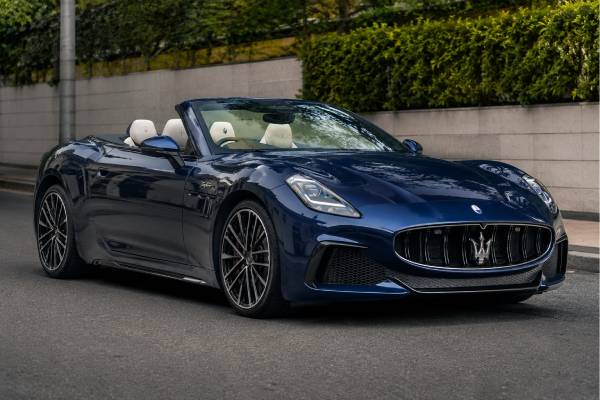
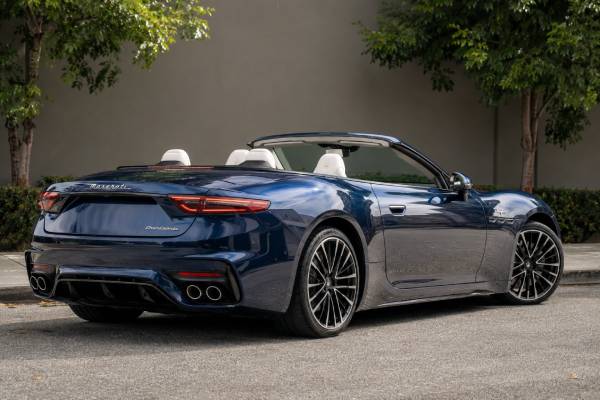
The 2024–2026 Maserati GranCabrio Trofeo is the launch version of the modern M189 convertible and the first open four-seat Maserati to use the twin-turbo Nettuno V6. With 550 hp, 650 N·m, all-wheel drive, an eight-speed automatic, air suspension, and a claimed 0–100 km/h time of 3.6 seconds, it is dramatically faster and more technically complex than the previous V8 GranCabrio. Yet Maserati kept the model’s core purpose intact: a fabric-roof grand tourer with genuine rear seats, long-distance comfort, and enough luggage space for carefully packed trips.
This article covers the original 550 hp Trofeo sold during the 2024–2026 period, not the later 590 hp update. The distinction is important because current model pages may show revised power, styling, equipment, and drive-mode details. Specifications also vary by market and measurement standard. Buyers should verify the VIN, build date, software level, warranty status, and factory option list rather than relying on a current configurator. The guide below explains the launch car’s engineering, performance, roof and cabin technology, early ownership concerns, and the practical checks that matter when purchasing one used or from remaining dealer stock.
Table of Contents
- A New Generation of Open Grand Touring
- 550 hp Nettuno and M189 Specifications
- Launch Years, Trims, and Personalization
- Lightweight Platform, Roof, and Digital Cabin
- Trofeo Performance on Real Roads
- Warranty, Software, and Service Reality
- Buying the Original 550 hp Trofeo
A New Generation of Open Grand Touring
The M189 Trofeo replaces the old V8 GranCabrio with a quicker, lighter, all-wheel-drive grand tourer built around modern electronics and aluminum-intensive construction. It preserves four-seat open-air travel but changes almost every mechanical ingredient.
Maserati launched the new GranCabrio in 2024 as the convertible counterpart to the GranTurismo. The first combustion model was the Trofeo, powered by the 3.0-liter twin-turbo Nettuno V6. It arrived alongside the battery-electric Folgore rather than as the only powertrain, showing that the platform was engineered from the start to support different propulsion systems.
Compared with the M145, the change in character is substantial. The previous car relied on a naturally aspirated 4.7-liter V8, rear-wheel drive, hydraulic steering, and a six-speed automatic. The new Trofeo uses turbocharging, electronically controlled all-wheel drive, electric power steering, an eight-speed transmission, air springs, adaptive dampers, active drive modes, launch control, and a much more extensive driver-assistance and infotainment network.
Performance improves dramatically. The launch Trofeo reaches 100 km/h in a claimed 3.6 seconds and continues to 316 km/h. Those numbers place it in serious high-performance territory, but the car remains a grand tourer rather than a stripped supercar. It has a quiet roof-up cabin, compliant suspension settings, a useful rear seat, and numerous comfort features.
The 550 hp specification also marks a defined chapter. Maserati later announced an updated GranCabrio Trofeo with 590 hp and revised exterior and interior details. A 2024–2026 car should therefore be described and valued according to its actual build specification, not retroactively assigned the later output. Software updates may improve operation, but they do not automatically convert the original model into the revised version.
The Trofeo’s appeal today is strongest for drivers who want a modern open GT with combustion-engine sound and very high speed, but who do not need the nostalgia of the old V8. It offers greater traction, safety technology, and daily usability, while demanding more disciplined management of software, warranty coverage, tires, brakes, and electronic systems.
550 hp Nettuno and M189 Specifications
The launch Trofeo uses a 2,992 cc twin-turbo V6 producing 550 hp and 650 N·m, driving all four wheels through an eight-speed automatic. Its official European figures include 3.6 seconds to 100 km/h, 316 km/h maximum speed, and a homologated weight of 1,895 kg.
| Item | Specification |
|---|---|
| Engine | Nettuno 90-degree twin-turbo V6 |
| Displacement | 2,992 cc |
| Maximum output | 550 hp |
| Maximum torque | 650 N·m |
| Transmission | Eight-speed automatic |
| Drivetrain | Electronically controlled all-wheel drive |
| 0–100 km/h | 3.6 seconds |
| Top speed | 316 km/h |
| 100–0 km/h braking | Less than 37 m under official test conditions |
| Combined consumption | About 10.4–10.5 L/100 km in EU data |
Nettuno technology uses a pre-chamber combustion concept derived from high-performance practice. A small combustion chamber above the main chamber helps initiate a rapid, controlled burn under suitable conditions, while a conventional spark arrangement supports operation across the full range. Twin turbochargers provide the low- and mid-range torque that the old naturally aspirated V8 lacked.
The engine’s 90-degree layout is compact in height and integrates with an all-wheel-drive system designed to favor rear-driven behavior. Front-axle assistance can be added when traction and stability require it. This gives the Trofeo strong launch performance and useful wet-weather security without making it feel like a nose-led sedan.
| Item | Specification |
|---|---|
| Body | Four-seat fabric-roof convertible |
| Structure | Multi-material architecture with extensive aluminum use |
| Suspension | Double-wishbone front; multi-link rear; air springs and adaptive damping |
| Steering | Electric power-assisted rack and pinion |
| Brakes | Large ventilated Brembo discs with multi-piston calipers |
| Wheels | Staggered 20-inch front and 21-inch rear configuration |
| Length | 4,966 mm |
| Width with mirrors | 2,113 mm |
| Height | 1,365 mm |
| Wheelbase | 2,929 mm |
| Fuel tank | 70 liters |
| Trunk capacity | 172 liters roof up; 131 liters roof stored |
| EU homologated weight | 1,895 kg |
Drive modes include Comfort, GT, Sport, and Corsa in launch-era literature, with Corsa delivering the sharpest throttle, transmission, damping, exhaust, and stability settings. Launch control is intended for controlled conditions and places high load on tires, driveline components, and brakes. It should not be used merely to demonstrate that a used car can activate the feature.
Launch Years, Trims, and Personalization
The 550 hp Trofeo is the original combustion flagship of the M189 GranCabrio. Correct identification depends on build records because the range expanded quickly, markets used different horsepower conventions, and the later 590 hp car can appear similar in casual listings.
The launch model’s defining combination is:
- M189 GranCabrio body with four seats and power fabric roof.
- 2,992 cc Nettuno twin-turbo V6 rated at 550 metric horsepower in most official global data.
- Eight-speed automatic and all-wheel drive.
- Trofeo-specific wheels, dark exterior accents, carbon-fiber details, and performance calibration.
- Four drive modes including Corsa and launch-control capability.
- Air suspension, adaptive damping, large Brembo brakes, and staggered wheel sizes.
North American material may list 542 hp because SAE net horsepower and metric horsepower are not identical. That does not describe a weaker engine. Always compare measurement standards before assuming that two markets received different calibrations.
The 2024 introduction emphasized Trofeo and Folgore. The less powerful 490 hp combustion GranCabrio joined later. This means an early car advertised simply as “GranCabrio” may still be a Trofeo, while later range descriptions require closer attention to trim and output.
Maserati offered extensive personalization through the normal catalog and Fuoriserie program. Exterior paint, roof color, brake calipers, wheel finish, leather, stitching, carbon-fiber trim, and decorative patterns can differ substantially. Five fabric-roof colors were promoted at launch, allowing the roof to function as part of the design rather than a default black cover.
Common or notable equipment includes:
- Full LED lighting and a modern vertical headlamp signature.
- 12.2-inch digital instrument display and head-up display availability.
- 12.3-inch central Maserati Intelligent Assistant touchscreen.
- Lower comfort display for climate and seat functions.
- Wireless smartphone integration and charging.
- Sonus faber audio, with a higher-output 16-speaker option.
- Three-level front neck warmers.
- Optional wind stopper for two-person roof-down travel.
- Advanced driver-assistance systems capable of Level 2 support functions.
- Carbon-fiber interior and exterior accents.
Option value depends on use. A wind stopper and neck warmers materially extend the open-roof season. High-end audio matters more with the roof raised than lowered. Carbon trim can strengthen the Trofeo identity, while unusual Fuoriserie colors may either add desirability or limit the resale audience.
The later 590 hp Trofeo should be treated as a separate specification. Revised front aero, wheels, interior controls, power output, and software features distinguish it. A dealer advertisement that calls an original 550 hp car “590 hp” because the current website shows the newer model is inaccurate unless documented factory work and homologation prove otherwise.
Lightweight Platform, Roof, and Digital Cabin
The M189’s major engineering achievement is integrating a fast power roof, four seats, all-wheel drive, and supercar-level performance into a structure lighter than the old GranCabrio. The result is still substantial, but it uses its mass more efficiently.
The architecture shares its basic form with the GranTurismo and relies heavily on aluminum. Maserati designed the coupe and convertible in parallel, allowing roof-removal requirements to be considered from the start rather than added after the coupe was complete. Reinforcement remains necessary, but the shell can maintain stiffness without the weight penalty typical of an older steel conversion.
The fabric roof opens or closes in about 14 seconds and can operate at speeds up to 50 km/h. Controls are integrated into the central display rather than relying solely on a large physical switch. The compact folded roof preserves a useful 131-liter trunk in the open position, increasing to 172 liters when the roof is raised. Soft luggage remains the practical choice.
A roof this complex depends on synchronized motors or actuators, latches, position sensors, side-window indexing, seals, software, and battery voltage. It should move evenly, complete every cycle without hesitation, and show no warning after operation. Inspect the fabric for abrasion, tension differences, stains, and fold marks, then check the headliner and all sealing surfaces.
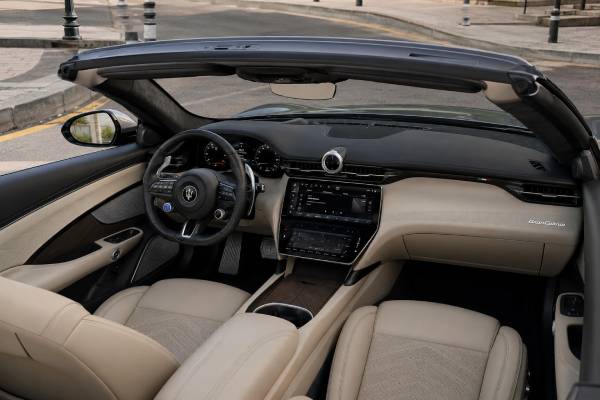
The cabin moves Maserati into a screen-led era. A 12.2-inch digital cluster handles primary driving information, the 12.3-inch central display manages navigation and infotainment, and a lower touchscreen controls climate and comfort functions. The arrangement provides flexibility but makes software responsiveness and display condition important used-car checks.
Physical elements prevent the cabin from feeling entirely digital. The steering wheel carries drive-mode controls, metal paddles remain within reach, the dashboard includes Maserati’s digital clock, and leather, carbon fiber, stitching, and patterned surfaces provide texture. The front seats include neck warmers that blow heated air toward occupants’ shoulders and necks, improving roof-down comfort in cool weather.
The rear seats are genuine but depend on front-seat position. Adults can travel for shorter distances, while children or smaller passengers will find them more comfortable. Access requires moving the long front seats, so verify seat motors, memory, and easy-entry functions. The roof-up rear headroom is reasonable for the body style but not sedan-like.
Exterior design avoids the old car’s oval headlamps and sweeping Pininfarina details. The M189 uses vertical lamps, a low grille, three side vents, broad rear haunches, and a short rear deck. The Trofeo adds darker and more technical details, while the fabric roof retains the classic convertible profile.
Aerodynamic engineering must work in two configurations. With the top down, airflow around the windshield, cabin, rear seats, and deck affects noise and stability. The optional wind stopper reduces turbulence for two occupants. It blocks the rear seats when installed, so buyers who regularly carry four people should consider how often they will actually use it.
Trofeo Performance on Real Roads
The 550 hp Trofeo feels extremely quick because turbo torque, all-wheel-drive traction, and close eight-speed gearing deliver speed without waiting for high revs. It remains comfortable in GT mode, but Sport and Corsa reveal a much more urgent car.
At low speed, the transmission shifts smoothly and the air suspension can isolate ordinary road texture. The V6 does not reproduce the old 4.7-liter V8’s gradual crescendo, yet it responds strongly from the mid-range and produces a purposeful exhaust note. Turbocharging makes overtaking effortless, and the extra ratios keep the engine near its useful torque band.
GT mode is the natural default for long travel. It balances throttle response, shift strategy, damping, exhaust, and stability systems. Comfort mode softens the presentation further for poor surfaces or relaxed urban use. Sport increases response and body control, while Corsa prioritizes performance and allows more assertive interventions.
Launch control combines engine torque management, transmission logic, and all-wheel-drive traction to achieve the 3.6-second claim. The event is violent by grand-touring standards. Tires must be warm, pressures correct, and the road legal and clear. Frequent use accelerates wear and should be considered when inspecting a used car that has spent time at drag events or media experiences.
Electric steering is precise and quick, though it filters more texture than the old hydraulic M145 rack. The front axle responds cleanly, and all-wheel drive helps pull the car out of bends. The underlying balance remains rear-oriented, but the driver should not assume that electronics defeat physics. At nearly 1,900 kg, the car carries serious energy into braking zones and tight corners.
Air springs and adaptive dampers give the Trofeo a broad range. In softer settings it can cross broken pavement without the brittle behavior of a fixed sports suspension. In Corsa, roll and pitch are reduced. A damaged tire, bent 21-inch rear wheel, or incorrect alignment can still make the car tramline or vibrate, so ride behavior is an important inspection tool.
The Brembo system is powerful and the official stopping distance is under 37 meters from 100 km/h. Pedal feel should be consistent, with no vibration or pull. Repeated hard stops generate substantial heat, and replacement rotors, pads, and tires are expensive. Carbon-ceramic brakes were not the default defining feature in the launch data, so verify the actual car rather than assuming from caliper appearance.
Roof-down driving changes the sensory balance. The exhaust is more audible, the neck warmers extend usability, and the windshield manages airflow well for front occupants. With the wind stopper in place, the cabin can remain calm at touring speeds, but rear seats become unavailable. Without it, rear passengers experience far more turbulence.
The car’s width—more than 2.1 meters with mirrors—demands care in city lanes, garages, and mountain roads. Cameras and sensors help, but expensive wheels and low bodywork remain exposed. The Trofeo is most convincing on wide, flowing roads and motorways where its stability, acceleration, and open-air comfort can work together.
Warranty, Software, and Service Reality
The M189 is too new for a mature long-term reliability record, so ownership decisions should focus on warranty coverage, software status, campaign completion, tire and brake condition, battery health, roof operation, and evidence of correct dealer servicing.
Software and control modules
The Trofeo relies on networked controllers for engine management, transmission, all-wheel drive, suspension, driver assistance, infotainment, roof operation, climate control, and body functions. A warning that disappears after restart can still leave useful fault history. A pre-purchase scan should cover every module and record software versions, stored faults, and incomplete programming.
Early-production vehicles often receive updates to improve calibration or correct edge cases. Confirm that dealer campaigns and rapid updates have been completed by VIN. Do not accept a promise that “all modern cars show warnings” without a diagnostic report. Repeated communication faults, blank displays, camera errors, or driver-assistance unavailability require investigation.
12-volt battery and storage
A weak 12-volt battery can create cascading alerts or prevent roof and convenience functions from completing properly. Check battery test results, charging behavior, storage history, and whether the correct maintainer was used. Cars kept in showrooms or collections may have experienced repeated low-voltage events even with minimal mileage.
Engine, cooling, and driveline
Inspect the Nettuno for oil or coolant residue, damaged undertrays, loose clamps, and signs of overheating. A cold start should be clean and stable. During the road test, check boost delivery, transmission shifts, all-wheel-drive operation, and hot restart. Any misfire, reduced-power message, abnormal turbo noise, or coolant loss needs dealer-level diagnosis.
Service intervals must follow the official schedule for the market and use approved fluids and parts. Time matters even on a low-mileage car. Warranty claims can be complicated by missed annual service, unapproved tuning, aftermarket intake or exhaust work, or poor documentation.
Air suspension, wheels, brakes, and tires
The car should sit level after storage and change ride height or damping modes without warnings. Listen for compressor overactivity and inspect air lines, struts, links, and sensors. Check all four wheels for impact damage. The 20/21-inch setup uses expensive performance tires, and all four rolling circumferences must remain compatible with the all-wheel-drive system.
Measure brake wear and inspect calipers, hoses, fluid, and electronic parking-brake operation. A low-mileage demonstrator may have experienced harder use than its odometer suggests. Tire shoulder wear, overheated brakes, chipped wheel faces, and launch-control counters or stored data can reveal that history.
Roof, water sealing, and cabin technology
Operate the roof repeatedly, inspect the fabric and latches, test every window, and search the trunk and carpets for moisture. Verify neck warmers, seat heating and ventilation where fitted, climate display, head-up display, cameras, audio, wireless charging, phone pairing, digital key or app functions, and every driver-assistance feature.
Extended warranty and service plans have real value on this model. Coverage terms vary, so read exclusions, transfer rules, mileage limits, and required maintenance. A cheaper out-of-warranty car with unresolved electronics can be more expensive than a newer example with documented support.
Buying the Original 550 hp Trofeo
The best 550 hp Trofeo is a correctly identified, unmodified car with remaining warranty, current software, completed campaigns, clean diagnostic history, fresh matching tires, and a roof that works perfectly. Price should reflect the later 590 hp model’s existence without dismissing the launch car’s capability.
Confirm the specification from the VIN and original order sheet. Look for the 550 hp Nettuno rating, Trofeo trim, wheel and brake configuration, roof color, interior, carbon package, audio, driver-assistance options, and market equipment. Compare production date with first registration because a car may have sat before delivery.
Request the complete dealer service record, warranty repair history, campaign list, and all keys. Check whether subscriptions, app access, digital services, and charging or connectivity features can be transferred. For an imported car, verify navigation region, radio standards, lighting compliance, warranty validity, and parts support.
A professional inspection should include:
- Battery test and full-module diagnostic scan before faults are cleared.
- Cold start, boost and fuel-trim review, cooling-system inspection, and hot restart.
- Transmission, all-wheel-drive, differential, and drive-mode operation.
- Air-suspension height, damping response, compressor behavior, and alignment check.
- Brake measurements, tire dates and tread, wheel runout, and underbody examination.
- Multiple roof cycles, seal and drain inspection, window indexing, and moisture search.
- Testing of every display, camera, sensor, seat function, climate feature, and driver aid.
- Paint-depth readings and inspection for curb, splitter, wheel, or structural damage.
Avoid tuned cars unless the work is fully documented, reversible, and acceptable to the warranty provider. Additional boost can increase thermal and driveline loads, while software changes may prevent factory updates or complicate resale. Cosmetic changes should also be assessed for wiring quality and retained original parts.
Compare the Trofeo with the 490 hp GranCabrio and the Folgore. The 490 hp car offers nearly the same body, roof, and cabin with less aggressive performance and may suit comfort-focused owners. The Folgore is quicker from rest and quieter, but it introduces battery condition, charging, range, and substantial mass. The 550 hp Trofeo remains the choice for buyers who want the launch specification, a combustion soundtrack, and 316 km/h capability.
Budget for consumables rather than only scheduled servicing. Tires, brake components, wheel repairs, alignments, and insurance can dominate annual cost. Secure storage, a battery maintainer, and access to an authorized or deeply experienced specialist are sensible. The car’s technology rewards proactive care and thorough documentation.
Properly bought, the original 550 hp GranCabrio Trofeo delivers exactly what the launch promised: a fast, four-seat, all-season-capable convertible that can be calm in daily use and extraordinarily rapid when the road opens. Its long-term success will depend less on the headline acceleration figure than on disciplined software, warranty, and maintenance management from the first owner onward.
References
- Debut of the New Maserati GranCabrio – The Trident’s New Spyder: Iconic Design and Open-Top Elegance 2024
- New Maserati GranCabrio – Press Kit June 2024 2024
- Maserati GranCabrio Trofeo – Power and Sporty Style 2026
- Maserati Guides & Documentation for your vehicle 2026
Disclaimer
This article is for informational purposes and is not a substitute for professional diagnosis, repair, or inspection. Specifications, torque values, service intervals, software, equipment, and procedures vary by VIN, market, and production date. Verify all details against official service documentation and dealer records for the specific vehicle. Please share this guide on Facebook, X/Twitter, or another enthusiast community if it was useful; sharing supports our work.