
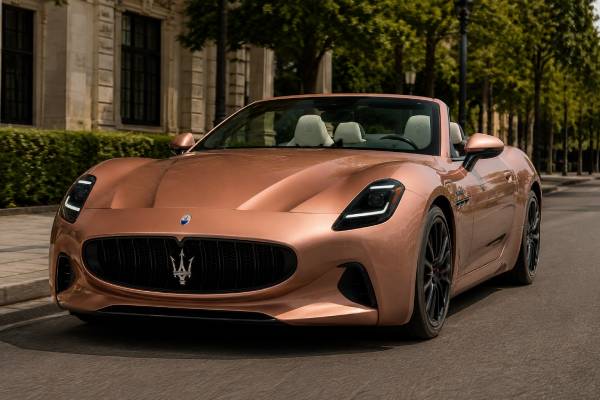
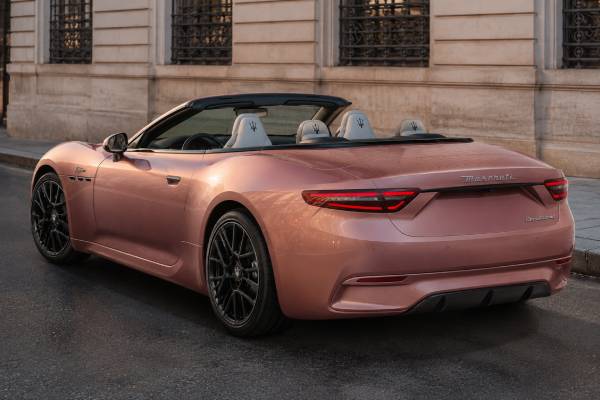
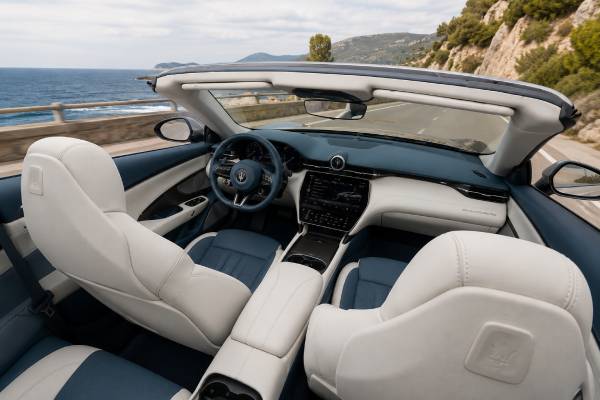
The Maserati GranCabrio Folgore is a four-seat electric convertible with three motors, an 800-volt electrical system, a 92.5 kWh gross battery, 761 hp, and a claimed 0–100 km/h time of 2.8 seconds. It is not simply an electric version of the old GranCabrio. The M189 platform was designed to support both combustion and battery power, allowing Maserati to retain the same elegant fabric-roof proportions while placing the battery in a T-shaped structure through the center tunnel and behind the cabin rather than in a conventional flat floor.
This guide covers the Folgore from its 2024 launch through the current 2026 period. Range, software features, charging offers, and equipment can vary by model year and market, and the 2026 update introduced further energy-management and design changes. The headline 761 hp figure also needs context: official material distinguishes continuous output, maximum boost, and the greater combined installed capability of the three 300 kW motors. Buyers should verify the exact VIN, software level, battery warranty, charging hardware, and market specification. The sections below explain the powertrain, packaging, road behavior, charging reality, early ownership risks, and a practical inspection process for this unusually complex open electric grand tourer.
Table of Contents
- The First Electric Maserati Convertible
- Tri-Motor System, Battery, and Charging
- Launch Specification and Model-Year Changes
- T-Bone Packaging, Roof, and Electric Design
- Acceleration, Range, and Open-Air Driving
- Battery Health, Software, and EV Maintenance
- Buying and Living with a Folgore
The First Electric Maserati Convertible
The GranCabrio Folgore is Maserati’s first fully electric production convertible and one of the first true four-seat luxury electric cabriolets. It preserves the brand’s grand-touring layout while replacing the engine, gearbox, exhaust, and fuel system with a tri-motor 800-volt powertrain.
Maserati introduced the Folgore after the combustion GranCabrio Trofeo, using the same M189 body architecture as the GranTurismo. Designing both coupe and convertible, combustion and electric versions together allowed engineers to avoid the awkward proportions that can result when a battery is added to an existing platform. The Folgore retains a low seating position, a long hood, a compact soft-top stack, and a trunk rather than adopting the tall floor common to many battery vehicles.
The basic idea remains grand touring. Four individual seats, neck warmers, a 14-second fabric roof, advanced climate control, high-end audio, and driver assistance support long-distance use. Performance is more extreme than the luxury mission suggests: 2.8 seconds to 100 km/h and a 290 km/h top speed made it the fastest production electric convertible at launch.
The Folgore also changes ownership priorities. There is no engine oil, turbocharger, exhaust valve, or eight-speed transmission to maintain. In their place are a high-voltage battery, cooling circuits, inverters, three motors, charging modules, contactors, software, and a 12-volt electrical system that must wake and coordinate the vehicle. Warranty status and diagnostic history matter as much as conventional service stamps.
Current relevance extends beyond novelty. The model demonstrates one way to build an electric performance car without turning it into an SUV or a heavy-looking coupe. Its success depends on whether owners can use the charging capability, accept range variation, and preserve a technically sophisticated car whose long-term repair costs are not yet well established.
Tri-Motor System, Battery, and Charging
The Folgore uses three permanent-magnet motors—one at the front and two at the rear—fed by an 800-volt, 92.5 kWh gross battery. Official launch specifications quote 761 hp, 1,350 N·m, 270 kW DC fast charging, and 22 kW AC charging.
| Item | Specification |
|---|---|
| Motor layout | One front motor and two independent rear motors |
| Motor type | Permanent-magnet synchronous |
| Installed motor rating | Three 300 kW units |
| Maximum quoted output | 761 hp |
| Maximum quoted torque | 1,350 N·m |
| Drive | Electric all-wheel drive with active torque distribution |
| Battery gross capacity | 92.5 kWh |
| Usable energy | Approximately 83 kWh in launch data |
| Electrical architecture | 800 volts |
| Maximum DC charging | 270 kW |
| DC 20–80 percent | About 18 minutes under ideal conditions |
| Maximum AC charging | 22 kW where infrastructure supports it |
The combined installed motor capacity exceeds the output the battery and control system deliver continuously. Maserati uses software to allocate available power according to battery state, temperature, drive mode, traction, and boost conditions. This is why adding the three motor ratings does not produce the car’s official horsepower figure.
Two rear motors allow torque to be varied side to side without a conventional differential. The system can support stability, traction, and rotation by giving each rear wheel an appropriate amount of drive. The front motor supplies additional traction and contributes to acceleration. Later updates include strategies that can disconnect or reduce front-axle participation under suitable conditions to improve efficiency.
| Item | Specification |
|---|---|
| 0–100 km/h | 2.8 seconds |
| Top speed | 290 km/h |
| Launch WLTP range | Up to about 441 km in official EU specification |
| Launch WLTP consumption | About 22.3–23.7 kWh/100 km |
| Length | 4,966 mm |
| Width with mirrors | 2,113 mm |
| Height | 1,365 mm |
| Wheelbase | 2,929 mm |
| Trunk capacity | 151 liters roof up; 114 liters roof stored |
| EU homologated weight | 2,340 kg |
Charging figures are maximums, not guarantees. A 270 kW peak requires a compatible high-power charger, low initial battery state, correct battery temperature, available station power, and favorable conditions. The car preconditions the battery when a suitable charger is entered in navigation. Charging power normally tapers as the battery fills, so repeated 10–80 percent stops are faster than waiting for 100 percent on a road trip.
Launch Specification and Model-Year Changes
The launch Folgore and the updated car share the tri-motor foundation and 761 hp headline, but software, range management, design, equipment, and market offers evolved. A current website should not be treated as a perfect description of every 2024 or 2025 example.
The original 2024 specification established the key hardware: 92.5 kWh battery, 800-volt architecture, three 300 kW motors, 270 kW charging, four seats, air suspension, staggered wheels, and the 14-second fabric roof. It also introduced the Atlantis High electronic architecture and Maserati’s Vehicle Domain Control Module, which coordinates propulsion, chassis, energy use, driver assistance, and interface behavior.
Folgore visual cues distinguish the electric car without radically changing the body. Copper-colored badges and details, illuminated or colored side-vent treatment, aerodynamic wheels, revised grille surfaces, and ECONYL regenerated-nylon interior materials identify the model. Exact details vary with option choices and Fuoriserie orders.
Drive modes were tailored to electric operation. Common launch-era modes include Max Range, GT, Sport, and Corsa, with an additional battery-management strategy depending on market and software. The driver can also influence regenerative braking through paddles or settings. The two rear motors enable sophisticated torque vectoring, while performance modes allow stronger power delivery when battery state and temperature permit.
The 2026 model evolution brought changes across the GranTurismo and GranCabrio family. For Folgore, Maserati emphasized improved range-management software and all-wheel-drive disconnect capability, along with exterior and cabin revisions. Updated front airflow treatment, wheel choices, lighting details, steering-wheel design, digital interfaces, and interior materials can separate newer production from launch cars.
Useful factory or common equipment includes:
- Five roof-color choices at launch.
- Three-level neck warmers for the front seats.
- Optional wind stopper that occupies the rear-seat area.
- 12.2-inch digital instrument cluster and 12.3-inch central display.
- Lower comfort touchscreen, head-up display, and digital clock.
- Sonus faber audio, including a 16-speaker high-premium system.
- Advanced driver assistance and surround-view cameras.
- Heat-pump and battery preconditioning strategies, depending on market specification.
- Charging cables, wallbox offers, and public-charging services that vary by country.
A used-car listing should identify model year, production date, installed software, charging-cable set, original wheels, roof color, interior, option packages, and warranty start. Verify whether later software has been installed and whether it changes displayed range or drive modes. Do not assume a changed menu means the battery or motors have been physically upgraded.
T-Bone Packaging, Roof, and Electric Design
The Folgore’s T-shaped battery arrangement is the key to its low seating position and classic proportions. Instead of spreading cells beneath the entire cabin floor, Maserati concentrates them through the center tunnel and rear area, leaving the footwells lower.
This “T-bone” packaging creates several advantages. Occupants sit closer to the road, the roofline remains low, and the car does not need an SUV-like body to provide battery space. The battery mass is centralized between the axles and low in the structure, helping reduce roll and supporting stable high-speed behavior. It also allows the combustion and electric cars to share much of their body geometry.
The disadvantages are practical. The battery shape is complex, rear cargo capacity is smaller than the Trofeo’s, and the central structure influences cabin and service packaging. The Folgore provides 151 liters with the roof up and 114 liters with it stored, making soft bags essential for four-person travel.
The roof itself is a multilayer fabric assembly that opens in about 14 seconds and can move at up to 50 km/h. Fabric saves space and weight compared with a retractable hardtop. It also preserves the graceful roof-up silhouette. Five colors were offered, making the roof an important specification choice.
Roof controls appear on the touchscreen, and the mechanism relies on position sensors, window indexing, latches, actuators, software, and adequate 12-volt power. A roof fault can therefore be electrical, mechanical, or calibration-related. During inspection, watch both sides of the frame, check fabric tension, listen for asymmetrical strain, and verify that every window returns to the correct seal position.
The body uses aluminum, magnesium, and high-strength steel in a multi-material structure. Convertible reinforcement and battery protection must coexist with crash requirements and stiffness. Underbody panels are functional for aerodynamics and pack protection; scraping or impact damage should never be dismissed as cosmetic without inspection.
Exterior design retains the M189’s vertical headlamps, low grille, three side vents, broad rear shoulders, and short deck. Folgore details communicate electric identity more subtly than many EVs. Aerodynamic wheels and closed surfaces reduce drag, while copper accents replace traditional red performance cues.
Inside, ECONYL material can carry laser-etched patterns, combining a technical appearance with regenerated nylon content. The rest of the cabin mixes leather or alternative materials, carbon fiber, metal, and three screens. The front-seat neck warmers are especially relevant in an electric convertible because cabin heating can consume energy; localized warmth may allow occupants to remain comfortable with less full-cabin heating.
Maserati developed an artificial exterior and cabin sound based on the electrical powertrain. Its purpose is both emotional and functional, helping communicate speed and load. The result will divide opinion, but it is integrated into the drive modes rather than added by an aftermarket speaker.
Acceleration, Range, and Open-Air Driving
The Folgore’s defining sensation is immediate, repeatable thrust with fine control from three motors. It accelerates harder than the combustion Trofeo from rest, yet its real-world usefulness depends on battery temperature, state of charge, tire condition, and route planning.
At low speed, the car is quiet and easy to place. One-pedal behavior varies with regenerative setting, and the brake system blends motor regeneration with hydraulic braking. The transition should feel smooth. A grabby pedal, inconsistent stopping response, or warning message deserves diagnosis because brake blending depends on software and multiple sensors.
GT mode suits everyday travel, balancing power, damping, and energy use. Max Range limits responses and climate demand to extend distance. Sport and Corsa increase accelerator sensitivity, torque availability, chassis control, and sound. Full output may be restricted when the battery is cold, hot, or at low state of charge; that is normal protection, not necessarily a fault.
The 2.8-second launch is achieved through instant motor torque and precise traction management. Repeated launches place enormous load on tires, half-shafts, motor mounts, wheel bearings, and the battery’s thermal system. A demonstrator with low mileage may have experienced far more full-power events than a privately owned touring car.
The two rear motors make corner exit unusually clean. Torque can be apportioned to help the car rotate and maintain traction. Steering is accurate, and the low central battery gives the car stable body behavior. Even so, 2,340 kg can be felt in tight transitions and braking. Electronics make the mass manageable; they do not remove it.
Air suspension provides a useful range between comfort and control. On good roads, the Folgore feels composed and quiet. Large wheels and low-profile tires can transmit sharp impacts, while a damaged wheel or tire creates vibration that the otherwise silent powertrain makes obvious. Tire choice strongly affects range, noise, grip, and ride.
Real-world range varies more than a single WLTP figure suggests. High speed, cold weather, cabin heat, wet roads, roof-down turbulence, elevation, headwinds, and repeated acceleration increase consumption. A driver using motorway speeds in winter should plan for substantially less than the maximum 441 km launch figure. Urban and moderate-speed routes can be much more efficient because regeneration recovers energy.
Roof-down operation increases aerodynamic drag, particularly at high speed. The neck warmers and heated seats can improve comfort with less energy than heating the entire open cabin, but they do not eliminate weather-related range loss. The wind stopper reduces turbulence for two occupants and may improve comfort, though it removes rear-seat use.
Fast charging is central to long-distance travel. The best strategy is to navigate to a compatible high-power charger so the battery can precondition, arrive with a low enough charge to accept high power, and leave before the final slow portion of the curve. Charger reliability and shared-site power can matter as much as the car’s 270 kW rating.
At high speed, the Folgore is remarkably stable and quiet, with wind and tire noise replacing engine sound. The 290 km/h capability is largely theoretical outside controlled settings. On public roads, the greater challenge is monitoring speed because acceleration arrives without the escalating engine note that traditionally warns the driver.
Battery Health, Software, and EV Maintenance
The Folgore reduces routine powertrain servicing but does not eliminate maintenance. Battery condition, thermal management, high-voltage isolation, charging hardware, tires, brakes, air suspension, roof systems, software, and the 12-volt battery become the main ownership priorities.
High-voltage battery and warranty
Request a battery state-of-health report from an authorized or properly equipped specialist. The displayed range is not a reliable health test because it changes with recent driving, weather, and climate use. Review usable capacity, cell balance, fault history, charging counters, temperature events, and warranty records where available.
Battery warranties vary by country and may include time, mileage, and minimum-capacity conditions. Confirm transferability and exclusions. Collision damage, flood exposure, improper lifting, unauthorized modifications, or missed required inspections can affect coverage. A pack replacement would be a major financial event, so warranty documentation materially influences value.
Inspect the underbody and battery enclosure for impact marks, distorted shields, missing fasteners, coolant residue, or evidence of repair. High-voltage work should only be performed by trained technicians using appropriate isolation procedures.
Charging system and thermal management
Test both AC and DC charging if practical. Confirm that the charge port locks, cables are present and undamaged, scheduled charging works, and the vehicle reaches plausible power on a suitable station. Charging speed alone cannot prove health because the station and battery temperature control the result.
The battery, motors, and power electronics use liquid cooling. Check for leaks, correct coolant levels, pump or valve faults, and repeated thermal warnings. Climate and heat-pump performance also matter because cabin conditioning and battery preconditioning share system resources.
Software, 12-volt supply, and digital systems
A low 12-volt battery can prevent the high-voltage system from waking and create numerous communication faults. Test the battery, charging strategy, and parasitic draw. Review over-the-air and dealer-installed software history, open campaigns, and module versions. A vehicle that repeatedly loses settings, shows blank screens, or disables driver aids requires a full scan.
Test navigation-based charging planning, phone apps, keys, cameras, radar and lane systems, infotainment, audio, head-up display, climate screen, digital clock, seat functions, neck warmers, and roof controls. Subscription services and app ownership must be transferred correctly.
Tires, brakes, suspension, and roof
The Folgore’s mass and torque consume tires. Inspect tread across the full width, date codes, sidewalls, and wheel damage. Fit a matching set approved for the correct load, speed, acoustic, and EV requirements. Mismatched rolling circumference can interfere with torque control.
Regeneration can reduce friction-brake use, which may allow discs to corrode or calipers to stick. Measure discs and pads, inspect fluid and hoses, and perform controlled firm stops. The air suspension should hold level after parking and change settings without compressor overactivity.
Cycle the fabric roof repeatedly and check drains, seals, side-window indexing, trunk moisture, and latch operation. The roof remains a major mechanical system even though the powertrain is electric.
Buying and Living with a Folgore
Buy a Folgore only after confirming battery health, warranty status, charging compatibility, software currency, and underbody integrity. The strongest deal is not necessarily the lowest-mileage car; it is the one with transparent diagnostic and charging history.
Begin with the VIN, original order sheet, production date, and market specification. Verify 761 hp Folgore trim, roof color, wheels, interior materials, driver-assistance package, audio, charging equipment, cables, wallbox entitlement, and digital services. Special or Fuoriserie claims require factory documentation.
Arrange an EV-capable pre-purchase inspection that includes:
- High-voltage fault scan, battery health data, cell-balance review, and warranty check.
- Underbody and battery-enclosure inspection on an approved lift.
- AC and DC charging test plus charge-port and cable examination.
- Cooling, heat-pump, cabin climate, and battery-preconditioning checks.
- Full scan of propulsion, chassis, body, roof, infotainment, and driver-assistance modules.
- Tire measurements, wheel runout, brake inspection, and air-suspension test.
- Repeated roof cycles, drain and seal inspection, window indexing, and moisture search.
- Road test at several states of power and regeneration, with attention to vibration and brake blending.
Assess your charging before purchase. A 22 kW onboard charger offers little benefit if the property can provide only a basic single-phase supply. Obtain an electrical survey, installation quote, tariff information, and permission from a landlord or building association where necessary. Map reliable high-power chargers on regular long-distance routes.
Compare the Folgore with the 550 hp or 590 hp Trofeo. The electric car is quicker from rest, quieter, and can be inexpensive to fuel at home. The combustion car refuels faster, weighs less, travels farther at sustained motorway speed, and provides an organic engine soundtrack. Neither is universally better; the right choice depends on route, charging, climate, and emotional priorities.
Depreciation and technology change are significant risks. Battery improvements, charging-network growth, software updates, and manufacturer strategy can affect future values. Buy the car for its experience and usable life rather than assuming scarcity guarantees appreciation. Strong colors, complete equipment, transferable warranty, and clean history should support resale.
Insurance deserves early attention. The aluminum-intensive body, high-voltage pack, low splitters, expensive lighting, and complex sensors can make even moderate collision repair costly. Confirm that the insurer recognizes authorized repair procedures and that local body shops are approved for high-voltage Maserati work.
Daily care is straightforward but disciplined. Keep the 12-volt system healthy, install software updates, avoid leaving the traction battery at very high or very low charge for unnecessary periods, use scheduled charging, monitor tire pressures, and keep drains clear. Follow the official guidance for long storage and extreme temperatures.
The GranCabrio Folgore is most compelling when its unusual combination matters: four-seat roof-down travel, near-supercar acceleration, genuine high-speed ability, and silent urban operation. With suitable home charging and active warranty support, it can be a practical exotic. Without those foundations, its impressive specifications may become less important than the inconvenience and uncertainty of resolving a single high-voltage or software problem.
References
- New Maserati GranCabrio Folgore – Press Kit June 2024 2024
- Maserati GranCabrio Folgore – 2027 Luxury Electric Convertible 2026
- Maserati GranCabrio Folgore Tignanello: the first 100% electric luxury convertible, an exclusive car inspired by tradition, innovation and craftsmanship made in Italy 2024
- New Maserati GranTurismo, GranCabrio and Grecale 2026
- Maserati Guides & Documentation for your vehicle 2026
Disclaimer
This article is for informational purposes and is not a substitute for professional diagnosis, high-voltage repair, or inspection. Specifications, charging rates, battery capacity, torque values, intervals, software, and procedures vary by VIN, market, and equipment. Verify all information against official service documentation and battery-warranty terms for the specific vehicle. Please share this guide on Facebook, X/Twitter, or another enthusiast community if it was useful; sharing supports our work.