
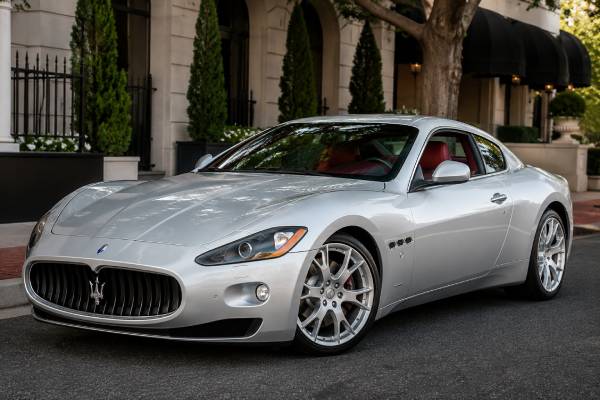
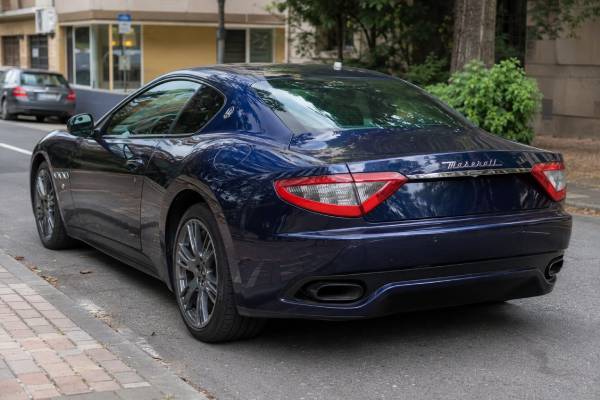
The 2008–2011 Maserati GranTurismo S is the version that turned the elegant M145 coupé into a genuinely serious driver’s car. Its naturally aspirated 4.7-liter F136 Y V8 makes 440 hp, but the more important change is behind the cabin: a six-speed electro-actuated transaxle that shifts the mass rearward and gives the car a distinctly different character from the automatic GranTurismo models. It remains a spacious 2+2 grand tourer, yet it feels sharper, louder, and more mechanically involved than the standard 4.2-liter car.
That combination explains both its appeal and its ownership demands. The engine is charismatic and generally durable when serviced correctly, while the MC-Shift transmission, clutch, suspension, brakes, and aging electronics require informed inspection. A low purchase price does not make neglected maintenance inexpensive. The best examples have complete records, measured clutch life, clean cold starts, functioning exhaust valves, and evidence that a Maserati specialist has addressed age-related needs. This guide covers the exact 440 hp transaxle model, including its specifications, factory distinctions, driving behavior, service risks, and the checks that matter before purchase.
Table of Contents
- The S Model That Changed the GranTurismo
- F136 V8, Transaxle, and Core Specifications
- Production Changes, Options, and Correct Identification
- Pininfarina Shape With Maserati Corse Detail
- How the 440 hp S Drives
- Maintenance Reality for an Aging Transaxle Maserati
- Buying the Right GranTurismo S
The S Model That Changed the GranTurismo
The GranTurismo S matters because it introduced the 4.7-liter V8 and rear transaxle layout that gave the M145 a much harder sporting edge. Maserati unveiled it in 2008, one year after the original 4.2-liter GranTurismo, as the performance flagship of the Pininfarina-designed four-seat coupé range.
The standard GranTurismo had already solved an unusual packaging problem. It combined a long, low nose and dramatic Italian proportions with rear seats that adults could actually use. The S preserved that basic formula but changed the car’s priorities. Power rose from 405 hp to 440 hp, front braking hardware became more serious, the chassis calibration tightened, and the gearbox moved from a conventional front-mounted torque-converter automatic to an electro-hydraulically actuated manual transaxle at the rear.
That last feature separates this model from the later GranTurismo S Automatic. Both use a 4.7-liter V8 and produce the same headline power, but they do not feel or behave alike. The transaxle S uses a dry clutch and automated manual shift system. It rewards deliberate throttle control and decisive use of the paddles, especially in Sport or MC-Shift operation. The automatic model is smoother in traffic and easier to own, but it lacks the transaxle car’s raw connection and rear-biased balance.
The GranTurismo S also formed an important bridge between Maserati’s road and racing programs. Its layout and character fed directly into the GranTurismo MC competition cars, MC Sport Line accessories, and eventually the MC Stradale. The S is not merely a trim package with more aggressive wheels. It is the foundation from which the most focused first-generation GranTurismo derivatives developed.
Today, the car occupies an attractive but complicated market position. It looks expensive, sounds exceptional, and offers genuine rarity for far less than many contemporary exotics. However, age, deferred servicing, clutch wear, and expensive chassis components can erase the apparent bargain. Its reputation is strongest among enthusiasts who understand that condition and documentation matter more than mileage alone.
F136 V8, Transaxle, and Core Specifications
The essential specification is a 4,691 cc naturally aspirated V8 driving the rear wheels through a six-speed electro-actuated transaxle. Maserati rated the engine at 440 hp at 7,000 rpm and 490 Nm at 4,750 rpm, with performance commonly quoted at about 4.9 seconds from 0–100 km/h and roughly 295 km/h at the top end.
| Item | Specification |
|---|---|
| Engine | F136 Y 90-degree naturally aspirated V8 |
| Displacement | 4,691 cc |
| Construction | Aluminum block and cylinder heads |
| Valve gear | DOHC, four valves per cylinder, variable timing |
| Fuel system | Electronic multi-point injection |
| Maximum power | 440 hp at 7,000 rpm |
| Maximum torque | 490 Nm at 4,750 rpm |
| Transmission | Six-speed electro-actuated manual transaxle |
| Drivetrain | Rear-wheel drive with limited-slip differential |
| Suspension | Independent double wishbones front and rear |
| Front brakes | Brembo dual-cast ventilated discs, six-piston calipers |
| Rear brakes | Ventilated discs with four-piston calipers |
| Wheels | 20-inch alloy wheels |
| Wheelbase | 2,942 mm |
| Length | About 4,881 mm |
| Width | About 1,847 mm |
| Height | About 1,353 mm |
| Fuel capacity | About 86 liters, market dependent |
| 0–100 km/h | About 4.9 seconds |
| Top speed | About 295 km/h |
The F136 Y belongs to the Ferrari–Maserati V8 family, but this car’s application has its own intake, exhaust, control strategy, and lubrication arrangement. It is a high-revving engine rather than a low-speed torque monster. Maximum torque arrives near 4,750 rpm, and the strongest acceleration comes when the driver keeps it in the upper half of the rev range.
The gearbox is mechanically a manual transmission. Hydraulic actuators operate the clutch and select gears in response to paddle or automatic-mode commands. There is no clutch pedal, but there is still a conventional friction clutch that wears. Shift quality depends on mode, throttle position, clutch calibration, hydraulic condition, and driver technique.
Placing the gearbox and differential at the rear helps create a rear-biased weight distribution, generally quoted around 47:53. That balance is a defining engineering advantage. The long coupé remains heavy, but its mass feels distributed along the wheelbase rather than concentrated over the nose.
Maserati’s dual-cast front discs combine an iron friction ring with an aluminum hat. This reduces unsprung mass and manages heat better than a simpler one-piece design. They are strong road brakes, though replacement cost and caliper condition must be treated seriously on any used example.
Production Changes, Options, and Correct Identification
A genuine 440 hp GranTurismo S should be identified by its transmission, equipment, VIN data, and build documentation rather than by badges alone. Cosmetic parts are easy to add, while the transaxle layout and factory specification are not.
The model entered production for the 2008 period and continued in 440 hp form before later 4.7-liter developments moved to 450 hp and then 460 hp. Market timing varies because European registration year, North American model year, and factory build date do not always align. Buyers should therefore confirm the exact build month and original sales market rather than relying only on an advertisement’s year.
Important visual and equipment distinctions include:
- Oval exhaust outlets rather than the smaller quad-tip arrangement of the earliest 4.2-liter car.
- Model-specific 20-inch wheels, though several designs were offered or fitted later.
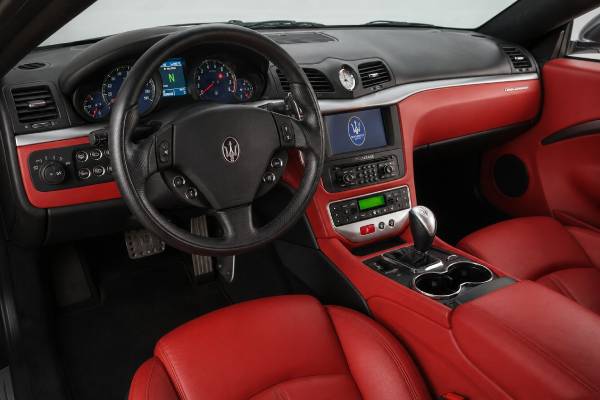
- More deeply shaped front and rear seats, commonly trimmed in Poltrona Frau leather and Alcantara.
- Larger front brakes with six-piston monobloc calipers and dual-cast discs.
- A center-console shift control and steering-wheel paddles associated with the electro-actuated gearbox.
- Sportier sill treatment, dark detailing, and subtle S identification.
The MC Sport Line program complicates identification in a useful way. It offered factory-backed carbon-fiber exterior and cabin pieces, suspension changes, wheels, brake-caliper colors, exhaust details, and racing-inspired trim. Some limited regional editions were produced in very small numbers, while many ordinary S cars received individual MC Sport Line options. A heavily carbon-trimmed car is not automatically a limited edition.
Desirable options depend on intended use. Carbon trim and special colors improve visual distinction, while front-seat comfort, parking sensors, upgraded audio, and usable navigation matter more for touring. Skyhook adaptive damping appears on related variants and in market-specific configurations, but buyers should decode the exact car rather than assume every S has identical suspension hardware.
Authenticity checks should include the original window sticker or build sheet, stamped service book, invoices, wheel part numbers, brake specification, and trim codes. Look for evidence of accident repairs around the aluminum hood, front structure, quarter panels, and long doors. Panel gaps should be even, headlamps should match, and paint depth should make sense across adjacent panels.
The best collector candidate is not necessarily the lowest-mileage car. A properly exercised example with continuous specialist care, recent tires, a healthy clutch, and documented fluid changes is often safer than a garage-bound car with old rubber, sticky actuators, weak batteries, and unknown service history.
Pininfarina Shape With Maserati Corse Detail
The GranTurismo S succeeds visually because its performance changes do not overwhelm the original Pininfarina shape. It remains elegant at first glance, with the aggression revealed through proportion, stance, brakes, wheels, and exhaust rather than a large fixed wing.
The body is built around a steel structure with an aluminum hood and carefully shaped exterior panels. Its long wheelbase supports both high-speed stability and useful rear-seat room. The engine sits behind the front axle line as far as the package permits, while the rear transaxle shifts drivetrain mass toward the driven wheels. This is a classic front-mid-engine grand-tourer solution rather than the packaging of a conventional front-engine luxury coupé.
The nose uses a low grille and prominent Trident, with the front fenders rising over the wheel arches. The cabin sits rearward, and the roof flows into broad rear shoulders. Those proportions make the car appear lower and shorter than its nearly 4.9-meter length. The long doors ease access to the rear seats, though their weight and width require care in tight parking spaces.
Cooling and braking needs shaped the S details. The front brake package demands effective airflow, and the larger exhaust outlets reduce back pressure when the valved system opens. In Sport mode, the exhaust character changes from a restrained bass note to a harder, metallic V8 sound. The acoustic transition is part of the engineering experience, not merely theater added through speakers.
Inside, the architecture reflects late-2000s Maserati design. There is a broad leather-covered dashboard, an analog clock, conventional buttons, and a central multimedia unit that now feels old. The positive side is physical control: key functions do not require layered touch menus. The negative side is that switches, soft-touch finishes, display graphics, and navigation hardware age more visibly than the leather and metalwork.
The seating position is lower and more enveloping than in the base car, but the GranTurismo is still a genuine four-seat coupé. Rear passengers get more legroom than in most sports cars, and the trunk is useful for weekend luggage. That practical capacity is central to the model’s identity. It can cross countries with passengers and bags, then deliver a far more intense experience on the final mountain road.
How the 440 hp S Drives
The 440 hp S feels best when driven as an analog grand tourer with a racing-style gearbox, not as a modern dual-clutch supercar. Its engine builds urgency with revs, its steering communicates the front tires clearly, and its shifts become cleaner when the driver times throttle inputs rather than expecting seamless automation.
At low speed, the electro-actuated transmission can feel clumsy. It slips the clutch when moving away, pauses during shifts, and may hesitate if the driver uses an inconsistent throttle. Automatic mode is convenient but often exposes the system’s least polished behavior. Manual paddle operation gives the driver more control and usually reduces unnecessary clutch slip.
Once the road opens, the character changes. The V8 responds cleanly, grows stronger beyond the midrange, and pulls with a linearity that turbocharged engines rarely match. The final approach to 7,000 rpm delivers the combination owners remember: induction noise, mechanical sharpness, and an exhaust note that becomes urgent without turning artificial.
MC-Shift operation is available under the appropriate conditions and delivers the quickest full-throttle upshifts. Those shifts are dramatic rather than smooth. The car interrupts torque, changes gear, and reconnects with a firm mechanical event. Drivers who want uninterrupted acceleration may prefer the S Automatic; drivers who value involvement often choose the transaxle car specifically for this behavior.
The steering is hydraulically assisted and carries more texture than most current electric systems. It is not nervous at highway speed, and the long wheelbase gives the car calm directional stability. In bends, the rear weight bias helps the front end feel less burdened than the car’s size suggests. The chassis favors progressive movement rather than abrupt rotation.
Ride quality depends on road surface, tire choice, wheel condition, and suspension specification. On good pavement the S is controlled and composed. Sharp impacts can reveal its 20-inch wheels and relatively low-profile tires. Worn dampers, tired bushings, or incorrect tire pressures make the car feel heavy and unsettled, so a poor-driving example should not be dismissed as normal.
The brakes offer strong initial response and good road endurance when healthy. A soft pedal, vibration, pulling, or visible disc cracking requires investigation. Repeated track use can consume expensive friction material quickly, especially if cooling laps and correct pad bedding were ignored.
Visibility is reasonable forward but limited over the rear quarters. The car is wide, the nose is long, and the doors are substantial. Parking sensors are valuable. On a long highway trip, however, the cabin, wheelbase, seats, and stability justify the GranTurismo name more convincingly than almost any two-door exotic of its era.
Maintenance Reality for an Aging Transaxle Maserati
The core V8 can be robust, but the car must be maintained as a complex hand-finished performance model rather than an inexpensive used coupé. The biggest financial risks are deferred clutch and gearbox work, cam-timing concerns, cooling leaks, suspension wear, brake replacement, and electrical faults caused or amplified by low battery voltage.
Clutch and electro-hydraulic system
A diagnostic clutch-wear reading is essential. Mileage alone cannot predict remaining life because city traffic, hill starts, parking maneuvers, automatic-mode use, and poor calibration increase slip. A car driven smoothly on open roads may retain a clutch far longer than one with fewer urban miles.
Check for delayed engagement, excessive rev flare, harsh take-up, selection warnings, hydraulic-fluid leaks, and deterioration after the drivetrain warms. Replacement may involve the clutch pack, release bearing, sensors, seals, flywheel assessment, hydraulic service, and careful electronic setup. Ask for the post-installation calibration record, not just a receipt for parts.
Engine and cooling system
Cold-start listening matters. A brief mechanical noise can have several causes, but persistent timing-area rattle deserves specialist diagnosis. Some F136 applications are known for cam-variator and oil-retention concerns, and the repair is labor intensive. Do not accept a seller’s claim that every rattle is normal.
Inspect valve-cover and timing-cover areas for oil seepage, smell for oil reaching hot exhaust components, and examine the undertray for hidden fluid. Cooling hoses, expansion tanks, radiators, fans, and connections deteriorate with heat and age. A stable temperature gauge does not prove the system is leak-free.
Chassis, brakes, and tires
The heavy body places real loads on ball joints, control-arm bushings, dampers, wheel bearings, and engine mounts. Listen for knocks, check tire wear across the full tread, and insist on an alignment printout if the car pulls or wears one shoulder. Bent 20-inch wheels can cause vibration that is mistakenly blamed on driveshafts or hubs.
Front dual-cast discs and quality pads are not ordinary consumables. Measure disc thickness and inspect heat condition. Brake-fluid history matters because moisture lowers boiling resistance and harms hydraulic components. Tires should match in brand and specification across each axle, carry an appropriate speed rating, and be judged by age as well as tread depth.
Electrical and cabin systems
A healthy, correctly specified battery is fundamental. Low voltage can trigger warning messages, transmission faults, parking-sensor errors, and erratic modules. Test charging output and battery condition before chasing multiple electronic symptoms.
Operate every seat motor, window, mirror, lock, light, parking sensor, climate function, audio control, and steering-wheel button. Check the trunk release and fuel flap. Sticky interior coatings, shrinking leather, loose headlining, worn bolsters, and damaged carbon trim do not stop the car, but restoring a special cabin properly is expensive.
Service intervals vary by market and use, so the official schedule for the VIN should govern. Regardless of mileage, annual inspection and fluid condition remain important on a car that may cover few miles. Engine oil, filters, brake fluid, coolant, gearbox and differential fluids, auxiliary belts, and air-conditioning performance all deserve time-based attention.
Buying the Right GranTurismo S
Buy the GranTurismo S for its transaxle character, not simply because it is the least expensive way to obtain a 4.7-liter Maserati. A buyer who mainly drives in traffic may be happier with the S Automatic, while someone seeking the most involving early M145 should accept the clutch, calibration, and specialist-care demands of this version.
Start with provenance. The ideal file includes annual servicing, clutch readings over time, major repair invoices, tire dates, brake measurements, battery replacements, and notes from a recognized Maserati specialist. A stamped booklet without supporting invoices is not enough to explain how the car was used or what remains due.
Use this inspection order:
- Confirm the VIN, build date, market specification, engine output, and transaxle equipment.
- Inspect the car completely cold and listen through the first start-up cycle.
- Scan every control module before clearing any stored fault.
- Read clutch wear and review hydraulic-system parameters with Maserati-capable diagnostics.
- Drive the car in Auto, manual, Sport, and permitted fast-shift operation after full warm-up.
- Measure brakes, inspect tires and wheels, and check suspension play on a lift.
- Examine oil, coolant, gearbox, differential, and hydraulic systems for leaks.
- Verify paintwork, chassis alignment, underbody condition, and evidence of track damage.
| Priority | What good looks like | Warning sign |
|---|---|---|
| Clutch system | Documented wear reading and consistent engagement | No reading, hot-shift faults, or excessive slip |
| Cold start | Prompt start with stable idle and no persistent rattle | Timing noise, smoke, warning lamps, or misfire |
| Service history | Continuous specialist invoices | Long gaps explained only by low mileage |
| Brakes and tires | Measured discs and recent matching tires | Cracks, vibration, old rubber, or mixed fitment |
| Electronics | Strong battery and every feature operating | Multiple intermittent faults or weak charging |
| Originality | Documented factory or MC Sport Line equipment | Unverified badges, poor carbon copies, or cut wiring |
Modifications need careful judgment. A quality exhaust, reversible infotainment upgrade, or specialist suspension improvement may make the car easier to enjoy. Poorly mapped engine software, bypassed warning systems, cheap wheels, altered ride height, or nonstandard clutch programming can introduce problems and reduce value. Original parts should accompany reversible changes.
Budget beyond the purchase price. Keep a meaningful reserve for immediate baseline servicing and one major repair. The car’s market value does not determine the cost of a transaxle clutch job, timing repair, brake overhaul, or set of correct tires. These remain exotic-car expenses.
A strong example should start cleanly, shift consistently, track straight, stop without vibration, maintain temperature, and show no unexplained warnings. Its cabin should feel cared for rather than cosmetically disguised. When those conditions are met, the GranTurismo S offers something increasingly rare: a naturally aspirated V8, hydraulic steering, rear transaxle, real rear seats, and a body that still looks special without relying on visual excess.
References
- Maserati presents the GranTurismo S 2008
- Maserati GranTurismo MC Concept 2008
- Limited-edition GranTurismo S MC Sport Line 2009
- Maserati product range MY 2011 2010
- Maserati TechInfo 2026 (Technical Information)
Disclaimer
This article is for informational purposes only and is not a substitute for professional diagnosis, inspection, or repair. Specifications, torque values, service intervals, fluids, and procedures can vary by VIN, market, production date, and equipment. Verify all work against the official service documentation for the specific vehicle and use a qualified Maserati specialist where appropriate.
Please share this article on Facebook, X/Twitter, or your preferred enthusiast community to support our work.