
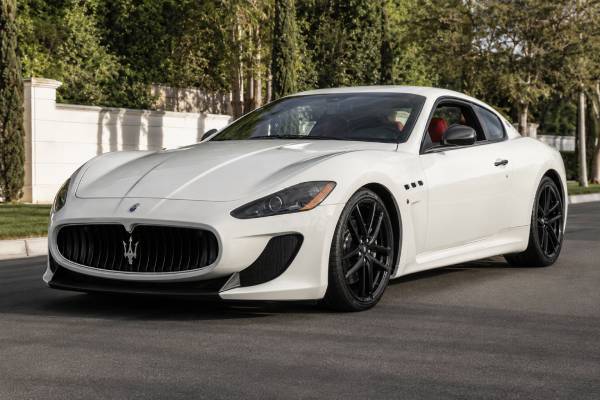
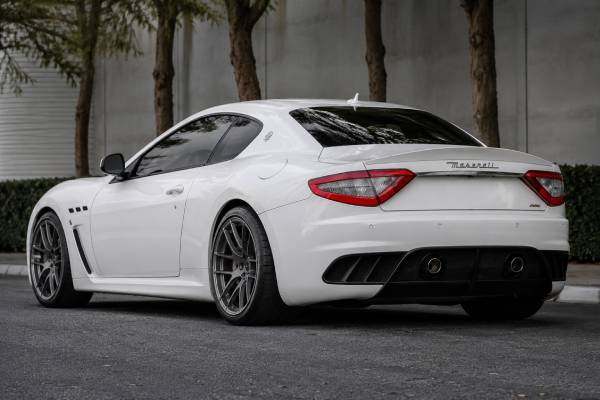
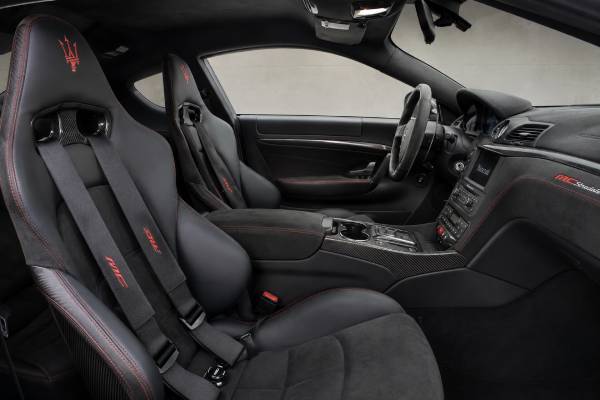
The original 2011–2013 Maserati GranTurismo MC Stradale is the most focused two-seat road car built from the first-generation M145 platform. It takes the 4.7-liter naturally aspirated V8 to 450 hp, removes the rear seats, cuts weight, adds carbon-ceramic brakes, introduces Race mode, and uses a faster MC Race Shift transaxle capable of 60-millisecond upshifts under the correct conditions. Its widened, vented body and central exhaust draw directly from Maserati’s Trofeo and GT4 competition programs, yet the long wheelbase and front-engine layout preserve enough composure for real road use.
That mixture makes the early Stradale unusually appealing and unusually easy to buy badly. Many examples have seen track use, clutch life depends heavily on technique, carbon-ceramic brake replacement is expensive, and model-specific body or cabin parts can be difficult to source. The car also shares age-related F136 engine, hydraulic, suspension, cooling, and electrical concerns with other GranTurismos. A complete history, diagnostic clutch reading, brake measurements, cold-start inspection, and evidence of correct repairs are essential. This guide focuses on the original 450 hp two-seat MC Stradale, not the later 460 hp four-seat version, and explains the details that determine authenticity, driving quality, and long-term ownership cost.
Table of Contents
- From Maserati Racing to a Road-Legal Stradale
- 450 hp V8, Race Shift, and Performance Specs
- Two-Seat Production and Factory Configuration
- Aerodynamics, Weight Saving, and MC Hardware
- What the Original MC Stradale Feels Like
- High-Cost Systems and Maintenance Priorities
- Buying an Authentic 450 hp Stradale
From Maserati Racing to a Road-Legal Stradale
The early MC Stradale is the road-going result of lessons from Maserati’s GranTurismo MC Trofeo and GT4 programs. It was conceived for owners who wanted a car that could travel on public roads yet feel credible during circuit use, without abandoning the basic elegance and stability of the GranTurismo platform.
Maserati revealed the model in 2010 and began sales in 2011. At the time it became the fastest, lightest, and most powerful road car in the company’s regular range. The 4.7-liter V8 gained 10 hp and 20 Nm over the 440 hp GranTurismo S, while extensive weight reduction and revised aerodynamics had a greater effect than the modest power increase suggests.
The defining feature of the first version is its two-seat cabin. Maserati removed the rear seats, installed lightweight carbon-fiber front seats, simplified parts of the interior, and offered track-oriented equipment such as a roll cage and four-point harnesses in some markets. This made it the first two-seat Maserati road model since the MC12.
The Stradale also introduced a dedicated Race mode. The button changes throttle response, transmission strategy, stability-control thresholds, exhaust behavior, and other adjustable systems. It is not a decorative label. In the right conditions, Race mode unlocks the transmission’s fastest shifts and gives the driver more direct control over a chassis calibrated beyond the standard S.
The model’s place in the range changed in 2013 when Maserati introduced a revised four-seat MC Stradale with 460 hp and a carbon-fiber hood. That later car retained much of the performance identity but added practicality and different exterior details. Buyers seeking the original specification should verify that the car is the two-seat 450 hp version rather than a later four-seater, converted car, or market-specific GranTurismo MC.
Today the early Stradale is valued for purity rather than headline speed. Modern performance cars accelerate harder and shift more smoothly, but few combine a high-revving naturally aspirated V8, hydraulic steering, rear automated transaxle, carbon-ceramic brakes, race-derived bodywork, and Pininfarina proportions in such a usable package.
450 hp V8, Race Shift, and Performance Specs
The original MC Stradale uses a 4,691 cc V8 producing 450 hp and 510 Nm, connected to a six-speed electro-actuated rear transaxle. Maserati quoted 0–100 km/h in about 4.6 seconds and a top speed of 301 km/h.
| Category | Specification |
|---|---|
| Engine | F136 Y 90-degree naturally aspirated V8 |
| Displacement | 4,691 cc |
| Maximum power | 450 hp at 7,000 rpm |
| Maximum torque | 510 Nm at 4,750 rpm |
| Transmission | Six-speed MC Race Shift electro-actuated transaxle |
| Fastest quoted upshift | 60 milliseconds in the required Race conditions |
| Drivetrain | Rear-wheel drive with asymmetrical limited-slip differential |
| Weight distribution | Approximately 48:52 front to rear |
| Dry weight | Approximately 1,670 kg |
| Ready-to-drive weight | Approximately 1,770 kg, depending on method and equipment |
| Suspension | Fixed-rate independent double wishbones |
| Brakes | Brembo carbon-ceramic discs with multi-piston calipers |
| Wheels | 20-inch MC-design alloys |
| Front tires | Typically 255/35 ZR20 |
| Rear tires | Typically 295/35 ZR20 |
| Wheelbase | 2,942 mm |
| Length | Approximately 4,933 mm |
| Width | Approximately 1,915 mm |
| Height | Approximately 1,343 mm |
| Fuel capacity | Approximately 90 liters |
| 0–100 km/h | About 4.6 seconds |
| Top speed | 301 km/h |
The extra engine output came from Maserati’s friction-reduction work, including low-friction treatment in the valvetrain and revisions to breathing and calibration. The unit remains naturally aspirated, so performance builds with revs. It has more immediate response than the standard S and a stronger upper range, but its personality is still defined by progression rather than a turbocharged torque surge.
The transaxle places the gearbox and differential behind the cabin. A dry twin-plate clutch connects the engine through the torque tube. Hydraulic actuators operate the clutch and select gears. In Race mode, with sufficient throttle and engine speed, upshifts can occur in 60 milliseconds. At low speeds, the same system can feel abrupt because it is still a manual transmission without a clutch pedal.
Carbon-ceramic brakes reduce unsprung mass and tolerate repeated heat better than the steel system fitted to lesser GranTurismos. They also require correct inspection. Surface appearance, disc mass or wear criteria, pad condition, and signs of impact or thermal damage must be evaluated by someone familiar with the system.
The suspension uses a fixed, model-specific calibration rather than comfort-first adaptive damping. Stiffer springs, dampers, anti-roll control, lower ride height, and unique geometry work with custom Pirelli tires. The long wheelbase remains, which gives the car stability and progressive breakaway rather than the nervousness of a short race special.
Two-Seat Production and Factory Configuration
The 2011–2013 450 hp Stradale should have two seats, a 450 hp engine specification, MC Race Shift transaxle, carbon-ceramic brakes, and the original early body configuration. Any deviation needs documentary explanation.
Production availability varied by market. The car was sold in many major regions but was not initially offered in the United States, Canada, or Korea in the same form. Other markets used different names or homologation descriptions. Registration year can also trail build date, so an early car may first appear on the road later than expected.
Core factory cues include:
- A two-seat cabin with no conventional rear bench.
- Lightweight carbon-backed front seats.
- A front bumper with larger cooling openings and an integrated splitter.
- Vented front fenders and model-specific side treatment.
- A revised rear bumper and central twin exhaust outlets.
- MC-design 20-inch wheels and carbon-ceramic brakes.
- Race mode in addition to Auto and Sport.
- Specific instrumentation, trim, and badges.
Optional or regional equipment can include a roll cage, harness provisions, different seat upholstery, extensive carbon-fiber trim, special paint, colored brake calipers, audio and navigation equipment, and convenience features. Some cars were ordered in restrained colors with full leather; others closely resemble a competition car.
Authenticity should be established with the VIN, factory build data, original invoice, certificate of conformity, service book, and parts documentation. A seller’s claim that a car is “Stradale specification” may mean it has aftermarket bumpers and wheels. That is not equivalent to a genuine factory Stradale.
Conversely, a real Stradale may have been softened for road use. Owners sometimes remove the roll cage, replace carbon seats, fit a quieter exhaust, or change wheel and tire combinations. Reversible changes are not necessarily harmful, but original parts are valuable and model-specific replacements are expensive.
The transition to the 2013 four-seat 460 hp version requires special care. The later car has a distinctive carbon-fiber hood with a central opening, revised details, four seats, and 460 hp. A two-seat 450 hp car converted to later appearance may lose historical clarity. A four-seat car advertised as the earlier lightweight version is simply a different model.
Aerodynamics, Weight Saving, and MC Hardware
The Stradale’s visual changes are functional: they improve cooling, aerodynamic balance, track stability, and component packaging while reducing mass. The design remains recognizably Pininfarina, but nearly every lower body area was reconsidered.
The front splitter works with the reshaped bumper to manage air beneath the car and increase front stability. Enlarged openings feed the engine and brakes. Vented fenders help release pressure from the wheel housings, while revised side skirts guide flow along the flanks. At the rear, the bumper and central exhaust arrangement separate the Stradale from ordinary GranTurismos.
Maserati aimed to add downforce without a matching rise in drag. This matters because the car was expected to exceed 300 km/h while remaining stable and visually elegant. Instead of using a large fixed wing, the body relies on integrated surfaces, underbody management, and careful front-to-rear balance.
Weight reduction came from several areas rather than one exotic structure. The rear seats disappeared, front seats changed to carbon shells, insulation and trim were reduced, wheels and brakes cut unsprung mass, and model-specific components replaced heavier standard pieces. Depending on measurement method, the car is commonly described as roughly 110 kg lighter than the GranTurismo S.
The cabin communicates function without becoming bare metal. Carbon fiber appears on seats, dashboard pieces, doors, paddles, and other details depending on the car’s factory specification. The driving position is lower and more supportive. The rear area becomes luggage space or houses optional safety equipment rather than passenger seating.
The fixed suspension calibration is another important MC feature. It removes some of the comfort range of Skyhook but gives more consistent body control and feedback during repeated hard use. Alignment, corner weights, tire pressures, and damper condition have a larger effect than many owners expect. A poorly set-up Stradale can feel worse than a healthy standard S.
The central exhaust is both visual and acoustic. Shorter routing and valved control help the V8 breathe and create a sharper, less muted sound. Heat management around the rear bumper and diffuser area should be checked, especially if an aftermarket exhaust or catalyst system has been installed.
What the Original MC Stradale Feels Like
The early Stradale feels like a large, stable GT stripped of hesitation and sharpened around the driver. It is not delicate, but it responds more quickly, brakes harder, and communicates more clearly than the standard GranTurismo range.
At town speeds, the gearbox is the dominant feature. The dry clutch must slip during starts, reversing, and creeping. The system can be smooth when calibrated and driven properly, but it will never imitate a torque-converter automatic. Manual paddle control is usually preferable because the driver can anticipate pauses and reduce unnecessary clutch work.
Sport mode increases response and sound, while Race mode changes the car more fundamentally. The fastest shifts require committed throttle and sufficient revs. Used casually, Race can feel unnecessarily abrupt; used on a circuit or open road with the drivetrain warm, it produces a direct, almost competition-style interruption and reconnection of torque.
The engine is highly responsive for a car of this mass. It pulls from the middle range, then becomes increasingly urgent toward 7,000 rpm. The 450 hp rating alone does not describe the experience. Throttle response, reduced weight, gearing, sound, and shift strategy make the car feel more intense than a simple comparison with the 440 hp S suggests.
Steering remains hydraulic and gains clarity from the lower mass and tighter front-end control. The car turns with confidence but still needs respectful speed management. The wide body and long wheelbase make it stable, while the rear weight bias helps it rotate progressively. Stability control allows more freedom in Race mode, so tire temperature and road conditions matter.
The carbon-ceramic brakes provide strong high-temperature performance and reduce fade during repeated stops. Cold pedal feel may be less reassuring than a good steel system, and surface contamination or incorrect pads can change response. On the road, the driver should not assume that expensive carbon discs automatically mean perfect braking.
Ride quality is firm, with more road texture and impact than a Skyhook-equipped GT. It should still feel controlled rather than brittle. Crashes, bouncing, steering kickback, or tramlining point toward old tires, damaged wheels, worn joints, bad alignment, or tired dampers.
On a track, the car’s strengths are stability, predictable balance, durable braking, and a drivetrain that rewards rhythm. Its size and weight remain apparent, so tires and brakes work hard. Cooling laps, fluid condition, and measured consumable wear are essential. On a road trip, the two-seat layout gives luggage space but sacrifices the family usefulness that defines other GranTurismos.
High-Cost Systems and Maintenance Priorities
The Stradale’s major ownership risks are concentrated in expensive performance hardware. A clutch, gearbox-hydraulic repair, carbon-ceramic brake replacement, engine timing job, suspension overhaul, or damaged MC body part can each materially change the economics of purchase.
Clutch and MC Race Shift system
Obtain a current clutch-wear reading with Maserati-capable diagnostics. Review engagement parameters, error history, hydraulic pressure, pump behavior, and calibration values. A percentage alone does not reveal a leaking line, weak accumulator, worn release bearing, damaged flywheel, or misadjusted position sensor.
Ask how the car was used. Urban mileage, steep driveways, repeated launches, and slow paddock movement can consume clutch life quickly. A circuit car may actually have less clutch slip than a city car, but it may show greater brake, tire, and suspension wear.
Carbon-ceramic brakes
Carbon discs require specialist assessment. Inspect for chips, cracks, impact damage, abnormal surface texture, heavy edge wear, and contamination. Verify remaining life by the manufacturer’s accepted method, which may include weight or dimensional criteria rather than a simple visual judgment. Check pad thickness, caliper seals, fluid age, and flexible hoses.
Never assume the brakes are healthy because the warning light is off. Replacement costs are high, and used discs of uncertain history are a poor solution. Steel conversions can reduce running cost but alter originality and must be engineered and documented properly.
Engine, cooling, and exhaust
Listen from a completely cold start for persistent cam-timing rattle. Inspect oil around covers and seals, check coolant hoses and radiators, test fans, and confirm stable temperature. Track heat can harden hoses, damage mounts, and accelerate leakage.
Exhaust valves, vacuum lines, catalysts, oxygen sensors, and central rear heat shielding should function correctly. A loud car may have deleted catalysts or poorly controlled valves, which can create warning lights, excessive cabin heat, or legal problems.
Suspension, wheels, and tires
Inspect control arms, bushings, tie rods, wheel bearings, dampers, springs, mounts, and underbody contact points. Measure alignment and examine the inside edges of all tires. Track curbs can bend wheels or damage suspension without obvious exterior marks.
Use correct high-performance tires in matching axle pairs. Age, heat cycles, storage flat spots, and previous puncture repairs matter. A Stradale on old or unsuitable rubber cannot demonstrate its chassis accurately.
Electrical, trim, and rare parts
Maintain a strong battery and verify charging performance. Scan all modules before clearing faults. Test windows, locks, seat controls, air conditioning, multimedia, lights, parking equipment, and Race-mode functions.
Carbon seats, splitters, vents, wheels, badges, and interior pieces can be costly or scarce. Check for cracks, poor repairs, missing fasteners, and incorrect reproductions. A damaged low front splitter is common, but repeated grounding may also affect the bumper, undertray, and mounting points.
Buying an Authentic 450 hp Stradale
The right early MC Stradale is an authentic two-seat car with transparent use history and measured condition. Purchase should follow evidence, not the emotional impact of its sound or rarity.
Use a structured inspection:
- Decode the VIN and confirm factory two-seat 450 hp MC Stradale specification.
- Inspect the car cold and keep the seller from pre-warming it.
- Run a complete electronic scan and save all fault data.
- Read clutch wear and hydraulic-system values.
- Measure or professionally assess every carbon-ceramic disc.
- Inspect tires, wheels, alignment, suspension play, and underbody damage.
- Test Auto, Sport, and Race modes only after proper warm-up.
- Check body panels, carbon pieces, seats, roll-cage equipment, and original parts.
- Review track records, service invoices, fluid changes, and consumable replacement.
| System | Strong evidence | Major warning |
|---|---|---|
| Identity | Factory data confirms two seats and 450 hp specification | Converted interior or unclear variant history |
| Clutch | Current reading, smooth engagement, documented calibration | Hot shift faults or no diagnostic access |
| Brakes | Measured discs with documented pad and fluid care | Chips, cracks, vibration, or unknown disc life |
| Track use | Open records with frequent fluid and consumable service | Heat damage denied despite obvious evidence |
| Body and carbon | Original undamaged parts or quality documented repair | Cracked splitter, missing panels, or imitation components |
| Engine | Clean cold start and stable temperature | Rattle, smoke, fluid loss, or repeated warnings |
A track-used example can be a good purchase when the owner maintained it accordingly. Frequent oil and brake-fluid changes, measured disc life, alignment records, tire replacement, and honest notes are better than a supposedly untouched car with no evidence. Conversely, cosmetic detailing cannot reverse repeated overheating or curb impacts.
Budget for the model you are buying. Keep a reserve large enough for clutch work, brake replacement, specialist suspension repairs, and rare trim. Insurance, storage, tires, and transport to the correct workshop also belong in the ownership calculation.
Avoid false economies. Cheap brake conversions, unknown clutch parts, generic diagnostic work, repaired carbon without structural assessment, and nonstandard software can turn a rare car into a difficult project. Reversible, documented upgrades are easier to accept than modifications that erase factory function.
The original MC Stradale is best for an owner who will use its capabilities and maintain it without shortcuts. It is louder, firmer, less practical, and more demanding than a GranTurismo Sport, but it offers a purer connection to Maserati’s competition program. A properly inspected example delivers a distinctive experience that the later four-seat car only partly replicates: a two-seat, naturally aspirated, front-engine racing-inspired GT with enough road manners to reach the circuit under its own power.
Ownership style should match the original two-seat Stradale’s purpose. It benefits from regular open-road exercise, complete warm-up, and deliberate clutch use, but repeated short trips and garage maneuvering create wear without delivering the conditions for which the car was calibrated. Owners who attend track events should log tire pressures, brake measurements, fluid changes, alignment settings, and heat-related inspections. That record helps distinguish responsible circuit use from neglect and can improve resale confidence. Equally, a car preserved only for display should receive annual fluid, battery, seal, and corrosion checks. The model rewards active mechanical stewardship more than either hard use without records or indefinite static storage.
References
- Worldwide Paris Premiere for the GranTurismo MC Stradale 2010
- Strong representation of Maserati Benelux at Brussels Motor Show 2012 2012
- Maserati GranTurismo MC Concept 2008
- The four-seater GranTurismo MC Stradale makes its debut in Geneva 2013
- Maserati TechInfo 2026 (Technical Information)
Disclaimer
This article is for informational purposes only and does not replace professional inspection, diagnosis, maintenance, or repair. Specifications, torque values, fluids, service intervals, and procedures may vary by VIN, market, production date, and equipment. Verify all details against the official service documentation for the specific vehicle and use a technician experienced with Maserati MC systems and carbon-ceramic brakes.
Please share this article on Facebook, X/Twitter, or your preferred automotive community to support our work.