
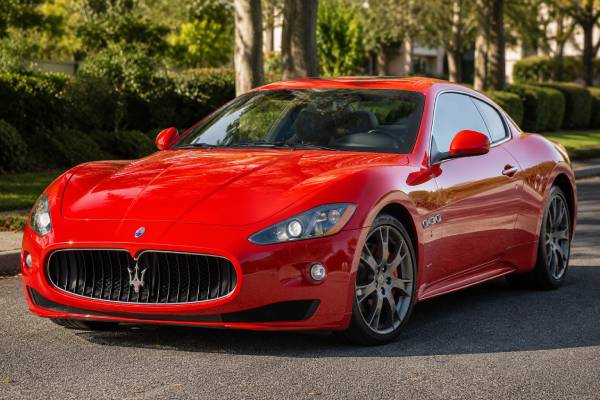
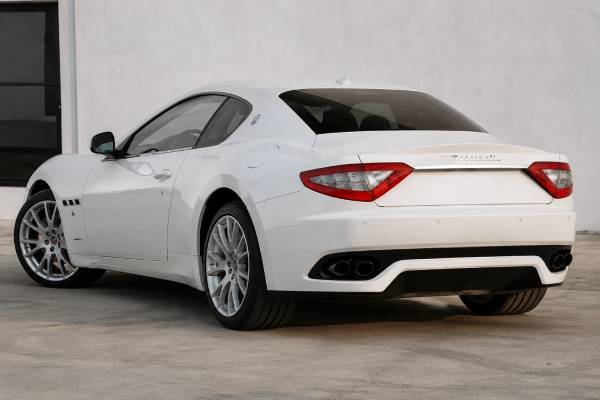
The Maserati GranTurismo S Automatic combines the 440 hp 4.7-liter V8 with a conventional six-speed ZF automatic, making it the most relaxed way to enjoy the early high-output M145 coupé. Introduced in 2009, it sits between the softer 4.2-liter GranTurismo and the more demanding transaxle-equipped GranTurismo S. The result is not simply the same car with a different selector. Its front-mounted transmission, wet-sump engine installation, adaptive Skyhook suspension, and touring-focused calibration give it a distinct balance of speed, comfort, and everyday usability.
That formula still works well, but the car is now old enough that condition matters more than its dramatic bodywork or low advertised price. The ZF gearbox avoids the automated-manual clutch wear that defines the MC-Shift model, yet buyers must still account for cam-timing noise, oil and coolant leaks, suspension wear, aging brakes, weak batteries, and increasingly fragile cabin electronics. A properly serviced example can cover distance with ease and deliver one of the most memorable naturally aspirated V8 soundtracks of its era. This guide explains the exact 440 hp automatic model, how it differs from related versions, what it feels like to drive, and how to inspect one intelligently.
Table of Contents
- Why the S Automatic Fills a Unique Role
- Powertrain, Chassis, and Performance Data
- Model Years, Equipment, and Factory Differences
- Grand-Touring Design With a Sporting Edge
- Road Manners of the ZF-Equipped 4.7
- Service Needs and Common Age-Related Faults
- Pre-Purchase Strategy for the S Automatic
Why the S Automatic Fills a Unique Role
The S Automatic is the early GranTurismo for drivers who want the 4.7-liter engine without the compromises of the rear automated-manual transaxle. It delivers the same 440 hp rating as the original GranTurismo S, but it pairs that output with smoother low-speed behavior and a more traditional grand-touring personality.
Maserati launched the model at the 2009 Geneva Motor Show after offering the GranTurismo range in two clearly separated forms: a 4.2-liter automatic and a 4.7-liter electro-actuated S. The S Automatic closed that gap. It retained the larger engine, sportier exterior details, 20-inch wheels, and stronger performance while making the car easier to use in traffic, parking maneuvers, and long-distance travel.
The distinction matters in the used market because sellers often shorten both cars to “GranTurismo S.” The transaxle S uses a dry clutch, rear-mounted gearbox, and shift paddles that command an electro-hydraulic manual. The S Automatic uses a torque converter and a six-speed ZF unit mounted directly behind the engine. It has no clutch-wear percentage to read and generally shifts more smoothly, although its transmission fluid, valve body, mounts, cooling, and software still require attention.
This version also emphasizes the original GranTurismo mission. Maserati designed the M145 as a four-seat coupé capable of covering long distances quickly rather than as a cramped two-seat supercar. The S Automatic has enough performance to feel special, but it remains calm on a motorway and manageable in town. That dual character is why many owners consider it the sweet spot of the early range.
Its reputation today rests on three strengths: timeless Pininfarina styling, a sonorous naturally aspirated V8, and unusually useful accommodation. The weakness is economic rather than conceptual. Depreciation has made purchase prices accessible, but parts and specialist labor remain tied to the car’s original status. A neglected example can need several years’ worth of ordinary-car maintenance in a single visit.
Powertrain, Chassis, and Performance Data
The S Automatic uses a 4,691 cc F136-family V8 rated at 440 hp and 490 Nm, driving the rear wheels through a six-speed ZF automatic. It reaches 100 km/h in roughly five seconds and has a top speed close to 295 km/h, figures that still make it a very fast road car.
| Category | Data |
|---|---|
| Engine | 90-degree naturally aspirated V8 |
| Engine family | F136 Y, wet-sump automatic application |
| Displacement | 4,691 cc |
| Maximum power | 440 hp at 7,000 rpm |
| Maximum torque | 490 Nm at 4,750 rpm |
| Transmission | ZF six-speed torque-converter automatic |
| Drive | Rear-wheel drive |
| Suspension | Double wishbones with Skyhook adaptive damping |
| Steering | Hydraulic power assistance |
| Front brakes | Ventilated dual-cast discs with six-piston calipers |
| Rear brakes | Ventilated discs with four-piston calipers |
| Wheels | 20-inch Trident-design alloys as standard |
| Wheelbase | 2,942 mm |
| Length | About 4,881 mm |
| Width | About 1,847 mm |
| Height | About 1,353 mm |
| Fuel capacity | Approximately 86 liters, depending on market |
| 0–100 km/h | About 5.0 seconds |
| Top speed | About 295 km/h |
The aluminum V8 uses dual overhead camshafts, four valves per cylinder, electronic injection, and variable cam timing. Its response is progressive. There is useful torque in normal driving, but the engine becomes much more animated above the middle of the rev range. Unlike a turbocharged unit, it does not produce one large surge; it gathers speed with increasing sound and urgency.
The ZF gearbox offers several operating strategies, including normal automatic behavior, sportier programming, manual selection, and an ice setting. In Sport, shift timing becomes more assertive and the exhaust valves open under the required conditions. Steering-wheel paddles allow the driver to hold a gear, although the underlying experience remains that of a refined automatic rather than a racing transmission.
Mounting the gearbox at the front creates a different mass distribution from the transaxle S. The automatic car carries a little more of its weight forward and feels less eager to rotate, but the long wheelbase, double-wishbone geometry, and Skyhook dampers keep it composed. The system continuously adjusts damping force to suit wheel movement and driving conditions, then adopts a firmer strategy when the driver selects Sport.
Brembo’s dual-cast front discs use an aluminum center and an iron friction ring. The design saves unsprung weight and manages heat effectively, but replacement is costly. The car’s mass also means tire quality and brake condition have a noticeable effect on steering, ride, and stopping confidence.
Model Years, Equipment, and Factory Differences
The 2009–2012 S Automatic evolved through detail updates rather than a complete mechanical redesign. Build date, market specification, trim code, and option list are therefore more useful than broad model-year assumptions.
The launch cars are recognizable by their sculpted side skirts, 20-inch Trident-style wheels, oval exhaust outlets, and interior equipment that moved the GranTurismo closer to a high-performance luxury coupé. Bluetooth became standard in many markets, while iPod integration, navigation, premium audio, parking assistance, and extensive leather or wood personalization varied by region and order.
Later production benefited from ongoing product-range changes. Maserati expanded MC Sport Line options, introduced additional matte and metallic colors, offered more carbon-fiber details, and changed combinations of leather, Alcantara, stitching, wood, and wheel finishes. Some cars received carbon mirror caps, sill extensions, rear aerodynamic fins, oval exhaust trim, steering-wheel pieces, or cabin inserts. These could be ordered individually, so a car with several MC items is not necessarily a numbered special edition.
The most important identification point remains the transmission. A true S Automatic should have the ZF automatic installation and corresponding controls. It should not be described as needing an “F1 clutch,” because it has a torque converter rather than the dry clutch used by the electro-actuated transaxle car. Confusion on this point is a warning that the seller may not understand the vehicle.
Factory provenance can be checked through:
- The VIN and original market data.
- A dealer or specialist build-sheet printout.
- The original sales invoice or window sticker.
- Service-book stamps supported by detailed invoices.
- Trim, paint, and wheel codes.
- Part numbers on rare carbon or MC Sport Line pieces.
Inspect cosmetic claims carefully. GranTurismo bumpers, wheels, badges, and carbon parts are often swapped. Some changes are attractive and reversible; others conceal accident repair or create an imitation of a later MC model. Factory authenticity usually supports value, but condition still takes priority. An original wheel with cracks and repeated repairs is less useful than a correctly sized quality replacement accompanied by the original set.
The 2012 transition into the 460 hp GranTurismo Sport also creates registration overlap. A late S Automatic and an early Sport can appear in the same calendar year. The later Sport has revised front styling, updated lighting, redesigned seats and steering wheel, and a more powerful 460 hp engine. Buyers should verify the exact variant rather than assuming that every 2012 registration has the newer specification.
Grand-Touring Design With a Sporting Edge
The S Automatic preserves the most successful element of the M145 project: a dramatic Pininfarina body wrapped around a genuinely usable four-seat cabin. Its sport additions sharpen the shape without disrupting the proportions.
The low grille, long hood, rearward cabin, and muscular rear fenders create the visual language of a front-engine Italian GT. The car is large, yet the roofline and surface treatment disguise much of its length. A wheelbase just under three meters provides space for rear passengers and contributes to straight-line stability.
Under the skin, the steel structure carries an aluminum hood and independent double-wishbone suspension. The front-mounted engine and automatic transmission are packaged behind the nose, while the differential remains at the rear. The exhaust runs to large oval outlets that distinguish the S family and provide a deeper visual link to the car’s sound.
Cooling requirements are integrated rather than exaggerated. Air enters through the grille and lower openings, while the wheel and brake package fills the arches without the widened bodywork of the later MC Stradale. The result looks formal enough for a hotel entrance but still communicates performance through stance and detail.
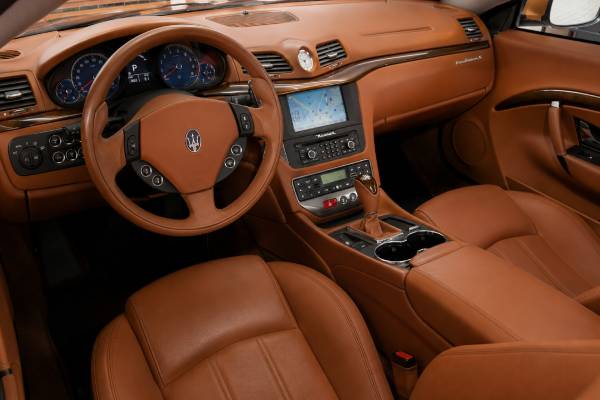
The cabin combines hand-finished materials with electronics that now reveal the car’s age. Poltrona Frau leather, Alcantara, stitched panels, metal accents, and an analog clock create a rich atmosphere. The central multimedia system, small display, and button layout belong to another era. For some owners, physical controls are refreshing; for others, the lack of modern connectivity is the car’s most obvious daily-use weakness.
Front seats provide a lower, more supportive position than the base GranTurismo, though comfort depends on body shape and exact seat specification. The rear seats are unusually credible for a performance coupé. Adults can use them for meaningful trips, provided front occupants share legroom. The trunk is practical enough for several soft bags, making the car suitable for the type of travel its name promises.
The long doors are both a benefit and a liability. They open wide for rear-seat access but require space in narrow garages. Door checks, window drop, seals, handles, and locking mechanisms should all be tested. Frameless glass must lower and raise correctly as the door opens and closes, otherwise wind noise and water sealing suffer.
Road Manners of the ZF-Equipped 4.7
The S Automatic is fast, expressive, and far easier to drive smoothly than the transaxle S. Its greatest strength is not a single acceleration figure but the way it moves between quiet touring and high-revving V8 performance without making the driver manage a dry clutch.
In normal mode, the ZF gearbox selects gears unobtrusively and uses the torque converter to make starts and parking maneuvers smooth. The car still feels substantial at low speed, and the hydraulic steering is heavier than many modern systems, but the controls are predictable. This makes it realistic to use for commuting or urban trips, provided the driver accepts its width, fuel consumption, and limited rear-quarter visibility.
Sport mode changes the mood. The transmission holds lower gears, downshifts more readily, and responds faster to throttle. The valved exhaust becomes more vocal, especially as revs rise. Manual paddle inputs are useful on a winding road because they let the driver prepare the engine before a corner and avoid an unwanted upshift.
The V8 is the centerpiece. It does not deliver modern turbocharged torque at idle, but it is never weak. From the midrange onward, it pulls with increasing intensity and a clean, mechanical note. The last portion of the rev range feels purposeful rather than strained. Drivers used to turbo engines may initially underestimate the car because the response is linear; repeated use of the upper rev range reveals its real pace.
Steering response is deliberate rather than razor sharp. The car turns accurately, communicates front-tire load, and settles into a corner with confidence. Skyhook keeps the body controlled while allowing more compliance than the fixed, track-oriented setups used by the most aggressive derivatives. It is a car to guide through a sequence with smooth inputs, not one that rewards frantic corrections.
The front-heavy difference from the transaxle car is noticeable near the limit. The S Automatic is more inclined toward safe understeer when asked too much of the front tires. Correct tire pressures, matched premium tires, and sound suspension bushings are essential. Worn front control-arm joints or old rubber can make the steering feel vague and the car reluctant to change direction.
Braking performance is strong when the system is healthy. The pedal should be firm and progressive, with no steering shake or pulsing. Because the car is heavy and fast, downhill or track use builds heat quickly. A road car with overheated discs, crumbling pads, dark fluid, or mismatched tires has likely been maintained to appearance rather than function.
On a motorway, the S Automatic makes its clearest case. It settles into a stable cruise, provides real passenger space, and retains enough response for effortless overtaking. Tire roar and wind noise depend greatly on wheel alignment, seal condition, and tire choice. A good one feels mature; a tired one feels loose, noisy, and much older than it should.
Service Needs and Common Age-Related Faults
The automatic model removes the major dry-clutch expense of the transaxle S, but it is not a low-maintenance alternative. Its common risks center on the F136 V8, cooling system, ZF transmission condition, Skyhook hardware, heavy-duty brakes, suspension joints, and voltage-sensitive electronics.
Engine start-up and oil leaks
Always hear the engine from fully cold. Persistent rattle from the cam-timing area requires expert assessment, particularly on earlier F136 applications. The exact cause and remedy must be diagnosed rather than guessed from a video or seller description.
Oil seepage often appears around cam covers, front covers, seals, or related joints. A small visible leak can require substantial labor because access is tight. Inspect the underside after removing the tray, and look for oil smell or smoke near hot exhaust components. Check that the dipstick moves freely and that the oil level and specification are correct.
Cooling and accessory systems
Age hardens hoses, weakens plastic tanks, and exposes radiator or connection leaks. Test both cooling fans, inspect the expansion tank and cap, and verify stable temperature in traffic as well as at speed. Air-conditioning performance matters because compressor, condenser, flap-motor, and control repairs are not trivial.
Auxiliary belts, pulleys, tensioners, and engine mounts deserve inspection. Collapsed mounts can create vibration and alter driveline alignment. A squeal or rumble at start-up should be traced before purchase.
ZF automatic and driveline
The gearbox should engage Drive and Reverse promptly, shift consistently when cold and hot, and show no flare between ratios. Claims that automatic-transmission fluid is permanently maintenance-free should not replace condition-based specialist advice. Fluid age, leaks, pan condition, adaptation values, mounts, and software all affect behavior.
A thump may come from mounts, differential bushings, driveshaft components, or excessive driveline play rather than the transmission itself. Scan for stored gearbox faults and drive the car long enough to reach full temperature.
Skyhook, steering, and brakes
Adaptive dampers are expensive. Warning messages, fluid leakage, uneven ride height, bouncing, or a harsh response can point to damper or control problems. Inspect ball joints, wishbone bushes, anti-roll-bar links, wheel bearings, tie rods, and the hydraulic steering system.
Measure disc thickness rather than judging through the wheel. Check caliper seals, pad wear, brake hoses, and fluid history. Old tires are unsafe even when their tread looks deep, and mixed brands can upset the chassis.
Electrical systems and interior aging
Battery condition is a first-line diagnostic item. A weak battery or poor charging system can create several unrelated warnings. Use the correct battery type and maintain it when the car sits.
Test the multimedia unit, amplifier, parking sensors, windows, seat controls, mirrors, lights, locks, climate panel, trunk release, and steering-wheel buttons. Inspect sticky switch coatings, stretched leather, headliner sag, dashboard lifting, and water entry. Cosmetic repair quality varies widely, so original but lightly worn trim may be preferable to a poor retrim.
Follow the schedule for the exact VIN and market, but do not allow low annual mileage to justify long gaps. Time ages oil, brake fluid, coolant, rubber, and seals. An annual specialist inspection is sensible even when the odometer barely changes.
Pre-Purchase Strategy for the S Automatic
The best S Automatic is the car with transparent history and consistent operation, not the one with the lowest mileage or brightest detailing. Choose evidence over presentation.
Begin by confirming that the vehicle is genuinely the 440 hp automatic version. Decode the VIN, note the build date, and compare its exterior, interior, wheel, brake, and transmission specifications with factory records. A late registration can still be an earlier build, and a modified car may resemble a later GranTurismo Sport or MC.
A proper pre-purchase inspection should include:
- A cold start after the car has remained off for several hours.
- A complete scan of engine, gearbox, suspension, body, and infotainment modules.
- A lift inspection with undertrays removed where practical.
- Engine-oil, coolant, transmission, differential, steering, and brake-fluid checks.
- Brake-disc measurement and tire date-code inspection.
- A road test from cold to full temperature in every gearbox mode.
- Suspension, steering, wheel, and alignment evaluation.
- Paint-depth readings and structural checks for previous repair.
| Area | Positive evidence | Reason to pause |
|---|---|---|
| History | Annual specialist invoices with detailed work | Long gaps or generic stamps only |
| Engine | Quiet cold start, stable idle, dry underside | Persistent rattle, smoke, or fresh cleaning over leaks |
| Transmission | Prompt engagement and smooth hot shifts | Flare, slam, delay, or stored faults |
| Suspension | No warnings, knocks, leaks, or uneven tire wear | Harshness blamed on “all Maseratis” |
| Brakes | Measured serviceable discs and quality pads | Vibration, deep lips, or unknown fluid age |
| Electrics | Strong battery and all equipment functional | Intermittent warnings or multiple dead features |
Consider how you will use the car. For frequent city driving, the automatic is clearly better suited than the MC-Shift version. For repeated track use, its weight, transmission calibration, and consumable costs make it less compelling than a lighter dedicated car. For weekend travel, scenic roads, and high-speed touring, it is exceptionally well matched.
Do not spend the entire budget on purchase. Reserve money for a full baseline service, correct tires, brake work, battery replacement, and one unexpected repair. The difference between an average car and a sorted one is often less than the cost of correcting a neglected example.
Modifications should be assessed for quality and reversibility. Modern infotainment can improve daily use, but cut wiring and poorly fitted screens create faults. Aftermarket exhausts may sound dramatic yet introduce drone or valve errors. Lowered suspension can damage ride quality and geometry. Factory MC Sport Line parts are desirable when documented, while imitation carbon and false badging rarely improve value.
A successful purchase should feel coherent. The engine, gearbox, damping, steering, brakes, and cabin electronics should all behave as parts of the same well-maintained car. When they do, the GranTurismo S Automatic remains one of the most usable ways to own a naturally aspirated Italian V8 coupé with real space for four.
References
- Maserati GranTurismo S Automatic unveiled at the Geneva Auto Show 2009
- Shanghai debut for Maserati GranTurismo S Automatic 2009
- Worldwide Paris Premiere for the GranTurismo MC Stradale 2010
- Maserati product range MY 2011 2010
- Maserati Owner Documentation 2026 (Owner Documentation)
Disclaimer
This article is for informational purposes only and does not replace professional diagnosis, maintenance, or repair. Specifications, torque values, fluids, intervals, and procedures vary by VIN, production date, market, and equipment. Confirm all work with the official service documentation for the individual vehicle and consult a qualified Maserati specialist.
Please share this article on Facebook, X/Twitter, or another enthusiast platform to help support our work.