
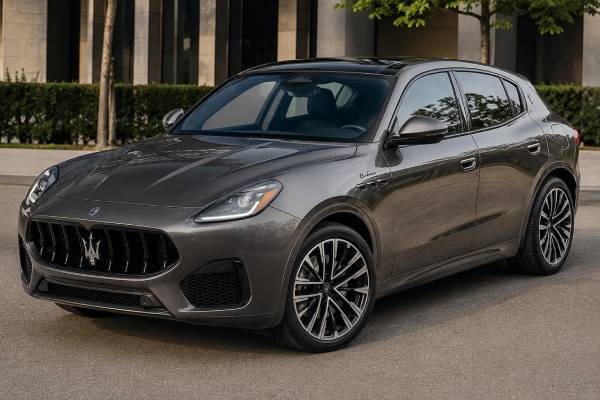
The 2022–2025 Maserati Grecale GT is the launch-era entry point to Maserati’s M182 luxury SUV range. Its 2.0-liter GME T4 gasoline engine works with a 48-volt mild-hybrid system to produce 300 hp and 450 Nm, while an eight-speed automatic transmission and standard all-wheel drive turn that output into confident all-weather performance. Official figures of 5.6 seconds from 0–100 km/h and a 240 km/h top speed place the GT well above ordinary compact SUVs, even though it sits below the 330 hp Modena and 530 hp Trofeo.
More important than the numbers is the GT’s role. It was designed to bring Maserati styling, a rear-biased chassis, useful rear-seat space, and modern digital features into a vehicle that could serve as daily transport. The mild-hybrid system improves response and stop-start operation, but this is not a plug-in hybrid and cannot travel meaningful distances on electricity alone. Buyers should view it as a turbocharged performance SUV with electrical assistance rather than an economy-focused hybrid. This guide covers its specifications, production changes, design, road behavior, service risks, recall checks, and the details that separate a strong used purchase from a costly one.
Table of Contents
- Why the Launch GT Matters
- Engine, Driveline, and Chassis Data
- Production Evolution, Trims, and Equipment
- Design Details and Technical Character
- How the 300 hp GT Drives
- Maintenance, Faults, and Long-Term Care
- Used GT Inspection and Purchase Strategy
Why the Launch GT Matters
The 300 hp Grecale GT established the basic personality of the entire Grecale line: a practical five-seat SUV with a more alert chassis, lower visual stance, and stronger performance identity than most comfort-led premium crossovers. It remains the version that best explains why Maserati built the Grecale in the first place.
Maserati unveiled the Grecale in March 2022 and positioned it below the larger Levante. The name follows the brand’s tradition of using winds, referring to a strong Mediterranean wind. Production took place at the Cassino plant in Italy, where the M182 model used a lengthened and extensively adapted version of the Giorgio architecture associated with the Alfa Romeo Giulia and Stelvio.
That foundation gave Maserati a useful starting point. A longitudinal engine, rear-oriented all-wheel-drive layout, independent suspension, and generous wheelbase allowed the Grecale to combine responsive handling with more cabin room than its tapered shape suggests. At 4,846 mm long with a 2,901 mm wheelbase in GT form, it is not a small vehicle, but it avoids the visual bulk of many similarly spacious SUVs.
The launch range included three distinct personalities. GT emphasized contemporary comfort and urban use. Modena raised the four-cylinder output to 330 hp and added sportier presentation. Trofeo introduced a 530 hp version of the Nettuno twin-turbo V6. The GT therefore was not intended to mimic the Trofeo at a lower price. Its purpose was to make Maserati’s design and road manners accessible in a calmer, easier-to-own package.
The model years in this assignment need one clarification. European production and market launch began during 2022, while some countries, especially the United States, sold the first vehicles as 2023 models. Registration year, build date, and model year may therefore differ. A car first registered late in 2022 can be mechanically similar to a 2023 car elsewhere.
The GT’s reputation today is mixed in a useful way. Drivers praise its steering response, cabin space, distinctive styling, and strong midrange pace. Criticism often focuses on the four-cylinder soundtrack, digital control layout, option pricing, and the possibility of software or electrical irritations in early cars. Depreciation can make a used example appealing, but it also reflects the need for careful inspection and realistic running-cost expectations.
The 300 hp GT makes the most sense for an owner who wants a daily Maserati rather than a collectible. It is quick enough for almost any public road, comfortable enough for long trips, and discreet enough to use every day. It is less suitable for someone who expects the engine character of a traditional Maserati V6 or wants hybrid fuel economy comparable with a full hybrid or plug-in model.
Engine, Driveline, and Chassis Data
The GT’s 1,995 cc turbocharged inline-four produces 300 hp and 450 Nm, assisted by a 48-volt system that supports response, regeneration, and stop-start operation. Power passes through a ZF eight-speed automatic to an all-wheel-drive system with a rear-oriented character.
| Category | Specification |
|---|---|
| Platform code | M182 |
| Engine family | GME T4 turbocharged inline-four |
| Displacement | 1,995 cc |
| Hybrid system | 48-volt mild hybrid with belt starter-generator |
| Maximum power | 300 hp |
| Maximum torque | 450 Nm |
| Transmission | Eight-speed automatic |
| Drive | All-wheel drive |
| 0–100 km/h | 5.6 seconds |
| Maximum speed | 240 km/h |
| Length | 4,846 mm |
| Wheelbase | 2,901 mm |
| Height | 1,670 mm |
| Width with mirrors | 2,163 mm |
| Fuel capacity | 64 liters |
| Body | Five-door, five-seat SUV |
The GME T4 uses direct fuel injection, turbocharging, and advanced valve control. Maserati combines the conventional turbo with an electrically powered compressor to improve low-speed boost response. The 48-volt belt starter-generator recovers energy during deceleration and restarts the engine more quickly than a basic starter motor. A compact lithium-ion battery stores that energy.
This system is called mild hybrid because the electric hardware assists the gasoline engine rather than replacing it. There is no external charging port and no useful electric-only range. The engine normally runs whenever the vehicle is moving. The main benefits are smoother restarting, better accessory management, reduced turbo lag in some conditions, and modest efficiency gains.
The engine’s 450 Nm torque figure is central to the GT’s everyday pace. Maximum power differentiates it from the 250 hp regional version, but the broad torque delivery allows the eight-speed transmission to use taller gears without making the vehicle feel weak. At motorway speeds, the extra 50 hp over the 250 version becomes more apparent because the engine continues pulling more strongly toward the upper rev range.
The ZF automatic offers conventional Drive operation and manual changes through fixed column-mounted paddles. Its programming varies with drive mode. Comfort settings favor early upshifts and low engine speed, while sportier modes hold gears, sharpen downshifts, and increase engine braking. The transmission should feel smooth once warm, though low-speed coordination between stop-start, creep, and throttle can be less seamless than in a naturally aspirated non-hybrid vehicle.
The all-wheel-drive system normally preserves a rear-led feel, then sends more torque forward when conditions require it. This gives the GT stable traction without the heavy steering and nose-first sensation common in front-based crossovers. Electronic stability control remains an important part of the package and can intervene before the chassis reaches its mechanical limits.
Front double-wishbone and rear multi-link suspension support accurate wheel control. Depending on market and options, a GT may use passive or adaptive damping, steel springs, or air suspension. Air suspension broadens ride-height and mode capability but adds compressors, valves, height sensors, and air springs that should be considered in long-term cost planning.
Wheel sizes usually begin at 19 inches and can increase substantially through factory options. Larger wheels bring a more aggressive stance and quicker initial response, but 19- or 20-inch setups generally suit the GT’s mission better. They reduce tire price, rim-damage risk, and harshness over broken pavement.
Production Evolution, Trims, and Equipment
The core 300 hp powertrain remained consistent through the launch-era 2022–2025 period, but equipment, software, option bundling, and regional availability changed. Buyers should compare vehicles by VIN and build sheet rather than assuming every GT from the same year has identical content.
Early 2022-built cars are historically interesting because they represent the first production run. They can also require the most careful software and campaign review. By 2023, wider market deliveries established a more consistent specification. For 2024 and 2025, the Grecale range gained broader electrification context through the Folgore, while individual markets adjusted trim names, option packages, wheel choices, and standard driver-assistance content.
A GT can be visually simple or heavily optioned. Typical GT identity includes restrained exterior detailing, comfortable seats, a less aggressive wheel specification, and trim materials such as open-pore wood or woven textile-inspired finishes. Optional packages can add sport seats, dark exterior details, upgraded leather, larger wheels, premium audio, panoramic glass, adaptive systems, and additional driver assistance.
Equipment worth prioritizing
For daily use, several options have more lasting value than cosmetic additions:
- A 360-degree camera system, because the body is wide and rear-corner visibility is limited.
- Adaptive cruise control and blind-spot monitoring for frequent motorway driving.
- Heated seats and steering wheel in cold climates.
- Ventilated front seats in hot regions.
- Premium audio for buyers who use the car as a long-distance vehicle.
- A power tailgate and keyless entry, provided both operate consistently.
- Adaptive dampers for drivers who want a broader ride-and-handling range.
A panoramic roof makes the cabin brighter but adds weight high in the body and introduces seals, drains, a shade mechanism, and possible trim noises. It is desirable when working perfectly, but a dry headliner and silent operation matter more than having the option.
GT versus Modena
The 330 hp Modena is the closest alternative. It offers slightly stronger acceleration, more assertive styling, and often richer standard equipment. The GT usually rides more comfortably on smaller wheels and may cost less to insure or tax. Since both use the same basic engine family and transmission, the maintenance difference is smaller than the performance difference suggests.
A used buyer should compare actual examples rather than trim names. A heavily optioned GT may be more satisfying than a basic Modena, especially when the GT has better history, smaller undamaged wheels, and the preferred interior. Conversely, the Modena may hold broader resale appeal if price and condition are equal.
Market and identity checks
Confirm whether a vehicle was originally sold in its current country. Imported Grecales can be good purchases, but navigation, radio frequencies, lighting, emissions certification, connected services, warranty, and parts specification may differ. Check that both keys are present and that the Maserati account can be transferred without unresolved ownership links.
The factory build sheet should match the car’s wheels, interior, trim, driver-assistance hardware, and suspension. A GT wearing aftermarket badges or a Modena-style appearance package is not automatically problematic, but the seller should describe modifications honestly. Original parts add value when reversibility matters.
Design Details and Technical Character
The Grecale GT’s strongest distinction is not its hybrid badge but the way Maserati wrapped practical SUV dimensions in proportions associated with a rear-drive performance car. The long hood, pushed-back cabin, pronounced rear shoulders, and low grille create a visual balance that remains identifiable even without large wheels or aggressive trim.
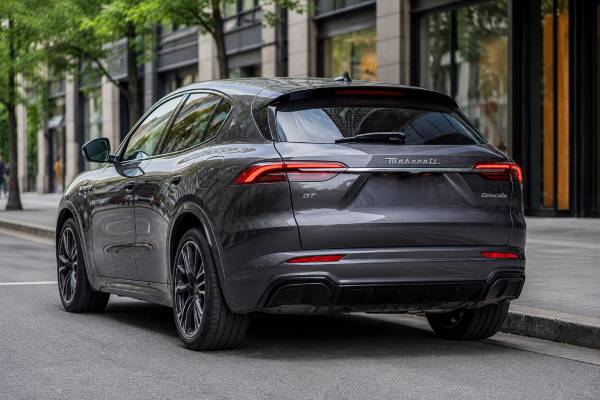
Centro Stile Maserati developed the exterior with familiar brand signatures. The Trident sits in a vertically emphasized grille. Three vents appear behind each front wheel. The rear lamps use a boomerang theme linked to earlier Maserati designs. The roof spoiler and tapered glass reduce visual height, while the lower body retains enough substance to look like an SUV rather than a raised wagon.
The M182 body uses modern mixed-material construction, with steel and aluminum selected according to strength, cost, and weight needs. The exact material distribution is less important to owners than repair quality. Aluminum panels can require specialized methods, and bumper work must account for cameras, parking sensors, and radar calibration.
Cooling and airflow needs are integrated into the front design. The four-cylinder GT does not require the Trofeo’s most aggressive openings, so its face appears cleaner. Underbody panels and carefully shaped exterior surfaces help high-speed stability and noise control. Aerodynamic efficiency is balanced against cooling, brake ventilation, styling, and the practical ground clearance expected of an SUV.
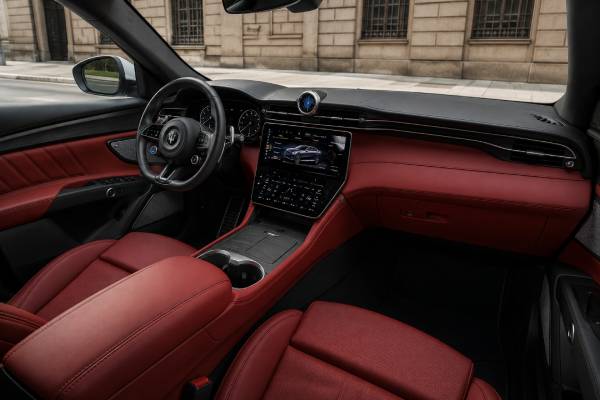
Inside, the Grecale introduced a screen-heavy layout. A digital instrument panel sits ahead of the driver. The central infotainment display handles navigation, media, and connected features. A lower screen controls climate and other functions. The traditional Maserati dashboard clock became digital and can show additional information.
This arrangement creates a modern appearance and allows software updates to change functions, but it also reduces physical redundancy. A failed lower display can affect climate adjustment, and a slow central screen can compromise camera use. Buyers should judge screen response as part of the vehicle’s mechanical condition, not as a minor entertainment issue.
The push-button gear selector frees console space but divides opinion. It looks clean and prevents a conventional lever from blocking the lower screen. During repeated forward-reverse maneuvers, however, some drivers prefer a lever they can operate by touch. Every button should engage the requested gear without delay, and the instrument display should confirm it immediately.
The fixed aluminum shift paddles add a distinctly Maserati touch. They are easy to find during cornering and feel substantial, though their size can interfere with stalk access for some drivers. Manual mode is useful on mountain roads because it lets the driver hold a gear and control engine braking.
Cabin packaging is a major strength. The 2,901 mm wheelbase gives rear passengers useful knee room, while the broad body provides shoulder space. The luggage compartment handles normal family travel, though the sloping rear profile reduces vertical volume compared with a squarer SUV. Owners should test child seats, strollers, golf bags, or pet crates rather than relying only on a published liter figure.
How the 300 hp GT Drives
The 300 hp GT feels brisk, stable, and more responsive than its size suggests. It is not a substitute for the Trofeo, but it has enough performance to make the chassis enjoyable and enough refinement to cover long distances without demanding constant attention.
Initial acceleration is strong because the engine reaches its 450 Nm torque plateau early and the transmission uses a short lower ratio. The official 5.6-second 0–100 km/h time is realistic under good conditions. Launch behavior is controlled rather than violent, with all-wheel drive managing traction and the transmission moving quickly through the first gears.
At urban speed, the powertrain’s complexity is most noticeable. The engine may stop at junctions, restart as the brake is released, and coordinate boost and gear selection as the driver asks for acceleration. A healthy car performs these actions with only a brief pause. A car that repeatedly jerks, hesitates, or displays hybrid warnings needs diagnosis.
The engine is strongest from the middle of the rev range upward. It has more high-speed energy than the 250 hp version and feels comfortable overtaking without a long run-up. Full-throttle sound is functional rather than exotic. Drivers accustomed to Maserati V6 models may miss a richer tone, while owners coming from four-cylinder German SUVs may find it entirely acceptable.
The transmission usually chooses sensible gears. In Normal or Comfort modes, it aims for low revs and may require a firm pedal input before downshifting. Sport mode makes the vehicle more immediate, but it can keep the engine busy in calm traffic. Manual paddle use is rewarding on winding roads because shifts are quick and the driver can keep the engine in its effective range.
Steering response is one of the GT’s better qualities. The wheel is quick off center, the front axle reacts accurately, and the vehicle changes direction with less delay than many tall luxury SUVs. Feedback is not unfiltered, but the driver can place the car confidently. The wide body remains noticeable on narrow roads, especially when optional wheels use broad tires.
Cornering balance is secure and mildly rear-led. Under steady power, the Grecale feels composed rather than front-heavy. If the driver enters too quickly, electronic systems manage understeer and wheel slip. The GT’s lower output means it rarely overwhelms the chassis on dry roads, which can make it easier to enjoy than a more powerful version in ordinary conditions.
Ride quality ranges from supple to firm depending on wheels and suspension. Standard-size tires absorb sharp edges better, while 21-inch wheels can make patched pavement feel abrupt. Adaptive dampers help control body movement, and air suspension can improve versatility, but no suspension can fully isolate very low-profile tires from potholes.
Braking is progressive and conventional in feel because regeneration is modest. The GT should stop straight with a firm, consistent pedal. Repeated hard road use can heat the system, but the steel brakes are well matched to the vehicle’s intended role. Owners planning track use should consider that tires, brake fluid, pads, and vehicle mass become limiting factors before engine power does.
On a motorway, the GT settles into a relaxed cruise. Wind noise is controlled, the wheelbase gives straight-line stability, and the engine turns quietly in upper gears. Driver-assistance systems can reduce fatigue when calibrated correctly. In town, cameras matter because the nose is long, the mirrors are wide, and the rear quarters are difficult to judge.
Real fuel consumption varies widely. The mild-hybrid system cannot overcome short cold trips, congestion, high speed, or aggressive acceleration. A mixed-use result around the high single digits or low double digits in liters per 100 km is plausible. Drivers expecting a dramatic hybrid advantage should instead evaluate the GT against similarly powerful gasoline SUVs.
Maintenance, Faults, and Long-Term Care
The GT rewards preventive maintenance and punishes neglect of batteries, software, fluids, and tires. A complete service record, current recall status, and stable electrical system are more valuable than unusually low mileage on a car that has spent months unused.
Oil, cooling, and turbocharger health
Use the exact oil grade and approval specified for the VIN and market. Turbocharged direct-injection engines place heavy demands on oil because it lubricates the turbo, controls heat, and supports variable valve systems. Repeated short journeys can contaminate oil with fuel and moisture, while hard use raises thermal stress.
Inspect for seepage around the upper engine, turbo oil and coolant connections, and lower covers. A clean engine bay can hide recent washing, so review invoices and look beneath the vehicle. Persistent coolant loss, sweet odor, staining, or an unstable temperature reading requires investigation.
Cold-start misfires, rough idle, smoke, or a reduced-power message are not normal. Possible causes range from ignition components and sensors to boost leaks or software. Diagnosis should use Maserati-capable equipment and freeze-frame data rather than replacing parts by guesswork.
Two electrical systems
The vehicle has a conventional 12-volt system and a 48-volt hybrid network. The 12-volt battery remains critical for control modules, locks, displays, and startup authorization. When it weakens, the car can produce multiple unrelated warnings. Battery testing should include state of health, charging voltage, parasitic drain, and evidence of repeated deep discharge.
The 48-volt system should operate without warnings, unusual belt noise, or disabled stop-start behavior. Specialized safety procedures apply when technicians work on hybrid components. General workshops without correct training should not probe or disconnect the system casually.
Software updates can correct camera, infotainment, and control-module behavior. Ask an authorized dealer or qualified specialist to check the VIN for outstanding campaigns. Grecale recalls in different markets have included rearview-camera display issues and other compliance matters. Applicability depends on build date and VIN, not simply model year.
Transmission, AWD, and tires
Test the eight-speed automatic from cold and after a long drive. It should select Reverse and Drive promptly, upshift without flare, and accelerate without shudder. A single abrupt shift can be adaptation or temperature related, but repeated harshness should be documented and diagnosed.
Check the transfer system, differentials, and driveshaft areas for leaks or vibration. Matching tires are essential. All four should have compatible size, construction, load rating, and similar tread depth. A mixed set may save a seller money but can reduce stability and stress the all-wheel-drive system.
Discuss transmission and driveline fluid service with a specialist if the car will be kept beyond the warranty period. “Lifetime” fluid language does not mean the fluid experiences no wear. Any service must use correct parts and temperature-controlled fill procedures.
Suspension, brakes, and cabin systems
Listen for front suspension knocks, rear-link noise, and wheel-bearing hum. Air-suspension cars should sit level after parking overnight and change height without delay. A leaning corner, compressor running too often, or suspension warning can indicate a leak or sensor issue.
Inspect brake discs for lips, scoring, cracking, and corrosion. Low-mileage cars can have rusty inner disc faces from storage. Check pad thickness and electronic parking-brake operation. Wheel damage is common on large-diameter options; inspect inner barrels for bends.
Operate every cabin function. Test both infotainment screens, digital instruments, cameras, phone pairing, climate zones, heated and ventilated seats, panoramic-roof shade, tailgate, keyless access, and all driver-assistance functions. Intermittent faults deserve attention because module replacement and calibration can be expensive.
Used GT Inspection and Purchase Strategy
Buy the best-documented GT rather than the cheapest or lowest-mileage one. A strong car has verifiable servicing, matched quality tires, no persistent warning messages, complete recall work, two functioning keys, and a clean diagnostic report from a Maserati-capable specialist.
Begin with the VIN. Confirm model year, build date, original market, engine output, factory options, warranty status, and recall history. Compare the certificate of conformity or registration data with the advertisement. Make sure the car is the 300 hp version and has not been confused with the 250 hp regional model.
Request service invoices, not only stamped entries. Invoices reveal oil specification, dates, software visits, battery replacement, tire history, brake work, and repeated complaints. A car that returned several times for the same warning may still have an unresolved intermittent fault.
Inspect the vehicle before it is started. A warm engine can hide cold-start noise, weak-battery behavior, smoke, and rough idle. Check fluid levels, tire dates, wheel condition, panel gaps, paint depth, underbody damage, and signs of water around the panoramic roof and luggage area.
During the drive, include:
- Slow parking maneuvers with repeated Drive and Reverse selection.
- Stop-start traffic to assess hybrid restart smoothness.
- Moderate and full acceleration after warm-up.
- Rough pavement to reveal suspension noise.
- A steady motorway run to check tracking and vibration.
- Several firm brake applications to detect judder.
- Every drive mode and suspension-height setting fitted.
Arrange a full-module diagnostic scan. Ask for stored, pending, and historical faults before codes are cleared. Confirm software and campaign status. A generic engine-code reader is insufficient because many costly problems involve body, infotainment, camera, suspension, or network modules.
| Priority | Prefer | Approach carefully |
|---|---|---|
| History | Complete invoices and dealer/specialist records | Long gaps or repeated undocumented resets |
| Powertrain | Factory software and smooth cold operation | Unknown remaps or tuning boxes |
| Wheels | 19- or 20-inch wheels with matched tires | Bent 21-inch wheels or mixed tire sets |
| Electronics | Fast screens and no warnings | Intermittent camera or ADAS faults |
| Suspension | Quiet steel setup or proven air system | Leaning stance or frequent compressor use |
| Body | Documented cosmetic repairs | Unexplained paintwork near sensors |
An extended warranty can be valuable if it clearly covers infotainment modules, hybrid components, air suspension, and driver-assistance hardware. Read exclusions, diagnostic-charge rules, claim limits, and servicing requirements. A warranty that covers only internal engine failure may leave the most likely expensive issues outside protection.
Budget for premium fuel, annual or mileage-based service, quality tires, insurance, taxes, and depreciation. Keep a reserve for a battery, wheel repair, brakes, or electronic diagnosis. The GT may be the least expensive Grecale to buy, but it remains a modern luxury vehicle with Maserati labor rates and complex electronics.
The 300 hp GT is the balanced launch model. It has enough pace to feel special, a chassis that rewards an engaged driver, and a cabin large enough for family use. Its limitations are clear: the engine lacks V6 drama, the hybrid system offers only modest efficiency, and early software condition matters. Choose a well-maintained example with sensible wheels and useful options, and it can deliver the everyday performance Maserati intended without the greater cost and intensity of the Trofeo.
References
- download the grecale catalogue 2022 (Official Catalogue)
- Maserati Grecale is the Everyday Exceptional 2022 (Manufacturer Publication)
- New Maserati Grecale Global Premiere 2022 (Manufacturer Publication)
- Vehicle Detail Search – 2023 MASERATI GRECALE | NHTSA 2026 (Recall Database)
- Maserati Owner Documentation 2026 (Owner’s Manual Portal)
Disclaimer
This article is for informational purposes and is not a substitute for professional diagnosis, inspection, maintenance, or repair. Specifications, torque values, intervals, procedures, software, recall applicability, and equipment vary by VIN, market, production date, and configuration. Always verify information against the official service documentation for the exact vehicle.
Please share this article on Facebook, X/Twitter, or another platform if it was useful. Sharing supports the creation of more detailed automotive guides.