
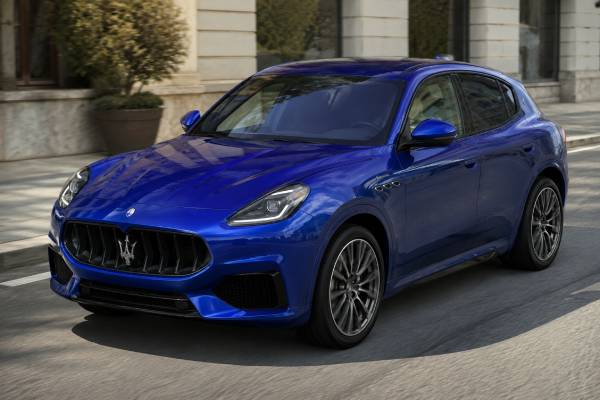
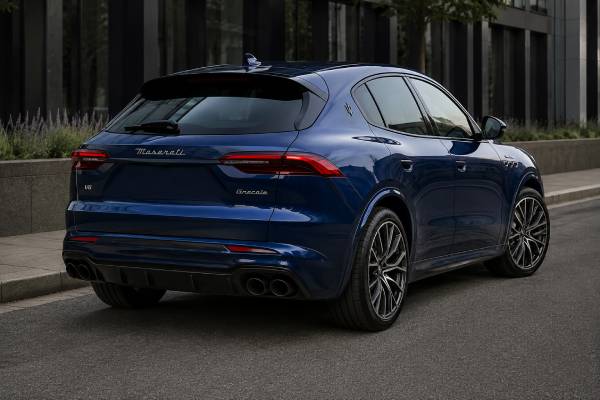
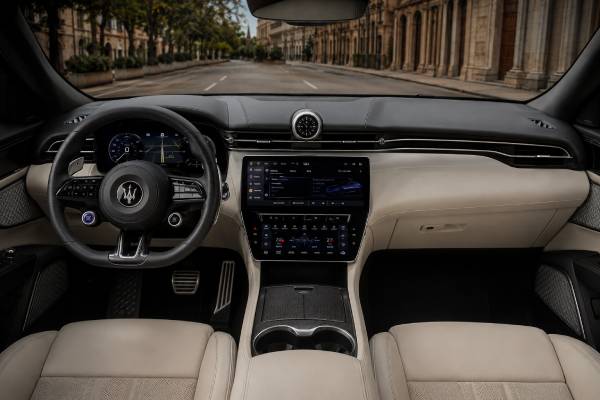
The 2027 Maserati Grecale Modena V6 is the new middle ground for buyers who want Nettuno power without the full visual and dynamic intensity of the Trofeo. Its 3.0-liter twin-turbo V6 produces 390 hp in metric-market specifications, or about 385 hp under the SAE rating used in North America, with 500 Nm of torque. Power reaches all four wheels through an eight-speed automatic, and current specifications list 0–100 km/h in 4.9 seconds and a 260 km/h top speed. Those numbers make it substantially faster than the 330 hp mild-hybrid Modena while leaving clear space above for the flagship Trofeo. The Modena V6 is also more than an engine choice. For model year 2027, Maserati revised the Grecale’s front styling, wheel range, steering wheel, digital clock, gear selector, driver monitoring, and interface graphics. Modena adds its own black exterior details, staggered wheel presentation, sport-oriented leather, and richer personalization choices. Because the version is newly launched, buyers cannot rely on long-term reliability data. A careful order specification, strong warranty support, correct service documentation, and an informed comparison with both the four-cylinder Modena and Trofeo are therefore essential.
Table of Contents
- The Modena V6’s Purpose and Position
- V6 Specification, Transmission, and Chassis
- Trim Content, Production, and Configuration
- Modena Design, Cabin, and Technology
- Performance and Grand-Touring Balance
- Service, Warranty, and Reliability Planning
- Purchase, Order, and Inspection Guide
The Modena V6’s Purpose and Position
The Grecale Modena V6 exists to combine the richer Modena trim with a genuine Maserati six-cylinder engine. It targets drivers who find the four-cylinder Modena too restrained but consider the Trofeo too expensive, aggressive, or demanding for daily use.
Grecale opened a new compact luxury SUV category for Maserati. The original range separated its personalities clearly: GT served as the accessible mild hybrid, Modena added power and visual detail, and Trofeo delivered the 530 hp Nettuno V6. Folgore later introduced full-electric propulsion. This hierarchy offered variety, but there was no moderate-output V6 between 330 and 530 hp.
The 2027 update addresses that gap with a 390 hp Nettuno-derived engine. The 2027 range includes both Grecale V6 and Modena V6 versions, with the Modena carrying the more athletic and luxurious trim treatment. In some markets the engine is quoted at 385 hp because of the local horsepower standard. The hardware and market positioning remain equivalent; buyers should compare kilowatt and torque figures when listings appear inconsistent.
Modena has traditionally represented a sophisticated sporting specification rather than a stripped performance model. The new V6 reinforces that identity. It offers stronger acceleration and sound while retaining a practical rear cabin, useful luggage capacity, three-zone climate capability, modern assistance systems, and an automatic transmission suited to stop-and-go traffic.
The range position can be summarized simply:
- Grecale or Grecale 250/300: lower price and operating cost, four-cylinder mild hybrid.
- Modena 330: sportier trim and 330 hp mild-hybrid power.
- Modena V6 390: the same broad luxury-sport theme with much stronger petrol V6 character.
- Trofeo V6: maximum road performance, more aggressive tuning, dedicated Corsa functions, and a higher ownership budget.
- Folgore: silent electric performance and home-charging dependence.
The Modena V6 is not a “detuned Trofeo” in the simple sense. Although both belong to the Nettuno family, calibration, dynamic systems, brakes, suspension, cooling, exhaust, tires, and standard equipment can differ. Parts should never be assumed interchangeable without VIN-based confirmation.
Its historical importance may outlast its sales volume. As regulations and electrification reshape luxury vehicles, a new non-flagship Maserati V6 SUV represents a deliberate investment in combustion-engine character. The model gives buyers a traditional emotional reason to choose Maserati while still serving family and business use.
Early reputation will depend on how well the version balances those goals. The specification suggests a convincing answer: sub-five-second acceleration, 500 Nm from low rpm, AWD traction, and a cabin designed for distance. The unanswered questions concern long-term electronics, new-model software, residual values, and the cost of maintaining Nettuno hardware outside warranty.
V6 Specification, Transmission, and Chassis
The Modena V6 uses a 3.0-liter twin-turbocharged petrol engine with Maserati’s pre-chamber combustion technology, an eight-speed automatic, and AWD. Its 390 hp and 500 Nm produce a claimed 4.9-second 0–100 km/h time and 260 km/h maximum speed in current European configurators.
| Category | Specification |
|---|---|
| Platform code | M182 |
| Engine layout | Twin-turbocharged V6 petrol engine |
| Displacement | Approximately 3.0 liters |
| Bore × stroke | 88 mm × 82 mm |
| Combustion system | Nettuno-derived pre-chamber ignition with conventional spark support |
| Maximum power | 390 hp at approximately 6,500 rpm; about 385 hp SAE in North America |
| Maximum torque | 500 Nm at approximately 2,000–3,750 rpm |
| Transmission | Eight-speed torque-converter automatic |
| Drivetrain | AWD |
| 0–100 km/h | 4.9 seconds in current market configurators |
| Top speed | 260 km/h |
| Wheelbase | 2,901 mm |
| Luggage capacity | Market publications list approximately 535–570 liters depending on measurement and specification |
Maserati Twin Combustion uses a small pre-chamber above the main combustion chamber. Under suitable load conditions, ignition in this space sends jets of burning mixture into the cylinder, promoting faster and more controlled combustion. A traditional spark plug supports operating conditions where conventional ignition is preferable. The system helps the engine combine high output with broad torque and clean response.
Two turbochargers supply boost. The 500 Nm plateau begins near 2,000 rpm, which is especially useful in an SUV. The engine can accelerate strongly without waiting for high revs, yet the 390 hp peak at about 6,500 rpm provides a sustained upper-range pull. The calibration is designed to feel smoother and more progressive than a simple peak-power figure suggests.
The eight-speed automatic is essential to the car’s dual role. Its torque converter allows gentle creeping and easy hill starts. Closely spaced lower and middle ratios keep the engine responsive, while high gears reduce revs during motorway travel. Paddle shifters give the driver control when approaching a bend or descending a long grade.
AWD helps deploy torque in poor weather and during hard acceleration. The Grecale platform retains a rear-oriented character, but the exact front-axle engagement, differential hardware, and electronic calibration are version-specific. Modena V6 should not automatically be credited with Trofeo’s most aggressive control logic or dedicated Corsa mode.
Suspension equipment varies by country and order. The Modena can be configured with more advanced damping or air suspension in some markets. Air suspension expands ride-height and damping flexibility, but it also adds air springs, valves, sensors, and a compressor. Buyers should decide whether the dynamic benefit justifies the long-term complexity.
Wheel and tire choice affects the Modena V6 more than brochure photographs imply. Wider rear tires support traction and the trim’s planted appearance. Large 21-inch wheels can sharpen turn-in and showcase the brakes, but 20-inch wheels may provide better ride quality, lower tire cost, and greater pothole protection.
European consumption material for the Modena V6 currently lists approximately 10.6–11.1 L/100 km combined and 243–253 g/km of CO₂. Those numbers can change with wheels, equipment, test update, and market. They are a clear warning that the V6’s emotional gain comes with higher fuel and tax costs than the mild hybrid.
Trim Content, Production, and Configuration
Modena V6 is a defined trim-and-engine combination, not merely a 390 hp engine option added to any Grecale. Its black exterior details, sport-oriented cabin, wheel stance, and equipment hierarchy distinguish it from a base Grecale V6 even when both share the same headline output.
The Grecale is produced in Italy on the M182 platform. For model year 2027, the range was reorganized into combustion, hybrid, and electric versions. Regional catalogs do not always display every global version, and some markets launched the Modena V6 before showing a separate Grecale V6. Supply, homologation, and pricing therefore need local confirmation.
Modena-specific visual cues
Several features give Modena a sportier appearance:
- Gloss-black front splitter rather than a body-color treatment.
- Black daylight-opening trim around the side glass instead of bright chrome.
- Black C-pillar badges.
- Black brake calipers in typical specifications.
- Staggered wheel and tire presentation, with a broader rear stance.
- Sport Premium leather seats with contrast stitching.
- Optional three-dimensional carbon-fiber interior trim.
These cues help identify the model, but they do not replace factory documentation. A base Grecale can be modified with black trim and wheels, while a Modena may be ordered with unusual Fuoriserie details. Confirm the VIN-linked specification and original order.
Factory options that deserve priority
A high-value Modena V6 configuration should support comfort, visibility, and future resale. The most useful items are often less dramatic than carbon trim:
- Full surround-view cameras.
- Adaptive cruise control with stop-and-go.
- Highway and traffic-jam assistance where offered.
- Blind-spot monitoring and intersection collision support.
- Head-up display.
- Heated and ventilated front seats with memory.
- Three-zone climate control.
- Premium Sonus faber audio.
- Panoramic roof.
- Adaptive damping or air suspension.
- Correct winter wheel-and-tire package.
Some market versions include a wide assistance package as standard; others bundle features. Read the final equipment printout line by line. Package names can remain similar while contents change between countries or production dates.
The 2027 update adds 20-inch Asteria and 21-inch Crono wheel designs in parts of the range. Before ordering, confirm the tire brand and type supplied, approved winter alternatives, brake clearance, and whether staggered sizing limits tire rotation.
Fuoriserie offers paint, badges, leather, stitching, trim, and more extensive bespoke choices. The program can create a special car, but it also lengthens replacement and repair decisions. A damaged uncommon wheel, seat panel, or paint finish may take longer and cost more to reproduce. Keep the original configuration file and paint code with the service records.
Modena Design, Cabin, and Technology
The 2027 Modena V6 combines a visibly lower, wider front treatment with a more tactile and driver-focused cabin. The refresh addresses the parts occupants use every day rather than changing the Grecale’s basic proportions.
The revised nose adopts a more pronounced horizontal structure and a shark-nose theme linked to newer Maserati sports models. Side air curtains help guide flow around the front wheel arches. The Modena’s gloss-black details make the fascia appear more athletic than the bright-trimmed base version.
The long hood, rear-set cabin, three side vents, frameless windows, and muscular rear shoulders remain central to the Grecale’s identity. Frameless glass looks elegant but requires correct window indexing. Each pane should lower slightly when a door opens and seal fully after closing. Wind noise, glass contact, or slow movement deserves attention.
Inside, the steering wheel has a new octagonal geometry with flatter upper and lower sections and a six-o’clock spoke. Perforated leather suits Modena’s daily-performance role. The digital clock receives a metal octagonal crown and mineral-crystal appearance, replacing a more ordinary previous surround.
The PRND selector is redesigned with three-dimensional metal buttons, lighting, and haptic operation. In supported configurations, paddle logic allows selection between drive and reverse at very low speed, below a defined threshold. The feature can make repeated parking maneuvers faster, but the driver should learn it in an open area before relying on it near obstacles.
The display layout includes a 12.3-inch central infotainment screen, an 8.8-inch comfort screen, a digital instrument panel, and an available head-up display. Updated graphics and a revised Drive Mode Explorer make changes in accelerator, suspension, and control settings easier to understand.
A driver-monitoring camera can detect distraction or drowsiness. Assistance systems may include adaptive cruise, lane management, intersection collision support, and a surround-view camera. Their operation depends on visible road markings, clean sensors, weather, and local software. They support the driver; they do not make the vehicle autonomous.
The Modena cabin emphasizes genuine materials. Leather, wood, metal, and optional carbon fiber give it a stronger sense of occasion than many mass-market luxury SUVs. Condition still matters. Glossy screens scratch, pale leather marks, and soft trim can be damaged by rings, luggage, or child seats. Protective care is preferable to harsh cleaning products.
Rear space benefits from the 2,901 mm wheelbase, and the cabin comfortably accommodates four adults. Three-zone climate and rear power connections improve family use. Cargo capacity is competitive, although published figures differ by regional measurement method. Buyers carrying a stroller, large pet crate, golf equipment, or mobility device should test the exact item.
Performance and Grand-Touring Balance
The Modena V6’s central achievement is speed without constant aggression. It can reach 100 km/h in 4.9 seconds, yet the torque converter, broad torque band, and refined cabin let it behave like a relaxed long-distance SUV.
At low speed, the V6 should feel more effortless than the 330 hp four-cylinder. The gearbox can use fewer downshifts because 500 Nm is available from around 2,000 rpm. This reduces noise during normal acceleration and makes the car more responsive when carrying passengers.
Under full throttle, the engine continues to build toward its power peak. The sound is richer and more layered than the mild hybrid, though Modena is not intended to be as loud or theatrical as Trofeo. Laminated glass and acoustic tuning should keep steady-speed cruising calm.
Drive modes adjust accelerator response, gearbox strategy, steering assistance, electronic controls, and suspension where applicable. GT is the natural setting for everyday travel. Sport increases urgency and holds gears longer. Off-Road supports lower-speed poor-surface use within the limits of road-focused tires and body clearance. Corsa remains a Trofeo feature and should not be expected on Modena V6.
The AWD system gives strong launch traction and stability in rain or cold conditions. It does not remove the need for suitable tires. A 390 hp SUV on summer performance tires can have very limited winter ability even with four driven wheels.
Steering should feel accurate and lighter than a traditional sports car. The long wheelbase aids stability, while the rear-oriented platform gives the vehicle a more natural balance than many front-based crossovers. The Modena’s staggered tires can improve rear grip but prevent normal front-to-rear rotation and may increase replacement cost.
Ride quality depends on the chosen hardware. Air suspension can soften urban impacts, maintain ride height under load, and lower the body in more dynamic settings. Large wheels still transmit sharper edges. A steel-spring car on 20-inch wheels may ride better than an air-suspended car on the most aggressive low-profile tires over broken pavement.
Braking should be strong and progressive. The car’s performance and mass demand healthy tires, pads, discs, and fluid. A colored caliper is not proof of a particular brake package. Confirm disc dimensions and material from the factory specification if repeated mountain or high-speed use is planned.
The Modena V6 is at its best on mixed long-distance routes: urban departure, motorway cruising, and a fast final road. It offers much of the emotional gain people seek from Trofeo while remaining calmer and potentially less costly. Drivers who prioritize track work, launch control, maximum brake endurance, or the most aggressive suspension should still choose Trofeo.
Service, Warranty, and Reliability Planning
The 2027 Modena V6 is too new for a meaningful long-term reliability verdict. Owners should treat early warranty coverage, correct oil, stable battery voltage, software updates, and documented dealer work as the primary defenses against expensive surprises.
Nettuno engine priorities
The twin-turbo V6 combines direct injection, complex ignition hardware, high combustion pressure, and substantial heat. It requires the exact approved oil specification and a service schedule matched to the VIN and market. Annual or time-based maintenance remains important for low-mileage cars that make frequent short trips.
Start the engine cold during any inspection. The initial mechanical sound should settle promptly. Persistent rattle, uneven idle, smoke, misfire, fuel odor, coolant loss, or a reduced-power message needs factory-level diagnosis.
Warm the engine before sustained high load. After a demanding drive, finish gently to let oil, coolant, turbocharger, and exhaust temperatures stabilize. Keep the front cooling openings and radiators clear of leaves and debris.
Transmission, driveline, and tires
The eight-speed automatic should engage drive and reverse without delay and shift consistently when cold and hot. A software reset may change adaptation, but repeated flare, shudder, or impact should not be accepted without a clear repair.
All four tires must meet the approved size, load, speed, and construction requirements. On staggered fitments, front and rear sizes differ by design, but circumference still must remain within the manufacturer’s tolerance. Replace damaged tires with the correct matching specification rather than the nearest available alternative.
Inspect the inner edges for alignment wear. Bent wheels and out-of-round tires can create vibration that feels like a driveline fault. AWD components also depend on consistent rolling radius.
Electronics and suspension
The new steering wheel, haptic selector, driver-monitoring camera, revised graphics, assistance systems, and connected services create many potential software interactions. Test every function and keep records of updates. A weak 12-volt battery can produce multiple unrelated warning messages.
When air suspension is fitted, the car should remain level after parking. Height changes should occur without excessive compressor operation. Slow response, leaning, or a recurring suspension warning requires inspection of air springs, valves, lines, sensors, and compressor health.
Panoramic-roof drains, frameless-window seals, and luggage-area water paths should remain dry. Moisture can damage modules before staining becomes obvious. Check beneath mats and around the spare-wheel or tool area.
Brake and tire costs will be significant. Performance tires may wear quickly under aggressive acceleration, while heavy city use can consume front pads. Low-use cars can develop disc corrosion. Measure condition rather than relying on mileage.
Warranty extensions and service plans are particularly valuable on an early production model. Confirm transferability, geographic coverage, exclusions, required servicing, and claim procedures before signing. Keep every invoice, diagnostic report, campaign notice, and software update record.
Purchase, Order, and Inspection Guide
The best Modena V6 purchase is a correctly specified car supported by a strong dealer, not simply the first available example. The version’s value depends on its option balance, wheel choice, warranty, and proof that it is a genuine factory Modena V6.
Ordering new
Obtain a complete written configuration showing the model code, 390 hp or local-equivalent rating, 500 Nm torque, AWD, suspension, brakes, wheels, tires, assistance systems, interior, paint, service plan, and warranty. Confirm the model year and estimated production date.
Ask specific questions:
- Is air suspension standard, optional, or unavailable on this market version?
- Which assistance package includes the surround-view camera?
- Are the front and rear tires staggered?
- What winter wheels are officially approved?
- Is premium audio included?
- Which connected services require subscriptions?
- Can the warranty be extended before delivery?
- Does the quoted emissions value change with the selected wheels?
Choose options around use. A frequent motorway driver benefits from adaptive cruise, head-up display, supportive seats, and moderate wheels. An urban owner should prioritize cameras, wheel protection, and ride comfort. A buyer focused on resale should avoid an excessively personal color combination unless the price reflects the narrower audience.
Inspecting a demonstrator or early used car
Request the VIN build sheet, warranty start date, service history, diagnostic and campaign record, both keys, charging accessories for devices, and proof of connected-account release. Demonstrators can accumulate hard launches, curb damage, and short cold journeys despite low mileage.
Inspect paint, wheel barrels, tire sidewalls, seat bolsters, steering wheel, screens, carbon or wood trim, cargo plastics, and underbody panels. Check glass dates and panel gaps for accident evidence. Verify that every Modena-specific trim piece matches the build sheet.
The road test should begin cold and include slow full-lock turns, gentle shifting, a safe full-throttle acceleration, steady-speed cruising, rough surfaces, and firm braking. Test all drive modes and suspension heights. Afterward, scan every module with Maserati-capable equipment and recheck for leaks or warnings.
A professional inspection should cover:
- Engine, cooling, and turbocharger systems.
- Automatic transmission and AWD fault memory.
- Battery health and charging behavior.
- Wheel runout, tire age, and alignment.
- Brake-pad and disc measurements.
- Air-suspension leak-down where equipped.
- Camera and radar calibration.
- Paint depth and structural repair signs.
- Software version compatibility across modules.
Modena V6 versus the alternatives
Choose the 330 hp Modena when lower tax, fuel consumption, and purchase price matter more than sound and acceleration. Choose Trofeo when maximum performance, Corsa mode, and flagship equipment justify the higher cost. Choose the Grecale V6 if available locally and its simpler trim offers better value with the same basic output.
The Modena V6 is likely to be the most desirable balanced combustion Grecale for many owners. It has the engine identity missing from the mild hybrids, a more usable temperament than Trofeo, and a trim level that feels special without becoming theatrical. Its risks are those of a new, complex, high-performance luxury vehicle: early software revisions, expensive options, high consumable costs, and limited long-term evidence. Strong warranty coverage and disciplined maintenance are part of the purchase, not optional extras.
References
- Maserati Grecale Modena – 2027 Luxury Crossover | Maserati 2026
- Grecale Modena 2026
- Maserati Build and Price – Car Configurator Tool 2026
- New Maserati GranTurismo, GranCabrio and Grecale 2026
- Maserati Owner Documentation 2026 (Owner’s Manual)
Disclaimer
This article is for informational purposes only and is not a substitute for professional diagnosis, maintenance, or repair. Specifications, torque values, service intervals, equipment, performance, and procedures vary by VIN, market, production date, and installed options. Verify all information against the vehicle’s official service documentation and consult a qualified Maserati technician. Please share this article on Facebook, X/Twitter, or another platform if it helped you; sharing supports our work.