
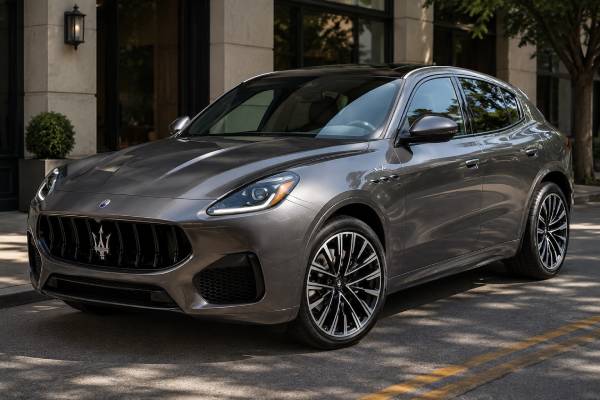
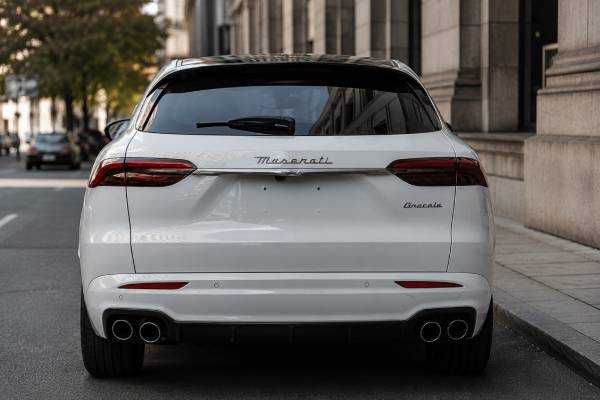
The 2026-on Maserati Grecale with the 300 hp 2.0-liter mild-hybrid engine is the central all-rounder in the M182 range. It sits above the 250 hp version offered in selected markets but below the 330 hp Modena, V6 models, and electric Folgore. Its appeal comes from balance rather than one headline feature: 300 hp, 450 Nm of torque, Q4 all-wheel drive, an eight-speed automatic, and a 0–100 km/h time of 5.6 seconds. Maserati also simplified the name for this generation of the range. The earlier “GT” designation gave way to Grecale, so a 2026 car may be advertised as Grecale 300 even though its basic mechanical idea continues the original 300 hp GT. That continuity can confuse specification comparisons because equipment packages, software, wheel choices, and market homologation changed over time. The 300 hp model remains the sensible choice for drivers who want stronger performance than the tax-focused 250 without paying for Modena trim or a V6. This article separates the 2026-on car from earlier versions and explains its specifications, engineering, road behavior, upkeep, and buying risks.
Table of Contents
- The 300 hp Grecale’s Range Role
- Powertrain, Platform, and Specifications
- Production Updates and Equipment Choices
- Body, Cabin, and Hybrid Systems
- Performance, Ride, and Handling
- Maintenance and Fault Prevention
- Used-Purchase Decision and Inspection
The 300 hp Grecale’s Range Role
The 300 hp Grecale is the range’s mainstream performance specification: fast enough to feel distinctly premium, restrained enough for daily ownership, and less specialized than Modena, Trofeo, or Folgore. It is the version most likely to suit a buyer who wants one Maserati for commuting, family travel, winter use, and occasional fast-road driving.
Grecale entered production as Maserati’s smaller SUV and broadened the brand beyond the larger Levante. The M182 model arrived in a market where luxury crossovers had become core products rather than side projects. Maserati therefore had to combine visual identity with the space, technology, safety equipment, and drivability expected from a modern premium SUV.
At launch, the 300 hp mild hybrid was commonly called Grecale GT. By model year 2026, several markets used the simpler Grecale name for the same output level. The change did not create an entirely new engine. It represented a lineup and equipment repositioning, with later colors, trim combinations, software, and package structures layered onto the existing longitudinal four-cylinder architecture.
The model sits in an important gap. The 250 hp Grecale can deliver almost the same everyday torque but is slower at the top of the rev range. The 330 hp Modena adds output and often richer trim. The V6 variants provide stronger sound and acceleration but consume more fuel and cost more to insure and maintain. Folgore offers immediate electric performance but introduces charging and battery considerations.
Why buyers still consider the 300 hp car:
- The 5.6-second acceleration figure is genuinely quick for a practical SUV.
- Its 450 Nm torque arrives across a broad middle range, so it rarely feels weak in ordinary traffic.
- Q4 all-wheel drive supports year-round use without making the car feel purely front-driven.
- It retains the same basic cabin concept and visual presence as more expensive Grecale versions.
- The eight-speed automatic is familiar, smooth, and better suited to towing or creeping traffic than a dual-clutch gearbox.
The main compromise is emotional. The 2.0-liter engine is effective, but its note and power delivery cannot reproduce the texture of a Nettuno V6. Buyers attracted by the Maserati badge for sound alone should compare versions back-to-back. Those who value response, comfort, and manageable running costs may find the 300 hp model more coherent.
Its reputation today depends heavily on specification. A well-optioned Grecale 300 with useful assistance systems, cameras, comfortable seats, and sensible wheels can feel complete. A sparsely equipped example may seem expensive next to German rivals. The badge tells only part of the story; the build sheet determines the actual ownership experience.
Powertrain, Platform, and Specifications
The 2026-on Grecale 300 uses a turbocharged 1,995 cc inline-four with 48-volt mild-hybrid assistance. It produces 300 hp and 450 Nm, drives all four wheels through an eight-speed automatic, and reaches 100 km/h in a claimed 5.6 seconds.
| Category | Specification |
|---|---|
| Model code | M182 |
| Engine | Turbocharged inline-four gasoline engine |
| Displacement | 1,995 cc |
| Hybrid system | 48-volt mild hybrid with belt starter-generator |
| Maximum power | 300 hp |
| Maximum torque | 450 Nm |
| Transmission | Eight-speed torque-converter automatic |
| Drive system | Q4 all-wheel drive |
| 0–100 km/h | 5.6 seconds |
| Current listed top speed | 229 km/h in several 2026 and current market specifications |
| Wheelbase | 2,901 mm |
Top-speed listings require care. Some earlier 300 hp GT material and certain market configurators show 240 km/h, while several model-year 2026 and current pages list 229 km/h. The difference may reflect homologation, software, tire approval, or market configuration. Buyers should use the certificate of conformity and VIN-specific documentation rather than assuming every 300 hp car has the same limiter.
The GME T4 engine is installed longitudinally. That matters because it allows Maserati to build the Grecale around rear-oriented proportions and a rear-biased driving feel. Direct fuel injection, turbocharging, variable valve control, and electronic boost management deliver the output expected from a smaller engine without requiring high revs in normal use.
The 48-volt system is an assistant, not a second propulsion source. A belt starter-generator recovers some energy during deceleration, supports smooth restarts, and reduces the load of certain accessories. The system also works with electrically assisted boost hardware to improve response before exhaust flow fully energizes the conventional turbocharger. It cannot provide meaningful electric-only driving.
The automatic transmission uses a torque converter for smooth launch behavior and eight ratios for flexibility. Lower gears help the SUV move decisively from rest, while upper ratios reduce engine speed on the motorway. Aluminum steering-wheel paddles are standard in many configurations and give the driver direct control without converting the vehicle into a track-focused machine.
Q4 all-wheel drive varies torque distribution according to grip and demand. The system’s rear-oriented behavior helps the Grecale rotate more naturally than a typical front-based crossover. Electronic stability control remains central to the strategy, and tire condition has a major influence on how well the system works.
The chassis uses independent suspension, electrically assisted steering, and disc brakes at all four corners. Steel springs and conventional or adaptive damping appear on many cars; air suspension may be optional depending on market and package. Wheel sizes can range from relatively comfort-focused choices to large, visually dramatic fitments. Larger is not always better. Added unsprung mass, lower tire sidewalls, and higher replacement prices can outweigh the small gain in initial steering sharpness.
Published dimensions changed slightly with later bumper and body-detail updates, while the 2,901 mm wheelbase remained a useful constant. Exact length, width, height, tire size, weight, cargo volume, fuel capacity, and towing limit should be checked against the specific vehicle’s documentation.
Production Updates and Equipment Choices
The 2026-on Grecale 300 is identified more by model-year equipment and naming than by a wholesale mechanical redesign. The critical buying task is to establish what the individual car actually includes, because market packages can alter comfort, appearance, assistance technology, and suspension specification.
Maserati produces the Grecale in Italy on the M182 architecture. During the model’s life, the company has adjusted trim names, color availability, wheel designs, interior combinations, connected functions, and standard equipment. The 300 hp engine remains a recurring base powertrain in many markets, but it is not universally sold everywhere or under identical naming.
A 2026 car may simply display “Grecale” in the configurator, while older sales material or dealers may continue to use “GT.” This can produce listings that appear inconsistent without being fraudulent. The safest identifiers are:
- VIN-linked factory specification.
- Engine output shown on registration documents.
- Model year and production date.
- Original sales invoice or order form.
- Factory option codes and approved wheel sizes.
- Software and campaign history from an authorized service system.
Equipment worth prioritizing
The most useful options improve visibility, long-distance comfort, and resale demand.
- 360-degree camera: strongly recommended for tight parking and wheel protection.
- Adaptive cruise control with stop-and-go: valuable for motorway and congested-road use.
- Blind-spot and active-lane functions: useful, but confirm exact capabilities rather than relying on package names.
- Heated, ventilated, or memory seats: important in extreme climates and expensive to retrofit.
- Panoramic roof: makes the cabin brighter; inspect seals, drains, shade movement, and headliner.
- Premium audio: desirable to many owners because the standard system may not meet luxury-car expectations.
- Adaptive dampers or air suspension: broaden the dynamic range but add complexity.
- Tow package: must be factory-approved or correctly integrated, with the VIN-specific limit observed.
Wheel choice deserves special attention. A smaller approved wheel generally provides a better ride, cheaper tires, and more pothole protection. A larger wheel can improve stance and steering immediacy but increases the chance of bent rims, cracked sidewalls, and cosmetic damage. Used buyers should inspect the inside barrel, not only the visible face.
Fuoriserie options can make a car unusually attractive or unusually difficult to resell. Factory evidence is essential for special paint, leather, stitching, carbon trim, or personalized details. A rare color is not automatically more valuable; condition and broad appeal still matter.
2026 versus later current production
Later catalog and website material may show revised exterior dimensions, a refreshed visual presentation, or altered range hierarchy. Those updates should not be applied retrospectively to every 2026 car. Owners ordering replacement body parts, wheels, sensors, or accessories should supply the VIN because visually similar Grecales may use different components or calibrations.
Connected services also depend on market, subscription status, mobile-network support, and account transfer. A seller’s working phone application does not guarantee that the new owner can activate every service. Confirm transfer rules before purchase.
Body, Cabin, and Hybrid Systems
The Grecale 300’s engineering character comes from its sports-car-influenced packaging inside a practical five-door body. A long hood, short front overhang, wide stance, and rear-set cabin create proportions that look less utilitarian than many SUVs.
The front grille and three fender vents make the vehicle recognizable as a Maserati. Frameless door glass gives a coupe-like detail without sacrificing rear doors. It also means window indexing must work correctly: the glass should lower slightly when a door opens and reseal cleanly when it closes. Wind noise, slow movement, or glass contact can point to alignment, calibration, battery, regulator, or seal problems.
Under the skin, the longitudinal engine position leaves room for the front axle and all-wheel-drive hardware while preserving rearward visual balance. Cooling is complex because the engine, turbocharger, charge-air circuit, transmission, air conditioning, and electrical systems all create heat. Front shutters, ducts, heat exchangers, and underbody panels should be intact after any collision or curb strike.
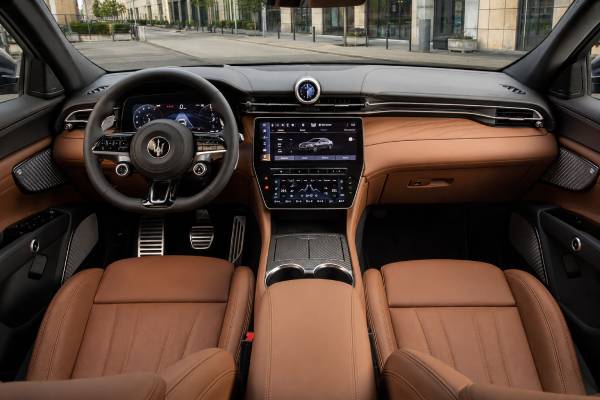
The cabin uses a layered digital layout. A configurable instrument display faces the driver, a central touchscreen manages infotainment, and a lower screen handles climate and other functions. The traditional Maserati clock position contains a digital display. This arrangement is visually distinctive, but it makes screen stability and module communication central to everyday usability.
Physical shortcuts remain limited compared with older cars. A buyer should test climate adjustment, demisting, seat controls, navigation, cameras, and media while driving safely to decide whether the interface feels intuitive. Software speed is not enough; the screens must also remain legible in glare and respond reliably when cold or hot.
The push-button transmission selector frees console space. It works well once familiar, but hurried drivers may initially reach for a nonexistent lever. Verify that every selector button responds immediately and that reverse-camera activation is consistent.
The hybrid hardware in daily use
The 48-volt system mainly improves transitions. It helps the engine restart, supports low-rpm response, and recovers limited energy. It does not need external charging, and the driver does not select an electric mode. The gasoline engine remains active for propulsion almost all the time.
This simplicity is useful for owners without charging access, but it also means fuel economy depends heavily on route and driving style. Short winter trips, repeated acceleration, urban congestion, and high-speed cruising can produce consumption far above an official combined figure. The strongest efficiency gains appear when the vehicle can coast, recover energy, and operate at steady moderate load.
Passenger space is competitive because of the long wheelbase. Adults can use the rear seats without the cabin feeling like a compromised sports derivative. The luggage area handles normal family needs, though roof slope and trim shape may reduce the usefulness of the last few liters. Test real objects such as a stroller, bicycle, mobility aid, or dog crate rather than relying only on volume figures.
Performance, Ride, and Handling
The Grecale 300 feels notably stronger than its four-cylinder description suggests. Its 450 Nm torque, fast-shifting automatic, and all-wheel-drive traction make overtaking and motorway merging easy, while the 5.6-second 0–100 km/h figure places it firmly in performance-SUV territory.
At low speed, the torque converter allows smooth creep and parking movement. The mild-hybrid restart system usually makes stop-start events less abrupt. In the middle gears, the engine pulls with useful urgency and does not require constant downshifts. Hard acceleration reveals the engine’s practical nature: it becomes louder and more strained than a V6, but the speed accumulates quickly.
Drive modes alter throttle response, transmission strategy, steering assistance, stability control, and suspension behavior where adaptive hardware is fitted. The normal setting best suits mixed use. A sportier mode holds lower gears and makes the car feel more alert, but it can also magnify abrupt throttle inputs in traffic.
The steering favors accuracy and ease over heavy feedback. The front end responds promptly for an SUV, and the rear-biased chassis helps the car feel balanced through a bend. Q4 adds front-axle drive when needed, reducing wheelspin and improving security. On public roads, the system’s greatest benefit is confidence in changing weather rather than dramatic corner-exit behavior.
Ride comfort varies more by wheel and suspension choice than by engine output. Moderate wheels and healthy tires allow the body to settle calmly over long undulations. Very large wheels can make broken city surfaces feel busy. Air suspension, where fitted, adds height adjustment and a wider comfort range, but buyers should not assume it is standard.
Brake feel should be progressive and stable. Gentle deceleration blends normal braking with energy recovery, though the effect is subtle. A pulsing pedal, steering shake, pull, or scraping noise is not normal. Repeated hard stops can overheat tires and brakes because the Grecale remains a heavy vehicle despite its agile character.
Visibility forward is reasonable, but the broad body and high rear shoulders make cameras valuable. The driving position offers a good range of adjustment, and the steering-wheel paddles are easy to reach. Rear visibility and tight urban maneuvering are less relaxed without parking assistance.
For a daily driver, the Grecale 300’s performance is arguably the sweet spot. It can be calm in traffic, quiet enough on a motorway, and entertaining on a flowing road. It lacks the Trofeo’s explosive force and soundtrack, yet it also avoids that model’s fuel use, tire demands, and purchase cost.
Maintenance and Fault Prevention
Reliable ownership depends on preventive care, stable battery voltage, correct tires, current software, and technicians who understand Maserati diagnostics. The 300 hp engine may be smaller than the V6, but the vehicle around it is still a complex luxury SUV.
Service intervals vary by VIN and market, so the official maintenance schedule takes priority over a generic distance. Time matters as much as mileage. Cars used only for short journeys may accumulate condensation, fuel dilution, battery discharge, and brake corrosion even when the odometer rises slowly.
Engine and cooling system
Start the engine cold and listen for abnormal noise after the initial oil-pressure phase. The idle should settle, exhaust smoke should clear promptly, and no persistent warning should appear. Check for oil seepage, dried coolant residue, damaged undertrays, and evidence of previous overheating.
Turbocharged direct-injection engines place high demands on oil. Use the exact approved grade and specification. Delayed oil changes can affect turbo bearings, timing hardware, deposits, and long-term wear. After a hard drive, an easy final section allows temperatures to stabilize before shutdown.
Cooling-system condition is critical. The front heat exchangers can collect debris or suffer hidden impact damage. Repeated fan operation, coolant smell, rising temperature, or reduced-power messages require diagnosis rather than topping up fluid and continuing.
Transmission, AWD, and tires
The eight-speed automatic should engage promptly and shift without repeated flare or thump. Software adaptation can influence behavior, but mechanical symptoms should not be dismissed as “normal Maserati character.” Confirm whether fluid service is recommended for the car’s use and age, especially after towing or high-temperature operation.
Install four matching tires with correct load and speed ratings. Keep tread depths close across the axles. Mismatched rolling circumference can confuse stability systems and increase stress on AWD components. Alignment should be checked when inner-edge wear, steering pull, or an off-center wheel appears.
Brakes are a significant cost. Measure pads and discs rather than judging through the wheel. Corrosion can develop on low-use cars, while aggressive driving can create heat spots or variation. Electronic parking-brake operation should also be tested.
Electronics and cabin hardware
A weak 12-volt battery can create a cascade of warnings that imitate larger faults. Battery state should be tested, not guessed. The 48-volt circuit requires trained handling and proper isolation procedures.
Check both keys and every powered item. Common ownership frustrations on modern luxury vehicles include intermittent cameras, infotainment resets, phone-pairing faults, window-indexing errors, sensor warnings, and failed software updates. One documented repair is less concerning than a pattern of unresolved visits.
Air suspension adds specific checks when fitted. The vehicle should sit level after being parked, change height without excessive delay, and avoid repeated compressor cycling. Inspect panoramic-roof drains and interior carpets for moisture. Water entry can damage expensive modules long after the original leak begins.
Warranty and service-plan coverage have real value because diagnosis often requires factory-level software and parts may not be inexpensive or immediately available. Keep complete invoices and update records to support both claims and resale.
Used-Purchase Decision and Inspection
A good Grecale 300 should be bought for its complete package, not merely because it is the least expensive Maserati in the search results. Condition, equipment, history, and remaining coverage matter more than a small difference in mileage.
Before viewing, request the VIN, build sheet, registration, service history, repair invoices, campaign record, and proof of both keys. Confirm that the advertised 300 hp specification matches the documents. Ask whether body glass, bumpers, suspension parts, or driver-assistance sensors have been replaced.
At the car, inspect it in dry daylight. Look along the paint for mismatched texture, overspray, uneven gaps, or different glass dates. Examine all wheels inside and out. Check tire dates, model, tread depth, and inner shoulders. Inspect the lower grille and radiators for stone or impact damage.
Start from cold. Allow every warning lamp to complete its self-check. Test stop-start operation after the vehicle is warm, all drive modes, manual shifts, parking sensors, cameras, assistance systems, climate control, seats, windows, roof, tailgate, audio, navigation, and connected functions.
The road test should include:
- Slow full-lock turns in both directions.
- Light and moderate acceleration through several gears.
- A safe full-power pull to check boost and shifting.
- Steady motorway speed for vibration and wind noise.
- Rough surfaces for suspension knocks.
- Firm braking for stability and disc condition.
- Repeated reverse and drive selection on level ground.
After driving, scan all modules with Maserati-capable diagnostic equipment. Generic code readers may miss network, suspension, hybrid, body, or assistance-system information. A specialist should also measure brakes, assess battery health, inspect the cooling system, check underbody damage, and verify alignment and ADAS calibration.
How to choose between nearby variants
Compare the 300 hp car directly with the 250 and 330 hp versions available in your market. The 250 may reduce tax or purchase cost while feeling similar at low rpm. The 330 Modena may include equipment that would cost more to add to a base Grecale. A V6 is more exciting but carries a different ownership budget.
The best value often lies in a 300 hp car with moderate wheels, comprehensive cameras and assistance, comfortable seats, a desirable but not extreme color combination, and documented maintenance. Air suspension is worth considering for ride quality, but buyers keeping the vehicle far beyond warranty may prefer simpler hardware.
Budget for premium fuel where specified, quality tires, brake wear, annual servicing, insurance, and depreciation. Do not spend the full purchase budget on the car itself. A reserve for an unexpected module, wheel, sensor, or cooling repair prevents a manageable issue from becoming a neglected one.
The verdict is that the 2026-on Grecale 300 is the most broadly useful four-cylinder version. It is fast, distinctive, and practical without pretending to be the range flagship. Buy a well-documented example with the right equipment, verify market-specific performance data, and treat software and battery health as seriously as traditional mechanical condition.
References
- Maserati Grecale: 2027 Luxury SUV Versions & Specs | Maserati 2026
- Maserati Grecale 2026: Luxury SUV – Versions and Specifications | Maserati UAE-EN 2026
- Build and Price 2026
- Maserati Owner Documentation 2026 (Owner’s Manual)
- Vehicle Detail Search – 2026 MASERATI GRECALE | NHTSA 2026 (Recall Database)
Disclaimer
This article is for informational purposes only and does not replace professional inspection, diagnosis, maintenance, or repair. Specifications, torque values, service intervals, equipment, and procedures vary by VIN, market, production date, and options. Always verify technical information against the vehicle’s official service documentation and use a qualified Maserati technician. Please share this article on Facebook, X/Twitter, or another platform if you found it useful; sharing helps support our work.