
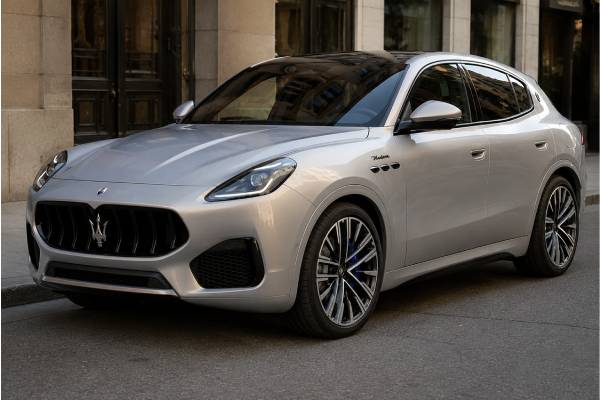
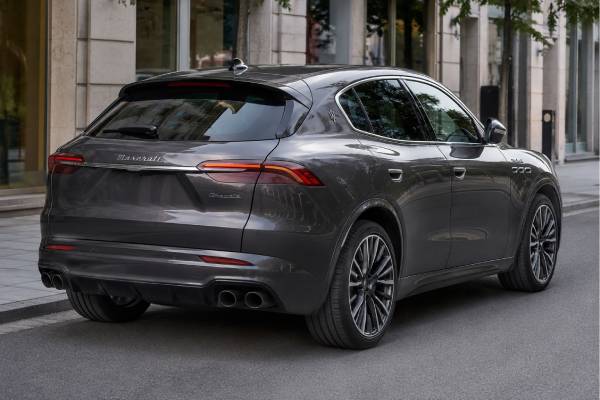
The Maserati Grecale Modena 330 is the most sporting version of the four-cylinder M182 Grecale. It combines a 2.0-liter GME T4 turbo engine, 48-volt mild-hybrid assistance, an eight-speed automatic, and all-wheel drive to produce 330 hp and 450 Nm. With 0–100 km/h in 5.3 seconds and a 240 km/h maximum speed, it offers a useful step beyond the original 300 hp GT without approaching the cost, fuel use, or intensity of the Nettuno-powered Trofeo.
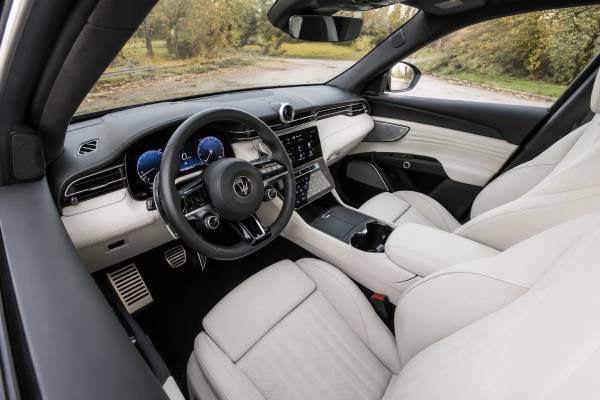
Modena trim also changes the atmosphere. Exterior detailing is darker and more assertive, wheel choices are usually larger, and cabins often use sportier leather, stitching, and trim. Yet the vehicle retains the Grecale’s 2,901 mm wheelbase, generous rear room, and practical five-door body. That combination makes it attractive to buyers who want a daily SUV with a stronger visual and dynamic identity rather than a dedicated high-performance model. The mild-hybrid label needs context: this is a self-charging 48-volt system that supports the gasoline engine, not a plug-in vehicle or an electric commuter. This guide explains the Modena 330’s history, technical layout, updates through the current range, driving character, maintenance needs, and the inspection steps that matter before purchase.
Table of Contents
- Modena 330 Role and Model History
- Technical Specifications and Chassis Layout
- Production Changes, Options, and Identification
- Sporting Design and Hybrid Technology
- Performance, Ride, and Real-World Use
- Maintenance, Weak Points, and Service Planning
- Buying a Grecale Modena 330
Modena 330 Role and Model History
The Modena 330 sits between the comfort-led Grecale GT and the V6 Trofeo, delivering most of the four-cylinder range’s usable performance with a more distinctive specification. It has remained an important global derivative from the Grecale’s 2022 launch into the updated range.
Maserati introduced the Grecale as a smaller companion to the Levante and named it after a Mediterranean wind. The M182 model uses a longitudinal-engine platform derived from the Giorgio architecture, but with Maserati-specific dimensions, body, electronics, calibration, and interior. Production began in Italy at the Cassino plant.
At launch, the range was deliberately tiered. The GT used a 300 hp mild-hybrid four-cylinder in most markets. The Modena raised output to 330 hp while preserving 450 Nm. The Trofeo used a 530 hp twin-turbo V6. This placed Modena in a valuable middle position: faster and more expressive than the base car, but lighter in character and easier to operate than the flagship.
The name also carries brand meaning. Modena is Maserati’s historic home, so the trim is intended to suggest a more focused Italian identity rather than merely an equipment package. Typical differences include black exterior accents, sportier bumpers or inserts, larger wheels, performance-themed upholstery, and a firmer visual stance. Actual equipment varies considerably by country and model year.
The Grecale arrived during a major transition for Maserati. Older sedans and the Levante were nearing the end of their cycles, while the brand was introducing the MC20, the new GranTurismo, and battery-electric Folgore models. The Modena 330 therefore represents Maserati’s attempt to combine traditional performance cues with downsized, electrified powertrain technology.
For the 2026 catalogue, the 330 hp Modena remained listed in many international markets even as North American offerings moved toward V6 power. For the advertised 2027 update, Maserati retained the 330 hp mild-hybrid in applicable markets while revising the front bumper and grille, adding new wheel designs, updating the steering wheel, improving the digital clock surround and PRND controls, and refreshing the interface graphics. Availability still depends on market.
The model’s current reputation reflects its balanced role. It is quick, spacious, and more agile than many luxury SUVs of similar size. It also lacks the sound and effortless upper-range thrust of the Trofeo. Buyers who accept the four-cylinder character often find the Modena the range’s practical sweet spot. Those who buy primarily for engine emotion may prefer the V6 despite higher running costs.
Technical Specifications and Chassis Layout
The Modena’s 1,995 cc turbocharged inline-four develops 330 hp and 450 Nm, assisted by a 48-volt belt starter-generator and electric compressor. An eight-speed ZF automatic and standard all-wheel drive deliver 0–100 km/h in 5.3 seconds and a 240 km/h top speed.
| Item | Specification |
|---|---|
| Model code | M182 |
| Engine | GME T4 turbocharged inline-four |
| Displacement | 1,995 cc |
| Electrification | 48-volt mild hybrid |
| Maximum power | 330 hp |
| Maximum torque | 450 Nm |
| Transmission | Eight-speed automatic |
| Traction | All-wheel drive |
| 0–100 km/h | 5.3 seconds |
| Maximum speed | 240 km/h |
| Wheelbase | 2,901 mm |
| Approximate length | 4,847 mm, depending on model year |
| Approximate width | 1,948 mm without mirrors |
| Fuel tank | 64 liters |
| Boot capacity | Up to 535 liters, configuration dependent |
The engine uses direct injection, turbocharging, variable valve control, and a 48-volt electrical network. The belt starter-generator recovers energy during deceleration and provides rapid engine restarts. An electric compressor helps build intake pressure before exhaust flow fully drives the main turbocharger. The result is stronger response at low engine speed than a conventional large-turbo four-cylinder might provide.
This arrangement does not make the Modena an electric vehicle. It has no charging socket and cannot complete normal journeys without the gasoline engine. The small high-voltage battery stores recovered energy for assistance and accessories. The practical benefit is response and smoother operation rather than long electric range.
The 330 hp calibration differs most clearly from the GT at higher load. Since both versions publish 450 Nm, they can feel similar during light urban acceleration. The Modena continues to pull more strongly as revs rise and reaches 100 km/h three tenths sooner than the 300 hp GT. On a fast road, that extra power makes overtaking and acceleration beyond motorway speed feel less strained.
The eight-speed automatic is a conventional torque-converter unit, not a dual-clutch gearbox. That choice suits an SUV because it allows smooth creep, controlled towing behavior where approved, and relaxed shifts in traffic. Large fixed steering-column paddles provide manual control. Shift speed and gear-holding strategy change with drive mode.
The all-wheel-drive system is calibrated to retain a rear-biased sensation in normal conditions. Torque can be sent forward as grip changes. A limited-slip rear differential may be fitted depending on version and market specification; buyers should verify the build sheet rather than assume all Modenas are identical.
Suspension uses double wishbones at the front and a multi-link rear layout. Standard or optional adaptive dampers manage body motion, while air suspension is available in some configurations. Air springs can alter ride height and help the Modena move between comfort and sport settings, but they add components that require inspection as the vehicle ages.
Wheel and tire packages strongly influence behavior. Modena models commonly use 20-inch wheels, with 21-inch alternatives offered. The larger setup improves appearance and initial steering sharpness but makes pothole damage, tire expense, and ride harshness more likely. A 20-inch car on quality matched tires is often the best long-term compromise.
Official WLTP fuel consumption generally falls around 8.9–9.3 L/100 km for the 330 hp mild-hybrid, with CO₂ around 201–211 g/km, though values vary by wheel, equipment, test update, and country. Real urban consumption can be higher. Buyers should use the exact certificate of conformity for tax calculations.
Production Changes, Options, and Identification
A Modena badge alone does not define the full specification. The trim has been sold with different standard equipment, option packages, emissions calibrations, and even powertrain availability across regions, so the VIN and factory build record are essential.
Launch-period cars were built from 2022, with many markets calling them 2023 model-year vehicles. Early examples may carry generous launch equipment but deserve close checking for software updates and completed campaigns. Later 2023–2025 cars benefited from production revisions, while 2026 and advertised 2027 specifications reflect regional range restructuring.
For 2027, published changes include a reshaped front bumper and grille, new 20- and 21-inch wheel designs, gloss-black exterior details, an updated flat-profile steering wheel, a more substantial metal surround for the digital clock, a three-dimensional illuminated gear selector, and revised human-machine-interface graphics. These updates improve presentation but do not change the core 330 hp powertrain where it remains offered.
How to verify a genuine Modena 330
Check the registration document, certificate of conformity, VIN decode, and factory option list. The power should correspond to 330 metric horsepower, normally 243 kW. Confirm the engine type, original market, emissions class, and model year. Imported vehicles may use different lighting, navigation, connected services, warranty terms, or equipment.
Exterior clues can include Modena badging near the fender vents, dark window surrounds, sportier lower trim, and larger wheels. These parts can be changed, so they are supporting evidence rather than proof. The interior often uses more athletic upholstery and trim, but Fuoriserie personalization creates exceptions.
Options with the greatest practical value
A useful specification is more important than the longest option list. Prioritize:
- Surround-view cameras and effective parking sensors.
- Adaptive cruise control, blind-spot monitoring, and lane assistance.
- Adaptive dampers for a wider ride range.
- Heated and ventilated seats suited to the local climate.
- Premium audio if the car will cover long distances.
- A complete set of two keys and functioning connected services.
- A service or extended-warranty plan with clear coverage.
Air suspension is desirable when it works correctly and has warranty support. A panoramic roof adds light, but drains, seals, shade operation, and headliner condition must be checked. Very large wheels add visual impact but can reduce comfort and increase immediate replacement cost.
Fuoriserie colors and interiors may improve desirability when tasteful and well preserved. Unusual combinations can also narrow the resale audience. Confirm that expensive special paint has been repaired correctly; color matching and finish quality are critical.
Sporting Design and Hybrid Technology
The Modena 330 distinguishes itself through a coordinated set of design and calibration choices rather than a different body. It uses the Grecale’s long-hood proportions and spacious cabin, then adds darker details, larger wheels, and a more performance-oriented interior.
Centro Stile Maserati shaped the Grecale around a low-set grille, sculpted hood, rearward visual cabin, three fender vents, and boomerang-inspired rear lamps. The body is less upright than many SUVs, yet the wheelbase provides real adult space in both rows. The design works particularly well in Modena trim because dark exterior accents emphasize width without requiring the Trofeo’s more aggressive treatment.
The architecture places the engine longitudinally and supports a rear-led drivetrain. That package helps produce more natural steering and power delivery than a front-drive-based crossover. The long wheelbase benefits stability and rear legroom, while short overhangs relative to overall length help the car look balanced.
The cabin combines traditional luxury materials with a digital interface. A configurable instrument screen sits ahead of the driver. The central touchscreen manages navigation, media, and connected functions. A lower display handles climate and vehicle settings. The dashboard clock is digital, preserving a Maserati signature in a modern form.
The system looks clean, but it makes software quality important. Climate, camera, drive-mode information, and infotainment depend on screens and control modules. A slow or rebooting display affects daily usability more than a faulty radio in an older vehicle. Updated 2027 graphics and controls aim to improve clarity, but earlier cars should still operate quickly when properly updated.
The fixed metal shift paddles are a functional brand detail. They remain in the same place as the steering wheel turns, making them easy to find on winding roads. The push-button PRND selector frees console room but requires familiarization during quick parking maneuvers.
The hybrid hardware is largely invisible. Energy recovered through the belt starter-generator feeds the 48-volt battery, which supports engine restarting and the electric compressor. The system can reduce the delay between throttle input and boost, especially at lower revs. It cannot propel the heavy SUV silently for any useful distance.
Sound is one area where engineering cannot fully hide displacement. The exhaust and intake calibration give the Modena more presence than an ordinary four-cylinder crossover, but it does not produce the complex note of the Nettuno V6. Buyers should listen during a full-throttle test rather than assume a Maserati badge guarantees a traditional soundtrack.
Performance, Ride, and Real-World Use
The Modena 330 is fast enough to feel genuinely sporting while remaining easy to drive every day. Its strongest qualities are midrange response, accurate steering, secure traction, and high-speed stability; its main compromises are four-cylinder sound and a ride that can become abrupt on the largest wheels.
Acceleration from rest is clean and repeatable on a dry surface. All-wheel drive limits wheelspin, the torque converter provides smooth initial movement, and 450 Nm arrives early enough to move the vehicle without excessive revs. The official 5.3-second run to 100 km/h places it close to many older performance SUVs.
In city driving, the powertrain is calmer than the figures suggest. The transmission shifts early and the engine may stop at junctions. A healthy 48-volt system restarts it quickly, but a slight transition remains perceptible. Jerking, repeated hesitation, or hybrid warnings should not be dismissed as normal.
Sport mode sharpens throttle response and holds gears longer. On air-suspension or adaptive-damper cars, it can also lower or firm the body. The result is more immediate, though the engine may sound busy in routine traffic. Manual paddle use suits mountain roads because it lets the driver select a lower gear before a bend and maintain engine braking on descents.
Steering is quick and precise. It does not deliver the unfiltered feedback of a lightweight sports car, but it gives the driver confidence to place a wide SUV accurately. Body roll is controlled, and the rear-oriented drivetrain helps the car rotate naturally under power. Electronic stability systems maintain a broad safety margin.
The Modena’s handling advantage over the GT depends partly on equipment. Larger wheels, adaptive damping, and sportier tires can make turn-in sharper, but a well-specified GT may feel similar at normal road speeds. The 330 hp engine becomes the clearer advantage during sustained acceleration and fast overtaking.
Ride comfort varies. On 20-inch wheels, the vehicle usually balances body control with acceptable compliance. On 21s, sharp joints and potholes are more obvious, especially with high tire pressures or cold performance rubber. Air suspension broadens capability but does not make very low-profile tires soft.
The brakes use conventional steel discs and provide strong road performance. Pedal feel should be progressive and stable. Regeneration is mild, so the transition between energy recovery and friction braking is less noticeable than in many full hybrids. Repeated vibration, pulling, or a pulsing pedal points to disc, tire, hub, or suspension issues.
Highway behavior is a strength. The long wheelbase and broad track create stability, while the eight-speed keeps engine speed low. Wind noise is controlled, though large tires can produce road roar on coarse surfaces. Adaptive cruise and lane systems are valuable if they operate without false warnings.
Practicality is better than the tapered styling implies. Rear passengers gain useful knee room, and the 535-liter luggage figure is competitive when measured in the applicable configuration. The sloping tail still limits tall loads, so owners carrying large dogs, equipment cases, or bulky child gear should test the actual space.
Fuel economy depends more on use than the hybrid badge suggests. Gentle extra-urban driving may approach official figures. Short trips, urban congestion, winter warm-up, and high-speed travel can push consumption well above 10 L/100 km. Premium fuel, wheel choice, and tire pressure also affect costs.
Maintenance, Weak Points, and Service Planning
The Modena 330 needs disciplined maintenance of its turbo engine, two electrical networks, software, transmission, all-wheel drive, and optional suspension. Most expensive ownership problems become worse when warning messages are ignored or when the vehicle sits with a weak battery.
Engine, cooling, and 48-volt equipment
Use only the oil specification approved for the exact VIN and market. The turbocharger, variable valve system, and high-output calibration depend on clean oil and stable pressure. Follow the official interval, and discuss shorter changes with a specialist when the vehicle sees repeated short trips, heat, dust, or hard use.
Inspect for oil residue, coolant stains, cracked intake plumbing, and loose clamps. Listen for abnormal belt noise around the starter-generator drive. Rough cold starts, persistent misfires, smoke, boost faults, or reduced-power messages require a proper scan and pressure testing.
A weak 12-volt battery can trigger numerous warnings even though the vehicle also has a 48-volt battery. Test both systems correctly. The 48-volt network requires trained handling and appropriate isolation procedures; ordinary workshops should not experiment with it.
Transmission and AWD
The ZF eight-speed should engage Drive and Reverse promptly and shift without flare or shudder. Test it cold, warm, under light throttle, and during firm acceleration. Harshness may involve software or adaptations, but recurring symptoms can also indicate mounts, fluid, driveline, or internal wear.
Check differential and transfer components for leaks and noise. All four tires should match in brand, model, size, and similar tread depth. Substantial circumference differences can stress AWD hardware and confuse stability systems.
For long ownership, ask a Maserati or ZF specialist about preventive transmission and differential-fluid service. Correct fluid, temperature, fill level, and procedure are essential. Avoid universal-fluid flushes.
Electronics, recalls, and cabin hardware
Test every display, camera, key, seat function, climate zone, audio source, roof mechanism, tailgate, and driver-assistance feature. Intermittent rear-camera or screen faults are important because some Grecale model years have been included in software-related safety campaigns. Recall applicability must be checked by VIN.
Published campaigns have also covered selected headlamp compliance issues. Completion records should come from an authorized source. A warning-free dashboard does not prove recall work is complete.
Check for water marks around the panoramic roof, hatch, and luggage floor. Confirm that the digital clock, lower climate screen, and PRND controls respond immediately. Software updates should be documented where possible.
Suspension, tires, and brakes
Listen for knocks over small sharp bumps and inspect control arms, links, dampers, and wheel bearings. Air-suspension cars should remain level after parking and change height without repeated compressor cycling. A leaning corner or frequent height warning needs diagnosis.
Large Modena wheels are vulnerable to cracks, bends, and curb damage. Inspect inner barrels and verify tire date codes. Uneven wear may reflect alignment, worn components, or previous impact damage. Brakes should have even disc surfaces and adequate pad thickness; low-mileage cars can still suffer corrosion from storage.
Buying a Grecale Modena 330
The best Modena 330 is factory-standard, correctly identified, fully serviced, electronically stable, and fitted with matched premium tires. Condition and documentation matter more than a small mileage difference or an unusually long option list.
Start by confirming identity. Match the VIN on the vehicle, registration, service records, and diagnostic report. Verify 243 kW or the correct regional equivalent, original market, build date, model year, and factory options. Be cautious when an advertisement mixes 300 hp GT and 330 hp Modena data.
Ask for invoices showing oil services, software visits, recall completion, battery replacement, brake work, and tire changes. A stamped digital history without detail may hide repeated complaints or non-approved fluids. Two working keys and successful connected-service transfer are meaningful value items.
Inspect the car cold. Check start quality, exhaust smoke, warning lights, screen boot time, suspension level, tire pressure, and fluid condition. Then allow a full warm-up and drive through town, on rough roads, and at highway speed.
| Area | Positive signs | Warning signs |
|---|---|---|
| History | Detailed invoices and continuous care | Gaps, vague stamps, repeated battery resets |
| Engine | Clean cold start and full power | Misfire, smoke, leaks, boost warnings |
| Transmission | Prompt engagement and smooth shifts | Shudder, flare, delayed reverse |
| Electronics | Fast screens and complete recall work | Camera dropout or persistent ADAS warnings |
| Suspension | Quiet operation and level stance | Knocks, leaks, or frequent compressor use |
| Wheels | Matched tires and straight rims | Mixed tires, inner-rim bends, uneven wear |
A full diagnostic scan should cover every control module. Request stored, pending, and historical codes before they are erased. Confirm software versions and campaign status. A generic emissions-code reader cannot evaluate the cameras, suspension, body network, or hybrid modules properly.
Treat aftermarket tuning cautiously. The 330 hp engine may be advertised as easily remapped, but extra boost and torque affect heat, emissions compliance, transmission requests, warranty, insurance, and resale. An undocumented tune is a liability even if the car feels fast. Factory software is preferable for most buyers.
Compare the Modena with both adjacent versions. A 300 hp GT may offer nearly the same daily experience for less money and with smaller wheels. A V6 model provides a more emotional engine and stronger performance but raises fuel, insurance, brake, and tire costs. The Modena 330 is the logical choice when the buyer values balance.
Budget for annual servicing, premium fuel, tires, brakes, tax, insurance, and a repair reserve. An extended warranty can be worthwhile when it includes hybrid electronics, displays, driver assistance, air suspension, and diagnostic labor. Read limits and exclusions carefully.
A well-chosen Modena 330 delivers the Grecale’s best combination of speed, style, space, and manageable complexity. Its four-cylinder engine is not the most charismatic Maserati power unit, but the strong torque, precise chassis, and useful cabin create a convincing daily performance SUV. Buy on history and condition, choose sensible wheels, verify every electronic function, and the Modena can be the most rational enthusiast version of the original Grecale range.
References
- Maserati Grecale Modena – 2027 Luxury Crossover | Maserati 2026 (Official Model Page)
- download the grecale catalogue 2022 (Official Catalogue)
- grecale-catalogue-digital-2026-en.pdf 2025 (Official Catalogue)
- Vehicle Detail Search – 2023 MASERATI GRECALE | NHTSA 2026 (Recall Database)
- Maserati Owner Documentation 2026 (Owner’s Manual Portal)
Disclaimer
This article is for informational purposes and is not a substitute for professional diagnosis, inspection, maintenance, or repair. Specifications, torque values, intervals, procedures, recalls, and equipment vary by VIN, market, production date, and configuration. Verify all technical information against the official service documentation for the exact vehicle.
Please share this article on Facebook, X/Twitter, or another platform if it helped you. Sharing supports our work on detailed vehicle guides.