
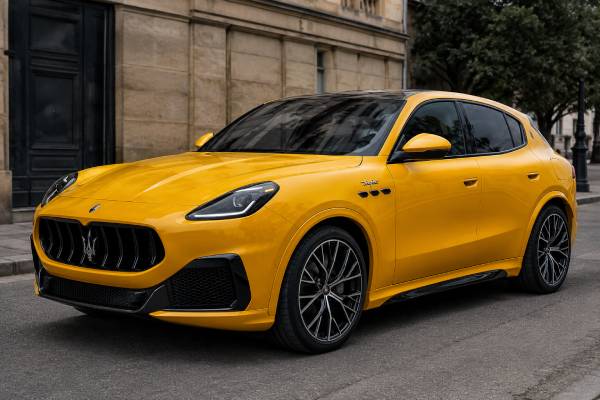
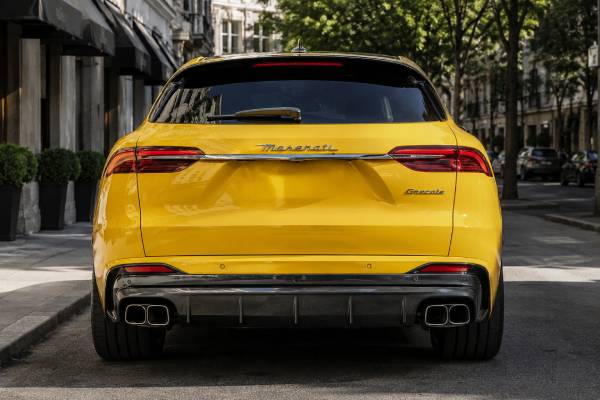
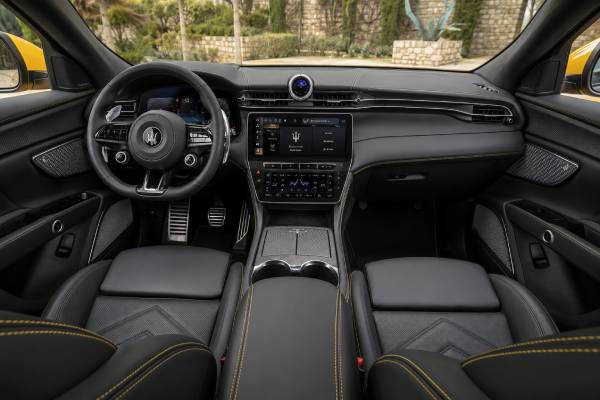
The Maserati Grecale Trofeo is the high-performance version of the M182 Grecale, built around a 3.0-liter twin-turbo Nettuno V6 producing 530 hp and 620 Nm. An eight-speed automatic, all-wheel drive, an electronically controlled rear differential, standard air suspension, and a dedicated Corsa mode allow this family-sized SUV to reach 100 km/h in 3.8 seconds and 285 km/h. Those figures place it in serious performance-SUV territory, but the Trofeo still provides five seats, a useful luggage area, and the digital comfort features of the wider Grecale range.
Its importance goes beyond speed. The Trofeo brought Maserati’s pre-chamber combustion technology from the MC20 concept into a more practical vehicle, while adapting the engine for SUV packaging, everyday service, and broader torque delivery. It also introduced chassis hardware and calibration unavailable on four-cylinder versions, including standard Skyhook-controlled air suspension and launch-control capability. Buyers should not treat it as a normal Grecale with a larger engine. Tires, brakes, cooling, driveline loads, insurance, and maintenance costs all rise with performance. This guide explains the exact 530 hp version, its production evolution, design and engineering, road behavior, known ownership risks, and how to inspect a used example without overlooking expensive details.
Table of Contents
- Trofeo Origins and Range Position
- Nettuno V6, Chassis, and Performance Data
- Model Years, Special Editions, and Options
- Functional Design and Trofeo Engineering
- Road, Track, and All-Weather Behavior
- Trofeo Maintenance and Failure Risks
- Pre-Purchase Checks and Ownership Costs
Trofeo Origins and Range Position
The Grecale Trofeo is the original flagship of the Grecale family and the only launch version powered by the Nettuno V6. It was created for buyers who wanted MC20-related engine technology in a usable five-door SUV rather than merely a more heavily optioned luxury crossover.
Maserati unveiled the Grecale in March 2022 after developing it at the Maserati Innovation Lab in Modena. Production began at the Cassino plant. The range opened with the 300 hp GT, 330 hp Modena, and 530 hp Trofeo, followed later by the battery-electric Folgore. The Trofeo’s combination of 530 hp, all-wheel drive, and 3.8-second acceleration gave the new SUV immediate credibility against the Porsche Macan GTS, Mercedes-AMG GLC models, BMW X3 M, and Alfa Romeo Stelvio Quadrifoglio.
The name “Trofeo” has long identified especially sporting Maseratis. In the Grecale, it signals much more than an appearance package. The Trofeo receives a unique V6 powertrain, wider rear track, larger tires, performance brakes, standard air suspension with continuously controlled dampers, an electronic limited-slip rear differential, Corsa mode, launch control, more assertive cooling and aerodynamic details, and a cabin finished with carbon fiber and performance-themed materials.
The engine connection to the MC20 is real but should be described accurately. Both use Maserati’s Nettuno architecture and patented pre-chamber combustion concept. The Grecale version is adapted for a front-engine SUV, including different lubrication, intake, exhaust, calibration, and packaging. It makes less peak power than the MC20 but offers a broad 620 Nm torque curve suited to a heavier all-wheel-drive vehicle.
From 2022 through the initial 2026 range, the core European specification remained 530 hp, 620 Nm, 3.8 seconds, and 285 km/h. Some markets express power as 523 bhp or 530 metric horsepower, which describes essentially the same calibration under different standards. Current market pages can also vary as Maserati rolls out updated model-year specifications, so a buyer must verify the exact output on the vehicle’s homologation documents rather than rely on a converted online figure.
For the advertised 2027 update, Maserati revised exterior and cabin details in several regions while retaining a 530-CV Trofeo listing on current official global material. Published changes include a new grille and bumper treatment, revised wheels, a flat-profile steering wheel, updated digital interfaces, metal-finished controls, and revised air-suspension default heights. Since market launches do not occur simultaneously, “present” specification is region dependent.
The Trofeo’s reputation is strongest among drivers who value the full package. It is very fast, but its steering, rear-biased balance, air-suspension range, and everyday space make it more than a drag-race version. Its limitations are equally clear: the engine and chassis create higher heat, tire wear, brake use, and fuel consumption, while the complex electronic and pneumatic systems require disciplined care.
Nettuno V6, Chassis, and Performance Data
The Trofeo uses a 2,992 cc twin-turbo 90-degree V6 with pre-chamber combustion, producing 530 hp and 620 Nm. It drives all four wheels through a ZF eight-speed automatic and reaches 100 km/h in 3.8 seconds, with launch control and a 285 km/h maximum speed.
| Item | Specification |
|---|---|
| Model code | M182 |
| Engine | Nettuno twin-turbo V6 |
| Displacement | 2,992 cc |
| Bore × stroke | 88 × 82 mm |
| Maximum power | 530 hp |
| Maximum torque | 620 Nm |
| Transmission | Eight-speed automatic |
| Drivetrain | All-wheel drive with electronic rear differential |
| 0–100 km/h | 3.8 seconds |
| Maximum speed | 285 km/h |
| Suspension | Air springs with Skyhook continuous damping |
| Wheelbase | 2,901 mm |
| Original-generation length | Approximately 4,859 mm |
| Width without mirrors | Approximately 1,979 mm |
| Fuel tank | 64 liters |
| Seating | Five |
Nettuno’s pre-chamber system uses a small combustion chamber above the main chamber and an additional spark plug to create rapid flame jets under suitable operating conditions. A conventional side spark plug supports operation when the pre-chamber strategy is not required. The concept promotes fast, controlled combustion and allows high specific output while meeting road-car drivability and emissions demands.
Twin turbochargers sit within a tightly managed intake and exhaust system. The engine delivers strong torque from low and medium revs, then continues pulling toward its power peak. Cylinder deactivation can reduce fuel use under light load by shutting one bank when conditions permit. The transition should be unobtrusive to the driver.
The Grecale engine uses a wet-sump lubrication system suited to SUV installation and normal service conditions, unlike the MC20’s more specialized dry-sump arrangement. This does not make it a lesser engine; it reflects different packaging, lateral-load, cost, and maintenance priorities. Owners must use the correct oil specification and level-check procedure because turbocharger health and pre-chamber performance depend on stable lubrication and combustion control.
The ZF automatic is calibrated for both smooth traffic operation and fast shifts in Corsa mode. It uses a torque converter rather than a dual-clutch mechanism, which improves low-speed refinement and launch consistency. Fixed aluminum paddles provide manual control. In the most aggressive setting, shifts are firmer and the transmission holds gears near the limiter.
All-wheel drive gives the Trofeo repeatable traction, while the electronically managed rear differential helps distribute torque between the rear wheels. The system retains a rear-led sensation until available grip requires more front-axle assistance. Launch control coordinates engine torque, transmission, tire grip, and stability systems; it should be used only after the vehicle is warm and conditions are suitable.
Air suspension with Skyhook damping is standard. It changes ride height and damper response according to mode, speed, and driver demand. Depending on model year, the system offers multiple levels from raised off-road positions to lower aerodynamic and Corsa settings. The lowered stance reduces body movement and improves high-speed stability, while raised modes help with ramps, snow, or rough surfaces.
The Trofeo uses wider rear bodywork and tires than four-cylinder Grecales. Original 21-inch staggered fitments commonly pair narrower front tires with substantially wider rears. This improves traction and visual stance but prevents normal front-to-rear tire rotation. Tire wear, matching specifications, and age therefore matter greatly.
Steel performance brakes provide powerful stopping capability. They are not carbon-ceramic units, so replacement cost is lower than on some super-SUVs, but large discs, multi-piston calipers, and high-performance pads still cost more than ordinary Grecale parts. The system must control a heavy vehicle repeatedly from high speed, making fluid condition and pad quality important.
Model Years, Special Editions, and Options
The mechanical identity of the 530 hp Trofeo stayed consistent through the first years, but software, standard equipment, appearance packages, recalls, and regional specification changed. A complete build sheet is essential because two Trofeos from the same year can differ significantly in comfort and driver-assistance equipment.
The earliest 2022-built vehicles were launch cars, often registered as 2023 models in some markets. They may include distinctive colors, extensive option content, or PrimaSerie launch-edition equipment. Early production is not automatically undesirable, but software update history and campaign completion deserve extra attention.
The PrimaSerie launch edition combined special paint, wheels, interior color schemes, and equipment for initial customers. Exact content varied by country. It can add collectability when original and well documented, but condition matters more than the badge. Damaged special paint, missing trim, or replacement wheels can erase much of the premium.
Later model years expanded color and Fuoriserie choices, adjusted package content, and introduced evolving infotainment software. The arrival of the Folgore also changed the broader range but did not replace the Trofeo’s role. For 2027 advertising, the Trofeo gains revised front styling, new wheel designs, a more angular steering wheel, updated digital-clock hardware, metallic PRND controls, revised interface graphics, and changes to air-suspension default positioning.
Options that improve ownership
The most useful features are not always the most dramatic:
- Surround-view cameras, essential for the wide body and expensive wheels.
- Adaptive cruise, blind-spot monitoring, and lane support for long trips.
- Front-seat ventilation and heating appropriate to climate.
- A head-up display that reduces the need to look away from the road.
- Premium Sonus faber audio for owners who value cabin sound as much as exhaust sound.
- A factory service plan or comprehensive extended warranty.
- Paint-protection film on vulnerable front and carbon-fiber areas, if applied cleanly.
The panoramic roof brightens the cabin but adds weight and future service points. Test the shade, seals, drains, and absence of creaks. Carbon-fiber trim should be inspected for lifting clear coat, scratches, cracks, or previous refinishing.
Authenticity and modification risk
Trofeos attract tuning. ECU software, exhaust changes, intake systems, wheel spacers, suspension coding, and cosmetic conversions are common. Modifications can increase sound or output, but they also affect warranty, emissions legality, insurance, heat management, and diagnostic clarity.
A stock car with full records is usually the safest purchase. If a modified example is considered, obtain invoices, original parts, tuner information, before-and-after diagnostic records, and proof that engine and transmission torque limits were handled correctly. A seller’s claim that the software was “returned to standard” does not prove the vehicle was never operated at higher boost.
Functional Design and Trofeo Engineering
The Trofeo’s styling is functional as well as decorative. Wider tracks, larger cooling openings, carbon-fiber details, a more assertive rear treatment, and staggered tires support the V6’s heat and performance demands while separating the flagship from ordinary Grecales.
The base Grecale design uses a low grille, long hood, three fender vents, and a cabin that appears set rearward. Trofeo adds deeper lower openings, dark or carbon details, wider rear arches, four exhaust outlets, and model-specific wheels. Its stance is lower in sporting modes, which reduces the visual gap around the tires and makes the body look broader.
Cooling is a central engineering concern. Two turbochargers, high combustion pressure, all-wheel-drive hardware, and a tightly packaged engine bay generate substantial heat. Front openings, ducting, underbody management, cooling circuits, and post-shutdown strategies all contribute. Owners should never block openings with decorative accessories or ignore damaged undertrays that guide air.
The exhaust is part of the Trofeo experience. Valves alter flow and sound according to mode and load. In calmer settings, the V6 remains suitable for residential areas and long trips. Sport and Corsa reveal a harder, more mechanical tone. Rattling valves, asymmetrical outlet deposits, or an unusually muted side can indicate a fault or aftermarket change.
Inside, the Trofeo combines performance cues with the same broad digital architecture as other Grecales. A 12.3-inch central screen, lower comfort display, digital instruments, and digital clock manage most functions. Dedicated Corsa graphics, carbon trim, sport seats, contrast stitching, and metal paddles distinguish the flagship.
The steering-wheel drive-mode control makes the vehicle’s breadth easy to access. Comfort relaxes responses. GT supports everyday use. Sport sharpens powertrain and chassis behavior. Corsa unlocks the most aggressive calibration and launch control. Off-Road raises the body for low-speed surfaces. The driver should understand that modes alter multiple systems simultaneously, including damping, ride height, stability thresholds, throttle, transmission, exhaust, and differential behavior.
The body’s 2,901 mm wheelbase provides useful rear-seat space despite the performance focus. The Trofeo’s luggage area is also practical, though published capacity can differ from four-cylinder versions because of powertrain packaging and measurement conventions. The vehicle remains more usable than a low sports car, which is the central reason for its existence.
Road, Track, and All-Weather Behavior
The Trofeo is brutally quick when requested but surprisingly calm in ordinary driving. Its ability to move from quiet, air-suspended transport to launch-controlled acceleration is its defining achievement, though tire temperature and road condition strongly affect what the chassis can deliver.
In Comfort or GT mode, the torque converter and broad 620 Nm curve allow smooth progress without high revs. The engine can deactivate cylinders under light load, and the suspension uses a more compliant setting. Low-profile tires still transmit sharp edges, so the ride is controlled rather than soft.
Full acceleration changes the character immediately. The turbochargers build pressure quickly, the transmission selects lower gears, and all-wheel drive turns torque into forward motion with little drama. The official 3.8-second 0–100 km/h time is repeatable on suitable tires and a clean surface. The speed arrives so quickly that drivers need restraint on public roads.
Launch control is not a party trick to use repeatedly on a cold vehicle. Engine oil, transmission fluid, tires, and brakes should be at appropriate temperature. The road must be straight, dry, legal, and clear. Repeated launches increase driveline and tire stress even when the system protects itself.
The engine sounds distinctive but not identical to the MC20. Longer exhaust routing, SUV insulation, different calibration, and turbo behavior create a deeper, more subdued character. In Corsa, the note becomes sharper and shifts more forceful. Some owners prefer aftermarket exhaust volume, but factory balance protects long-distance comfort and legal compliance.
Steering is quick and accurate. The front tires bite decisively when warm, while the rear differential helps the vehicle rotate under power. The Trofeo feels rear-driven in attitude but uses front torque to stabilize exits. It is more agile than its mass suggests, yet physics remains present: braking distances, tire loads, and direction changes all reflect a heavy, powerful SUV.
Air suspension controls roll and pitch effectively. Lower Corsa height improves response, but rough public roads may suit Sport with a less aggressive damper setting. Some configurations allow separate damping adjustment, which lets a driver combine sharp powertrain response with more compliant suspension.
Braking is strong and confidence inspiring when the system is healthy. A firm pedal, even disc surfaces, fresh fluid, and correct tires are essential. Track sessions can overheat standard road pads and fluid because the vehicle repeatedly sheds large amounts of energy. Owners planning circuit use should obtain specialist guidance, inspect brakes before and after, and avoid assuming road specifications are unlimited.
Tire temperature matters. Summer performance tires can feel wooden and lose grip in cold conditions. Winter or all-season alternatives must carry the correct size, load, and speed ratings and remain compatible with the AWD system. Mixing tread patterns or replacing only one tire can upset balance and driveline operation.
On a motorway, the Trofeo is stable and quiet enough for touring. At legal speeds, much of its performance remains unused, but effortless overtaking and strong reserve power reduce strain. Fuel consumption, however, is high. Calm travel may produce a respectable result for the output, while city use or repeated boost can quickly move into the mid-teens in L/100 km.
Visibility is acceptable forward and limited at the rear corners. Cameras are vital because curbing a forged wheel or carbon detail is expensive. The wide body also demands care in parking structures and narrow roads.
Trofeo Maintenance and Failure Risks
A Trofeo should be maintained as a high-output performance vehicle, not simply by following the cheapest minimum schedule. Correct oil, warm-up, cooling-system health, battery condition, software, tires, brakes, and air suspension determine whether ownership remains rewarding.
Nettuno engine and turbo system
Use only the exact approved oil and filter. Check the level by the official procedure and investigate any sudden change. Turbocharged engines can consume some oil, but rapid consumption, smoke, external leakage, or oil in intake plumbing requires diagnosis.
Cold starts should settle quickly without sustained misfire, metallic noise, or warning messages. The pre-chamber system, direct injection, ignition coils, plugs, sensors, and fuel delivery all operate under demanding conditions. Spark-plug replacement must follow the correct interval and part specification.
Inspect coolant reservoirs and connections for staining or odor. Cooling fans should operate correctly, and temperatures must remain stable after hard driving. A damaged front heat exchanger or blocked cooling stack can reduce thermal margin. After a fast run, allow the vehicle to cool through normal light driving rather than switching off immediately after maximum load.
Turbocharger noise should be smooth. Siren-like whine, smoke after idling, boost loss, or oil leaks are warning signs. Heat shielding and underbody panels must be intact.
Transmission, differential, and AWD
Test the transmission cold and hot. Delayed gear engagement, flare, repeated harsh shifts, or vibration under load are not acceptable. Software adaptations can influence behavior, but diagnosis should also consider mounts, fluid, driveshafts, differentials, and transfer hardware.
The electronic rear differential and AWD system rely on correct tires. All four must be compatible, with close rolling circumference. Inspect for leaks and listen for whine or clunks during tight turns and throttle transitions. Discuss preventive fluid service with a qualified specialist for long-term ownership.
Air suspension and electronic controls
A healthy Trofeo sits level after parking, raises and lowers promptly, and does not run the compressor excessively. A sinking corner may indicate an air-spring, line, valve-block, or sensor issue. Skyhook damper faults can reduce mode functionality and require model-specific diagnosis.
The 12-volt battery is a frequent source of misleading warnings in modern luxury vehicles. Test battery health, charging, and parasitic drain. Keep infrequently used cars on an approved maintainer. Low voltage can affect screens, cameras, keyless access, suspension, and drivetrain modules.
Test every display and assistance feature. Grecale campaigns in some markets have addressed rearview-camera software and headlamp compliance. Check recall completion by VIN, including over-the-air updates that may not be obvious in paper records.
Brakes, tires, and body condition
Measure pad and disc condition rather than relying on mileage. Hard use can consume brakes quickly, while storage can corrode inner disc faces. Look for heat cracks, lips, vibration, and uneven pad deposits. Brake fluid should be changed according to official requirements and use.
Inspect tire dates, inner shoulders, sidewalls, and heat cycles. A tire can have legal tread yet be hardened, cracked, or repeatedly overheated. Staggered sizes increase replacement cost and reduce rotation options.
Check carbon trim, wheel barrels, lower spoilers, and undertrays for impact damage. Paint repairs near radar and cameras require calibration evidence. A high-performance SUV may have seen track days, so inspect tow points, brake discoloration, tire debris in liners, and repeated heat damage without assuming track use is automatically abusive.
Pre-Purchase Checks and Ownership Costs
Buy a Trofeo only after a cold inspection, full-module diagnostic scan, service-record review, tire and brake measurement, and VIN-based recall check. The lowest purchase price is rarely the lowest total cost when a single set of tires, brake overhaul, air-suspension repair, or electronic module can erase the saving.
Verify the car’s identity and exact output. Match the VIN, registration, factory build sheet, and service system. Confirm original market, model year, optional equipment, warranty, and whether it is a launch edition or Fuoriserie build. Converted horsepower figures may differ, so use homologated kilowatts and original documentation.
Ask for invoices showing oil and filter services, spark plugs, brake fluid, software updates, batteries, tires, brake measurements, alignment, and any cooling or suspension work. A stamped service history with no detail is less useful. Repeated visits for the same warning should be explained.
| Area | What to check | Cost risk |
|---|---|---|
| Engine | Cold start, oil level, boost, coolant, fault history | Very high |
| Driveline | Shift quality, differential noise, AWD leaks | Very high |
| Suspension | Overnight level, compressor cycles, damper faults | High |
| Brakes | Disc thickness, pad depth, vibration, fluid | High |
| Tires | Matching set, dates, inner wear, heat damage | High |
| Electronics | All screens, cameras, ADAS, keys, recalls | Medium to high |
| Body | Carbon, undertrays, paint depth, sensor calibration | Medium to high |
Drive the vehicle from cold through urban traffic, rough surfaces, motorway speed, and several safe high-load accelerations after warm-up. Use every mode and ride height. Perform firm braking. The car should track straight, shift consistently, maintain temperature, and show no warnings.
A specialist scan must cover engine, transmission, differential, AWD, suspension, brakes, body, cameras, infotainment, and driver assistance. Ask to see stored and historical faults before clearing. Compare software versions with campaign requirements.
An extended warranty is particularly valuable when it covers turbochargers, cooling, transmission, differential, air suspension, infotainment, driver-assistance modules, and diagnostic labor. Read maximum claim values and exclusions. A limited engine-only policy is not enough.
Budget for premium fuel, frequent rear tires if driven hard, matched four-tire replacement when necessary, large brakes, specialist servicing, high insurance, tax, and depreciation. A reserve fund is essential. Track use, repeated launch control, or very large annual mileage should increase the budget.
The right Trofeo is one with factory software, documented care, fresh matched tires, healthy brakes, stable electronics, and no hidden accident or underbody damage. In that condition, it offers a rare combination: genuine supercar-derived combustion technology, 3.8-second acceleration, secure all-weather traction, and space for normal life. Its running costs are substantial, but they are predictable when the vehicle is selected and maintained with the seriousness its performance demands.
References
- Maserati Grecale Trofeo – 2027 High-Performance SUV 2026 (Official Model Page)
- download the grecale catalogue 2022 (Official Catalogue)
- New Maserati Grecale Global Premiere 2022 (Manufacturer Publication)
- grecale-catalogue-digital-2026-en.pdf 2025 (Official Catalogue)
- Vehicle Detail Search – 2023 MASERATI GRECALE | NHTSA 2026 (Recall Database)
Disclaimer
This article is for informational purposes and is not a substitute for professional diagnosis, inspection, maintenance, or repair. Specifications, torque values, service intervals, procedures, software, recalls, and equipment vary by VIN, market, production date, and configuration. Verify every technical detail against the official service documentation for the exact vehicle.
Please share this article on Facebook, X/Twitter, or another platform if it was helpful. Sharing supports our work on detailed automotive guides.