
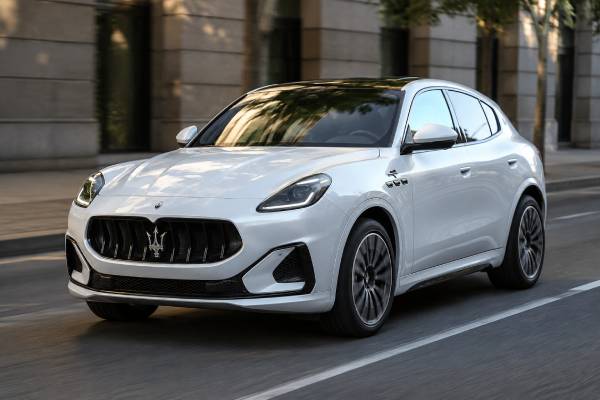
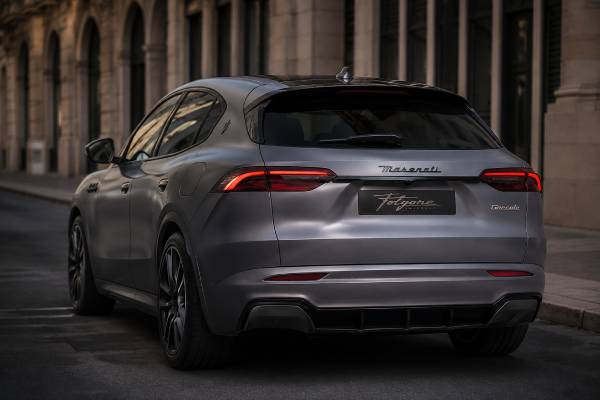
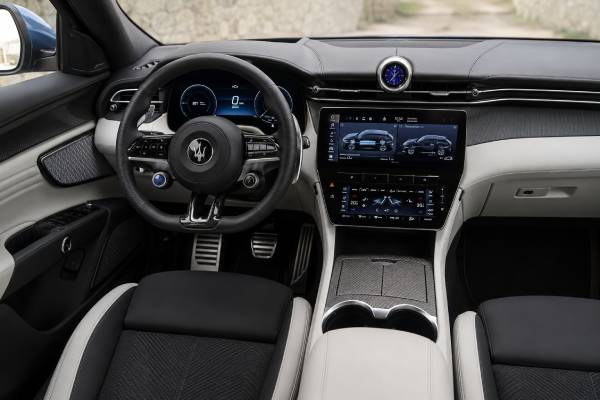
The Maserati Grecale Folgore is the brand’s first fully electric SUV and the battery-powered counterpart to the gasoline and mild-hybrid M182 Grecale. Two electric motors provide all-wheel drive, 410 kW or about 550 hp, and 820 Nm. A 105 kWh nominal battery operating on a 400-volt architecture supports 22 kW AC charging and up to 150 kW DC charging. Official performance includes 0–100 km/h in 4.1 seconds and a 220 km/h top speed, making the Folgore substantially quicker than the four-cylinder Grecales while remaining calmer and quieter than the V6 Trofeo.
It preserves the Grecale’s useful rear space, 535-liter luggage area, Italian styling, and digital cabin while removing fuel stops, engine servicing, and exhaust noise. Its main compromises are a homologated mass around 2,480 kg, range sensitivity to speed and temperature, tire wear, and charging performance limited by a 400-volt system rather than the fastest 800-volt technology. Updated versions improve efficiency and introduce an all-wheel-drive disconnect that allows rear-drive operation when full traction is unnecessary. This guide explains the Folgore’s development, battery and charging data, equipment changes, road behavior, maintenance realities, and the checks required before buying a used electric Maserati.
Table of Contents
- Maserati’s First Electric SUV
- Battery, Motors, Charging, and Specifications
- Model-Year Updates, Range, and Options
- Folgore Design, Packaging, and Electric Systems
- Driving, Range, and Charging in Practice
- EV Maintenance, Battery Health, and Faults
- Used Folgore Buying and Home Charging
Maserati’s First Electric SUV
The Grecale Folgore marked Maserati’s move from mild electrification to a full battery-electric SUV. It joined the range for the 2024 model year and gave buyers an electric alternative without abandoning the body, cabin space, or road-focused character of the conventional Grecale.
“Folgore” means lightning in Italian and identifies Maserati’s electric models. The Grecale version was designed, developed, and produced in Italy. Rather than create a visually unrelated EV, Maserati adapted the M182 architecture so gasoline, hybrid, and electric derivatives could share their basic proportions and assembly strategy.
That decision brought benefits and compromises. The Folgore looks like a Grecale, offers familiar seating and controls, and avoids the unusual appearance of some purpose-built electric SUVs. It also carries a large battery within a platform that was not designed only around electric propulsion. The result is substantial mass and a 400-volt charging architecture, but also straightforward everyday packaging and recognizable Maserati design.
At launch, the Folgore’s 410 kW output, 820 Nm torque, 4.1-second acceleration time, and 220 km/h top speed made it the quickest Grecale below the Trofeo. Unlike the V6, it delivers torque immediately and silently. It does not reproduce a combustion engine’s sound or gear changes, so its character comes from instant response, stability, steering, and controlled body motion.
The initial European specification offered up to roughly 500 km WLTP in favorable configuration. Later software, tire, thermal, and efficiency improvements raised published figures. The 2026 catalogue listed a range window extending as high as 580 km, depending on equipment. Current 2027 material describes up to 590 km while homologation is completed, with an all-wheel-drive disconnect and aerodynamic refinements contributing to the gain.
Range claims need context. WLTP is a standardized comparison, not a promise for every trip. High motorway speed, cold weather, cabin heating, heavy wheels, roof accessories, and repeated acceleration can reduce range substantially. Urban and moderate-speed driving can be much closer to the official result because regenerative braking and lower aerodynamic demand favor an EV.
The Folgore’s current reputation centers on exclusivity, design, and refinement. It is less common than many German electric SUVs and offers a more intimate cabin atmosphere. Its weaknesses are high purchase price, depreciation uncertainty, public-charging speed that is adequate rather than class-leading, and a smaller specialist network for high-voltage Maserati service.
It best suits an owner with reliable home or workplace charging, predictable daily mileage, and an appreciation for the Grecale’s style. It is a poor choice when the driver depends entirely on unreliable public charging or regularly completes long high-speed trips in cold weather without planning.
Battery, Motors, Charging, and Specifications
The Folgore uses a 105 kWh nominal lithium-ion battery and one motor at each axle. Combined output is 410 kW, torque is 820 Nm, and the vehicle supports 22 kW three-phase AC charging plus up to 150 kW DC fast charging.
| Item | Specification |
|---|---|
| Model code | M182 |
| Drive motors | Dual motor, one per axle |
| Maximum output | 410 kW / approximately 550 hp |
| Maximum torque | 820 Nm |
| Drivetrain | Electric all-wheel drive |
| Battery energy | 105 kWh nominal |
| Electrical architecture | 400 volts |
| Maximum AC charging | 22 kW |
| Maximum DC charging | 150 kW |
| DC charging benchmark | 20–80% in approximately 29 minutes |
| 0–100 km/h | 4.1 seconds |
| Maximum speed | 220 km/h |
| Original WLTP range | Up to about 500 km |
| Current advertised WLTP range | Up to about 590 km, configuration and homologation dependent |
| Homologated mass | Approximately 2,480 kg |
| Length | Approximately 4,865 mm at launch |
| Wheelbase | 2,903 mm |
| Boot capacity | 535 liters |
The two motors allow rapid torque distribution between axles without a mechanical driveshaft connecting an engine and transfer case. Control software manages traction, stability, regeneration, and thermal limits. Peak 820 Nm is available quickly, but maximum output can depend on battery temperature, state of charge, drive mode, and protection limits.
The 105 kWh figure is nominal battery capacity. The usable amount available to the driver is lower because the battery-management system reserves energy at the top and bottom to protect cell life. Maserati does not always publish the same usable figure in every market, so charging calculations should use the vehicle’s displayed energy and actual charging records rather than assuming all 105 kWh can be consumed.
A 400-volt architecture keeps component cost and packaging conventional but limits charging current relative to newer 800-volt systems. At a suitable DC station and proper battery temperature, the Folgore can charge from 20% to 80% in about 29 minutes. The peak 150 kW rate is not held for the entire session. Charging normally rises, reaches a peak, and tapers as the battery fills.
The 22 kW onboard AC charger is a major advantage in countries with three-phase electrical service and compatible wallboxes. It can restore a large amount of range during an overnight stop more quickly than common 7.4 or 11 kW systems. Actual home power depends on the building supply, wallbox, cable, and local grid approval.
Regenerative braking converts some kinetic energy back into electricity. The driver can select different regeneration behavior through drive settings and controls. Regeneration reduces friction-brake use but cannot recover all energy. Hard braking, a full or cold battery, and low-grip conditions can reduce the amount available.
The battery, motors, inverters, onboard charger, and cabin require thermal management. Liquid circuits move heat where needed, while software preconditions the pack for performance or charging. A driver should use navigation-based charger routing when available so the battery reaches a suitable temperature before a DC stop.
The mass of approximately 2,480 kg affects tires, brakes, and suspension. The Folgore can accelerate quickly because electric torque is immediate, but every stop and corner still manages substantial momentum. Correct load-rated tires and alignment are essential.
Model-Year Updates, Range, and Options
The Folgore’s core 410 kW and 105 kWh hardware remained recognizable from launch, while software, efficiency, range, styling, and drivetrain-control updates improved the product. Buyers should identify the exact model year because a later car may travel farther without being more powerful.
Launch vehicles for 2024 used published dimensions around 4,865 mm long, 1,948 mm wide without mirrors, 1,651 mm high, and a 2,903 mm wheelbase. They offered about 500 km WLTP in the most favorable configuration, with official consumption around 24 kWh/100 km in early material.
Later homologation lists broader consumption and range windows because wheel size, equipment, climate testing, and regulatory updates affect the result. The 2026 catalogue published approximately 475–580 km depending on configuration. It is normal for a high-specification car on 21-inch wheels to have a lower certificate value than a lighter car on 20-inch wheels.
For the advertised 2027 update, Maserati introduced an axle-disconnect strategy that can decouple the front motor and operate primarily as rear-wheel drive when full traction is unnecessary. Reducing drag in the front drivetrain improves efficiency. The system reconnects automatically when acceleration, grip, or stability requires it. Underbody and active-aerodynamic refinements add further range.
Exterior and interior updates broadly follow the refreshed Grecale family. They include a redesigned front treatment, new wheels, updated steering wheel, revised digital-clock surround, improved metallic controls, and refreshed interface graphics. Exact content and timing vary by market.
Options that materially affect range
Several choices change energy consumption more than buyers expect:
- Twenty-inch wheels normally improve range and ride compared with heavier 21-inch designs.
- Wider or stickier performance tires increase rolling resistance.
- Roof bars and roof boxes add aerodynamic drag, especially at motorway speed.
- A panoramic roof adds mass but may improve perceived cabin quality.
- Large audio and comfort packages add modest weight and electrical load.
- Winter tires increase consumption but may be essential for safety.
Range should not be the only criterion. A buyer who values steering response may accept larger wheels, while a long-distance owner should prioritize the efficient configuration. The certificate of conformity shows the specific vehicle’s homologated range.
Folgore-specific presentation
Rame Folgore copper paint became the signature launch color. The model also introduced electric-specific details, reduced grille openings, aerodynamic wheels, copper-colored accents, and interior materials using recycled ECONYL nylon in selected specifications. These features separate the EV without making it visually unrelated to the rest of the range.
Fuoriserie personalization can create rare combinations. Special paint and interior trim require careful condition checks because repair or replacement can be expensive. A unique specification may increase desirability for one buyer while narrowing resale demand.
Folgore Design, Packaging, and Electric Systems
The Folgore preserves the Grecale’s proportions while using a smoother, more closed exterior treatment to reduce drag and cooling demand. Its engineering challenge was fitting a large battery and dual motors without sacrificing the practical five-seat cabin.
The body retains Maserati’s low grille shape, three fender vents, long hood, rearward visual cabin, and boomerang-inspired lamps. The grille has less open area because electric motors do not require the same airflow as a turbocharged engine. Cooling remains necessary for the battery, inverters, motors, onboard charger, and cabin, so lower ducts and controlled airflow still serve a functional role.
The battery sits low in the structure, which lowers the center of gravity relative to the mass. It also increases overall weight and influences floor packaging. The Folgore’s wheelbase is slightly different in published data from combustion versions, while luggage capacity remains a useful 535 liters. There is no large front trunk because the front motor, inverter, cooling, and structural components occupy the space.
Air suspension and adaptive damping help control the heavy body. Ride height can change with mode and speed, reducing drag on the motorway or raising the vehicle for rough access. The system must balance comfort with the need to contain more than two tonnes during direction changes.
The cabin uses the same basic digital architecture as other Grecales: a configurable instrument display, central infotainment screen, lower comfort screen, digital clock, and push-button transmission controls. EV-specific pages show energy flow, range, charging, battery condition, and regeneration.
Folgore drive modes alter accelerator response, torque delivery, regeneration, suspension, and climate strategy. A range-focused mode limits energy use and may soften performance. Sport settings make throttle response more immediate. Off-road behavior uses all-wheel drive and ride-height control to manage low-grip surfaces, though the vehicle’s tires and mass still limit serious terrain use.
Artificial sound is used to provide feedback and pedestrian awareness. The experience remains much quieter than a Trofeo. Some drivers value the calm; others miss mechanical drama. The Sonus faber audio system can become a more important part of the cabin experience because there is little engine noise to mask it.
The charge port, cable storage, and software are central ownership features. The port door should open reliably, lock the cable correctly, and release it after charging. The vehicle should recognize both AC and DC stations without repeated errors. Charging timers and target state of charge should save correctly in the interface or app.
Driving, Range, and Charging in Practice
The Folgore feels immediate, quiet, and securely planted. Its 4.1-second acceleration is easy to access, but its best daily quality is smooth torque rather than repeated full-power launches.
From a standstill, both motors deliver traction without waiting for turbo boost or gear selection. Acceleration is strong at urban and motorway speeds, though output can taper at very high speed. The 220 km/h limit is high for an EV SUV and protects energy and thermal margins.
Throttle calibration is progressive in normal modes. The vehicle can creep and maneuver smoothly, which matters in tight garages. In Sport, pedal response becomes much sharper. Drivers should be careful in wet conditions because 820 Nm can arrive quickly even with sophisticated traction control.
Steering remains fast and accurate. Battery placement lowers the center of gravity, but the mass is noticeable in quick transitions and braking. The Folgore feels stable rather than light. Air suspension controls pitch and roll effectively, while large wheels can create a firm reaction over sharp edges.
Regeneration changes how the car approaches bends and traffic. Stronger settings reduce the need for the brake pedal, while lighter settings allow coasting. Full one-pedal stopping behavior may vary by mode and software. Drivers should still use the friction brakes periodically to keep disc surfaces clean.
Range depends heavily on speed. Aerodynamic drag rises rapidly, so a 130 km/h motorway journey uses far more energy than a 90 km/h route. Cold weather reduces battery efficiency and increases heating demand. Hot weather adds air-conditioning load, though the effect is often smaller than winter heating.
A sensible long-trip strategy is to leave home with the desired charge, use the built-in route planner, arrive at a fast charger with a warm battery and low-to-moderate state of charge, and stop charging when the rate tapers sharply. Charging to 100% at every DC stop usually wastes time. A 20–80% session is the useful benchmark.
At home, daily charging to a moderate target can reduce time spent at public stations. Owners should follow Maserati guidance for routine limits and charge to 100% when the extra range is needed. Leaving the battery at very high or very low state of charge for extended periods is generally undesirable.
The 22 kW AC charger is especially useful for destination charging. On a compatible three-phase unit, it can add energy quickly during a meal, hotel stay, or workday. In homes limited to single-phase power, actual speed may be far lower.
Braking is powerful, but pedal feel blends regeneration and friction. The transition should be smooth. A heavy EV can expose tire or brake imbalance, so vibration, pulling, or noise deserves attention. Tires influence every aspect of performance: acceleration, range, steering, noise, and braking.
Cabin refinement is excellent at low speed because motor noise is minimal. At motorway speed, tire and wind noise become more apparent. The absence of gear changes makes overtaking effortless, and driver-assistance systems reduce fatigue when properly calibrated.
EV Maintenance, Battery Health, and Faults
The Folgore requires less routine engine-related work than a gasoline Grecale, but it is not maintenance-free. Battery cooling, high-voltage safety, tires, brakes, suspension, 12-volt power, software, charging equipment, and cabin systems all need scheduled inspection.
High-voltage battery and thermal system
Battery health should be evaluated through diagnostic data and an official certificate where available. State of health estimates usable capacity compared with a new pack, but the number can vary with temperature and software calculation. Review charging history, fault records, and cell-balance information where the diagnostic system permits.
Inspect the underbody battery shield for impact damage. A curb, road debris strike, or incorrect lifting can damage protective panels even when the vehicle still drives normally. Any dent, scrape, coolant leak, or high-voltage warning requires specialist assessment.
Battery and power-electronics cooling uses dedicated circuits. Check coolant condition and level according to official procedures. Pumps, valves, sensors, and heat exchangers must work correctly for fast charging and full performance. Repeated reduced charging speed can result from station limitations, but persistent thermal faults need diagnosis.
Charging hardware
Test AC and DC charging before purchase if possible. Confirm that the port door, pins, locking actuator, indicator lights, onboard charger, and communication with the station operate correctly. Examine the supplied cable for heat damage, bent contacts, or cuts.
The vehicle should accept a charging schedule and target percentage without losing settings. Ask about failed sessions, error messages, and any onboard-charger replacement. Home wallbox problems can imitate vehicle faults, so compare more than one charger.
12-volt battery and software
Like other EVs, the Folgore still depends on a 12-volt battery to wake control modules, unlock the car, close contactors, and run low-voltage systems. A weak 12-volt battery can make a fully charged vehicle appear dead or create numerous warnings. Test its state of health and charging behavior.
Software controls charging, thermal preparation, range prediction, screens, cameras, assistance systems, and motor operation. Verify that updates and recalls are complete. Test both screens, the app, keys, navigation, camera views, over-the-air functions, climate preconditioning, and driver assistance.
Tires, alignment, brakes, and suspension
The combination of 820 Nm and 2,480 kg can wear tires rapidly, especially at the inner shoulders. Inspect tread across the full width and confirm matched, EV-suitable load ratings. Uneven wear may indicate alignment drift, suspension damage, or repeated hard acceleration.
Regeneration reduces brake-pad use, which can allow discs to corrode. Look at both outer and inner disc faces. Use the friction brakes periodically and follow service instructions. Brake fluid still absorbs moisture and requires periodic replacement.
Air suspension should hold the vehicle level after parking and change height without warnings. Listen for knocks and inspect dampers, links, bushings, and wheel bearings. Heavy vehicles place high loads on these parts.
Used Folgore Buying and Home Charging
A used Folgore should be purchased only after confirming battery health, warranty coverage, charging performance, underbody condition, tire wear, software status, and the owner’s ability to charge reliably. A low price cannot compensate for unsuitable charging access.
Begin with the VIN and factory records. Confirm original market, model year, wheel size, battery warranty, equipment, recall completion, and whether connected services can be transferred. Check that both keys, charging cables, adapters, and emergency-release tools are present.
Request service invoices and battery reports. The maintenance history should include inspections, brake fluid, cabin filters, cooling-system checks, software updates, tire work, alignment, and any high-voltage repairs. A car that has visited several dealers for charging faults deserves careful review.
Arrange an EV-capable Maserati inspection. The technician should scan every module, check isolation and high-voltage fault history, review battery state of health, inspect the pack and underbody, test thermal management, and verify AC/DC charging. Generic scan tools are inadequate.
| Area | Good evidence | Warning signs |
|---|---|---|
| Battery | Healthy certificate and balanced diagnostic data | Rapid range loss or high-voltage faults |
| Charging | Successful AC and DC tests | Port errors or repeated session failures |
| Underbody | Undamaged battery shield and lift points | Dents, scrapes, leaks, poor repairs |
| Tires | Matched set with even inner and outer wear | Rapid inner wear or mixed specifications |
| Software | Current updates and stable screens | Camera, app, or range-prediction faults |
| Warranty | Transferable battery and vehicle coverage | Import exclusions or missing records |
Assess home charging before signing a purchase contract. Ask an electrician to evaluate supply capacity, cable route, grounding, load management, and wallbox options. In a shared building, obtain written permission and understand billing. A 22 kW wallbox is useful only when the property and grid support three-phase power at that level.
During the test drive, start with the battery at a known state of charge. Observe projected range, energy consumption, regeneration, climate effect, steering, braking, and suspension. Use several drive modes. After the drive, perform a charging session and confirm that the estimated time updates logically.
Compare the displayed range with temperature, wheel size, and recent use. A low estimate after repeated high-speed driving is not proof of battery degradation. A controlled diagnostic test is more meaningful than a dashboard guess.
An extended warranty should cover high-voltage components, onboard charger, inverters, motors, thermal equipment, air suspension, infotainment, and diagnostic labor. Read battery-capacity thresholds and exclusions carefully. Standard degradation is not always treated as a defect.
Budget for insurance, depreciation, tires, alignment, suspension, home-charger installation, public charging, and eventual 12-volt battery replacement. Electricity can be inexpensive at home and costly on premium rapid networks, so calculate using the owner’s actual tariff.
The Grecale Folgore is most rewarding when used as a home-charged premium SUV with occasional planned long trips. It offers instant performance, strong refinement, distinctive design, and genuine family space. Its 400-volt charging is not the fastest in the class, and its weight demands respect, but a healthy, well-supported example can provide a convincing electric Maserati experience without sacrificing the everyday usefulness that defines the Grecale.
References
- Maserati Grecale Folgore – 2027 Luxury Electric SUV 2026 (Official Model Page)
- Grecale GT Grecale Trofeo Grecale Modena 2023 (Official Technical Flyer)
- grecale-catalogue-digital-2026-en.pdf 2025 (Official Catalogue)
- folgore maintenance 2025 (Maintenance Program)
- Maserati Owner Documentation 2026 (Owner’s Manual Portal)
Disclaimer
This article is for informational purposes and is not a substitute for professional diagnosis, high-voltage inspection, maintenance, or repair. Specifications, torque values, charging rates, ranges, intervals, procedures, battery warranties, recalls, and equipment vary by VIN, market, temperature, production date, and configuration. Verify all information against the official service and warranty documentation for the exact vehicle.
Please share this article on Facebook, X/Twitter, or another platform if it was useful. Sharing supports our work on detailed vehicle guides.