
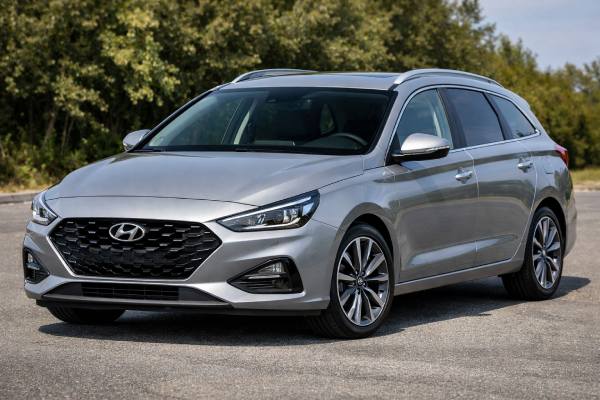
The facelift Hyundai i30 Wagon with the 1.5 T-GDi 48V mild-hybrid powertrain is one of those cars that looks conventional until you start noticing how much useful engineering sits underneath it. It combines a compact exterior footprint with a genuinely large cargo bay, a turbocharged petrol engine, light hybrid assistance, and the sort of calm, well-resolved chassis tuning that matters more in daily life than flashy headline numbers. For families, commuters, and long-distance drivers, that mix makes a lot of sense. The 2024 update also sharpened the design, upgraded the cabin tech, and widened the everyday safety equipment. The only real catch is modern complexity. This is still a direct-injection turbo engine with electrified support and either an intelligent manual or dual-clutch gearbox, so service history, software condition, and tyre quality matter more than they would on a simpler old-school estate. Buy the right one, though, and it is a deeply usable car.
Fast Facts
- The Wagon body brings real utility, with a long roof, big cargo area, and compact-car road manners.
- The 1.5 T-GDi 48V powertrain offers strong mid-range pull without the cost or weight of a full hybrid.
- Facelift cars gained better connectivity, cleaner styling, and a broader SmartSense safety package.
- Public market data for this engine can vary by country and tune label, so VIN-specific verification matters.
- A 10,000–15,000 km or 12-month oil-service routine is the safest long-term ownership habit.
Section overview
- Hyundai i30 Wagon mild-hybrid picture
- Hyundai i30 Wagon 140 data
- Hyundai i30 Wagon trims and safety tech
- Reliability, weak spots and updates
- Service planning and used-buy advice
- Driving feel and real efficiency
- Wagon value against rivals
Hyundai i30 Wagon mild-hybrid picture
The facelift Hyundai i30 Wagon 1.5 T-GDi 48V is the kind of estate car that survives because it does its job exceptionally well. It does not try to be an SUV, and it does not need to. Instead, it offers the low loading height, clean on-road manners, and efficient packaging that estates have always done better than taller crossovers. The 2024 update kept that identity intact while making the car feel more current in exactly the right places: exterior detailing, cabin technology, safety systems, and day-to-day convenience.
The powertrain is the most important part of that story. Hyundai pairs a 1.5-litre turbocharged petrol engine with a 48-volt mild-hybrid system, using a belt starter-generator rather than a full hybrid traction motor. That distinction matters. This is still a normal petrol estate in the way it behaves, refuels, and responds to the driver. It does not creep around electrically in town, and it does not bring the packaging compromises of a large battery. What it does do is smooth stop-start operation, support coasting and energy recovery, and make the car feel more polished in traffic.
One complication deserves honest mention. Current public Hyundai material is not perfectly consistent on this engine. The 2024 UK press release for the updated Tourer markets the car as a 1.5 T-GDi 140PS 48V mild hybrid, while some live UK configurator metadata still exposes older 159PS engine values in the background. That is exactly the kind of detail that can confuse used buyers and parts buyers alike. The safest practical rule is simple: treat the facelift Wagon as a 1482 cc 48V 1.5 T-GDi family car, then verify the exact tune, transmission, and emissions calibration by VIN.
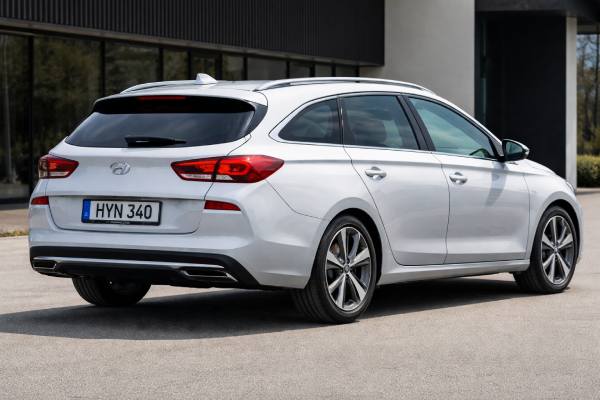
The Wagon body itself remains one of the model’s biggest strengths. Hyundai did not simply stretch the hatchback and call it done. The rear bodywork is long enough to make the luggage area meaningfully more useful, while the wheelbase and overall road footprint still stay compact by family-estate standards. That makes the i30 Wagon easier to park and place than larger estates, but far more practical than most hatchbacks.
The facelift update also helped the car visually. The revised grille, lighting signatures, wheel designs, and cleaner cabin details make the current Wagon look newer without changing its basic proportions. That matters in ownership because this is the sort of car people often keep for years. It still needs to look current halfway through that period.
Overall, the 2024-on i30 Wagon 1.5 T-GDi 48V is a rational car in the best sense. It is efficient without being slow, roomy without being bulky, and modern without becoming needlessly complicated. That is why it is so easy to recommend when the specific car has the right history behind it.
Hyundai i30 Wagon 140 data
For this model, the technical picture needs one small clarification up front. Hyundai’s current UK market material describes the updated Wagon as a 1.5 T-GDi 140PS 48V mild hybrid, while earlier public Hyundai technical sheets for the same facelift-era 1482 cc Wagon powertrain family list 159 PS. The body dimensions, 48-volt architecture, and major hardware remain consistent, but current published market data is not perfectly aligned on output naming. In practice, buyers should verify the exact VIN and local registration data. The table below reflects the current facelift Wagon layout and the 140 hp article brief, while noting the known family-spec details where Hyundai’s open technical sheets are clearer.
Powertrain and efficiency
| Item | 6iMT | 7DCT |
|---|---|---|
| Code | Smartstream / Kappa-family 1.5 T-GDi 48V mild hybrid | Smartstream / Kappa-family 1.5 T-GDi 48V mild hybrid |
| Engine layout and cylinders | Inline-4, DOHC, 4 valves/cyl | Inline-4, DOHC, 4 valves/cyl |
| Displacement | 1.5 L (1482 cc) | 1.5 L (1482 cc) |
| Bore × stroke | 71.6 × 92.0 mm (2.82 × 3.62 in) | 71.6 × 92.0 mm (2.82 × 3.62 in) |
| Induction | Turbocharged, single-scroll | Turbocharged, single-scroll |
| Fuel system | Direct injection | Direct injection |
| Compression ratio | 10.5:1 | 10.5:1 |
| Max power | 140 hp class / 140 PS market label (current UK); verify VIN-specific tune | 140 hp class / 140 PS market label (current UK); verify VIN-specific tune |
| Max torque | 253 Nm (187 lb-ft) | 253 Nm (187 lb-ft) |
| Timing drive | Chain | Chain |
| Mild-hybrid motor | Belt starter-generator | Belt starter-generator |
| System voltage | 48 V | 48 V |
| Battery chemistry | Lithium-ion polymer | Lithium-ion polymer |
| Battery capacity | 0.44 kWh | 0.44 kWh |
| Rated combined efficiency | about 6.0 L/100 km | about 5.8 L/100 km |
| Rated economy | 47.1 mpg UK / 39.2 mpg US | 48.7 mpg UK / 40.6 mpg US |
| Real-world highway @ 120 km/h | about 6.1–7.0 L/100 km | about 6.0–6.8 L/100 km |
Transmission and driveline
| Item | 6iMT | 7DCT |
|---|---|---|
| Transmission | 6-speed intelligent manual | 7-speed dual-clutch automatic |
| Drive type | FWD | FWD |
| Differential | Open | Open |
Chassis and dimensions
| Item | Hyundai i30 Wagon 1.5 T-GDi 48V |
|---|---|
| Suspension front / rear | MacPherson strut / multi-link, though some lower market mixes in the i30 range use a simpler rear setup on lesser engines |
| Steering | Electric rack-and-pinion |
| Steering ratio | 13.4:1 |
| Steering turns lock-to-lock | 2.57 |
| Brakes | Front vented discs 280–305 mm; rear discs 272–284 mm, trim-dependent |
| Common tyre sizes | 205/55 R16, 225/45 R17, or 225/40 R18 |
| Ground clearance | 140 mm (5.5 in) |
| Length / Width / Height | 4585 / 1795 / 1465 mm without roof rails |
| Height with roof rails | 1475 mm (58.1 in) |
| Wheelbase | 2650 mm (104.3 in) |
| Turning circle | 10.6 m (34.8 ft) |
| Kerb weight | roughly 1350–1510 kg manual; 1380–1540 kg DCT, depending on trim and market |
| GVWR | about 1860–1890 kg |
| Fuel tank | 50 L (13.2 US gal / 11.0 UK gal) |
| Cargo volume | 602–1650 L (21.3–58.3 ft³), VDA |
| Roof load | 80 kg |
| Towing capacity | up to 1410 kg braked / 600 kg unbraked in earlier official Wagon data; verify exact current VIN and gearbox |
Performance and service capacities
| Item | 6iMT | 7DCT |
|---|---|---|
| 0–100 km/h | about 10.0 s | about 10.1–10.3 s |
| 0–60 mph | 9.6 s | about 9.7 s |
| Top speed | 210 km/h (130 mph) class | 210 km/h (130 mph) class |
| Engine oil incl. filter | about 4.2 L (4.4 US qt) | |
| Gear oil / transmission fluid | about 1.6 L (1.7 US qt) | about 2.0 L (2.1 US qt) |
| Coolant | about 6.3 L manual / 6.1 L DCT | |
| Wheel nut torque | about 107–127 Nm (79–94 lb-ft), verify by wheel package |
Safety and driver assistance
| Item | Hyundai i30 family benchmark |
|---|---|
| Euro NCAP | 5 stars |
| Adult / child / vulnerable road users / safety assist | 88% / 84% / 64% / 68% |
| IIHS | not applicable in this market context |
| ADAS | FCA, LKA, LFA, ISLA, TPMS, and eCall standard or widely available; blind-spot and rear cross-traffic support trim-dependent |
The big technical takeaway is simple: the facelift Wagon remains a compact estate with real carrying ability, modern mild-hybrid support, and enough torque to feel stronger than its conservative appearance suggests.
Hyundai i30 Wagon trims and safety tech
For the 2024-on Wagon, trim structure matters more than it might on the hatchback, because Hyundai does not offer the full body-style and trim matrix in every market. In the current UK update, the Tourer is limited to two higher-specification trims, Advance and Premium, while the sportier N Line and N Line S are reserved for the Hatchback. That is useful for buyers, because it means current Wagon buyers are funneled toward the more comfort- and utility-focused versions of the i30 range rather than the appearance-led sport trims.
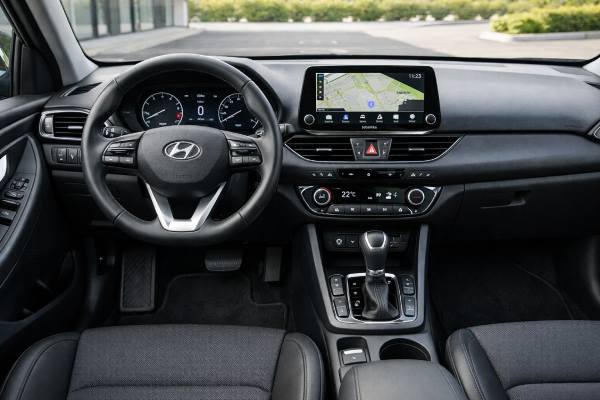
That makes a lot of sense for this body style. The Advance trim already covers the basics well: 16-inch alloy wheels, LED lighting signatures, rear camera, front and rear parking sensors, cruise control, power-folding heated mirrors, 10.25-inch navigation and media screen, 10.25-inch digital driver display, USB-C points, and the core SmartSense safety bundle. In practical terms, that means an entry-level current Wagon already avoids the sparse feel that some compact estates still suffer from.
Premium trim is where the car starts to feel noticeably more upmarket. Hyundai adds 17-inch alloys, heated front seats, heated steering wheel, dual-zone climate control, electrical driver’s seat adjustment, keyless entry, privacy glass, auto-dimming mirror, and a more complete forward collision system with junction support. Those upgrades are meaningful in daily use, especially if the car is used for family trips or longer motorway runs. Heated seats and steering wheel, for example, sound minor on paper but make a real difference in cold climates. The electric seat and dual-zone climate help the i30 Wagon feel like a more expensive long-distance tool.
The facelift also sharpened cabin tech. The updated i30 family gained broader connected-service support, improved graphics, refreshed trim materials, more USB-C charging, and more polished lighting and upholstery details. None of that changes how the car drives, but it does change how current the car feels. For buyers keeping a car for many years, that matters.
Safety is one of the Wagon’s strongest selling points. The underlying i30 family has a five-star Euro NCAP result, and Euro NCAP’s public record shows that mild-hybrid variants were added into the model-range coverage during the later reviews. The facelift also expanded Hyundai SmartSense availability. Current materials highlight Forward Collision-Avoidance Assist for cars, pedestrians, and cyclists, Lane Follow Assist, Lane Keep Assist, Intelligent Speed Limit Assist, TPMS, and eCall as standard across the updated range. Premium trim adds stronger forward-collision support at junctions, and depending on market, buyers may also find rear cross-traffic or blind-spot-related systems elsewhere in the broader i30 family.
A final used-buy point is worth stressing: ADAS is only valuable when it is calibrated and working correctly. Windscreen replacement, bumper repair, radar or camera component changes, and even poor-quality accident repairs can all affect these systems. On a used Wagon, confirmation that the assistance systems function correctly is part of buying the car, not an optional extra.
Reliability, weak spots and updates
The facelift i30 Wagon 1.5 T-GDi 48V is fundamentally a sensible, modern family estate, but it should not be treated like an old naturally aspirated workhorse that can skip maintenance without consequence. Its reliability story is mostly good, yet it depends heavily on service habits, software condition, and the quality of consumables.
Common | Low to medium cost: ignition-related drivability complaints.
This is one of the first areas where a modern turbo petrol shows neglect. Aging spark plugs, weak ignition coils, marginal battery voltage, or poor fuel quality can cause hesitation under load, occasional misfire warnings, rough idle, or sluggish response. These are usually manageable faults, but they matter because they are also early warnings that a car has not been maintained carefully.
Common | Medium cost: intake-valve carbon build-up over time.
The 1.5 T-GDi uses direct injection, so fuel no longer washes the backs of the intake valves. Cars that do many short journeys can gradually build deposits, especially as mileage climbs. Typical symptoms are rough cold running, uneven idle, or slightly duller throttle response. This is not a reason to avoid the car. It is simply part of owning a direct-injection turbo petrol for the long term.
Occasional | Medium cost: 7DCT low-speed awkwardness.
The dual-clutch gearbox suits mixed commuting and open-road work well, but it still behaves like a dual-clutch. In slow crawling traffic, some cars feel slightly abrupt, hesitant, or mechanically busy. That does not always mean a fault, but a badly maintained or poorly adapted DCT can feel clearly worse. Any used DCT Wagon should be driven from cold, in reverse, on an incline, and in stop-start traffic before purchase.
Occasional | Low to medium cost: 48V system warnings and battery-related behavior.
The mild-hybrid system is not especially exotic, but it does add a belt starter-generator, control electronics, inverter logic, and a lithium-ion polymer battery. If the car shows erratic stop-start behavior, random charging messages, or unexplained warning lights, a proper diagnostic scan is the right next step. Do not rely on a seller saying “it just needs a battery.”
Occasional | Low to medium cost: suspension, tyre, and alignment wear.
The Wagon usually rides and tracks well when it is on good tyres and correct geometry. Cheap replacement tyres, kerb damage, worn bushes, or poor alignment can make the car feel noisy and less settled than it should. This is especially true on 17-inch or 18-inch wheel packages.
Rare | Medium to high cost: timing-system and turbo concerns on neglected cars.
The engine uses a chain, not a timing belt, which is good news. It still needs clean oil. Poor oil-change history increases the odds of cold-start chain noise, tensioner wear, or tired turbo behavior over time. None of this is inevitable, but it is the area where maintenance neglect becomes expensive.
Software and calibrations deserve their own line item. The facelift i30 depends more than older cars on updated infotainment, correctly functioning assistance systems, and stable powertrain control logic. Cars with documented dealer or specialist support are worth more than those that merely have the right body and engine.
For recalls and service actions, always use Hyundai’s official VIN lookup and dealer records. The i30 family has market-specific service actions over time, and exact VIN confirmation is more reliable than internet lists or owner memory.
Service planning and used-buy advice
The best way to keep the facelift i30 Wagon 1.5 T-GDi 48V healthy is to ignore the temptation to treat it like a low-stress appliance. It is a modern turbocharged mild-hybrid estate, and the smartest owners service it a bit earlier than the longest official schedules might imply.
A practical maintenance plan looks like this:
- Engine oil and filter: every 10,000–15,000 km or 12 months. This is the most valuable preventive step you can take.
- Engine air filter: inspect every service; replace around 30,000 km sooner in dusty use.
- Cabin filter: every 12 months.
- Spark plugs: inspect by about 45,000 km and replace around 45,000–60,000 km depending on use and fuel quality.
- Brake fluid: every 2 years.
- Coolant: inspect yearly and renew according to the official age schedule and exact coolant specification.
- Manual gear oil or DCT fluid: if the service history is unclear, a preventive change is worth considering rather than waiting for symptoms.
- Tyres, alignment, brake pads, and discs: inspect at every service. The Wagon’s road manners depend heavily on good tyres.
- Timing chain: no routine belt replacement is required, but monitor cold-start behavior, chain noise, and timing-correlation faults.
- 12 V battery and 48 V health: test annually from around year 4 onward, especially if stop-start or charging behavior changes.
- Belt starter-generator and related hardware: inspect at service intervals because the mild-hybrid system depends on it.
Useful capacities from official i30 Wagon technical data for this engine family include 4.2 L engine oil, 1.6 L manual gear oil, 2.0 L DCT fluid, about 6.3 L coolant manual or 6.1 L DCT, and a 50 L fuel tank. The mild-hybrid battery is a 0.44 kWh lithium-ion polymer unit. Exact oil approvals, refrigerant charge, compressor oil amount, and some torque figures remain VIN- and market-sensitive, so workshop work should always be checked against official service information for the specific car.
As a used purchase, the checklist is refreshingly clear:
- full service history with dates and invoices
- clean cold start and even idle
- no hesitation under load
- no unexplained battery, charging, or stop-start warnings
- quiet timing area on cold start
- smooth DCT creep and engagement if automatic
- matching-quality tyres on each axle
- straight braking with no vibration
- working parking sensors, camera, and lane systems
- official recall and service-campaign confirmation by VIN
The best cars are usually the least dramatic ones: stock, well maintained, and wearing good tyres. Avoid cars with patchy oil history, cheap mixed tyres, unresolved warning lights, or sellers who cannot explain recent maintenance.
Long-term durability looks good when the Wagon is treated like the modern turbo mild-hybrid it is. Neglect does not always show immediately, but it does make itself known later.
Driving feel and real efficiency
On the road, the facelift i30 Wagon 1.5 T-GDi 48V feels exactly like the kind of estate many people wish still dominated the market: tidy, planted, easy to place, and calmer than its size suggests. The steering is light but accurate, the ride quality is mature on sensible wheels, and the long roof helps the car feel stable at motorway speed. It does not try to excite the driver constantly. Instead, it aims to reduce effort, and that suits its role perfectly.
The powertrain character is also well judged. The turbo engine has enough low-end and mid-range torque that the Wagon rarely feels strained, even with passengers or luggage. The 48-volt system is subtle, which is a compliment. It smooths restart behavior, supports coasting logic, and makes the whole car feel a touch more refined in urban use. Buyers expecting a full-hybrid EV-like feel will be disappointed. Buyers wanting a normal turbo petrol with cleaner stop-start manners usually come away satisfied.
The 6iMT is the choice for drivers who still want a manual and a simpler ownership story. It also works well with the mild-hybrid coasting logic. The 7DCT is the easier commuter option. It suits steady traffic and motorway use well, though its behavior at crawling speed is still more mechanical than a torque-converter automatic. Neither version is a sports estate, but both feel comfortably stronger than the entry-level 1.0-litre alternatives.
Real-world pace is respectable. Current official UK market data gives the 140PS manual Tourer a 9.6-second 0–60 mph time and a 130 mph top speed, which places it squarely in the “usefully brisk” category. That is enough for easy overtaking and stress-free motorway merging, even if it is not remotely trying to be an N model. In everyday driving, the strength is not the headline sprint but the car’s relaxed, unforced way of carrying speed.
Fuel use is one of the Wagon’s strongest arguments. In realistic mixed driving, expect around 6.5–7.5 L/100 km. A steady open-road run can drop into the 6.0–6.8 L/100 km range, while colder weather, town-heavy work, or bigger wheels can push the car toward 7.8–8.5 L/100 km. In mpg terms, that translates to about 31–36 mpg US / 37–43 mpg UK mixed, 35–39 mpg US / 42–47 mpg UK on the highway, and a little less in full urban use.
Noise levels are well contained. This is not a whisper-quiet premium wagon, but wind and tyre noise are managed well enough that long trips feel easy. With good tyres fitted, the car has the sort of calm that families and commuters will value more than sharper steering feel.
That is really the verdict. The i30 Wagon 1.5 T-GDi 48V is not thrilling, but it is polished, useful, and economical enough to make daily driving easier. For its intended job, that is exactly right.
Wagon value against rivals
The facelift i30 Wagon 1.5 T-GDi 48V competes in a shrinking but still important part of the market. Estates are less common than they used to be, which actually helps the Hyundai. It gives buyers a practical alternative to compact SUVs without forcing them into a larger or more expensive class.
Against a Volkswagen Golf Variant, the Hyundai often gives away a little badge prestige and some interior softness, but it usually counters with better value, generous equipment, and very honest ergonomics. Compared with a Skoda Octavia Estate, the i30 Wagon loses some outright rear-seat and cargo dominance, though the Hyundai feels tidier in size and a little easier to place in town. Versus a Kia Ceed Sportswagon, differences are smaller because the engineering roots are closely related, so trim, condition, and pricing matter more than badge loyalty.
The Hyundai also makes a strong case against compact SUVs. A Kia Sportage, Hyundai Tucson, or Nissan Qashqai may offer a higher seating position, but the i30 Wagon fights back with lower weight, cleaner motorway aerodynamics, better fuel efficiency in like-for-like petrol form, and a luggage area that is often easier to load. For buyers who do not need extra ground clearance, the estate layout is still a smarter answer.
Its strongest points are clear:
- large cargo area without SUV bulk
- efficient mild-hybrid petrol powertrain
- mature ride and motorway stability
- strong safety and technology updates in facelift form
- sensible used values
Its weak spots are equally clear:
- current public spec data can be inconsistent by market
- DCT needs a careful test drive
- direct injection and mild-hybrid hardware add modern complexity
- it is more rational than exciting
That last point is not really a criticism. The i30 Wagon is supposed to be rational. It exists for drivers who want one car to do almost everything well: commute, travel, carry family gear, return decent fuel economy, and still feel pleasant behind the wheel. In that sense, it succeeds.
As a used or nearly new buy, it looks especially good when compared with compact SUVs that cost more, weigh more, and often do not carry luggage any better in the real world. The facelift 2024-on update keeps the car visually and technologically current, and the Wagon body keeps it genuinely useful. That combination gives the i30 Wagon 1.5 T-GDi 48V a stronger case than many people first assume.
References
- Hyundai Motor UK has confirmed pricing and specification for the new i30, with new top-level N Line S trim available on Hatchback 2024 (Specifications)
- Bolder and more high-tech: i30 gets update 2024 (Press Release)
- Hyundai i30 Kombi | Technische Daten | Stand: 4.2019 2020 (Technical Data)
- EuroNCAP | Hyundai i30 2017 (Safety Rating)
- Home | Hyundai Recalls & Service Campaigns 2026 (Recall Database)
Disclaimer
This article is for informational purposes only and is not a substitute for professional diagnosis, repair, or VIN-specific workshop documentation. Specifications, torque values, service intervals, cargo figures, procedures, and even published output labels can vary by VIN, market, trim, transmission, and model year, so always verify the exact data against official Hyundai service information for the specific vehicle.
If this guide helped you, please consider sharing it on Facebook, X, or another community you trust to support our work.