
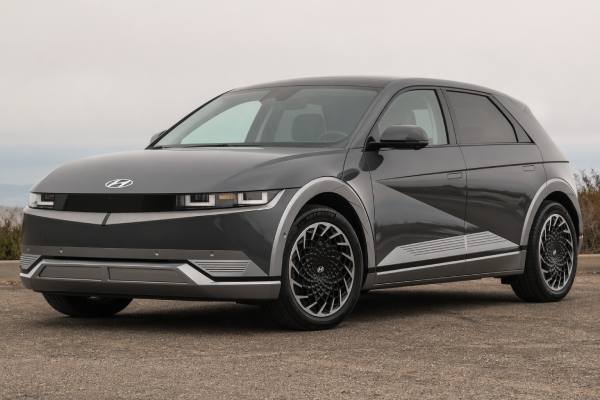

The 2022–2024 Hyundai IONIQ 5 AWD with the 77.4 kWh battery is the long-range dual-motor version that turned the NE platform from an interesting EV into a genuinely complete family car. It combines a strong 239 kW system output, secure all-weather traction, very rapid DC charging potential, and one of the most spacious cabins in its class. Even a few years on, that mix still feels unusually well judged.
What matters most in ownership is that this version is not just the fast IONIQ 5. It is also the heavier, more complex one, which means wheel choice, software status, and recall history matter more than they do on the rear-drive cars. The payoff is a better motorway reserve, a more effortless overtaking feel, and real towing usefulness. For used buyers, the main task is finding one with complete campaign work, healthy charging behavior, and sensible tyre and brake condition. Do that, and this remains one of the most rounded early-generation family EVs.
Essential Insights
- Strong mid-range punch, secure AWD traction, and a roomy 3,000 mm wheelbase cabin make it a very capable daily EV.
- The 800-volt charging system is still a major strength on high-power DC chargers.
- Towing ability and winter traction are materially better than in the rear-drive versions.
- ICCU recall completion and software history matter more than mileage alone.
- Inspect it every 10,000 km or 12 months, and change brake fluid every 30,000 km or 24 months.
Section overview
- IONIQ 5 AWD long-range profile
- IONIQ 5 AWD hard numbers
- IONIQ 5 AWD equipment and protection
- Fault trends and fixes
- Service plan and shopping advice
- Speed, efficiency and charging feel
- Where it stands against rivals
IONIQ 5 AWD long-range profile
The long-range AWD IONIQ 5 is the version that best shows what Hyundai was trying to do with the original NE platform. It was never just about straight-line speed. The real idea was to pair dual-motor performance with a large enough battery and a high-voltage charging system that could make the car feel easy rather than compromised. That is why this variant still matters on the used market. It gives you the full design and packaging concept of the IONIQ 5 with the least need for excuses.
The dual-motor layout changes the car’s character more than the raw numbers suggest. Yes, 325 hp and 605 Nm make it noticeably quick, but the bigger gain is how little effort it needs in normal use. It pulls strongly from any sane road speed, feels planted in bad weather, and copes better with hills, passengers, luggage, and towing than the single-motor versions. It is a heavy EV, but it is rarely caught out by that weight in ordinary driving because the torque reserve is generous.
The 77.4 kWh battery is also central to the ownership experience. This is the battery size that makes the pre-facelift IONIQ 5 feel like a realistic one-car EV for many households. On paper, the range is decent rather than class-leading. In practice, the larger buffer matters because it gives the car more flexibility in winter, at motorway speeds, and on days when heating, wet weather, or repeated high-speed use would make the smaller pack feel tight. It also means the car works far better as a road-trip machine, especially if you have access to reliable high-power charging.
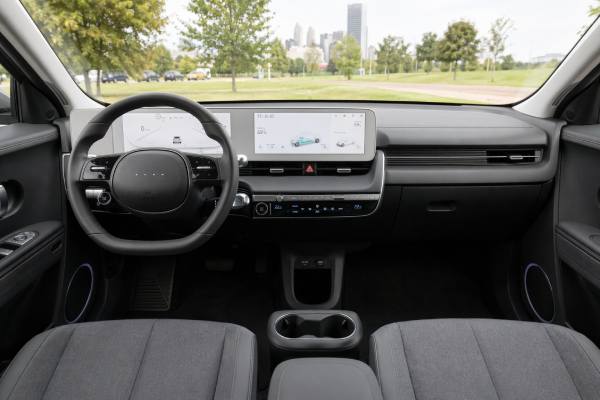
Inside, the IONIQ 5 still feels clever. The wheelbase is long, the floor is flat, and the cabin has a sense of width and openness that many rivals still do not match. Rear legroom is generous, front-seat space feels almost lounge-like, and the broad dashboard layout makes the car feel modern without becoming visually cluttered. That matters because many buyers live with their EV in traffic, parking lots, and school runs far more than they use its launch control equivalent.
The trade-off is simple. This is the most complete regular IONIQ 5 of the 2022–2024 period, but it is also the version where specification matters most. Wheels affect range and ride more, trim level affects comfort and winter capability more, and recall history matters more because the car’s appeal depends on everything working together properly. When all of that is right, though, it remains one of the most convincing all-round electric family cars from its era.
IONIQ 5 AWD hard numbers
Powertrain, battery, and efficiency
| Spec | Value |
|---|---|
| Platform code | NE |
| Powertrain layout | Dual-motor battery electric vehicle |
| Motor type | Permanent magnet synchronous motor front and rear |
| Motor count and axle | Two motors, front and rear |
| Front motor output | 74 kW |
| Rear motor output | 165 kW |
| Combined system output | 239 kW (325 hp) |
| Front motor torque | 255 Nm (188 lb-ft) |
| Rear motor torque | 350 Nm (258 lb-ft) |
| Combined system torque | 605 Nm (446 lb-ft) |
| Battery type | Liquid-cooled lithium-ion |
| Traction battery gross capacity | 77.4 kWh |
| Battery output | 272 kW |
| System voltage | 697 V |
| Battery layout | Underfloor |
| Thermal management | Liquid cooling with battery heating system and heat pump on equipped cars |
| Official efficiency test | WLTP |
| Rated efficiency | 19.1 kWh/100 km (307 Wh/mi) |
| Rated range | 454 km (282 mi) |
| Real-world highway at 120 km/h | About 24.0 kWh/100 km (386 Wh/mi) |
| Real-world highway range at 120 km/h | About 308 km (191 mi) |
Charging and driveline
| Spec | Value |
|---|---|
| Transmission | Single-speed reduction gear front and rear |
| Rear reduction gear ratio | 2.263 |
| Front reduction gear ratio | 2.263 |
| Final gear ratio | 4.706 |
| Drive type | AWD |
| AWD system | HTRAC Dual Motor with Disconnector Actuator System |
| Differential type | Open with brake-based control |
| AC charging connector | Type 2 |
| DC charging connector | CCS Combo 2 |
| Charging port location | Right rear quarter |
| Onboard AC charger | 10.5 kW |
| Charger compatibility | 400 V / 800 V |
| DC fast-charging class | 350 kW ultra-fast compatible |
| AC charging time | 10–100% in about 11 h 45 min at 7 kW |
| DC charging time at 50 kW | 10–80% in about 73 min |
| DC charging time at 350 kW | 10–80% in about 18 min |
| Vehicle-to-Load output | 250 V, 3.6 kW, 15 A |
| Battery preconditioning for DC charging | Cold-climate battery conditioning on equipped cars |
Performance, chassis, and dimensions
| Spec | Value |
|---|---|
| 0–100 km/h | 5.1 s |
| 80–120 km/h | 3.4 s |
| Top speed | 185 km/h (115 mph) |
| Steering type | Rack-mounted motor-driven power steering, rack and pinion |
| Turning circle | 11.98 m (39.3 ft) |
| Steering wheel turns lock to lock | 2.67 |
| Front suspension | MacPherson strut |
| Rear suspension | Multi-link |
| Brake system | Dual diagonal-split circuit with active hydraulic booster |
| Front brakes | Ventilated disc, 345 mm x 30 mm |
| Rear brakes | Ventilated disc, 345 mm x 20 mm |
| Wheel size | 20 x 8.5J +54.5 |
| Tyre type | Michelin Pilot Sport EV |
| Tyre size | 255/45 R20 105W |
| Length | 4,635 mm (182.5 in) |
| Width | 1,890 mm (74.4 in) |
| Height | 1,605 mm (63.2 in) |
| Wheelbase | 3,000 mm (118.1 in) |
| Ground clearance | 160 mm (6.3 in) |
| Kerb weight | 2,125 kg (4,685 lb) |
| GVWR | 2,560 kg (5,644 lb) |
| Roof load limit | 80 kg (176 lb) |
| Front trunk load limit | 10 kg (22 lb) |
| Braked towing capacity | 1,600 kg (3,527 lb) |
| Unbraked towing capacity | 750 kg (1,653 lb) |
| Maximum tow ball weight | 100 kg (220 lb) |
| Rear cargo volume | 527–1,587 L |
| Front cargo volume | 24 L |
Safety and service data
| Spec | Value |
|---|---|
| Euro NCAP rating | 5 stars |
| Euro NCAP scores | Adult 88%, Child 86%, Vulnerable Road Users 63%, Safety Assist 88% |
| IIHS rating picture | Good in the main crash tests |
| IIHS award status | Top Safety Pick+ for 2024 |
| IIHS headlight rating | Good or Acceptable, depending on trim |
| LATCH ease of use | Acceptable |
| Airbags | Front, front centre side, front side, and full-length curtain |
| Battery warranty | 8 years or 160,000 km |
| Brake fluid specification | DOT 4 |
| Brake fluid interval | Every 30,000 km or 24 months |
| Cabin air filter interval | Every 30,000 km or 24 months |
| Reduction gear fluid capacity | 3.4 + 0.1 L |
| Reduction gear fluid specification | HK ATF 65 SP4M-1 |
| Coolant for electric devices and motor | Approx. 6.4 L |
| High-voltage battery LCW coolant | Approx. 11.2 L |
| A/C refrigerant | R-1234yf on Type A systems |
| A/C refrigerant charge with heat pump | 900 ± 25 g |
| A/C compressor lubricant with heat pump | 180 ± 10 g |
| Wheel lug nut torque | 11–13 kgf·m (79–94 lb-ft) |
IONIQ 5 AWD equipment and protection
For trim descriptions, Australia is the clearest baseline market because Hyundai published a clean breakdown for the 239 kW AWD car. In that market, the long-range AWD sat above the rear-drive versions and appeared in Techniq and Epiq trims rather than in the basic standard-range model. Other regions used different names, but the equipment logic was similar: the dual-motor car was usually sold as a better-equipped, more premium version rather than as the bargain entry point.
The mechanical hardware stayed broadly the same across those AWD trims. You got the same dual-motor drivetrain, the same 77.4 kWh battery, the same HTRAC system, the same 1,600 kg braked tow rating, and the same core chassis layout. What changed was the convenience and winter-use detail. Higher trims often added the features that matter to daily life more than to brochures: better seats, memory settings, power tailgate, stronger audio, head-up display, upgraded parking assistance, and richer cabin trim. On some early market versions, battery conditioning and a heat-pump-based cold-weather package were tied more closely to upper trims. By later pre-facelift versions, that equipment became easier to find.
Wheel choice is one of the biggest ownership differences. The AWD car was often associated with 20-inch wheels, and they do change the verdict slightly. They sharpen the visual stance, but they also cut some range and introduce more edge into the ride on rough surfaces. That does not ruin the car, but it does explain why some used examples feel more relaxed than others. Buyers who care about comfort and efficiency should pay real attention to wheel and tyre setup rather than assuming every 325 hp IONIQ 5 will behave the same way.
Safety is a major strength. Euro NCAP gave the IONIQ 5 five stars, and the result remains respectable for a modern family EV. Hyundai also built in the features buyers expect in a dedicated EV platform from this period: a front-centre airbag, broad active-safety coverage, rear child-seat anchors, and a strong passive-safety structure. In U.S. IIHS testing, the IONIQ 5 performed well from launch, but the 2024 model year is the most impressive from a safety-award perspective. Hyundai added reinforcements around the B-pillar and door sill for the updated side test, which helped the 2024 car earn a Top Safety Pick+ result.
ADAS coverage is wide, but exact content depends on trim and market. The core package generally includes forward collision avoidance with vehicle, pedestrian, and cyclist detection, lane following, lane keeping, blind-spot support, rear cross-traffic assistance, adaptive cruise, traffic-sign-related speed support, and parking distance assistance. Higher trims add the genuinely useful extras: surround view, blind-spot camera displays, remote parking functions, and richer visualization. After any body repair, alignment work, or windshield replacement, proper calibration matters. On a used IONIQ 5, badly calibrated safety systems are one of the fastest ways to turn a premium EV into an irritating one.
Fault trends and fixes
The long-range AWD IONIQ 5 is generally a sound EV, but it is not a car you should buy casually. Its weaknesses are less about fundamental motor or battery design and more about campaign history, charging-control hardware, and software maturity. That means condition and documentation matter more than mileage alone.
The headline issue is the ICCU, or Integrated Charging Control Unit. On affected 2022–2024 cars, an ICCU fault can damage low-voltage charging support, which can then discharge the 12 V battery and eventually reduce motive power. The symptoms usually start as warning messages, failed charging attempts, or a 12 V battery that behaves like it is getting old too quickly. The official remedy has involved software inspection and updates, plus ICCU and fuse replacement where fault codes or inspection results require it. This is the first thing any buyer should check through a VIN recall search and dealer history.
The next issue is software and calibration. Early cars received important updates related to regenerative braking brake-light logic and i-Pedal behavior. Those updates do not sound dramatic, but they matter because they change how naturally the car behaves in traffic and how predictably it signals deceleration. They are also a reminder that early E-GMP cars improved meaningfully once the software caught up with the hardware.
A useful way to think about the problem map is this:
- Common, medium-to-high severity: ICCU and 12 V system faults. Symptoms are charging warnings, repeated low-voltage battery events, reduced-power behavior, or failure to start cleanly. Remedy is recall verification, fault-code diagnosis, and replacement of the ICCU or fuse where required.
- Occasional, medium severity: cold-weather DC charging complaints. Symptoms are unexpectedly slow charging, poor battery warm-up, or inconsistent fast-charge performance. Root cause is often missing battery-conditioning functionality, outdated software, or owner misunderstanding of trigger conditions. Remedy is software verification and functional testing.
- Occasional, low-to-medium severity: brake corrosion and sticky friction hardware. Heavy regen means discs can rust before pads wear out, especially in wet climates or low-mileage use. Remedy is brake service, correct lubrication, and periodic friction-brake use.
- Occasional, low severity: trim rattles, charge-port flap complaints, and sensor alignment issues. These are annoying rather than alarming, but they affect perceived quality.
Battery durability itself is not the part most buyers need to fear. The 77.4 kWh pack is liquid-cooled and has held up well in normal use. The bigger concern is whether the car charges and cools properly, not whether the pack is inherently weak. A healthy example should show stable state-of-charge behavior, predictable charging taper, and no history of repeated HV warnings. As ever with EVs, repeated high-speed driving, hot climates, towing, and constant DC fast charging will accelerate wear, but there is no broad evidence that this version is a battery problem car first and foremost.
Pre-purchase, ask for recall proof, any ICCU or fuse invoices, records of coolant work if carried out, and a battery state-of-health or diagnostic printout. Then test what matters: DC charging, 12 V stability, brake condition, tyre wear pattern, suspension quietness, and ADAS cleanliness. A well-kept IONIQ 5 AWD is a very good used EV. A neglected one can become an expensive electronics case study.
Service plan and shopping advice
The long-range AWD IONIQ 5 does not demand the maintenance burden of an ICE SUV, but it rewards discipline. The right maintenance plan is mostly about inspections, fluids, tyres, brakes, and temperature-management systems. This is not a car to ignore just because it has no engine oil.
A practical working schedule starts with a general inspection every 10,000 km or 12 months. That interval is sensible because it catches the things EV owners tend to overlook: brake corrosion, tyre shoulder wear, small coolant leaks, suspension looseness, and early 12 V weakness. Brake fluid should be replaced every 30,000 km or 24 months. Cabin air filter service also falls at 30,000 km or 24 months in common Hyundai EV schedules. If the car lives in dusty cities or on rough roads, move the filter inspection earlier.
Coolant is where buyers need to read the book for the exact car. Depending on coolant type and market, Hyundai schedules differ. On official IONIQ 5 service data, the standard coolant can run much longer, while low-conductivity coolant for the HV system has a shorter replacement schedule. That means you should never accept “it has lifetime coolant” as a serious answer from a seller. Ask what coolant the car uses and whether it has ever been replaced correctly with the designated EV coolant.
For decision-making, these are the most useful service facts:
- Brake fluid: DOT 4, replace every 30,000 km or 24 months.
- Cabin air filter: every 30,000 km or 24 months, earlier in dust-heavy use.
- Reduction gear fluid: inspect regularly, check sooner in hard use, and replace on severe-use schedules.
- Wheel nut torque: 79–94 lb-ft after tyre or brake work.
- Reduction gear fluid specification: HK ATF 65 SP4M-1, capacity 3.4 + 0.1 L.
- Electric devices and motor coolant: about 6.4 L.
- High-voltage battery low-conductivity coolant: about 11.2 L.
For used buyers, the checklist should be focused. Start with the battery, but do not obsess only over battery state-of-health. Watch how the car charges. A healthy long-range AWD should ramp strongly on a high-power DC charger when warm, then taper in a predictable way rather than dropping early or throwing warnings. Also inspect the charge port, latch, rubber seals, supplied cables, and V2L adapter if included. These sound minor, but neglect here usually tells you the rest of the story.
Next, inspect the chassis honestly. The AWD car is heavy and often rides on expensive 20-inch tyres, so alignment matters. Uneven wear, rumbling wheel bearings, or a nervous straight-line feel all deserve attention. Look underneath for damaged battery-area shields, scraped lifting points, bent undertrays, and neglected fasteners. Then check the brakes. Low pad wear is not the same as healthy brakes on an EV.
The best examples are usually later 2023 or 2024 cars with complete campaign history, clean charging behavior, and strong service records. The ones to approach carefully are early cars with vague charging complaints, no recall proof, or sellers who cannot explain software history. Long term, expect the battery to outlast many owners under normal use. The more likely high-cost items are tyres, charging-control hardware, 12 V system problems, and suspension or brake work on poorly maintained examples.
Speed, efficiency and charging feel
The long-range AWD IONIQ 5 feels stronger than its numbers suggest because the power delivery is so immediate and so clean. Off the line, it is quick enough to feel properly premium, and the 80–120 km/h shove is what really defines the car in daily driving. It does not need drama to be effective. Overtakes happen with very little effort, motorway merges are easy, and the car feels more relaxed under load than the rear-drive versions.
The chassis tune is mature rather than playful. Straight-line stability is very good, body control is better than you might expect from a tall EV, and the low battery placement helps the car feel planted. Steering feel is accurate more than talkative, which suits the car’s family role. The downside is that the AWD version, especially on 20-inch wheels, is not as supple as the better-riding rear-drive 19-inch cars. It is still comfortable, but you notice sharper impacts more readily.
Noise levels are also wheel-sensitive. At city speeds the cabin is impressively calm. At motorway pace, wind and tyre noise become more noticeable, especially on rough surfaces and bigger wheels. Even so, the IONIQ 5 remains quieter and more settled than many early EV crossovers. Brake feel is generally good for a blended regen-friction system. There is still a slight synthetic edge near walking pace, but the handoff is smoother than in many rivals from the same period.
Range depends heavily on how you use the car. In town and mixed driving, the AWD model can feel more efficient than expected because regen helps and the power reserve means it is never working hard. On the highway, physics reasserts itself. Expect something in the high teens to low twenties kWh per 100 km in careful mixed use, but nearer the mid-20s at sustained 120 km/h in less friendly weather. In real terms, that usually means roughly 300 km of steady warm-weather motorway range is realistic, with a visible drop in winter or in strong headwinds. That is still usable, but it is why the 325 hp version should be bought by people who understand that power and all-wheel drive always cost some range.
Charging remains one of the car’s strongest arguments. On AC, the three-phase setup is easy to live with if your home or workplace supply supports it. Overnight charging is simple. On DC, the IONIQ 5 still feels advanced. When the battery is warm and the charger is strong, 10–80% stops are genuinely quick and help the car travel like a more recent EV. The caveat is temperature. Cold batteries, high starting state of charge, or missing battery-conditioning functionality can take much of the shine off the charging curve. That is why a proper road test should include charging, not just driving.
With passengers or a trailer, the AWD version keeps its composure well. The tow rating is useful, and the extra front motor helps traction on wet ramps and steep starts. The penalty is energy use. Moderate towing can cut usable range sharply, often by around a third or more depending on speed, weather, and trailer shape. This is a competent tow EV, but not a free one.
Where it stands against rivals
The Kia EV6 is the closest rival because it shares the same E-GMP foundation and similar charging strengths. The Kia feels lower, tighter, and slightly more driver-oriented. The Hyundai feels more spacious and more relaxed, with a cabin that prioritizes openness over sportiness. For many family buyers, the IONIQ 5’s rear-seat room and lounge-like atmosphere make it the easier car to live with, while the EV6 feels a little more focused from behind the wheel.
Against the Tesla Model Y, the comparison depends on what you value. The Tesla generally wins on software integration, route planning, and outright efficiency. The Hyundai answers with a more distinctive cabin, more conventional controls, better long-distance comfort on comparable wheels, and a stronger sense of material warmth. The IONIQ 5 also feels less austere. Buyers who like a more traditional premium-car atmosphere often prefer the Hyundai even when the Tesla looks stronger on a charging or navigation spreadsheet.
The Ford Mustang Mach-E takes a different route. It feels more overtly sporty in steering and front-end response, and some drivers will prefer its road manners. The Hyundai counters with faster charging potential, a more spacious-feeling cabin, and a more innovative interior layout. If your priority is family usability with strong real-world fast-charging ability, the IONIQ 5 is usually the more rounded proposition.
The Volkswagen ID.4 GTX is another logical alternative. It is easygoing, comfortable, and less visually divisive, but the Hyundai still feels like the more advanced product in charging architecture and interior design. The IONIQ 5 also has a more memorable cabin and a stronger sense of technical ambition. The Volkswagen’s advantage is that it can feel simpler and less attention-seeking if that is what you want in a daily EV.
That leads to the real verdict. The 2022–2024 IONIQ 5 AWD is not necessarily the cheapest used EV to run, and it is not the best choice for buyers who only do short urban miles. But it is one of the most complete early EV crossovers if you want a real family car with proper pace, fast charging, towing usefulness, and a cabin that still feels fresh. Its weaknesses are mostly manageable if you buy carefully: campaign history, tyres, brakes, and electronics matter more than the drivetrain fundamentals.
In other words, this version compares well because it does not rely on one trick. It is not just quick. It is not just spacious. It is not just a good charger. It does all three convincingly, which is why it still deserves serious attention in the used EV market.
References
- Hyundai IONIQ 5. 2022 (Specification Sheet)
- OWNER’S MANUAL 2025 (Owner’s Manual)
- Euro NCAP | Hyundai IONIQ 5 2021 (Safety Rating)
- 2024 Hyundai Ioniq 5 2024 (Safety Rating)
- Safety Recall 272: Integrated Charging Control Unit (ICCU) 2024 (Recall Database)
Disclaimer
This article is for informational purposes only and is not a substitute for professional diagnosis, repair, or a pre-purchase inspection. Specifications, torque values, maintenance intervals, procedures, and equipment can vary by VIN, market, trim, software level, and factory options, so always verify against the correct official service documentation for the exact vehicle.
If this guide helped you, please consider sharing it on Facebook, X, or another social platform to support our work.