
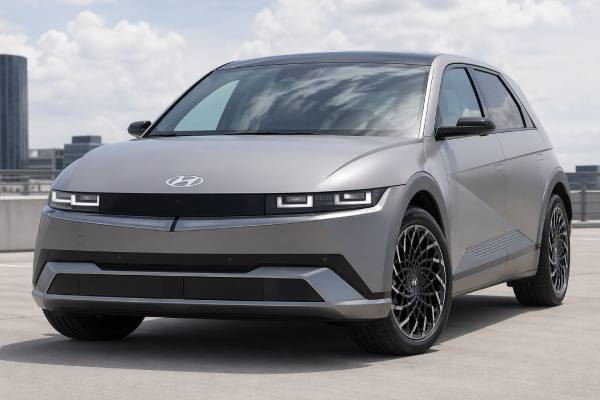

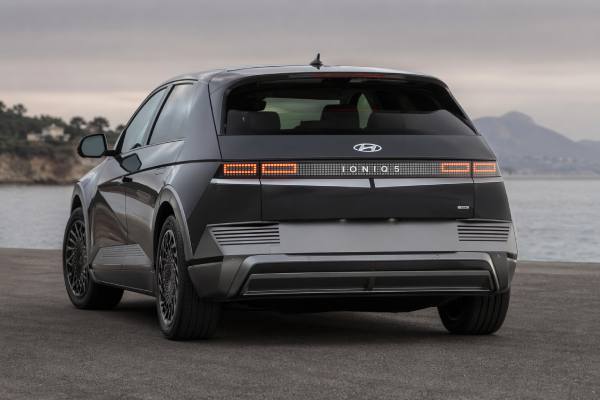
The facelifted Hyundai IONIQ 5 AWD is the version that turns the original concept into a more complete long-range family EV. It keeps the same basic recipe that made the car stand out in the first place: a roomy cabin, a long 3,000 mm wheelbase, and Hyundai’s fast-charging 800-volt E-GMP platform. But the 2024 update adds several meaningful ownership improvements. The battery grows to 84.0 kWh, battery heating and pre-conditioning become standard across the range in key markets, and the cabin gets more usable physical controls. Hyundai also sharpened the body, improved ride refinement, and finally added a rear wiper. In this 325 hp dual-motor AWD form, the facelifted IONIQ 5 is not the range leader of the line, but it is arguably the most balanced version for drivers who want confident all-weather traction, strong overtaking performance, and road-trip charging that still feels unusually quick for a mainstream EV.
Top Highlights
- The facelift brings a larger 84.0 kWh battery and useful detail upgrades, not just cosmetic changes.
- Standard battery pre-conditioning and heat pump support make winter charging and efficiency less frustrating.
- The AWD setup gives strong traction and easy mid-range pace without making the car feel harsh.
- Early ownership still depends on careful VIN checks for recalls and software campaigns, especially around charging hardware.
- Inspect tyres, brakes, and core EV systems every 10,000 km or 12 months.
Section overview
- Hyundai IONIQ 5 AWD facelift highlights
- Hyundai IONIQ 5 AWD technical figures
- Hyundai IONIQ 5 AWD versions and driver aids
- Trouble spots and factory actions
- Ownership schedule and buyer checks
- Everyday pace and energy use
- Facelift IONIQ 5 against competitors
Hyundai IONIQ 5 AWD facelift highlights
The facelifted IONIQ 5 AWD is a better-resolved version of an already strong EV. Hyundai did not rewrite the car from scratch, but it targeted the parts owners actually notice: usable range, winter charging behavior, cabin controls, ride refinement, and day-to-day practicality. That matters because the original IONIQ 5 was already one of the most interesting family EVs on the market. The facelift turns it into a more mature one.
In this form, the car uses the updated 84.0 kWh battery and the familiar dual-motor layout with a 74 kW front motor and a 165 kW rear motor. Combined output is 239 kW, or about 325 PS, which is roughly 320 hp in the way many markets quote it. On paper, that makes it quick. In practice, it makes the car feel effortless. The key trait is not drama off the line. It is the way the car gathers speed without strain, even when loaded with passengers or driven in poor weather.
The facelift also addresses several points that owners of earlier cars regularly mentioned. One is charging consistency in winter. In important markets, Hyundai made battery heating, pre-conditioning, and the heat pump standard across the range. That is a significant ownership upgrade because the earlier car could feel more sensitive to software state, temperature, and options. Another fix is physical usability. The revised cabin brings back more direct access to common climate and seat functions, which suits a daily-driven family car much better than burying everything in menus.
There are also smaller but meaningful changes. The rear wiper may sound minor, yet it directly improves bad-weather visibility. The revised steering wheel, refreshed materials, and updated infotainment environment make the cabin feel newer. Hyundai also worked on the body and chassis, with structural and refinement changes aimed at cutting vibration, booming noise, and steering-column shake over rougher roads. Those updates suit the IONIQ 5’s personality. This has always been a calm, spacious, comfort-led EV rather than a razor-sharp one.
The AWD version is the one to choose if you want the IONIQ 5 to feel complete in all seasons. The rear-wheel-drive car is still the efficiency champion, but the AWD model is a better match for wet roads, steep grades, snow use, and frequent heavy loads. It is also the trim level where the IONIQ 5 starts to feel genuinely premium in both performance and confidence.
The only major caveat is that, despite the facelift, this remains a sophisticated EV whose ownership quality depends heavily on software and campaign status. A clean service history, correct recall completion, and properly functioning charging systems matter more than a glossy advert. Get that right, and the facelifted IONIQ 5 AWD remains one of the most convincing electric family crossovers on sale.
Hyundai IONIQ 5 AWD technical figures
Powertrain, battery, and efficiency
| Spec | Value |
|---|---|
| Motor type | Dual permanent magnet synchronous motors |
| Motor layout | One front motor and one rear motor |
| Front motor output | 74 kW |
| Rear motor output | 165 kW |
| Combined output | 239 kW (325 PS / about 320 hp) |
| Combined torque | 605 Nm (446 lb-ft) |
| Drive type | AWD |
| Battery chemistry | Lithium-ion polymer, NMC |
| Battery layout | Floor-mounted underbody pack |
| Gross battery capacity | 84.0 kWh |
| Usable battery capacity | 80.0 kWh |
| System voltage | 697 V |
| Electrical architecture | 800 V |
| Thermal management | Liquid-cooled battery and power electronics |
| Heat pump | Standard in key facelift markets |
| Battery preconditioning | Standard, navigation-linked |
| Official efficiency standard | WLTP |
| WLTP rated efficiency | 18.2 kWh/100 km (293 Wh/mi) |
| WLTP rated range | 494–501 km (307–311 mi) |
| Real-world mixed range | about 445 km (277 mi) |
Driveline, charging, and performance
| Spec | Value |
|---|---|
| Transmission | Single-speed reduction gear |
| Charging connector (AC) | Type 2 |
| Charging connector (DC) | CCS Combo 2 |
| Charging port location | Right rear quarter |
| Onboard charger (AC) | 11 kW |
| DC fast-charge peak | 260–263 kW |
| Typical DC average power, 10–80% | about 196 kW |
| Replenishment time, DC 10–80% | 18 min |
| Replenishment time, AC 0–100% | about 8 h 45 min |
| Vehicle-to-load output | 3.6 kW |
| 0–100 km/h | 5.3 s |
| 0–62 mph | 5.3 s |
| Top speed | 185 km/h (115 mph) |
| Towing capacity, braked | 1600 kg (3527 lb) |
| Towing capacity, unbraked | 750 kg (1653 lb) |
Chassis, dimensions, and capacities
| Spec | Value |
|---|---|
| Front suspension | MacPherson strut |
| Rear suspension | Multi-link |
| Steering type | Rack-and-pinion electric power steering |
| Wheels and tyres | 19-inch or 20-inch alloy wheel packages |
| Length | 4655 mm (183.3 in) |
| Width | 1890 mm (74.4 in) |
| Width with mirrors | 2152 mm (84.7 in) |
| Height | 1605 mm (63.2 in) |
| Wheelbase | 3000 mm (118.1 in) |
| Turning circle | 12.0 m (39.4 ft) |
| Kerb weight | about 2165 kg (4773 lb) |
| GVWR | 2685 kg (5920 lb) |
| Payload | 595 kg (1312 lb) |
| Cargo volume | 520 L seats up / 1580 L seats folded |
| Front trunk | 24 L |
Safety and service data
| Spec | Value |
|---|---|
| Euro NCAP | 5 stars |
| Euro NCAP adult occupant | 88% |
| Euro NCAP child occupant | 86% |
| Euro NCAP vulnerable road users | 63% |
| Euro NCAP safety assist | 88% |
| IIHS award | Top Safety Pick+ |
| IIHS crash ratings | Good in small overlap, updated moderate overlap, side, and whiplash tests |
| IIHS headlight rating | Good or Acceptable, depending on trim |
| ADAS suite | AEB, adaptive cruise control, lane keep assist, lane follow assist, blind-spot assist, rear cross-traffic assist, speed sign assist |
| Brake fluid | DOT 4 |
| Brake fluid service interval | Replace every 30,000 km or 24 months |
| Reduction gear fluid severe-use interval | Replace every 120,000 km (80,000 miles) |
| A/C refrigerant with heat pump | R-1234yf, 900 ± 25 g (32 ± 0.9 oz) |
| A/C compressor oil with heat pump | POE J639, 180 ± 10 g (6.35 ± 0.35 oz) |
| Wheel nut torque | 108–127 Nm (79–94 lb-ft) |
| High-voltage battery warranty | 8 years or 160,000 km |
Hyundai IONIQ 5 AWD versions and driver aids
For the facelifted 84 kWh range in the UK and much of Europe, the AWD powertrain sits higher up the lineup rather than being spread across every trim. That is important for buyers because you are not simply choosing power. You are also choosing wheel size, equipment depth, and whether the car leans more toward comfort, sport styling, or flagship luxury.
The key facelift trims for the AWD car are typically N Line, Ultimate, and N Line S. Advance and Premium form the lower part of the facelift range, but they are mainly rear-wheel-drive territory in this update cycle. That makes the AWD buyer’s decision easier than it was on some earlier IONIQ 5 variants.
N Line AWD is often the best choice for drivers who want the stronger powertrain and the facelift’s updated hardware without paying for every luxury item. It usually carries the more aggressive bumpers, unique wheel design, and a sportier visual treatment inspired by the IONIQ 5 N. Mechanically it still behaves like a road-focused family EV, not a hot crossover, but it looks more assertive and tends to attract buyers who want the facelift for both performance and appearance.
Ultimate AWD is the comfort-and-technology version. It is usually the trim that best showcases the IONIQ 5’s premium ambitions, with more camera-based assistance, richer seating features, upgraded convenience equipment, and more of the everyday niceties that justify the car’s price. It is also the facelift AWD trim with the strongest official range figure in the UK specification, which makes it a particularly attractive choice for buyers who want the best balance of usable equipment and efficiency.
N Line S AWD effectively combines the sportier presentation with the broader equipment loadout. It is the easiest car in the facelift range to identify from a distance because it layers the N Line look over a near-top-spec feature list. It suits buyers who want the strongest visual identity, but it is not automatically the rational used buy if long-term tyre cost, ride softness, and replacement expense matter more than appearance.
The facelift itself adds useful identifiers. The rear wiper is the most obvious visual change in daily use. Revised bumpers, fresh wheel designs, altered interior trim, the updated steering wheel, and the repositioned physical buttons around the center console also help separate the facelift car from the earlier 77.4 kWh model.
Safety and driver assistance are strong areas. The IONIQ 5 keeps seven airbags, including the front-center airbag, along with ABS, ESC, lane-based support systems, adaptive cruise control, and forward collision-avoidance features. The facelift also adds newer convenience and safety functions in some markets, including Hands-On Detection, the next stage of lane support, improved parking-assist functions, and broader over-the-air update capability. That matters for long-term ownership because the system suite is now more update-friendly than before.
Buyers should still remember that ADAS capability and ADAS correctness are not the same thing. After a windshield replacement, bumper repair, alignment change, or camera and radar service, recalibration matters. A used facelift IONIQ 5 with no warning lights but poor lane-centering or inconsistent driver-assistance behavior is not truly sorted. On this model, proof of professional service work counts for more than a long feature list in an advert.
Trouble spots and factory actions
The facelifted IONIQ 5 AWD is still too new for a full long-term reliability map, and that is the first thing a serious buyer should understand. Most examples have not yet reached the age or mileage where deep battery-aging patterns, repeat drivetrain failures, or broader suspension wear trends fully reveal themselves. That is good news in one sense, but it also means buyers should focus on known inherited watchpoints rather than waiting for a neatly settled verdict.
The first watchpoint is still the charging and 12-volt support system, especially around the ICCU. Earlier IONIQ 5s established the pattern clearly: a fault in the Integrated Charging Control Unit can stop the car from properly charging the 12-volt battery, trigger driver warnings, and eventually reduce motive power as the auxiliary system falls away. The facelift does not automatically mean immunity. The safest approach is to treat any 2024-onward car as a VIN-check vehicle first and a used-car bargain second. Symptoms worth taking seriously include repeated 12-volt battery discharge, charging warnings, unexpected reduced-power messages, or a car that has already had multiple auxiliary-battery events.
The second area is AC and DC charging behavior. The facelift should be better here because battery heating, pre-conditioning, and the heat pump are more consistently fitted and better integrated. Even so, buyers should verify that the car fast-charges normally and holds a stable home-charging session. Symptoms such as repeated charge interruption, sudden current reduction, or charger handshake problems may still come from a mix of software, wallbox compatibility, thermal limits, or hardware faults in the charging chain.
Third, watch the usual EV wear items. This is a heavy dual-motor crossover with instant torque. Tyres wear faster than some first-time EV buyers expect, especially on 20-inch cars. Brake discs and calipers can also suffer if the car lives in damp conditions and is driven gently enough that regeneration does most of the work. The issue is not poor brake design. It is underuse of the friction system combined with vehicle weight and weather.
On the positive side, there is no strong early evidence that the facelifted 84 kWh pack suffers from unusual degradation. That does not mean every car is equal. Rapid charging habits, repeated deep cycling in extreme temperatures, and careless accident repair can still shorten the life of expensive EV systems. But the battery itself does not currently stand out as the weak point.
Software and calibration work remain central to ownership quality. A properly updated car should deliver better winter charging behavior, smoother system integration, and fewer false alarms than an example that missed service campaigns or deferred dealer updates. That includes infotainment, charging logic, driver assistance calibration, and control-unit firmware tied to battery thermal management.
From a buyer’s perspective, the checklist is simple:
- Request a full dealer printout of completed recalls and service campaigns.
- Confirm whether any ICCU, fuse, or 12-volt battery work has been done.
- Ask for a battery health report if the car is already outside the earliest ownership window.
- Verify AC and DC charging in real use, not just by promise.
- Inspect the underside for battery-tray damage, missing aero covers, and poor repair signs.
- Check brakes and tyres carefully, especially on cars with low mileage but long periods parked.
This is one of those EVs where a well-documented example is worth more than a cosmetically shinier car with vague history. The facelift improves the ownership proposition, but paperwork still matters.
Ownership schedule and buyer checks
The facelifted IONIQ 5 AWD is straightforward to maintain if you follow the EV-specific schedule rather than assuming it needs nothing. Hyundai’s routine service pattern focuses on inspection, fluid condition, cooling-system integrity, tyres, brakes, and the 12-volt support system. That suits the way the car ages. You are not paying for engine-service items, but you do need to stay ahead of wear, corrosion, and charging-related problems.
A practical schedule looks like this:
- Every 10,000 km or 12 months: inspect brake discs and pads, brake hoses and lines, 12-volt battery condition, coolant hoses, steering rack and linkage, front suspension ball joints, driveshaft boots, cabin air filter, and tyre pressure and tread.
- Every 10,000 km or 12 months: rotate tyres as needed, inspect alignment condition, and check for unusual inner-edge wear on the front axle.
- Every 30,000 km or 24 months: replace brake fluid using DOT 4 fluid.
- At 60,000 km or 36 months: replace low-conductivity coolant where that schedule applies.
- At 200,000 km or 120 months, then every 40,000 km or 24 months: replace standard coolant on the long-cycle schedule.
- Under severe use: replace reduction-gear fluid every 120,000 km and shorten cabin-filter and brake checks.
Severe use is not rare with an EV like this. Hyundai specifically treats short winter trips, dusty roads, corrosive winter roads, repeated mountain driving, towing, heavy stop-start traffic, frequent rapid acceleration, and commercial-style use as harder service. That means a family using the IONIQ 5 AWD for school runs, holiday towing, and winter motorway work is already closer to the severe-use schedule than many owners realize.
Fluid choices matter. Brake fluid is DOT 4. The air-conditioning system with heat pump uses R-1234yf refrigerant and POE compressor oil in the specified quantity shown on the under-hood label. The reduction gear should use the correct Hyundai fluid, and although some owners treat it as lifelong, a condition-based drain-and-fill is sensible under hard use or higher mileage. Wheel nuts tighten to 108–127 Nm, and that should be done correctly, not guessed with an impact gun.
As a used or nearly new purchase, the facelift IONIQ 5 AWD deserves a focused inspection:
- Battery health: check state-of-health data, charging taper, and real displayed range at a known state of charge.
- Charging hardware: inspect the port flap, latch, seals, supplied cables, and real charging performance on AC and DC.
- Thermal management: confirm correct coolant service history, heat-pump operation, and battery pre-conditioning function.
- Chassis and body: inspect tyres, front suspension, undertrays, battery-housing protection, and corrosion on exposed fasteners.
- Electronics: test every camera, sensor, screen, key function, over-the-air menu, and driver-assistance feature.
- History: verify recall completion by VIN and insist on dealer records, not verbal assurances.
The facelift car is still young enough that warranty support remains part of the buying equation. That makes good examples especially attractive, because they combine the updated hardware with remaining manufacturer cover. The best ones are usually well-optioned but not overloaded: 19-inch wheels, complete campaign history, working pre-conditioning, and no unexplained charging stories. That is the version to seek if you want the most convincing long-term ownership case.
Everyday pace and energy use
The facelifted IONIQ 5 AWD drives the way a fast family EV should. It feels immediate, quiet, and composed rather than twitchy or theatrical. The powertrain has more than enough performance for daily use, but the delivery is still smooth. Around town, the car feels easy and calm. On a fast road, it has the kind of reserve that makes overtaking feel almost casual.
The extra battery capacity helps, but the real gain is how the whole car now feels better integrated. Standard battery heating and pre-conditioning mean the facelift is a more dependable long-distance tool in colder weather than the earlier option-sensitive versions. You do not just notice that at chargers. You also notice it in how confidently the car settles into a road-trip routine.
Ride quality remains one of the IONIQ 5’s strongest assets. The facelift changes to body stiffness, damping, and noise control suit the car well. The long wheelbase gives it a natural advantage over shorter rivals, and the cabin still feels unusually airy and relaxed. Nineteen-inch-wheel cars are the smart buy. They ride better, usually travel farther on a charge, and cost less to replace. Twenty-inch cars look stronger, but the range penalty and extra road noise are real.
Handling is secure rather than playful. The low-mounted battery keeps body movement tidy, and the AWD system gives the car real authority in rain and poor surfaces. Still, this is not an EV built around steering feel. The wheel is accurate and nicely weighted, but the IONIQ 5 remains comfort-first in its dynamic priorities. That is not a criticism. It is one of the reasons the car works so well as a family daily driver.
Regenerative braking is handled well. The steering-wheel paddles remain one of Hyundai’s better EV ideas because they let the driver fine-tune coast and regen behavior easily. One-pedal driving is intuitive, and most owners adapt quickly. The brake pedal itself is competent, though like many blended EV systems it can feel slightly synthetic in harder stops when the car transitions from regeneration to friction braking.
Real-world efficiency is respectable rather than class-leading. In urban use, the facelift AWD can be surprisingly frugal for a roomy dual-motor crossover. In mixed driving, around 18 to 21 kWh/100 km is realistic in mild conditions with sensible use. Motorway driving is where physics takes over. At a true 120 km/h, most drivers should expect something closer to the low-20s kWh/100 km in mild weather and a noticeable drop in winter. A useful working expectation is around 320 to 360 km of motorway range depending on temperature, wind, and wheel size.
Charging remains the car’s signature strength. Home charging on 11 kW AC is easy to fit into normal life, while high-power DC charging still makes the IONIQ 5 feel advanced. In good conditions, 10 to 80 percent in 18 minutes is genuinely useful. Even more important, the car holds a strong charge curve deep into the session. That is what keeps long-distance stops short.
With passengers, luggage, or a trailer, the car remains stable and confident. Towing is viable, but range loss is large. A moderate trailer can cost roughly 35 to 45 percent of normal range, especially at higher speed. In ordinary use, the facelifted IONIQ 5 AWD succeeds because it feels polished, easy, and very complete.
Facelift IONIQ 5 against competitors
The facelifted IONIQ 5 AWD sits in a very strong part of the market, but it still has a distinct identity. It is not the cheapest dual-motor EV, not the sportiest, and not the outright efficiency leader. What it offers instead is an unusually convincing mix of cabin space, charging speed, ride comfort, and real-world usability.
Against the Kia EV6 AWD, the Hyundai still feels like the more relaxed interpretation of the shared hardware. The Kia is lower, a little sharper, and slightly more driver-focused. The IONIQ 5 counters with a more open cabin, better rear-seat atmosphere, and a calmer long-distance character. Buyers who want the sportier personality will still lean toward the EV6. Buyers who want the better family lounge tend to land on the Hyundai.
Against the Tesla Model Y Long Range, the Hyundai usually loses on software ecosystem, route-planning simplicity, and outright aerodynamic efficiency at speed. The Tesla is still the easier car to use for drivers who value charging-network integration above everything else. But the Hyundai fights back with a more distinctive cabin design, a more comfortable ride for many drivers, and high-power charging performance that remains genuinely competitive when everything is working properly.
Against the Ford Mustang Mach-E AWD, the IONIQ 5 feels more purpose-built as an EV. The Ford can feel more traditional in its control responses and can be more involving in corners, but the Hyundai usually offers the stronger packaging, the faster charging experience, and the more relaxed motorway character. If your priorities are family space and charging efficiency rather than styling attitude, the Hyundai makes the stronger case.
Against the Volkswagen ID.4 GTX or Skoda Enyaq 85x, the Hyundai stands out most in charging speed and cabin sense of occasion. The German alternatives are practical and straightforward, but the IONIQ 5 feels more special and more technically ambitious. That is still one of its biggest selling points, especially as used buyers become more selective about which EVs still feel fresh a few years on.
The facelift sharpens that advantage. It does not change the IONIQ 5’s core personality, but it fixes enough daily-use details to make the whole package more satisfying. Better controls, standard thermal hardware in key markets, revised refinement, and the larger battery all make the AWD version easier to recommend than before.
The main compromise remains the same: this is a heavy, comfort-led EV, so it will never be the most efficient at sustained high speed. But for buyers who want all-weather traction, serious charging capability, strong cabin space, and a design that still looks original, the facelifted IONIQ 5 AWD remains one of the most rounded electric crossovers in its class.
References
- Hyundai Motor UK reveals New IONIQ 5 pricing and specification 2024
- OWNER’S MANUAL 2025 (Owner’s Manual)
- Euro NCAP | Hyundai IONIQ 5 2021 (Safety Rating)
- 2025 Hyundai Ioniq 5 2025 (Safety Rating)
- Safety Recall 272: Integrated Charging Control Unit (ICCU)–Dealer Notification (REMEDY) 2024 (Recall Database)
Disclaimer
This article is for informational purposes only and is not a substitute for professional diagnosis, repair, or VIN-specific technical advice. Specifications, torque values, intervals, procedures, and equipment can vary by market, production date, software version, and trim, so always verify details against the correct official service documentation for the exact vehicle.
If this guide was useful, please consider sharing it on Facebook, X, or another social platform to support our work.