

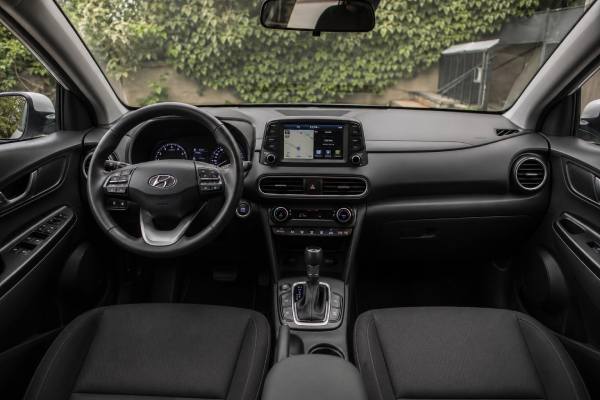
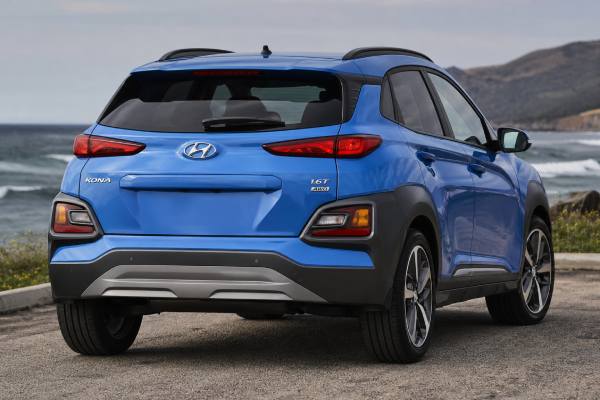
The 2017–2020 Hyundai KONA 4WD with the 1.6 T-GDi engine is the fast petrol version of the first-generation OS KONA. It combines a compact crossover shape with a strong 177 hp turbo four-cylinder engine, a 7-speed dual-clutch transmission, and an on-demand all-wheel-drive system that gives it more traction and a more planted rear axle than lower-power front-wheel-drive versions. In daily use, that makes this KONA feel more eager and more refined than its size suggests, especially on open roads and in wet weather. It is also one of the more interesting small SUVs from this period because the 1.6 T-GDi AWD setup brought meaningful hardware changes, not just extra badge value. The trade-off is that it is not the cheapest KONA to run. Fuel use is noticeably higher than the smaller petrol versions, and the dry-clutch DCT needs the right driving style and proper maintenance history to remain a good ownership proposition.
At a Glance
- Strong mid-range performance and secure wet-weather traction for a small crossover.
- Multi-link rear suspension gives the 1.6 T-GDi 4WD a more settled feel than lower-spec versions.
- Higher trims often include richer safety and infotainment equipment than expected in this class.
- The 7-speed dry-clutch DCT is the main ownership watch point, especially in heavy stop-start use.
- Engine oil and filter service is typically every 10,000 km or 12 months, and every 5,000 km or 6 months in severe use.
Guide contents
- Hyundai KONA OS 4WD essentials
- Hyundai KONA 1.6 T-GDi data
- Hyundai KONA trims and safety tech
- Reliability and known faults
- Maintenance and buying advice
- Road manners and real economy
- Against its closest rivals
Hyundai KONA OS 4WD essentials
The first-generation Hyundai KONA arrived as a compact crossover with bold styling, but the 1.6 T-GDi 4WD version stood apart because it was engineered as more than a cosmetic step up. In this form, the OS-series KONA used Hyundai’s 1.6-liter direct-injection turbo petrol engine, paired with a 7-speed dual-clutch transmission and an active all-wheel-drive system. In several markets, it also received a more sophisticated rear suspension setup than lower-output front-wheel-drive models. That matters because it changes the way the car feels on the road. This is not simply the same KONA with more power. It is the version that makes the platform feel most complete.
The engine delivers 177 hp and 265 Nm, which is enough to make the KONA genuinely quick by small SUV standards of the late 2010s. It does not feel oversized or excessive, but it does give the car strong motorway merging performance, confident overtaking ability, and useful extra pace when the vehicle is loaded with passengers or luggage. The AWD system is road-focused rather than intended for serious off-road work, yet it gives the car a clear advantage on wet tarmac, gravel roads, and winter surfaces. In markets where a low-speed lock mode was fitted, drivers could also bias torque distribution for better traction in poor conditions.
Ownership appeal depends heavily on what a buyer wants from a small crossover. The 1.6 T-GDi 4WD KONA is a good fit for drivers who value compact exterior dimensions, brisk performance, and a slightly more premium feature set than entry-level versions usually offer. It is especially appealing for people who live in regions with frequent rain, poor roads, or winter weather, because the traction and rear-suspension advantage can be felt in normal daily driving. It also tends to feel more mature at speed than lighter-duty versions of the same model line.
There are trade-offs. The dry-clutch dual-clutch transmission is the main mechanical caution point. It can be smooth when driven cleanly and maintained properly, but it is less forgiving of repeated crawling traffic, hill creeping, or a neglected software and service history than a conventional torque-converter automatic. Fuel economy is also acceptable rather than exceptional. Buyers stepping into this model from a naturally aspirated small crossover or a hybrid will notice the extra fuel use.
As a used purchase, the pre-facelift 2017–2020 KONA 1.6 T-GDi 4WD is strongest when it has complete service records, good tyres, no transmission hesitation, and evidence of careful ownership. Get that right, and it remains one of the more convincing performance-oriented small crossovers of its generation: compact, quick enough to be enjoyable, and more mechanically substantial than its footprint suggests.
Hyundai KONA 1.6 T-GDi data
Factory specifications for the 2017–2020 Hyundai KONA 1.6 T-GDi 4WD vary slightly by market, trim, wheel package, and test cycle. The figures below focus on the pre-facelift OS-series 1.6 T-GDi AWD configuration and note where common market differences matter. Cargo volume also varies depending on whether the source uses VDA or SAE measurement standards.
| Item | Specification |
|---|---|
| Engine code family | 1.6 T-GDi petrol turbo four-cylinder |
| Engine layout and cylinders | Inline-4, DOHC, 16 valves, 4 valves per cylinder |
| Bore × stroke | 77.0 × 85.4 mm (3.03 × 3.36 in) |
| Displacement | 1.6 l (1,591 cc) |
| Induction | Turbocharged |
| Fuel system | Direct injection |
| Compression ratio | 10.0:1 |
| Max power | 177 hp (130 kW) @ 5,500 rpm |
| Max torque | 265 Nm (196 lb-ft) @ 1,500–4,500 rpm |
| Transmission | 7-speed dual-clutch automatic (DCT) |
| Drive type | AWD / 4WD, on-demand system |
| Differential | Open differential layout with electronic traction support |
| Suspension | Front MacPherson strut / rear multi-link |
| Steering | Motor-driven power steering; about 2.5 turns lock-to-lock |
| Brakes | Front ventilated discs 305 mm (12.0 in), rear discs 284 mm (11.2 in) |
| Item | Specification |
|---|---|
| Most common tyre size | 235/45 R18 on higher trims; 215/55 R17 in some markets |
| Ground clearance | About 170 mm (6.7 in), market-dependent |
| Length / width / height | 4,165 / 1,800 / about 1,550–1,565 mm (164.0 / 70.9 / 61.0–61.6 in) |
| Wheelbase | 2,600 mm (102.4 in) |
| Turning circle | 10.6 m (34.8 ft) |
| Kerb weight | About 1,401–1,507 kg (3,089–3,322 lb), depending on trim and market |
| GVWR | About 1,910–1,940 kg (4,211–4,277 lb) |
| Fuel tank | 50 l (13.2 US gal / 11.0 UK gal) |
| Cargo volume | 334 l (11.8 ft³) VDA seats up / 1,116 l (39.4 ft³) VDA seats down; some SAE sources show larger figures |
| Towing capacity | 1,250 kg (2,756 lb) braked / 600 kg (1,323 lb) unbraked |
| Payload | Roughly 414–509 kg (913–1,122 lb) |
| Item | Specification |
|---|---|
| 0–100 km/h (0–62 mph) | About 7.9 seconds |
| Top speed | 204 km/h (127 mph) |
| Rated efficiency | Typically about 5.6–7.0 l/100 km (42.0–33.6 mpg US / 50.4–40.4 mpg UK), depending on market, trim, and test cycle |
| Real-world highway @ 120 km/h | Usually higher than official figures; high-7 l/100 km to low-8 l/100 km is a realistic expectation |
| Engine oil | API latest / ILSAC latest or ACEA A5/B5; 5W-30 preferred; capacity 4.5 l (4.8 US qt) |
| Coolant | Phosphate-based ethylene glycol for aluminum radiator; about 7.1 l (7.5 US qt) |
| DCT fluid | HK DCTF 70W, API GL-4 SAE 70W; about 1.9–2.0 l (2.0–2.1 US qt) |
| Transfer case oil | API GL-5 SAE 75W/90; about 0.47–0.52 l (0.50–0.55 US qt) |
| Rear differential oil | About 0.47–0.52 l (0.50–0.55 US qt) |
| A/C refrigerant | R-1234yf; 450 ± 25 g (15.9 ± 0.9 oz) |
| A/C compressor oil | PAG; 120 ± 10 mL (4.1 ± 0.3 fl oz) |
| Wheel nut torque | 107–127 Nm (79–94 lb-ft) |
In practical terms, these numbers explain why the 1.6 T-GDi AWD KONA feels notably stronger than the lower-power versions. The torque plateau starts early, the chassis hardware is more serious, and the towing allowance is useful for such a small vehicle. The main thing buyers should remember is that published fuel economy figures can vary sharply by wheel size, trim, and local test method, so it is best to compare like-for-like examples rather than one headline number.
Hyundai KONA trims and safety tech
Trim structure for the 2017–2020 Hyundai KONA 1.6 T-GDi 4WD depends heavily on region. In the UK, this powertrain was concentrated toward the top of the range and was strongly associated with higher equipment levels such as Premium GT. In Australia and some other markets, the same engine and AWD combination appeared across a broader spread of trims. That matters for used buyers because two visually similar KONA 1.6T AWD cars can differ substantially in safety equipment, infotainment, lighting, and driver-assistance features.
Mechanically, the core package stayed consistent: 1.6 turbo petrol engine, 7-speed DCT, and AWD. The meaningful differences usually came from wheel and tyre package, trim-specific safety systems, audio and navigation level, and comfort equipment. Higher trims commonly added 18-inch wheels, larger infotainment screens, navigation, upgraded audio, wireless phone charging, head-up display, and more complete driver-assistance hardware. Lower trims in some markets could feel simpler and a little lighter on equipment while keeping the same strong powertrain.
A quick way to identify richer versions is to look for features such as factory navigation, head-up display, blind-spot monitoring, rear cross-traffic alert, LED lighting, and branded audio. On the road, 18-inch wheel cars tend to look better and feel sharper, but they also ride more firmly and are more sensitive to tyre condition. That means the best trim is not always the most expensive trim. Buyers in rough-road areas may actually prefer a smaller wheel package if they can find one with the right powertrain.
Safety equipment improved the KONA’s appeal, but availability was not uniform. Core passive safety hardware was solid for the class, with front, side, and curtain airbags, electronic stability control, hill-start support, and tyre-pressure monitoring widely available. Lane-keeping assistance and driver-attention warning were broadly fitted in better-equipped markets, while blind-spot monitoring, rear cross-traffic alert, and more advanced autonomous emergency braking could be optional or reserved for upper trims. Buyers should not assume every 1.6 T-GDi AWD example has the full ADAS suite.
Euro NCAP gave the KONA a strong five-star result in period testing, with good adult and child occupant scores. North American IIHS results were also generally favorable, but equipment-specific details matter, especially where headlight performance and optional front crash prevention packages changed the rating outcome. In other words, the platform itself tested well, but the exact vehicle specification still matters.
For family buyers, the important practical point is that this KONA can be a well-equipped and genuinely safe small SUV, but only when the trim level matches the brochure promise. Always verify the actual hardware on the car. A higher-grade example with the correct lighting, driver-assistance options, and complete service history is far easier to recommend than a base-looking car that merely shares the same engine badge.
Reliability and known faults
The 2017–2020 Hyundai KONA 1.6 T-GDi 4WD is better described as condition-sensitive than inherently fragile. The engine itself is usually solid when oil changes are done on time and the cooling and ignition systems are kept in good order. The main mechanical concern is the 7-speed dry-clutch dual-clutch transmission, especially on cars that have spent years in heavy stop-start traffic or have been driven with excessive creeping on inclines and during parking maneuvers.
The most common issue is low-speed shudder, hesitant take-off, or a jerky feel when moving away gently. The likely causes are clutch wear, heat stress, adaptation issues, or calibration that no longer matches actual clutch condition. The remedy depends on the car. Some improve with software updates and adaptation, while others need clutch or transmission work. Official campaign history matters here because certain 2018 and 2019 vehicles received dealer updates or, in some cases, transmission-related campaign work. A car with documented dealer attention is a safer buy than one with vague verbal assurances.
Common engine-side complaints are less dramatic but still worth watching. Under load, worn or tired spark plugs can trigger hesitation or a soft misfire before a fault becomes obvious. On direct-injection engines, intake carbon build-up can slowly affect smoothness over time, especially on cars used for repeated short trips. Intercooler and intake hoses should also be checked for leaks, oil misting, or loose connections if the engine feels flat. These are usually medium-cost issues rather than disaster-level faults, but they can make a good car feel poor.
Occasional issues include wheel-bearing noise, front anti-roll-bar link knocks, rear brake slider corrosion, and battery-related warning light cascades. The last one is easy to underestimate. A weak 12 V battery can cause a modern Hyundai to show multiple warnings that look more serious than the real root cause. On winter-road cars, inspect the rear suspension hardware, subframe areas, and brake backplates carefully. The body shell is not notorious for severe corrosion, but stone chipping and underbody exposure can catch up with neglected examples.
Software and calibration checks are worthwhile. Early cars may have received ECM or transmission-related updates that affect drivability, cruise-control logic, or shift behavior. ADAS-equipped cars should also be checked after windscreen replacement or front-end repair, because camera- and radar-based systems may require proper calibration.
A sensible reliability view looks like this:
- Common, medium severity: DCT shudder, low-speed hesitation, clutch heat wear.
- Common, low to medium severity: spark plug and ignition sensitivity, worn tyres affecting drivability, brake binding in salted climates.
- Occasional, medium severity: wheel bearings, suspension links, intake leaks, battery-related electrical faults.
- Rare, high severity: neglected transmission examples needing major DCT work.
Before buying, ask for full service records, proof of software or campaign work, evidence of correct tyres on all four corners, and recent fluid service history for AWD components if the car has seen hard use. As with many fast small crossovers, the gap between a good one and a cheap one is large.
Maintenance and buying advice
This is a KONA that rewards disciplined maintenance. The basic schedule is not extreme, but the 1.6 turbo engine, DCT, and AWD hardware mean buyers should not stretch intervals or treat the car like a low-stress economy model. If there is one rule to follow, it is simple: service early rather than late, especially if the car spends time in traffic, cold weather, dust, hills, or towing conditions.
A practical maintenance plan looks like this:
| Item | Normal use | Severe use |
|---|---|---|
| Engine oil and filter | Every 10,000 km or 12 months | Every 5,000 km or 6 months |
| Tyre rotation | Every 10,000 km | Every 10,000 km |
| Cabin air filter | Every 20,000 km or 12 months | More often in dust or heavy urban use |
| Engine air filter | Inspect regularly, replace around 40,000 km | Replace earlier if dirty |
| Spark plugs | Every 70,000 km | Earlier if drivability worsens |
| Valve clearance | Inspect at 90,000 km or 72 months | Same baseline, sooner if noisy |
| Drive belt | Inspect at 96,000 km or 72 months, then every 20,000 km or 24 months | Inspect earlier |
| Coolant | First change at 192,000 km or 10 years, then every 48,000 km or 24 months | Do not delay if condition is poor |
| DCT fluid | Inspect | Replace around 116,000 km |
| Transfer case and rear differential oil | Inspect | Replace around 120,000 km |
| Brake inspection | At every service | At every service |
Useful factory service values include 4.5 l of engine oil, about 7.1 l of coolant, about 1.9 to 2.0 l of DCT fluid, and roughly 0.47 to 0.52 l each for the transfer case and rear differential. Wheel nuts are tightened to 107–127 Nm. The preferred engine oil grade is 5W-30, though acceptable alternatives vary with climate.
The fuel filter is generally treated as maintenance-free, but inspection and replacement are sensible if symptoms appear, especially in regions with poor fuel quality. Brake fluid should also be monitored closely even where the schedule emphasizes inspection more than replacement, because age and moisture matter as much as distance.
For used buyers, the inspection checklist should focus on the items that separate a healthy KONA from an expensive one:
- Cold-start idle quality and smoothness under throttle.
- DCT take-up from rest, especially uphill and during parking.
- Full-throttle upshifts with no flare, bang, or warning messages.
- No leaks from transfer case, rear differential, or driveshaft areas.
- Even tyre wear and matching tyres on all four corners.
- No rear brake drag or heavily corroded discs.
- Full infotainment, camera, sensor, and ADAS operation.
- Underbody corrosion, stone damage, and neglected suspension hardware.
The best cars are usually later, higher-trim examples with complete dealer or specialist history, correct software updates, and evidence of regular oil service. The cars to avoid are the ones with vague transmission behavior, mixed tyres, patchy maintenance, or repeated warning-light stories that were never properly diagnosed.
Road manners and real economy
On the road, the 2017–2020 Hyundai KONA 1.6 T-GDi 4WD feels more substantial than its size suggests. The engine gives it real urgency, particularly in the mid-range, where the 265 Nm torque output makes the car feel stronger than most naturally aspirated small crossovers from the same era. Official acceleration to 100 km/h takes around 7.9 seconds, which still feels respectable. In everyday driving, that translates into easy overtaking, strong uphill performance, and less need to plan around slow-moving traffic.
Throttle response is good once the turbo is in its working range, though there can be a brief pause from a gentle roll if the DCT is deciding how aggressively to engage. That is typical of many dry-clutch setups. Driven cleanly, the transmission shifts quickly and suits the engine well. Driven in constant crawl, it can feel less relaxed than a conventional automatic. Sport mode usually sharpens the response and holds gears longer, while Eco smooths the initial edge but can make the drivetrain feel a little less eager.
Ride and handling are a pleasant surprise. The AWD 1.6 T-GDi version benefits from the multi-link rear suspension, and that gives it a calmer rear axle than lower-spec torsion-beam versions often have over broken surfaces. The steering is light rather than deeply communicative, but it is accurate enough and easy to place on narrow roads. The car turns in cleanly, stays stable at motorway speed, and handles poor weather with more confidence than the average small SUV. It is not a hot hatch, but it does not feel clumsy.
Tyres make a noticeable difference. Cars on 18-inch wheels look sharper and respond crisply, but they also ride firmer and can generate more noise on poor surfaces. Buyers who spend time on rough city streets may prefer the idea of a smaller wheel package, even if the visual stance is less aggressive.
Real-world fuel use is where expectations need to stay reasonable. Official figures vary by market and wheel package, but this is not the economy champion of the KONA range. In mixed driving, owners should expect results that depend heavily on traffic, terrain, and temperature. A calm motorway run can still be respectable, but at a true 120 km/h the 1.6 turbo AWD setup usually settles above the best brochure numbers. Cold weather, short trips, and winter tyres will move it further away from the headline figure.
The AWD system helps most on slippery launches, wet bends, and loose surfaces. Where fitted, the low-speed lock function can improve traction further, but this is still a road-biased crossover rather than a trail vehicle. Overall, the driving verdict is clear: the 1.6 T-GDi 4WD KONA is the driver’s version of the early KONA range. It feels quicker, more planted, and more complete than the lower-output alternatives, provided the transmission is healthy and the tyres are good.
Against its closest rivals
The strongest rivals to the 2017–2020 Hyundai KONA 1.6 T-GDi 4WD are not always the obvious ones. The KONA sits in the small crossover class, but this engine and driveline combination pushes it closer to the upper end of the segment in performance. That means it should be judged against other compact SUVs that offer either strong petrol turbo performance, AWD traction, or both.
Against the Mazda CX-3 AWD, the KONA usually feels quicker and more muscular in the mid-range. The Mazda counters with a more traditional automatic transmission feel and, in many versions, a slightly more natural steering character. Buyers who prioritize simplicity may lean toward the Mazda, but the Hyundai generally wins on straight-line pace, cabin tech in upper trims, and traction-backed punch.
Against the Suzuki Vitara Boosterjet AllGrip, the comparison becomes interesting. The Suzuki is lighter, often more efficient, and can feel less complicated mechanically. The Hyundai answers with a more upscale cabin impression in high trims, more power, and a more settled long-distance character. For drivers who spend time on fast roads, the KONA feels like the more substantial vehicle. For drivers who want lower running costs and a simpler ownership experience, the Suzuki can be easier to justify.
The older Nissan Juke is more style-led and less convincing dynamically in comparable form. The KONA is usually the better all-rounder, especially in interior quality, safety technology, and chassis maturity. Against European alternatives such as the SEAT Arona or Peugeot 2008 from the same broad period, the Hyundai’s main selling point is its combination of turbo power and AWD. Some rivals may ride more softly or cost less to buy used, but many do not offer the same blend of compact size, traction, and strong petrol performance.
Where the KONA loses ground is in transmission refinement and absolute fuel economy. Rivals with conventional automatics can feel smoother in urban use. Hybrids, of course, are far cheaper to run in stop-start conditions. That means the KONA 1.6 T-GDi 4WD is not the universal answer in this class. It is a targeted choice for someone who wants a small crossover with real pace, all-weather confidence, and better-than-basic chassis hardware.
That is also why the best comparison is not simply price-based. A cheap rival with lower performance and simpler equipment may still be the better tool for a mostly urban owner. But for drivers who genuinely value acceleration, secure wet-weather handling, and a compact body that still feels grown-up on a fast road, the KONA earns its place. In that specific use case, it remains one of the more convincing performance-oriented small SUVs of its era.
References
- Hyundai Kona – Specifications 2018 (Specifications)
- Euro NCAP | Hyundai KONA 2017 (Safety Rating)
- 2018 Hyundai Kona 2018 (Safety Rating)
- OS CAN-E 8.qxp 2019 (Owner’s Manual)
- OS CAN-E 7.qxp 2020 (Maintenance Manual)
Disclaimer
This article is for informational purposes only and is not a substitute for professional diagnosis, repair, or official service information. Specifications, torque values, intervals, procedures, and equipment can vary by VIN, market, model year, and trim, so always verify the exact vehicle against official service documentation before carrying out maintenance or repairs.
If you found this guide useful, please consider sharing it on Facebook, X, or another social platform to support our work.