


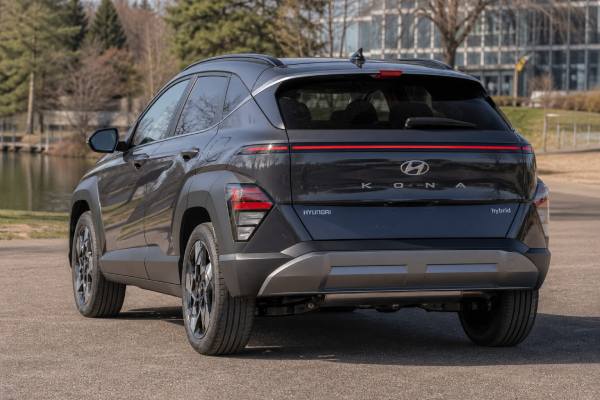
The Hyundai KONA SX2 with the 1.6 T-GDi petrol engine in 150 hp form fills an interesting gap in the range. It is the version for buyers who want more effortless pace than the 1.0-liter car offers, but who do not need the stronger 180 hp all-wheel-drive model or the different character of the hybrid and electric versions. In practice, that makes it one of the most balanced petrol KONA options in the current European lineup.
It matters for another reason too: this is not just a lightly updated old KONA. The SX2-generation car is bigger, more refined, better packaged, and more mature on fast roads. Rear-seat space is much better than before, luggage space is genuinely useful, and the cabin feels designed around daily ownership rather than novelty. For owners, the appeal is clear. You get a modern compact SUV with meaningful mid-range torque, strong safety equipment, and good long-trip manners. The caution is equally clear: exact specs, intervals, and some performance figures vary by market, gearbox, and trim, so VIN-level checking still matters.
What to Know
- The 1.6 T-GDi 150 hp KONA feels noticeably stronger and more relaxed than the 1.0-liter version on motorways and hilly roads.
- Cabin space, rear-seat room, and cargo usefulness are among the best reasons to choose the SX2 over the earlier KONA.
- Hyundai’s safety and driver-assistance package is generous even before expensive options are added.
- Early-production SX2 cars deserve careful recall, software, and calibration checks before purchase.
- Normal oil service is every 10,000 km or 12 months, while severe use cuts that to 5,000 km.
Navigate this guide
- Hyundai KONA SX2 petrol focus
- Hyundai KONA SX2 technical sheet
- Hyundai KONA SX2 grades and protection
- Fault patterns and service campaigns
- Care schedule and buying checks
- On-road character and economy
- Rival SUVs and best alternatives
Hyundai KONA SX2 petrol focus
The SX2-generation KONA is a more substantial vehicle than the first-generation car in almost every way that matters to an owner. It is longer, wider, and built around a layout that gives the rear cabin and cargo area more useful space. That matters because the 1.6 T-GDi 150 hp version is not meant to be a niche performance trim. It is a mainstream petrol KONA for people who want the car to feel easy rather than strained.
That distinction is important. On paper, 150 hp may not sound dramatic in a market now full of hybrids, downsized turbos, and electric crossovers. On the road, though, this engine gives the KONA the sort of flexible performance that suits a family small SUV. It has enough torque to make overtaking simple, enough reserve to carry passengers and luggage without feeling labored, and enough headroom to stay relaxed at motorway speeds. Hyundai also pairs it with either a 6-speed manual or a 7-speed dual-clutch transmission in the continental-European format that this article focuses on.
There is a small but important naming issue to understand. Some current European Hyundai material lists this version as 150 PS rather than 150 hp, while some English-language market listings round it into “150 hp” shorthand. In practical terms, the car discussed here is the front-drive 1.6 T-GDi petrol KONA positioned below the stronger 180 PS all-wheel-drive version. That is the correct ownership and market context for this guide.
The rest of the package supports that engine choice well. The KONA SX2 feels more settled than the old car over rough roads, and it is more planted at speed. The longer wheelbase helps with ride composure, but it also helps the cabin feel less compromised. Rear-seat passengers get more legroom, and the luggage bay is far easier to use for daily family duties, weekend bags, or a folded stroller.
From an ownership perspective, the 150 hp petrol model also makes sense because it avoids some of the complexity and price of electrified alternatives while still giving solid everyday pace. That does not mean it is the cheapest KONA to run. The hybrid is still the obvious pick for low urban fuel use. But for drivers who do regular longer journeys, who live in colder climates, or who simply prefer a straightforward petrol powertrain with stronger mid-range response, the 1.6 T-GDi is a convincing choice.
Its strengths are easy to summarize. It is spacious for its class, feels more mature than many B-segment SUVs, and has a genuinely useful step up in performance over base petrol rivals. Its main caveat is that it is a modern turbocharged, electronics-heavy SUV. That means service quality, software updates, and trim-specific equipment matter more than they would on a simpler older crossover.
Hyundai KONA SX2 technical sheet
For this article, the baseline vehicle is the continental-European Hyundai KONA SX2 1.6 T-GDi front-drive petrol version marketed at 150 PS, with notes where Hyundai’s open market material publishes only trim- or region-specific figures.
| Item | Specification |
|---|---|
| Code | Smartstream G1.6 T-GDi |
| Engine layout and cylinders | Inline-4, 4 cylinders; bore × stroke 75.6 × 89.0 mm (2.98 × 3.50 in) |
| Displacement | 1.6 L (1,598 cc) |
| Induction | Turbocharged |
| Fuel system | Direct injection |
| Compression ratio | Not consistently published in current open market sheets |
| Max power | 150 PS / about 148 hp (110 kW) |
| Max torque | 250 Nm (184 lb-ft) |
| Timing drive | Chain |
| Transmission | 6-speed manual or 7-speed dual-clutch transmission |
| Drive type | FWD |
| Differential | Open differential |
| Rated efficiency | Market and gearbox dependent; broadly high-6 L/100 km WLTP territory for closely related European specs |
| Real-world highway @ 120 km/h (75 mph) | Typically around 6.8–7.8 L/100 km (34.6–30.2 mpg US / 41.5–36.2 mpg UK), depending on tyre size, weather, and transmission |
| Item | Specification |
|---|---|
| Suspension (front / rear) | MacPherson strut / coupled torsion beam axle on the front-drive petrol version |
| Steering | Motor-driven power steering; 2.5 turns lock-to-lock |
| Turning circle | 10.6 m (34.8 ft) |
| Brakes | Ventilated front discs and solid rear discs; exact disc diameters are not published consistently in open 150 PS market sheets |
| Wheels and tyres | 205/65 R16 on lower trims or 215/55 R18 on Comfort Line and N Line examples |
| Ground clearance | Not published consistently in current open 150 PS literature |
| Length / Width / Height | 4,350 mm (171.3 in), or 4,385 mm (172.6 in) in N Line form / 1,825 mm (71.9 in) / 1,585 mm (62.4 in) |
| Wheelbase | 2,660 mm (104.7 in) |
| Kerb weight | Roughly 1,330–1,460 kg (2,932–3,219 lb) depending on trim and gearbox |
| GVWR | Around 1,885 kg (4,156 lb) to 1,915 kg (4,222 lb), depending on configuration |
| Fuel tank | 47 L (12.4 US gal / 10.3 UK gal) |
| Cargo volume | 466 L seats up / 1,300 L seats down (16.5 / 45.9 ft³), VDA |
| Acceleration | Official open 150 PS figures vary by market and are not always published cleanly; expect roughly 10 seconds to 100 km/h depending on gearbox |
| Top speed | Market dependent; broadly around 195 km/h (121 mph) in closely related front-drive petrol specs |
| Braking distance | Factory 100–0 km/h figure not commonly published |
| Towing capacity | About 1,300 kg (2,866 lb) braked / 600 kg (1,323 lb) unbraked in related European 1.6 T-GDi specs |
| Payload | About 425–555 kg (937–1,224 lb), depending on trim and gearbox |
| Item | Specification |
|---|---|
| Engine oil | SAE 0W-20, API SN PLUS/SP or ILSAC GF-7; 4.8 L (5.1 US qt) |
| Coolant | Ethylene glycol base coolant for aluminium radiator, mixed with distilled or deionized water; 8.5 L (9.0 US qt) |
| Transmission fluid | ATF SP-IV specification; 6.5 L (6.9 US qt) for the automatic transmission family listed in the manual |
| Rear differential oil | Not applicable to this FWD 150 hp version |
| Transfer case oil | Not applicable to this FWD 150 hp version |
| Brake fluid | DOT 4 |
| A/C refrigerant and compressor oil | Verify by VIN and under-bonnet label; open owner literature does not provide one universal public fill figure for every market |
| Wheel nut torque | 79–94 lb-ft (about 107–127 Nm) |
| Euro NCAP | 4 stars; 80% adult occupant, 83% child occupant, 64% vulnerable road users, 60% safety assist |
| IIHS | No exact 150 hp European-variant IIHS entry; U.S.-spec SX2 KONA structure scores well, but that is not the same published test entry as this exact powertrain |
A quick technical note helps make sense of the figures. Hyundai’s open data for the current KONA is market-sensitive. The UK publishes a 138 PS 1.6T sheet, while Austria and other continental-European material show the current front-drive petrol version at 150 PS and 250 Nm. Dimensions, packaging, and core chassis architecture remain very similar, but emissions, wheels, weights, and performance numbers can shift slightly with region and gearbox.
Hyundai KONA SX2 grades and protection
The 150 hp 1.6 T-GDi version is not a stripped base KONA. In current continental-European form, it tends to sit in the middle or upper-middle part of the petrol lineup, which is good news for used buyers. The engine itself is part of the appeal, but the more useful story is that it is commonly bundled with better wheels, better cabin trim, and a more complete safety package than the entry-level 1.0-liter cars.
In Austria, for example, the 150 PS petrol appears in Comfort Line and N Line forms, with the manual and DCT split across those versions. That already tells you something practical. The 150 hp KONA is meant to feel like a better-equipped everyday car, not simply a power upgrade. Comfort Line brings the more rounded equipment mix, while N Line adds sportier styling, larger wheels, more aggressive exterior detailing, and access to extra convenience equipment.
There are meaningful feature differences by trim. Lower trims can stay on 16-inch wheels with 205/65 R16 tyres, while higher trims move to 18-inch alloys with 215/55 R18 tyres. That changes both appearance and ownership costs. The larger wheel looks better and sharpens turn-in slightly, but it also means pricier tyres and a slightly firmer reaction to broken pavement. On a daily car, that matters more than most brochure language suggests.
The option structure is also useful to understand. Hyundai’s SmartSense package can bring the more expensive convenience-and-visibility technologies that many buyers actually want in real use: 360-degree camera, parking support with rear emergency braking, side parking sensors, rear cross-traffic alert, blind-spot assist, and blind-spot view monitor. N Line grades can also add seat comfort packages, while Bose audio and digital key functionality appear in upper-option packs. For a used buyer, these items affect both resale value and everyday satisfaction more than cosmetic extras do.
Safety equipment is strong for the class. The Austrian equipment sheet shows a center airbag between the front seats, lane keep assist, lane follow assist, forward collision avoidance, speed-limit assist, rear occupant alert, ABS, ESC, and ISOFIX on the rear outer seats. Adaptive cruise control and Highway Driving Assist are linked to DCT-equipped versions, which is worth knowing because buyers sometimes assume every KONA has the full long-distance package. They do not.
Euro NCAP’s public result for the SX2 KONA is a four-star rating. That score needs context. The tested model was an electric KONA, not this exact petrol one, but the result is still relevant because the platform and core safety architecture are shared. The KONA performed well in many areas, but it was held back by a few weaker points in adult occupant performance and safety-assist scoring. In practice, that means the car is well equipped and fundamentally safe, but not the standout class leader the way some buyers may expect from the amount of onboard technology.
After service work, ADAS calibration is a serious point, not a footnote. Windscreen replacement, bumper repair, radar movement, or front-end accident work can all affect system accuracy. On a modern KONA, that can show up as lane-support faults, unstable warning behavior, or poor parking-assist performance. A clean scan and a recent service invoice are helpful, but proof of proper calibration after body or glass work is better.
Fault patterns and service campaigns
The current SX2 KONA is still young enough that long-term patterns are incomplete. That means the reliability discussion has to be a little more disciplined than the usual recycled “bulletproof” or “problematic” labels. The better view is this: the 1.6 T-GDi 150 hp version does not presently show a single dominant engine flaw that defines the car, but it is still a modern turbo petrol crossover with several early-production campaigns, a sensitive electronics layer, and the usual maintenance dependence of direct-injection engines.
The most useful way to think about issues is by prevalence and cost.
Common, usually low to medium cost
- Infotainment glitches, phone-pairing issues, and occasional camera or parking-sensor oddities.
- Trim noises from the cargo area, tailgate area, or door panels.
- Brake corrosion or noise on cars used mainly for short city runs.
Occasional, medium importance
- Jerky low-speed behavior from the 7DCT in heavy traffic or on steep, creeping inclines.
- Uneven tyre wear from alignment drift, pothole damage, or aggressive kerb contact.
- Battery-related electronic fussiness, especially after long inactivity or repeated short-trip use.
Occasional, higher importance
- Early-production service campaigns and recalls in some markets relating to wiring protection, rear-seat-belt hardware, and EGR-related components.
- Poorly calibrated driver-assistance systems after glass or body repairs.
- Neglect-related turbo petrol issues such as contaminated oil, increased deposits, or rough running if servicing is stretched.
For the engine itself, the risk profile is fairly typical for a modern small-displacement turbo four-cylinder. The main things to watch are not dramatic failures but habits that shorten durability: infrequent oil changes, repeated short journeys where the engine rarely reaches full temperature, and poor-quality fuel or incorrect oil. Direct injection means intake deposit build-up remains possible over time. It is not yet a defining SX2 scandal, but it is a known ownership consideration for almost every DI turbo petrol of this type.
The timing chain deserves sensible monitoring rather than paranoia. There is no routine chain-replacement interval in normal service, but cold-start rattle, correlation faults, or unexplained roughness should not be ignored. The proper response is diagnosis, not guesswork. Chain noise, tensioner wear, and oil-condition problems tend to travel together on neglected engines.
The 7-speed dual-clutch transmission also needs realistic expectations. It is not inherently bad, but it behaves differently from a torque-converter automatic. Repeated crawling in traffic, prolonged clutch slipping on gradients, and heavy heat load can make it feel abrupt or hesitant. Occasional low-speed awkwardness does not automatically mean failure. Repeated shudder, warning lights, strong engagement shock, or worsening behavior when warm is another matter and deserves proper inspection.
For used buyers, early-production service actions matter. The safest approach is simple: ask for dealer printouts showing campaign completion, then verify by VIN through the relevant official recall or dealer system for your country. A modern KONA can drive well and still be missing a software update or campaign action that matters later. That is especially true for cars from the first production wave.
The pre-purchase checklist should include a cold start, a full warning-light scan, a slow-speed transmission check, a motorway test for straight tracking and wind noise, and a careful look at tyre wear. Uneven front-tyre wear, brake corrosion, sensor warnings, and patchy service history tell you more about a used SX2 than a polished cabin ever will.
Care schedule and buying checks
The KONA 1.6 T-GDi rewards routine more than improvisation. It is not a difficult car to maintain, but it is the sort of modern petrol SUV that becomes expensive if the basics are delayed. The right oil, the right interval, and careful attention to tyres, brakes, and electronic functions matter more than flashy accessories.
| Item | Normal service | Useful note |
|---|---|---|
| Engine oil and filter | Every 10,000 km or 12 months | Use full-synthetic SAE 0W-20 to the required Hyundai specification |
| Engine oil and filter in severe use | Every 5,000 km | Important for short trips, heavy traffic, towing, salt exposure, or frequent hard use |
| Engine air filter | Inspect every 10,000 km; replace every 40,000 km | Replace sooner in dusty regions |
| Cabin air filter | Every 30,000 km or 24 months | Earlier replacement helps HVAC performance |
| Spark plugs | Every 70,000 km | Do not delay on a turbo engine |
| Coolant | First replacement at 200,000 km or 120 months, then every 40,000 km or 24 months | Use only the correct coolant chemistry |
| Brake fluid | Every 30,000 km or 24 months | Important for pedal feel and ABS/ESC health |
| Tyre rotation | Every 10,000 km or 12 months | Check tread wear and pressures at the same time |
| Timing chain | No fixed replacement interval | Inspect on symptom: rattle, timing faults, or abnormal cold-start noise |
| Valve clearance | Inspect every 90,000 km or 72 months | Only if required by noise or measurement result |
| Automatic transmission fluid | No routine service in normal schedule | Severe-use guidance calls for replacement at 100,000 km |
| Transfer case and rear differential oil | Not applicable to this FWD model | For AWD cars, monitor by schedule and replace after water submersion |
| 12 V battery | Test annually from year 4 onward | Weak batteries often show up first as sensor or infotainment complaints |
A few fluid and workshop figures matter enough for owners to know before they buy. Engine oil capacity is 4.8 liters. Coolant capacity is 8.5 liters. The automatic transmission family listed in the owner literature uses 6.5 liters of SP-IV-spec fluid. Wheel nut torque is roughly 107 to 127 Nm. Those are not substitute workshop instructions, but they are useful decision-making numbers when you compare service invoices or ask a seller what has been done.
For buyers, condition beats mileage. A slightly higher-mileage KONA with perfect service proof, correct oil, clean tyres, and completed campaigns is usually a safer buy than a lower-mileage car with missing paperwork and vague seller answers. Look closely at tyre wear, brake condition, front bumper alignment, and windscreen history. These cars are technology-heavy enough that minor accident repairs can create repeated annoyance later.
The used-buy shortlist is simple:
- Prefer later-built cars over the earliest launch examples when history is otherwise equal.
- Verify recall and software completion by VIN.
- Test every camera, parking aid, and driver-assistance feature.
- Inspect for uneven tyre wear and signs of crash repair.
- Avoid neglected cars that show long oil-change gaps, poor battery health, or gearbox hesitation that worsens when hot.
Long-term durability looks promising rather than fully proven. Mechanically, the 150 hp KONA is not an extreme tune. But it still needs disciplined care. Owners who stay ahead of service and fix small electrical or sensor issues early are the ones most likely to have a very good experience.
On-road character and economy
The 1.6 T-GDi version gives the KONA the kind of performance that feels right for the body. That may sound like faint praise, but it is actually the core of the car’s appeal. Many small SUVs feel either underpowered with a full load or unnecessarily firm in pursuit of a sporty image. The 150 hp KONA mostly avoids both traps.
The engine’s character is defined by useful mid-range torque. It does not need constant revs to make progress, and it feels more grown-up than many 1.0- to 1.2-liter turbo rivals once the road opens up. Around town, it is easy to drive and flexible. On faster roads, it gives the KONA enough shove that overtakes need planning but not anxiety. That makes it well suited to mixed family use, hilly areas, and regular longer-distance work.
Ride quality is one of the SX2’s real strengths. The longer wheelbase makes the car calmer over broken surfaces than the previous KONA, and it feels less nervous on motorways. Straight-line stability is good, and the cabin generally stays quieter than many style-first rivals. The caveat is wheel size. Sixteen-inch or softer setups usually give the best comfort. Eighteen-inch cars look better and feel slightly sharper, but they also pass more impact harshness into the cabin.
Steering is light and accurate rather than especially communicative. That suits the car. This is not a crossover bought for steering feel. It is bought because it is easy to place, easy to live with, and stable enough to inspire confidence when the weather is poor or the road is fast. Braking feel is usually predictable, though short-trip cars can develop disc surface corrosion and feel rough until the brakes are cleaned up by regular use.
Transmission choice changes the character more than the basic engine does. The 6-speed manual will appeal to drivers who want simplicity and a little more direct control, and it avoids some of the low-speed quirks typical of dual-clutch gearboxes. The 7DCT is more relaxed in daily commuting and suits the engine’s torque band, but it needs the usual dual-clutch allowances in creeping traffic and on steep inclines. Once moving normally, it fits the car well.
Fuel use is respectable rather than exceptional. Expect roughly 7.5 to 9.5 L/100 km in heavy urban driving, around 6.8 to 7.8 L/100 km in steady motorway use at real-world 120 km/h cruising, and about 6.8 to 8.2 L/100 km in mixed use depending on trim, tyres, traffic, weather, and driving style. Cold weather, short trips, and larger wheels all tend to push the car toward the upper end of those ranges. The hybrid is plainly cheaper to fuel in city use, but it does not give the same straightforward turbo response on an open road.
If equipped to tow, the KONA is competent within its size. With a moderate trailer, stability is acceptable and the engine has enough torque to cope, but this remains a compact SUV. Full-load towing on grades, repeated crawling, or hot-weather traffic asks far more of the gearbox and cooling system than ordinary solo driving does. It is capable, but it is not the sort of vehicle that shrugs off abuse without consequence.
Rival SUVs and best alternatives
The KONA 1.6 T-GDi 150 hp sits in a crowded part of the market, but it has a clear identity. It is for buyers who want a compact crossover that feels spacious, modern, and properly strong in the mid-range without stepping into an expensive performance trim or a fully electrified ownership model.
| Rival | Where the KONA is stronger | Where the rival can win |
|---|---|---|
| Volkswagen T-Roc 1.5 TSI | Fresher cabin architecture, stronger tech feel, often better rear packaging | More familiar controls, mature drivetrain feel, wide dealer and parts support |
| Ford Puma 1.0 EcoBoost 155 | More rear-seat room, more settled motorway behavior, stronger cabin tech impression | Sharper steering, lighter feel, more playful chassis balance |
| Toyota C-HR Hybrid | Better motorway pull, simpler petrol-turbo character, easier long-distance pace | Lower urban fuel use, smoother city automatic behavior, very strong efficiency reputation |
| Mazda CX-30 e-Skyactiv G | Better infotainment size and tech density, stronger packaging, broader ADAS availability in some trims | More premium cabin feel, richer steering response, excellent seating position |
| Skoda Kamiq 1.5 TSI | More visual presence, more powerful-feeling step up from base engines, stronger premium-tech impression | Often cheaper to buy, simpler spec logic, very practical everyday packaging |
The KONA’s biggest advantage is that it feels like a slightly bigger class of car without becoming cumbersome. Its rear-seat room, cargo usability, and general refinement help it stand out in a segment where many rivals still feel optimized around front-seat use and urban image. The 1.6 T-GDi also makes more sense than some smaller turbo rivals if you regularly drive at motorway speeds or carry passengers often.
Its biggest weakness is that it is not the cheapest path to sensible ownership. The hybrid KONA is cheaper to fuel, and some rivals have slightly simpler drivetrains or lower tyre costs. So this is not the automatic choice for every buyer. It is the right choice for the buyer who values a roomy, modern, compact SUV with genuine mid-range performance and a well-developed safety suite.
That is why the verdict is fairly easy. The Hyundai KONA SX2 1.6 T-GDi 150 hp is one of the more rounded non-hybrid small SUVs in the class. It is not the thrift champion, and it is not old-school simple, but it combines space, usable performance, strong equipment, and everyday civility in a way that makes a lot of sense. Buy it with the right history, the right trim, and the right expectations, and it is a very convincing long-term family crossover.
References
- Der Hyundai KONA – Kompakter SUV mit Stil, Effizienz & modernster Technik | Hyundai Österreich 2026 (Manufacturer Model Page)
- Hyundai KONA | Technical, Specifications and Pricing | Model year 2025 | June 2024 2024 (Technical Data)
- Recommended lubricants and capacities 2025 (Owner’s Manual)
- Normal Maintenance Schedule (Smartstream 1.6 T-GDi) 2025 (Owner’s Manual)
- Euro NCAP | Hyundai KONA 2023 (Safety Rating)
Disclaimer
This article is for informational purposes only and is not a substitute for professional diagnosis, repair, or workshop guidance. Specifications, torque values, maintenance intervals, procedures, emissions figures, and equipment can vary by VIN, market, model year, transmission, and trim, so always verify the exact vehicle against official service documentation and dealer campaign records before servicing or buying.
If this guide helped you, please consider sharing it on Facebook, X, or another social platform to support our work.