
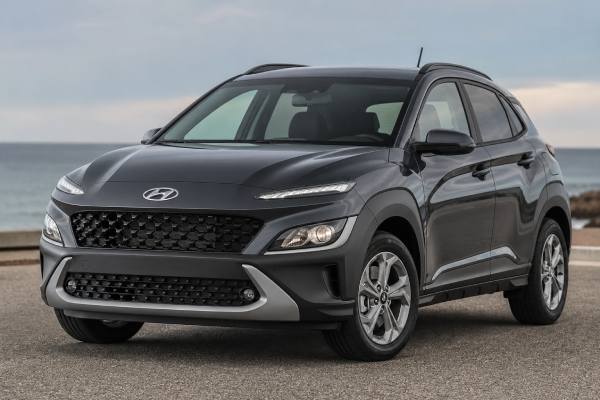
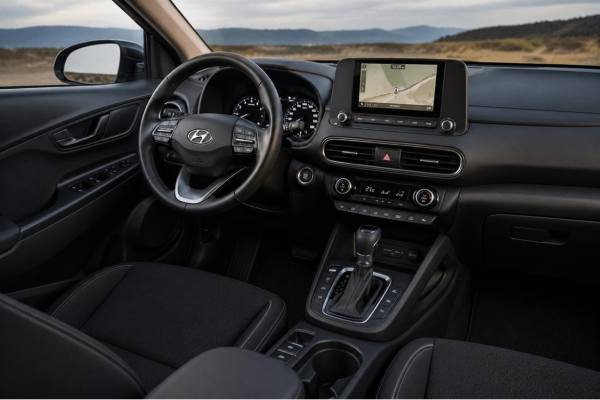
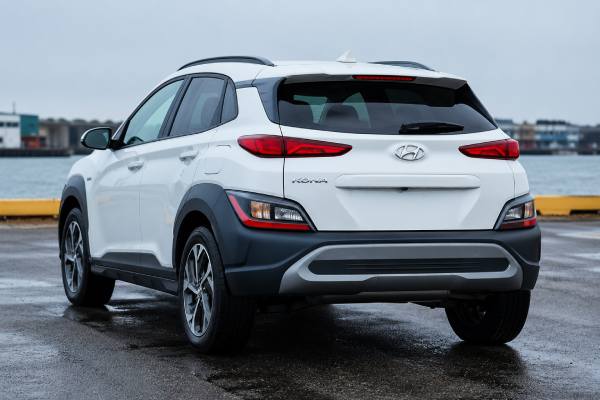
The facelifted 2020–2023 Hyundai KONA (OS) with the 1.0 T-GDi 120 hp engine is one of those small SUVs that makes more sense the longer you look at it. It sits below the stronger 1.6 T-GDi models, but that is part of its appeal: lighter nose, lower running costs, and a simpler ownership case for buyers who want a compact crossover that feels modern without becoming expensive to run. In most European markets, this version paired the 1.0-litre turbocharged three-cylinder with front-wheel drive, usually a 48-volt mild-hybrid system and Hyundai’s six-speed intelligent manual. Some markets also offered a seven-speed dual-clutch version. The facelift brought sharper design, better infotainment, broader safety tech, and a noticeably more polished cabin. Its weak points are not dramatic, but they matter: short-trip use is hard on small direct-injection turbo engines, and gearbox choice changes the ownership experience. Bought with a clear service record, this Kona remains one of the more thoughtful used B-SUV options.
What to Know
- The 1.0 T-GDi feels light, willing, and efficient in daily driving, especially in urban and mixed use.
- The facelift added better screens, cleaner design, and a wider spread of active safety features.
- Front-wheel drive keeps running costs and tyre wear lower than the heavier AWD petrol versions.
- Repeated short trips can accelerate carbon build-up, oil dilution, and exhaust filter complaints on neglected cars.
- A practical oil service interval is every 10,000–15,000 km or 12 months, depending on use and climate.
Contents and shortcuts
- Hyundai KONA facelift character
- Hyundai KONA facelift data
- Hyundai KONA facelift grades and ADAS
- Common faults and recall history
- Servicing plan and used buying
- On-road feel and fuel use
- How it stacks up against rivals
Hyundai KONA facelift character
The facelifted Hyundai KONA 1.0 T-GDi is best understood as a compact European-market crossover with a smart blend of style, efficiency, and everyday usability. It is not the most spacious car in its class and it is not the quickest. What it does well is package modern equipment, good visibility, sensible dimensions, and a genuinely easy driving character into a body that still looks fresh.
This facelift mattered more than a simple bumper update. Hyundai sharpened the front end, cleaned up the lighting signatures, improved the dash presentation, and widened the spread of driver assistance features. The cabin also gained a more mature feel. Earlier first-generation Konas could seem cheerful but slightly busy inside. The facelifted car feels more resolved. Controls remain easy to understand, and that matters in a small SUV that many owners use every day in traffic, poor weather, and tight parking.
The 1.0-litre turbo petrol is a sensible fit if your priorities are reasonable fuel use and lighter front-end feel rather than outright speed. With 120 hp, it is strong enough for normal motorway work, school runs, and mixed commuting. It does not have the relaxed shove of the 1.6 T-GDi, but it is also lighter, cheaper to buy, and usually cheaper to insure. In most facelift markets, it was front-wheel drive only, which suits the engine well. The Kona’s steering is light but accurate, and the car turns in more neatly than many small SUVs with heavier drivetrains.
The powertrain story is important. In many European markets, the facelift 1.0 T-GDi was linked to Hyundai’s 48-volt mild-hybrid system and six-speed intelligent manual transmission. That setup improves stop-start smoothness and helps emissions and fuel economy, but it also means the car is no longer a plain old manual in the traditional sense. The clutch behavior remains familiar, yet the system has more electronic intervention than buyers of older Hyundai manuals may expect. Some markets also offered a seven-speed dual-clutch version, which changes the feel of the car more than the engine itself does.
As a used buy, the Kona 1.0 facelift appeals to buyers who want a compact SUV that feels current without forcing them into hybrid complexity or full-electric ownership. It is especially good for drivers who value a higher seating position, modest exterior size, and a clean technology interface. Rear-seat space is acceptable rather than class-leading, and cargo capacity is useful but not exceptional. Still, the total package works well.
Its biggest advantage is balance. Nothing about the 1.0 T-GDi facelift Kona is extreme. That makes it easier to recommend than some flashier rivals with less polished drivability or weaker long-term ownership logic.
Hyundai KONA facelift data
The exact figures for the facelifted KONA 1.0 T-GDi vary by market, trim, tyres, and transmission. The clearest baseline for this article is the European front-wheel-drive facelift car, with UK and broader European data used where Hyundai published it openly.
| Item | Specification |
|---|---|
| Code | Smartstream / Kappa family 1.0 T-GDi |
| Engine layout and cylinders | Inline-3, DOHC, 12 valves, 3 cylinders, 4 valves per cylinder |
| Bore × stroke | 71.0 × 84.0 mm (2.80 × 3.31 in) |
| Displacement | 1.0 L (998 cc) |
| Induction | Turbocharged |
| Fuel system | Direct injection |
| Compression ratio | About 10.5:1 |
| Max power | 120 hp (88.3 kW) @ 6,000 rpm |
| Max torque | 172 Nm (127 lb-ft) @ 1,500–4,000 rpm on the common manual and iMT version; some DCT applications are listed with a higher torque figure |
| Timing drive | Chain |
| Rated efficiency | Typically 5.5–6.1 L/100 km (38.6–42.8 mpg US / 46.3–51.4 mpg UK) for the 48V 6iMT European facelift car, depending on trim and wheel size |
| Real-world highway @ 120 km/h (75 mph) | Usually about 6.4–7.2 L/100 km (32.7–36.8 mpg US / 39.2–44.1 mpg UK) |
| Item | Specification |
|---|---|
| Transmission | 6-speed intelligent manual in many facelift markets; optional 7-speed DCT in some regions |
| Drive type | FWD |
| Differential | Open |
| Suspension (front / rear) | MacPherson strut / coupled torsion beam axle |
| Steering | Motor-driven power steering, rack-and-pinion |
| Brakes | Front ventilated discs, rear discs or drums depending on market and wheel package; consumer literature does not always publish diameters for every 1.0 facelift trim |
| Wheels and tyres | Most common facelift sizes are 215/55 R17 and 235/45 R18 |
| Ground clearance | About 170 mm (6.7 in), market dependent |
| Length / width / height | About 4,205 / 1,800 / 1,565 mm (165.6 / 70.9 / 61.6 in) |
| Wheelbase | 2,600 mm (102.4 in) |
| Turning circle | About 10.6 m (34.8 ft) |
| Kerb weight | Roughly 1,300–1,400 kg (2,866–3,086 lb), depending on trim and gearbox |
| GVWR | Usually just under 1,850–1,900 kg (4,079–4,189 lb), market dependent |
| Fuel tank | 50 L (13.2 US gal / 11.0 UK gal) |
| Cargo volume | About 374 L (13.2 ft³) seats up / 1,156 L (40.8 ft³) seats down, VDA-style published figure range |
| Acceleration 0–100 km/h | Usually around 11.5–12.0 seconds depending on transmission and trim |
| Top speed | About 180–185 km/h (112–115 mph) |
| Braking distance 100–0 km/h | Not consistently published in Hyundai consumer-facing data for this exact variant |
| Towing capacity | Commonly around 1,200 kg (2,646 lb) braked and 600 kg (1,323 lb) unbraked where homologated, but market rules vary |
| Payload | Typically around 450–550 kg (992–1,213 lb) |
| Item | Specification |
|---|---|
| Engine oil | Commonly 0W-30 or 5W-30 to Hyundai approval and market climate guidance; about 3.6–3.8 L (3.8–4.0 US qt) |
| Coolant | Long-life ethylene glycol mix to Hyundai specification; exact fill quantity depends on market and service method |
| Transmission fluid | VIN-specific for 6iMT and 7DCT applications; use workshop data, not generic substitutes |
| Differential / transfer case | Not applicable on the usual FWD 1.0 facelift car |
| A/C refrigerant | R-1234yf on most facelift European cars |
| A/C compressor oil | VIN-specific compressor oil specification |
| Key torque spec | Wheel fasteners are typically around 107–127 Nm (79–94 lb-ft) |
| Crash ratings | Euro NCAP 5 stars, with the original score carried through the facelift review; IIHS body-shell ratings remain strong for 2018–23 Kona, though trim and lamp differences matter |
| Headlight rating | Trim dependent; halogen lamps are the weak point, better LED setups perform much better |
| ADAS suite | AEB, lane support, driver attention warning, speed sign functions, and blind-spot or rear cross-traffic systems depending on trim and market |
The important reading of the table is that the 1.0 T-GDi facelift Kona is a compact, light, front-drive small SUV whose value lies in efficiency and usability. The engine output is modest, but the overall package is competitive because the car does not carry unnecessary mass or drivetrain drag.
Hyundai KONA facelift grades and ADAS
For trims and equipment, the UK is a useful baseline because Hyundai published a clean facelift-era trim sheet for it. There, the 1.0 T-GDi 48V 120 ps model appeared in grades such as SE Connect, N Line, Premium, and Ultimate. Other European markets used different names, but the structure was similar: entry trim, sporty trim, comfort-focused mid trim, and a top trim with the strongest lighting and safety equipment.
The most basic lesson for used buyers is that the drivetrain stayed familiar while the equipment spread changed sharply by trim. Even on the same 1.0 engine, a base car and an upper-trim car can feel like different ownership propositions. Lower trims are the value play. Upper trims make the facelift feel genuinely premium for the class.
Quick trim character guide:
- SE Connect-type cars usually bring the essentials: 17-inch wheels, touchscreen, rear camera, cruise control, and the core active safety systems.
- N Line adds the sportier body treatment, unique wheels, trim-specific seats, and a sharper visual identity without changing the basic ownership logic.
- Premium is the point where the facelift feels most complete for many buyers, with heated seats, better screen package, keyless entry, more comfort features, and stronger technology.
- Ultimate adds the best light units, the richest seat trim, HUD in some markets, and a broader ADAS package.
The easiest real-world identifiers are the wheels, lamp units, seat trim, and dashboard screen layout. Basic cars are simpler and more honest. Premium and Ultimate cars look and feel much richer inside. N Line cars are easy to spot from the bumpers, wheel design, and interior accents.
Mechanically, there were fewer differences than in some rival ranges. That is good news. You do not need to decode several suspension, brake, or AWD combinations just to understand the 1.0. Most cars are front-wheel drive, torsion-beam rear, and built around the same mild-hybrid small-turbo logic. The bigger differences are transmission choice, tyre package, and equipment level.
Safety is one of the Kona’s stronger selling points, but only if you read beyond the star rating. Euro NCAP’s five-star result is reassuring, and the rating was carried through the facelift review. That means the facelift did not lose the core crash performance that made the original car attractive. The IIHS result is also useful because it underlines how strong the basic structure remained across the wider 2018–23 Kona family.
But not all Konas are equal at night or in active safety detail. Headlight performance depends heavily on lamp type. Better LED setups are meaningfully superior to the weaker halogen units found on lower trims. The same logic applies to ADAS. Forward collision avoidance and lane support are common, but blind-spot assistance, rear cross-traffic alerts, safe-exit functions, and the more complete assistance layers generally appear on richer trims.
The passive safety package is solid for the class. Expect front, side, and curtain airbags, ESC, ABS, hill-start support, ISOFIX outer rear positions, and tyre-pressure monitoring. Calibration matters after repair, though. Windscreen replacement, camera alignment, wheel alignment, or front-end repair can upset ADAS performance if a car is not recalibrated correctly. That is a genuine used-buy issue on modern crossovers and worth checking in the history file.
Common faults and recall history
The facelifted Kona 1.0 T-GDi is not known for one single catastrophic flaw in the way some other small turbo cars are. Its reliability story is more about usage pattern, service quality, and the specific transmission fitted.
The most common, low-to-medium-cost issue is the general small-turbo-direct-injection problem set. Cars used for frequent short trips, repeated cold starts, and long oil intervals can develop rougher cold running, early spark plug wear, oily intake deposits, and in some cases gradual carbon build-up on the intake side. The driver usually notices slight hesitation, a less clean idle, or a drop in eagerness rather than a dramatic failure. The usual remedy is sensible: shorter oil service intervals, correct plugs, strong fuel quality, and cleaning work only when symptoms justify it.
The next issue is occasional, medium-cost and mostly linked to electrified facelift cars: the 48-volt mild-hybrid hardware and its control logic. This does not make the car unreliable overall, but it does add more electrical complexity than an old-school manual petrol crossover. Owners can report stop-start inconsistency, weak restart behavior, warning lights, or intermittent charging-system faults. Sometimes the cause is simply a tired 12 V battery, sometimes a software update, and sometimes a belt-driven starter-generator or sensor issue that needs proper diagnosis rather than guesswork.
Transmission choice matters. The 6iMT generally feels more predictable long term than the 7DCT, but it is not purely mechanical in the traditional sense. If it starts to behave oddly, the solution may involve calibration or actuator diagnosis, not just clutch feel. The 7DCT, where fitted, is the more likely source of occasional, medium-cost complaints such as low-speed hesitation, shudder in crawling traffic, or jerky take-up when manoeuvring. That does not mean every DCT is a bad buy. It does mean you should test it in stop-start traffic, on an incline, and during repeated slow reverses.
A more usage-related problem is common, low-cost at first: exhaust and particulate-filter complaints on cars that live a purely urban life. On facelift petrol cars, repeated short trips can make the exhaust after-treatment system less happy, especially if the car rarely gets a sustained motorway run. Symptoms may include warning lights, rough regeneration behavior, or flat-feeling response. The fix is often a proper diagnosis, a software update if applicable, and changing the usage pattern rather than immediately replacing parts.
Chassis issues are usually ordinary wear items. Expect common, low-cost anti-roll-bar links, bushes, tyre wear from poor alignment, and rear brake corrosion on cars that spend their lives in light urban use. None of that is unusual in this class. What matters is whether the car has been maintained early, not after the problem becomes obvious.
For recalls and campaigns, the safest rule is simple: do not trust memory, trust the VIN. Hyundai’s official recalls and service-campaign portal is the right place to verify open actions, and dealer history should show completed work. The Kona family has seen campaign activity over its life, and the exact action can vary by year, factory batch, and market. A car with full dealer history and documented campaign completion is much easier to recommend than a cheaper example with vague paperwork.
Before buying, ask for:
- dealer or specialist service history with dates and mileage
- proof of recall and campaign completion
- cold-start behavior from fully cold
- smooth clutch and throttle response on iMT cars
- low-speed manoeuvre quality on DCT cars
- warning-light scan and battery health check
- even tyre wear and no cheap mixed tyre set
- proof of ADAS recalibration after front-end or windscreen work
The Kona 1.0 facelift is not fragile, but it does not reward neglect. A well-kept example usually feels tight and modern. A deferred-maintenance car feels older than it is.
Servicing plan and used buying
For long-term ownership, the right approach is to be slightly more conservative than the longest published intervals. That is especially true for a small turbo three-cylinder with direct injection and mild-hybrid assistance. The engine itself can hold up well, but only if oil quality, plugs, and cooling health stay on script.
| Item | Distance or time | Practical note |
|---|---|---|
| Engine oil and filter | 10,000–15,000 km or 12 months | Shorter interval is smarter for cold starts, city traffic, towing, or repeated short runs |
| Engine air filter | Inspect every service, replace around 30,000–45,000 km | Earlier in dusty use |
| Cabin filter | Every 15,000–20,000 km or 12 months | Helps HVAC efficiency and windscreen demist performance |
| Spark plugs | About 60,000–75,000 km | Do not stretch this on a turbo DI engine if idle or response starts to fade |
| Coolant | Long-life fill, inspect yearly, replace by official schedule or sooner if contamination appears | Use the correct Hyundai-compatible coolant only |
| Timing chain | No fixed replacement interval | Inspect if startup rattle, correlation faults, or poor service history raise concern |
| Accessory and 48V belt system | Inspect every service | Important on mild-hybrid cars because belt condition affects charging and restart quality |
| Brake fluid | Every 2 years | Moisture control matters more than mileage |
| Brake pads and discs | Inspect at every service | Rear corrosion is common on lightly used cars |
| Gearbox service | VIN and gearbox specific | DCT cars deserve closer attention than owners often give them |
| Tyre rotation and alignment | Every 10,000–12,000 km and after impacts | Prevents noise, wear, and steering drift |
| 12 V battery test | Annually from year 4 | Weak batteries can trigger odd mild-hybrid and stop-start behavior |
Useful ownership figures to keep in mind:
- engine oil capacity: about 3.6–3.8 L
- fuel tank: 50 L
- common tyre sizes: 215/55 R17 or 235/45 R18
- wheel fastener torque: around 107–127 Nm
The used-buyer checklist on this model is less about body rust and more about drivetrain honesty. The best cars are usually those with regular dealer or strong specialist history, matching tyres, current software, and no gaps in service dates. This is not the type of car that hides neglect gracefully.
What to inspect closely:
- cold idle quality and any timing-chain-like rattle
- smooth turbo response from 1,500 rpm upward
- no hesitation or clutch oddness when moving off
- no shunt or shudder during parking manoeuvres
- clean cooling system and stable coolant level
- even brake wear front to rear
- no ADAS or chassis warning lights
- original or properly repaired front-end structure
- documented recalls and service campaigns
- recent battery replacement or battery test on older cars
The trim sweet spot is often a Premium-spec facelift 1.0 if you want the best balance of comfort, tech, and resale appeal. An SE Connect is still sensible if price matters more than features. An N Line is worth choosing for looks and cabin feel, but only if you genuinely want that appearance package. A tired top trim is rarely a better buy than a clean mid trim.
Long-term durability looks decent if the engine has had frequent oil changes, the transmission behavior is healthy, and the car has not spent its whole life on cold short runs. Treated well, it ages like a modern Hyundai should: not perfect, but usually dependable.
On-road feel and fuel use
The facelift Kona 1.0 T-GDi drives like a well-sorted urban crossover first and a mini adventure SUV second. That sounds obvious, but it matters because some rivals chase styling or sportiness and end up awkward at low speed. The Hyundai does not. Its controls are easy, the seating position is natural, and the body is compact enough that you never feel as though you are driving more car than you need.
Ride quality is one of its strengths on 17-inch wheels. The suspension does not erase sharp edges, but it stays composed and avoids the brittle, busy feel that some small SUVs suffer on poor roads. On 18-inch trims the Kona looks better, but you feel more impact through patched surfaces and rough urban tarmac. The difference is not dramatic, though it is worth noting for buyers who care more about comfort than styling.
Steering is light rather than talkative, but that suits the car. It tracks cleanly on the motorway, places itself easily in town, and does not feel nervous in crosswinds. In corners, the Kona is tidy and secure. It is not especially playful, yet it changes direction with less reluctance than some taller rivals. The lighter 1.0 engine helps here. It gives the car a more agile front end than heavier powertrains.
The powertrain character depends partly on transmission. The 1.0 turbo is smooth for a three-cylinder once warm, with enough low-end torque to avoid constant downshifts. There is some turbo lag if you ask too much below the boost zone, but it is mild. The six-speed intelligent manual suits the engine well because it lets the driver keep the motor in its useful middle range. The 7DCT, where fitted, can feel slick once moving but never quite as natural during slow traffic manoeuvres.
Noise levels are respectable. The engine sounds busy under full load, which is normal for a 1.0-litre turbo triple, but at a steady cruise the Kona is quiet enough for long drives. Wind noise is fair, tyre noise depends strongly on the wheel package, and the facelift feels better insulated than the earliest OS cars.
Real-world economy is one of the reasons to buy this version:
- city: around 6.3–7.4 L/100 km
- highway: around 6.0–7.2 L/100 km at typical motorway pace
- mixed: around 5.8–6.8 L/100 km
That translates roughly to:
- 31.8–37.2 mpg US in city-heavy use
- 32.7–39.2 mpg US on the highway
- 34.6–40.6 mpg US in mixed driving
In UK figures, that is usually about 38–48 mpg UK, depending on trip type. Winter fuel, heated seats, demisting, and short-distance driving can easily add 0.5–1.0 L/100 km. Cars on larger wheels also tend to sit at the worse end of the range.
The Kona 1.0 is not a performance buy, but it does not feel underpowered in normal life. Its strength is that it feels coherent. Everything works together well enough that you stop thinking about the specs and just use the car.
How it stacks up against rivals
The facelift Kona 1.0 T-GDi sits in a very crowded part of the market, so the verdict depends on what you value most. Its rivals are not only other small SUVs, but also the smarter end of the raised hatchback market.
Against the Ford Puma 1.0 EcoBoost, the Hyundai feels a little less lively and less entertaining, but usually more straightforward inside and often easier to buy with a simpler trim logic. The Ford is the sharper drive. The Hyundai is the calmer, more measured everyday tool.
Against the Volkswagen T-Cross 1.0 TSI, the Kona usually feels more distinctive and more generously equipped for the money. The Volkswagen counters with better rear-seat packaging and a more conservative interior design. Buyers who want maximum practicality often lean T-Cross. Buyers who want stronger value and a more interesting look often prefer the Hyundai.
Against the Skoda Kamiq 1.0 TSI, the Hyundai loses a little on cabin space and sheer family usefulness. The Skoda is one of the most rational cars in the class. The Kona’s answer is stronger visual appeal, a higher perceived feature count, and a slightly more premium feel in upper trims.
Against the Toyota Yaris Cross, the Kona 1.0 is the choice for buyers who still want a petrol turbo feel and a more open-road personality. The Toyota wins the pure low-speed economy battle and has a strong reliability image, but the Hyundai can feel more relaxed at motorway pace and more conventional in its controls.
Against Hyundai’s own BAYON 1.0 T-GDi, the Kona justifies its higher position by feeling more substantial and more like a true crossover. The Bayon is roomier than some expect and often cheaper to run, but the Kona has better stance, better perceived quality in richer trims, and a more mature chassis feel.
So who is the facelift Kona 1.0 for? It is ideal for buyers who want:
- a small SUV that is genuinely compact outside
- a modern cabin without overcomplication
- good active safety availability
- solid mixed-use fuel economy
- a used car that still feels current
Who should skip it? Buyers who carry adults in the rear all the time, want class-leading boot volume, or dislike the idea of small turbo engines with mild-hybrid add-ons.
In the used market, the Kona 1.0 facelift remains easy to justify because it avoids the extremes. It is not the most exciting, but it is one of the more complete and easier-to-live-with choices in its class.
References
- Hyundai confirms pricing and specifications for Kona hybrid and mild hybrid ranges and the new N Line 2020 (Specifications)
- KONA 2021 – Car & User Manual 2021 (Owner’s Manual)
- Euro NCAP | Hyundai KONA 2017 (Safety Rating)
- 2021 Hyundai Kona 4-door SUV 2021 (Safety Rating)
- Hyundai Recalls & Service Campaigns: Home 2026 (Recall Database)
Disclaimer
This article is for informational purposes only and is not a substitute for professional diagnosis, inspection, or repair. Specifications, torque values, service intervals, procedures, and equipment can vary by VIN, trim, market, transmission, and production date, so always verify the exact details against the correct official service documentation for the vehicle in front of you.
If this guide was useful, please consider sharing it on Facebook, X, or other social platforms to support our work.