
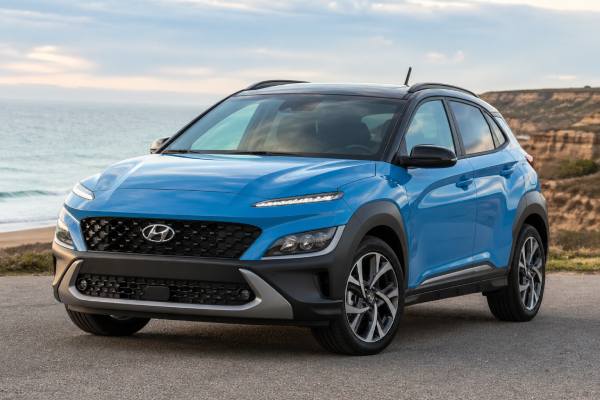
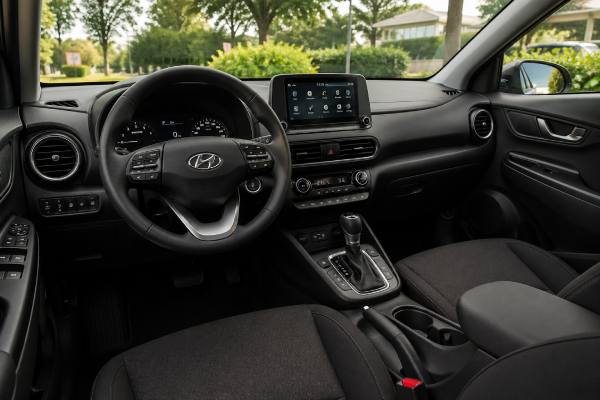
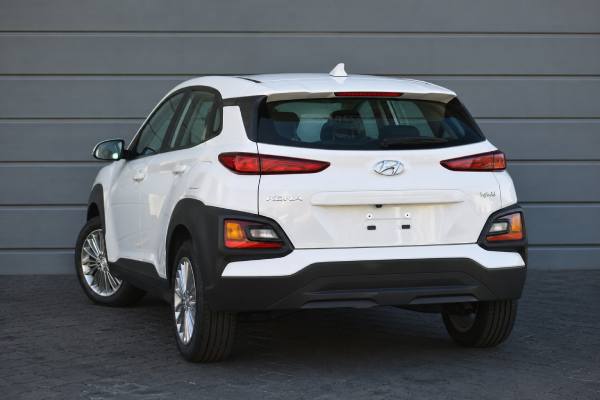
The facelifted Hyundai KONA (OS) 1.6 T-GDi 198 hp is the version of the first-generation KONA that turns the car from a stylish small crossover into something genuinely brisk and entertaining. Hyundai’s 2020 update did more than freshen the nose and lights. It also sharpened the model’s identity, added the N Line, and kept the 1.6-litre turbo petrol at the top of the regular range with 198 PS, available in both two-wheel-drive and four-wheel-drive layouts depending on market. That matters because this is the KONA for buyers who want easy overtaking, stronger motorway performance, and a more premium equipment mix than the lower-output versions usually offer. It is also the version that asks for the most care. The direct-injection turbo engine and seven-speed dual-clutch transmission reward timely servicing and honest inspection more than casual ownership does. Market differences are substantial, so exact VIN and region always matter.
Quick Specs and Notes
- Strong mid-range torque makes this facelift KONA feel much quicker than the ordinary petrol models.
- The facelift improved styling, cabin tech, and upper-trim appeal without losing the KONA’s easy urban size.
- Better-equipped versions often include a strong Hyundai SmartSense package and 18-inch wheels.
- The main ownership caution is the 7-speed DCT, which should be checked carefully for low-speed judder or rough engagement history.
- A sensible oil and filter baseline is every 10,000 km or 6 to 12 months, even if official schedules can be longer in some markets.
Section overview
- Hyundai KONA OS facelift identity
- Hyundai KONA OS hard data
- Hyundai KONA OS equipment and protection
- Common faults and factory actions
- Upkeep schedule and buying advice
- On-road behaviour and fuel use
- Against rival small performance SUVs
Hyundai KONA OS facelift identity
The facelift KONA 1.6 T-GDi sits in an unusual but appealing corner of the small-SUV market. It is still compact enough to work as a city car, yet it has enough power to feel relaxed and almost warm-hatch quick on a fast road. Hyundai positioned this drivetrain as the top regular petrol choice in the facelift lineup, and that is exactly how it drives. It is not a stripped economy special with a big engine. It is the version that makes the KONA feel complete.
What changed with the facelift matters. Hyundai’s September 2020 update brought a cleaner front end, a more mature interior layout, a wider spread of driver-assistance features, and the new N Line trim. The company also said the revised KONA received retuned springs, dampers, stabilizer bars, rear bump stops, steering calibration, and reduced road-noise measures. In plain terms, Hyundai tried to make the facelift car more refined without sanding away the sharper character that makes the 1.6 turbo version worth buying.
This powertrain also needs market context. Hyundai’s own facelift material shows the 198 PS 1.6 T-GDi as available in both 2WD and 4WD form in Europe-facing communication, while market brochures from places such as Cyprus and Malaysia show that actual trim structure, equipment, and even drivetrain choice varied widely by country. In some regions the 198-output car was tied closely to N Line styling; in others it sat as a high trim without full N Line treatment. That means buyers should never assume a classified ad title tells the whole story. Wheel design, seat trim, ADAS menu, drive layout, and VIN decode all matter.
For ownership, the core strengths are easy to understand. The 1.6 turbo gives the KONA enough shove to feel effortless, especially when carrying passengers or climbing grades. The body remains small enough for daily parking. The facelift cabin and safety package also hold up well against newer rivals. The trade-off is equally clear. This is a turbocharged direct-injection engine paired, in the core facelift configuration, with a seven-speed dual-clutch gearbox. That combination can be durable, but it is not the version to buy on looks alone. It makes the most sense for owners who will maintain it properly and who actually want the stronger drivetrain, not just the badge or the body kit.
Hyundai KONA OS hard data
The 198 hp facelift OS KONA was not globally identical, so the most useful approach is to show the common hard points first and then flag the market-dependent items. Hyundai’s official facelift launch material, open brochures, and MY22 regional spec sheets agree on the key numbers: a 1.6-litre turbocharged four-cylinder, 1,598 to 1,591 cc depending on market notation, around 265 Nm of torque, and brisk 0–100 km/h performance in the high-seven-second range.
| Item | Hyundai KONA (OS) facelift 1.6 T-GDi 198 hp |
|---|---|
| Code | Smartstream G1.6 T-GDi, often also described as Gamma II 1.6 T-GDi in market brochures |
| Engine layout and cylinders | Inline-4, DOHC, 16 valves |
| Bore × stroke | 75.6 × 89 mm (2.98 × 3.50 in) |
| Displacement | 1.6 L (1,591–1,598 cc depending on source notation) |
| Induction | Turbocharged |
| Fuel system | Gasoline direct injection |
| Compression ratio | 10.0:1 |
| Max power | 198 PS at 6,000 rpm in Hyundai facelift brochures; some market sheets describe the same tune as 198 bhp at 5,500 rpm |
| Max torque | 265 Nm (195 lb-ft) at 1,600–4,500 rpm |
| Timing drive | Verify by VIN and service documentation before internal timing work; public brochures do not publish the detail clearly |
| Transmission | 7-speed dual-clutch transmission |
| Drive type | 2WD / FWD or 4WD depending on market |
| Differential | Open; AWD markets use an on-demand rear axle rather than a mechanical locking setup |
| Suspension front / rear | MacPherson strut / coupled torsion beam axle on 2WD, multi-link on 4WD |
| Steering | Rack and pinion, column-mounted motor-driven power steering |
| Brakes | Ventilated front discs 17 in, solid rear discs 15 in on the Malaysia 1.6 Turbo N Line brochure |
| Most common tyres | 235/45 R18 |
| Item | Hyundai KONA (OS) facelift 1.6 T-GDi 198 hp |
|---|---|
| Length / Width / Height | 4,205 / 1,800 / 1,565 mm (165.6 / 70.9 / 61.6 in); N Line length 4,215 mm and height 1,575 mm in some brochures |
| Wheelbase | 2,600 mm (102.4 in) |
| Fuel tank | 50 L (13.2 US gal / 11.0 UK gal) |
| Cargo volume | 374 L (13.2 ft³) VDA in the Malaysia 1.6 Turbo material |
| Acceleration | 0–100 km/h in 7.7 s for 2WD, about 8.1 s for 4WD in the Cyprus MY22 sheet |
| Top speed | 210 km/h (130 mph) in the Cyprus MY22 sheet |
| Rated efficiency | WLTP combined 6.2 L/100 km for 2WD and 7.0 L/100 km for 4WD in the Cyprus MY22 sheet |
| Real-world highway at 120 km/h | About 7.0–8.0 L/100 km is a sensible expectation for a healthy 2WD car on 18-inch tyres |
| Engine oil | Public Hyundai service schedule for the 1.6 Turbo family lists 0W-20 and a 4.5 L fill reference |
| Coolant | Premix coolant, first change at 100,000 km then every 80,000 km in the published schedule |
| DCT fluid | SAE 70 DCT fluid in the published schedule |
| Brake fluid | DOT 4 in the published schedule |
These figures come directly from Hyundai’s facelift launch communication, the global brochure, the Malaysia N Line brochure, the Cyprus MY22 price-and-spec sheet, and Hyundai’s published maintenance schedule. The single biggest caution is that 2WD and 4WD facelift cars differ mechanically at the rear suspension and in official consumption figures, while N Line cars also change exterior dimensions slightly. Euro NCAP kept the OS KONA at a 5-star rating through its 2020 facelift review, but IIHS data belongs to the separate North American Kona family rather than this exact 198 PS export-market configuration.
Hyundai KONA OS equipment and protection
If you are shopping the 198 hp facelift KONA, trim matters almost as much as the engine. In many regions, the 1.6 T-GDi was not just another engine choice. It was bundled with the more desirable equipment sets, stronger lighting, larger wheels, and a wider driver-assistance package. That makes it a better car when well chosen, but it also means you need to separate a plain 1.6 turbo from a true N Line or upper-grade 1.6 turbo with the full convenience and safety stack.
Hyundai’s facelift announcement introduced the N Line as a distinct styling and equipment step, with its own front and rear bumpers, body-colour cladding, specific 18-inch wheel design, side sill mouldings, twin-tip muffler treatment, and interior red accents. That is useful in the used market because it gives buyers visual clues. N Line seats, trim accents, bumper shape, and wheel design are usually the fastest way to tell whether a car is a genuine factory N Line or merely a standard KONA wearing aftermarket parts.
On non-N Line upper trims, the 1.6 T-GDi often still arrived well equipped. Open market brochures show features such as full automatic climate control, leather or leather-trimmed seating, head-up display, wireless charging, LED headlamps, electronic parking brake with auto hold, dynamic parking camera guidance, and the bigger supervision display. Those items do not change the engine, but they change the ownership experience. In practical terms, a 198 hp facelift KONA often feels like a near-premium small crossover rather than a basic hatch on stilts.
Safety is another strong point. Euro NCAP recorded 87% for adult occupant protection, 85% for child occupant protection, 62% for vulnerable road users, and 60% for safety assist, and its model-range validity section explicitly shows the rating carrying forward through the 2020 facelift review. That is important because it means the facelift did not merely inherit an old score without review. It stayed within Euro NCAP’s validity framework for the updated car.
ADAS content also improved materially. Hyundai’s own material names features such as Forward Collision-Avoidance Assist, Lane Keeping Assist, Lane Following Assist, Blind-Spot Collision-Avoidance Assist, Rear Cross-Traffic Collision-Avoidance Assist, Driver Attention Warning, Smart Cruise Control with Stop and Go, Safe Exit Alert, and High Beam Assist, although standard-versus-optional status varies by market and trim. That means the safest used-car approach is to verify the car itself, not assume every 1.6 T-GDi has the full package. For buyers, the best examples are usually the ones where the stronger engine and fuller SmartSense suite came together.
Common faults and factory actions
The most important thing to understand about reliability on the facelift 1.6 T-GDi KONA is that there is a difference between known family watch points and documented factory actions. The clearest official paper trail is for the seven-speed dual-clutch transmission. Hyundai’s May 2022 transmission bulletin for the Kona OS 1.6T covers abnormal low-speed vibration, calls for judder diagnosis, a TCU software update with revised logic, and, if required, double-clutch replacement. It specifically says the bulletin was expanded to include 2018–2021 Kona OS 1.6L Turbo vehicles. For a facelift buyer, that makes DCT behaviour the first thing to test, not the last.
In real ownership, that means slight dry-DCT awkwardness at parking speed is not automatically a defect, but repeated shudder, hot-clutch smell, rough take-up after warm-up, or obvious low-speed vibration deserves attention. A good used example should pull away cleanly once warm, reverse without drama, and behave consistently in stop-start traffic. A stack of invoices showing dealer software work is not bad news here. It can be evidence that the car actually received the updates Hyundai intended.
Beyond the DCT, the other watch points are the usual turbo-GDI concerns rather than an OS KONA-only disaster list. This engine likes clean oil, fresh plugs, intact boost hoses, and an honest maintenance record. Over time, a neglected direct-injection turbo engine can drift into rougher idle, weaker throttle response, and occasional coil or plug complaints. None of that is unique to Hyundai, and none of it means the 1.6 T-GDi is inherently bad. It does mean that late oil changes and bargain-basement ownership show up faster here than they do on a simpler naturally aspirated engine. The published Hyundai service schedule itself points to frequent oil changes, spark-plug replacement, and DCT-fluid service as meaningful upkeep items, which supports that more careful view of long-term ownership.
Chassis and body concerns are more ordinary. Eighteen-inch cars are more likely to reveal alignment issues, inner-edge tyre wear, and suspension knocks on poor roads. Lightly used examples can corrode discs and pads sooner than mileage alone suggests. A weak 12 V battery can also create nuisance warnings on a modern KONA that look more serious than they are. Those are not model-breaking defects, but they are exactly the kinds of reconditioning costs that make one used KONA much cheaper to own than another.
For service actions and campaigns, the smartest approach is VIN-based. Use Hyundai’s official recalls and service-campaign checker for your region and then ask the seller for dealer printouts or invoices. That matters more than hearsay. On this car, proof of software history and transmission attention can be nearly as valuable as proof of routine oil changes.
Upkeep schedule and buying advice
A practical maintenance plan for the facelift 1.6 T-GDi KONA is simple in principle: shorten the risk. Hyundai’s public schedule for the 1.6 Turbo family gives a useful backbone, but an owner who intends to keep the car beyond the easy years should usually be a little more conservative than the longest allowable interval. That is especially true for urban use, hot climates, or hard driving.
| Item | Sensible interval | Useful note |
|---|---|---|
| Engine oil and filter | 10,000 km or 6–12 months | Public schedule lists 0W-20 and 4.5 L total fill reference |
| Engine air filter | About 40,000 km in the schedule | Shorten it in dusty use |
| Cabin air filter | About 30,000 km in the schedule | Earlier if HVAC output drops |
| Brake fluid | About every 30,000 km in the published schedule | Use DOT 4 |
| DCT fluid | About 60,000 km in the published schedule | Important on city-driven cars |
| Spark plugs | About 80,000 km in the published schedule | Do not ignore misfire under load |
| Fuel filter | About 90,000 km in the published schedule | Market-specific part choice matters |
| Drive belt | About 100,000 km in the published schedule | Inspect earlier if noisy or cracked |
| Coolant | 100,000 km first change, then every 80,000 km | Premix coolant only per schedule note |
| Brake pads, discs, and calipers | Inspect every service | Rear-brake neglect is common on lightly used cars |
| Tyres and alignment | Inspect every 10,000–15,000 km | Especially important on 18-inch cars |
| 12 V battery | Test annually from year four onward | Weak batteries can cause nuisance faults |
For buyers, the inspection checklist is direct. Look for a complete service record, smooth cold start, clean warm take-off, no persistent DCT shudder, even tyre wear, no drivetrain warning lights, and no evidence of poor front-end repair around camera or radar areas. Ask whether the car has had transmission logic updates, when the plugs were last replaced, and whether the DCT fluid has ever been serviced. On a car like this, vague answers are usually a warning sign.
The best versions to buy are usually boring on paper: stock car, full history, matching tyres, no tuning parts, and no cosmetic shortcuts. A genuine N Line or high-spec 1.6 turbo can be worth the premium because it often combines the better drivetrain with the better safety and comfort package. The versions to avoid are modified cars, low-mileage examples with rough DCT manners, and anything with a thin maintenance trail. Long-term durability can be very good, but only when the owner has respected the drivetrain rather than treating it like an appliance.
On-road behaviour and fuel use
The main reason enthusiasts look for this KONA is simple: it is fast enough to feel fun without becoming tiring. The 1.6 T-GDi delivers the kind of torque that makes a small crossover feel light on its feet. It is quick off the line, strong in the middle of the rev range, and far less strained on a motorway than the lower-output engines. The official 0–100 km/h time of 7.7 seconds for the 2WD version matches that impression.
The facelift tuning changes help. Hyundai said the revised KONA received new spring and damper calibration, revised stabilizer bars, updated rear bump stops, improved tyre specification on 18-inch wheels, lower rolling resistance, and extra NVH work. That shows up on the road as a car that feels tauter and quieter than the earliest OS cars without becoming stiff or brittle. It still rides like a small crossover on 18-inch tyres, but it is better resolved than the old caricature of a short-wheelbase SUV with too much wheel.
The seven-speed DCT shapes the driving feel as much as the engine does. Once moving, it suits the car well, keeping the turbo motor in its useful zone and helping the KONA feel alert. At parking speeds and in slow stop-start traffic, it behaves more like a dry-clutch automated manual than a creamy torque-converter automatic. That is normal to a point. The line between normal and unhealthy is consistency. A good car feels deliberate. A tired one feels clumsy, shuddery, or hot-tempered.
Fuel use is respectable rather than miraculous. Hyundai’s MY22 2WD figure of 6.2 L/100 km WLTP is a solid official baseline for a 198-output small SUV, while the 4WD version rises to 7.0 L/100 km. In real use, a healthy 2WD car on standard 18-inch tyres will usually sit roughly in the 7.0–8.0 L/100 km range on steady highway work, around 8.0–9.5 L/100 km mixed, and higher in short-trip urban service. Those real-world numbers are a sensible working expectation rather than a factory claim.
The verdict on the road is easy to understand. This is not the most polished small SUV in existence, and it is not the cheapest to run if abused. But it is one of the most satisfying regular-production KONA variants because it makes the platform feel properly powered. For many buyers, that alone justifies the extra attention the drivetrain asks for.
Against rival small performance SUVs
The facelift KONA 1.6 T-GDi 198 hp works best when you compare it with other small SUVs that try to offer more than simple transport. Its natural rivals are not the slow base-grade crossovers. They are the better-equipped, quicker versions of cars like the Ford Puma, Volkswagen T-Roc, SEAT Arona, and Mazda CX-30. In that company, the KONA’s strongest card is balance.
It is smaller and easier to place than some rivals, yet it still offers useful luggage space and a reassuring driving position. It also feels faster than many similarly sized crossovers that rely on 1.0-litre or lightly tuned 1.5-litre petrol engines. Buyers who care about overtaking punch will notice that immediately. The KONA also scores well for safety equipment depth on better trims, and the facelifted cabin feels newer than its age suggests.
Its weaknesses are equally clear. The rear seat is not class-leading for long adult trips, the ride on 18-inch tyres is controlled rather than plush, and the dual-clutch transmission demands more understanding than a conventional automatic does. If your priority is absolute smoothness in traffic, a rival with a torque-converter automatic may feel easier. If your priority is the most premium cabin finish, some German and Japanese alternatives make a stronger case.
Where the KONA usually wins is as an all-rounder with personality. It is brisk, compact, well equipped, and more enjoyable than most small SUVs without forcing you into a full-performance niche model. That makes it especially attractive for drivers who want one car to cover commuting, family use, and occasional back-road enjoyment.
So how does it compare overall? The KONA 1.6 T-GDi facelift is rarely the class champion in any single line-item test, but it is very often the car that makes the most sense once performance, safety, features, and real ownership appeal are weighed together. That is why the cleanest, best-documented examples remain worth seeking out.
References
- KONA 2021 (Brochure)
- NEW HYUNDAI KONA MY22 2022 (Specifications)
- PERIODIC MAINTENANCE SERVICE FOR KONA 1.6 Turbo 2021 (Maintenance Schedule)
- Hyundai Motor Unveils Stylish Enhancements for KONA and Launches Sporty All-New KONA N Line 2020 (Official Release)
- Hyundai KONA 2017 (Safety Rating)
Disclaimer
This article is for informational purposes only and is not a substitute for professional diagnosis, inspection, or repair. Specifications, torque values, service intervals, procedures, capacities, and equipment can vary by VIN, market, trim, drivetrain, and production date, so always verify the exact vehicle against official service documentation before making repair or maintenance decisions.
If this guide helped you, please consider sharing it on Facebook, X, or another platform to support our work.